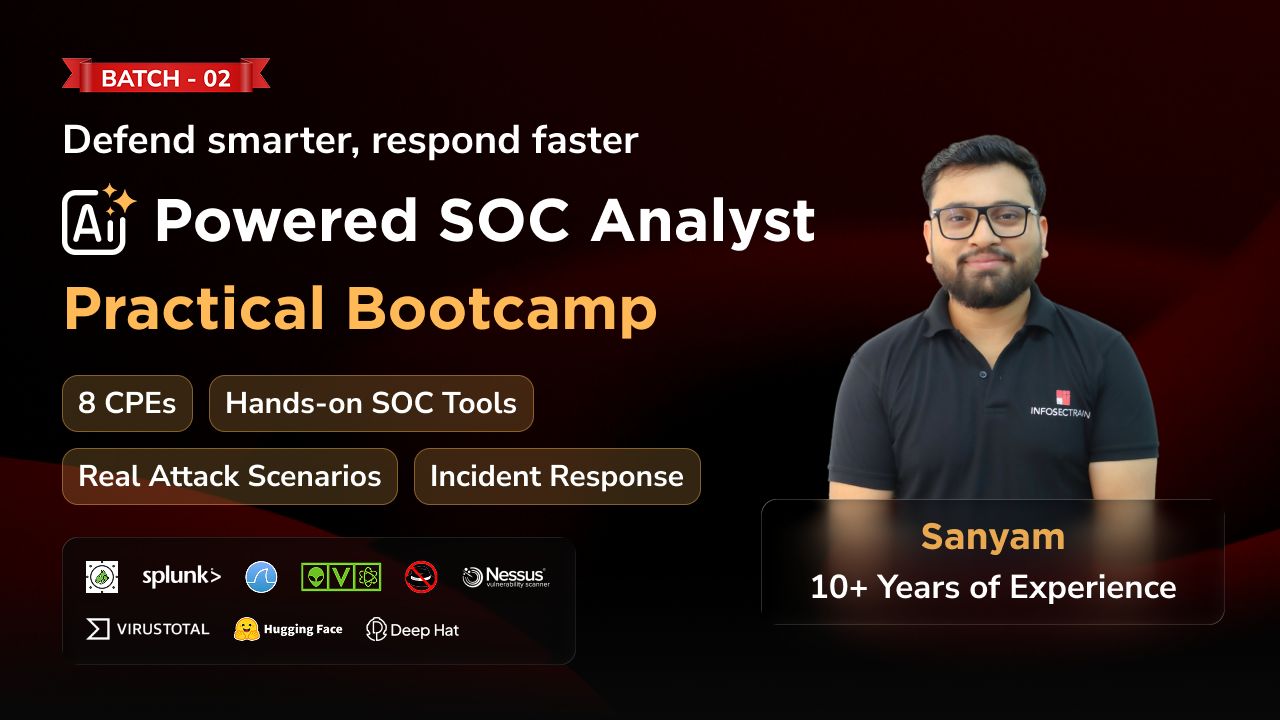
AI Powered Course
Certified AI Systems Professional for Cybersecurity Training
Build Secure, Trusted, and Compliant AI Systems
 29 Aug




Program Highlights
InfosecTrain offers Certified AI Systems Professional for Cybersecurity Training to help professionals master AI risks, secure ML systems, and build robust AI security capabilities for modern enterprises. This course is designed to prepare learners for the next era of cyber defense. You will not only understand how AI works, but also learn how to secure it, use it responsibly, and leverage it for both defensive and offensive cybersecurity operations.
Through structured modules, governance frameworks, real-world labs, and hands-on cloud deployments, this training delivers an end-to-end skill set aligned with emerging AI security roles.
 40-Hour of Hands-On AI Security Training
  AI Basics → Governance → Red & Blue Teaming → Cloud AI
  Labs: Adversarial Attacks, AI Red Teaming, LLM Security
  Cloud AI using Google AI Studio & Vertex AI
  Offensive AI: Recon, Payloads, Phishing, Exploits
  Defensive AI: Detection Models, Email & User Security, SIEM
  Aligned with NIST AI RMF & ISO 42001
  Mentorship & Post-training Support
  Access to Recording Sessions
Training Schedule
- upcoming classes
- corporate training
- 1 on 1 training
| Start - End Date | Training Mode | Batch Type | Start - End Time | Batch Status | |
|---|---|---|---|---|---|
| 28 Jun - 08 Aug | Online | Weekend | 19:00 - 23:00 IST | BATCH FULL | |
| 29 Aug - 11 Oct | Online | Weekend | 19:00 - 23:00 IST | BATCH OPEN | |
| 31 Oct - 13 Dec | Online | Weekend | 19:00 - 23:00 IST | BATCH OPEN |
Why Choose Our Corporate Training Solution
- Upskill your team on the latest tech
- Highly customized solutions
- Free Training Needs Analysis
- Skill-specific training delivery
- Secure your organizations inside-out
Why Choose 1-on-1 Training
- Get personalized attention
- Customized content
- Learn at your dedicated hour
- Instant clarification of doubt
- Guaranteed to run

About Course
InfosecTrain’s Certified AI Systems Professional for Cybersecurity Training training program offers a comprehensive introduction to securing modern AI systems across the full AI lifecycle. Designed for cybersecurity, cloud, and AI practitioners, this course blends foundational AI learning with practical security applications; ranging from responsible AI design and governance to AI-powered offense, defense, and cloud-based model deployment. Through a structured progression of concepts, guided labs, and real enterprise use cases, participants learn how AI models are built, where they fail, how to defend them, and how to operationalize secure AI workloads in real environments. This training ensures professionals gain the competencies needed to secure ML/LLM systems, enable AI-driven SOC capabilities, and confidently navigate the evolving landscape of AI governance, threats, and enterprise adoption.
Course Curriculum
-
AI Basics
- Module 1 – Introduction to AI (2 Hours)
- Evolution of AI
- AI Tech Stack and Components of an AI system
- Demystifying AI – Types, Key Terminologies, Learning Types
- Types Of Algorithms
- AI Applications: Predictive AI vs Generative AI
- Understanding AI Model Development
- Understanding NLP
- LLM Architecture
- Lab: Understanding Generative AI technically via Open AI Playground and LM Studio
- Module 2 – Python Basics for Using AI Frameworks and building AI Models (6 Hours) – Whole module uses hands on lab
- Understanding Introductory Programming Concepts: Variables, Datatypes, Keywords, Functions (Pre-defined), Printing, User Inputs, Comments, Operators
- User Defined Functions
- Creating Program Flow with Conditionals and Loops
- Advanced Datatypes: Lists, Tuples, Sets, Dictionary
- Libraries for AI: Data Engineering Phase: Numpy, Pandas, Matplotlib, NLTK (for NLP)
- Model Engineering Phase: Scikit-learn (Machine Learning), Tensorflow (Deep Learning)
- How are AI Systems Built – The AI Model Development Lifecycle:
- Problem Definition and Decision Boundary Identification
- Data Sourcing, Trust Boundaries, and Data Preparation Pipelines
- Model Selection, Design Choices, and Dependency Considerations
- Training and Fine-tuning within Controlled Environments
- Validation, Risk Assessment, and Approval Gates
- Deployment and Inference Architecture (APIs, Access, Exposure)
- Monitoring, Feedback Loops, and Drift Detection
- Model Updates, Versioning, and Retirement
- Using No code Low Code Frameworks for AI Model Development: AutoML
- Using GenAI Tools for AI Model Development
- Module 3 – Considerations for Building a Responsible AI System (2 Hours)
- Why AI Governance Matters: Trust, Ethics, Compliance, Risk
- Key Governance Principles: Safety, Fairness, Explainability, Privacy, Robustness, Auditability
- Regulatory Frameworks, Standards and Compliance: NIST AI RMF, ISO 42001
- AI Regulations and Guidelines Worldwide: EU AI Act, OECD AI Principles
- Module 4 – AI Cloud Governance (4 Hours)
- Why Cloud Complicates AI Governance: Scalability, Multi-region Data, Opaque AI Services
- The Shared Responsibility Model: What’s Governed by Cloud Provider vs. Customer in AI Workloads
- Mapping Existing AI Governance Principles (Fairness, Explainability, Privacy) to Cloud Controls (IAM, DLP, Encryption, Audit Logs)
- Data Governance: Cloud Data Lineage, Provenance, and Labeling Accountability, Managing Data Residency and Sovereignty (Multi-region Storage Policies)
- Model Governance: Model Versioning, Approval, and Explainability Tracking
- Cloud Risk, Compliance & Audit Controls
- Module 5 – Using AI for Cyber Offense (3 Hours)
- Automated Reconnaissance: Passive Recon Script Generation, Company Profiling
- Vulnerability Scanning: Automating NMAP Scan Task Generation and Scan Report Assessment
- Payload Generation & Obfuscation
- Phishing & Social Engineering: Email Generation and Pretext Building using AI
- Exploitation Assistance: Explain CVEs, Convert Exploit POCs, Automate Shell Handling using AI
- Tools: OpenAI, Shell GPT, Open-Source Models from Hugging Face and Ollama
- Module 6 – Pentesting AI Systems (4 Hours)
- Evasion, Poisoning and Theft
- ML Top 10
- LLM Top 10
- Lab: Pentesting ML and DL Models with FGSM and ART
- Lab: LLM Vulnerability Scanning using Garak
- Module 7 – Building AI-based Security Controls using the AI Model
- Development Lifecycle (6 Hours) (Whole module uses hands on lab)
- Security Controls for Network Security
- Security Controls for Email Security
- Security Controls for User Security
- Security Controls for Endpoint Security
- Module 8 – Using AI for Security Analysis (4 Hours) (Whole module uses hands on lab)
- Integrating Custom Models with SIEM tools (ELK stack)
- Using AI for Log Analysis
- Using AI Tools and Models for Security Analysis
- Agentic AI (Crew AI) for SOC Environment
- Module 9 – Securing AI Systems (5 Hours)
- Threat Modelling of AI Systems (Lab: MITRE ATT&CK and ATLAS, STRIDEGPT)
- Model Versioning and Monitoring (Lab: MLFLOW)
- Model Explainability (Lab: LIME and SHAP)
- Model Fairness (Lab: What-if tool)
- Securing ML and DL Models with Adversarial Training (Lab: ART, Cleverhans)
- Rate Limiting (Lab: Building Rate Limiter for LLMs using Langchain)
- Applying Guardrails on LLMs to Protect Against Adversarial Attacks (Lab: LLM-Guard, Guardrails AI, Models from Hugging Face)
- Module 10 – Using the Cloud Environment to Build AI Models (4 Hours)
- Fundamentals of using AI in the Cloud and Deploying AI on the Cloud
- Google AI Studio Essentials
- Introduction to Vertex AI
- Vertex AI Pipelines
- Lab: Building & Deploying an ML Model on GCP using Vertex AI
AI Governance
AI Red Teaming
AI Blue Teaming
AI and Cloud
Target Audience
- SOC Analysts, Incident Responders, Cybersecurity Professionals
- Cloud Engineers, Cloud Architects, DevSecOps Teams
- Penetration Testers & Red Teamers
- Data Scientists, ML Engineers, AI Practitioners
- Security Engineers securing ML/LLM systems
- Developers integrating AI in enterprise apps
- Anyone preparing for AI security certifications
- Professionals adopting AI in SOC & security automation
Pre-requisites
- Solid understanding of core IT and cybersecurity fundamentals such as networking, threat landscape, and security controls
- Basic programming familiarity is helpful, but not mandatory-programming concepts are covered from the ground up
- No prior ML or DL experience required; all AI concepts are taught from first principles
- Strong curiosity to learn AI, build models, and secure AI systems in real-world environments
Course Objectives
- Build a holistic understanding of AI systems and their security
- Bridge the gap between AI engineering and cybersecurity
- Train professionals in Responsible AI practices
- Equip teams to secure enterprise AI and LLM deployments
- Enable AI-driven cyber defense capabilities
- Prepare learners for advanced AI security careers


Vision

Goal

Skill-Building

Mentoring

Direction

Support

Success
Benefits of InfosecTrain’s Certified AI Systems Professional for Cybersecurity Training

Master AI security, governance, and LLM protection skills

Hands-on labs for real-world AI offense and defense

Learn to secure AI models across the full lifecycle

Build AI-driven detection and SOC automation capabilities

Gain cloud AI deployment skills with Google AI Studio & Vertex AI
Average Salary
Average Salary
Hiring Companies





"Source: Indeed, Glassdoor"
Confused about the right course for yourself?


It was a very good experience with the team. The class was clear and understandable, and it benefited me in learning all the concepts and gaining valuable knowledge.

I loved the overall training! Trainer is very knowledgeable, had clear understanding of all the topics covered. Loved the way he pays attention to details.

I had a great experience with the team. The training advisor was very supportive, and the trainer explained the concepts clearly and effectively. The program was well-structured and has definitely enhanced my skills in AI. Thank you for a wonderful learning experience.

The class was really good. The instructor gave us confidence and delivered the content in an impactful and easy-to-understand manner.

The program helped me understand several areas I was unfamiliar with. The instructor was exceptionally skilled and confident in delivering content.
The program was well-structured and easy to follow. The instructor’s use of real-life AI examples made it easier to connect with and understand the concepts.

Frequently Asked Questions
What is the Certified AI Systems Professional for Cybersecurity Training Course?
The Certified AI Systems Professional for Cybersecurity Training is a hands-on program by InfosecTrain designed to help learners secure modern AI, ML, and LLM-based systems across the full AI lifecycle. It covers AI fundamentals, governance, adversarial ML, AI red & blue teaming, cloud AI deployment, and real-world defensive/offensive AI techniques. The course prepares you for emerging job roles in AI security, AI governance, and SOC automation.
Who should enroll in the Certified AI Systems Professional for Cybersecurity Training certification?
This course is ideal for cybersecurity professionals, SOC Analysts, Cloud Engineers, Red Teamers, Data Scientists, ML Engineers, Developers integrating AI into applications, and anyone working with or securing AI/LLM systems.
What skills will I learn in this AI security training?
You will learn AI fundamentals, Python for AI, governance frameworks (NIST AI RMF, ISO 42001), adversarial attacks, LLM security, AI red/blue teaming, cloud AI deployment on Vertex AI, guardrails implementation, model hardening, threat modeling, fairness testing, explainability, AI-powered SOC analysis, and building AI-based detection systems.
Is prior AI or cybersecurity experience required for this course?
No prior AI or ML background is required. Basic IT or cybersecurity understanding is sufficient. The training starts from foundational AI concepts and gradually moves to advanced AI security techniques with guided hands-on labs.
How does this course help in securing AI/ML systems?
The course teaches how AI models are built, where they can fail, and how to secure them at each stage of the AI lifecycle. You’ll learn adversarial defense, model monitoring, LLM guardrails, secure deployment practices, threat modeling, and AI-based incident detection. Labs simulate real-world AI vulnerabilities and enterprise attack surfaces.
Will I get hands-on labs and real-world AI security scenarios?
Yes. The training is highly practical and includes labs on adversarial attacks, LLM red teaming, rate limiting, guardrails, MLflow monitoring, cloud AI deployment, SOC integration, and AI-powered analysis. Real enterprise scenarios involving offensive and defensive AI are also covered.
Does InfosecTrain provide recorded sessions and post-training support?
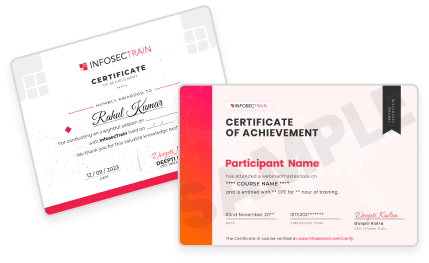
Yes. Learners receive access to session recordings, mentoring support, and post-training assistance to help with exam preparation, doubt resolution, and career guidance in AI security and governance.
What career opportunities are available after completing this certification?
You become job-ready for roles such as:
- AI Security Engineer
- LLM Security Analyst
- AI Governance Specialist
- AI-Based SOC Analyst
- AI/ML Engineer (Security-focused)
- AI Security Architect
How do I enroll in the Certified AI Systems Professional for Cybersecurity Training at InfosecTrain?
To enroll in the Certified AI Systems Professional for Cybersecurity Training at InfosecTrain:
- Visit the InfosecTrain website, www.infosectrain.com, and navigate the Certified AI Systems Professional for Cybersecurity Training course page.
- Fill out the registration form.
- You will receive a confirmation email with further instructions.
- Book your free demo with the Expert.