 AI Powered Course
Hands-On DevSecOps AI Training
Secure, Automate, and Accelerate DevOps with AI Insights




Program Highlights
InfosecTrain’s AI-Powered Practical DevSecOps with AI Training empowers professionals to secure and automate software pipelines while integrating AI-driven tools and practices. Learners gain hands-on experience in CI/CD, container and Kubernetes security, vulnerability scanning, secrets management, and AI-assisted detection. The course includes real-world scenarios, labs, and a capstone project, preparing participants to implement robust, intelligent, and scalable DevSecOps workflows.
 45-Hour LIVE Instructor-Led Training
  Scenario-based Practical Approach
  6+ Intermediate Learning Projects Covered
  Immersive Learning
  Hands-on Projects for Each Tool
  Learn from Industry Experts
  Career Guidance and Mentorship
  40+ Open-source Tools
  Access to Recorded Sessions
Training Schedule
- upcoming classes
- corporate training
- 1 on 1 training
Looking for a customized training?
REQUEST A BATCHWhy Choose Our Corporate Training Solution
- Upskill your team on the latest tech
- Highly customized solutions
- Free Training Needs Analysis
- Skill-specific training delivery
- Secure your organizations inside-out
Why Choose 1-on-1 Training
- Get personalized attention
- Customized content
- Learn at your dedicated hour
- Instant clarification of doubt
- Guaranteed to run

About Course
AI-Powered Practical DevSecOps Training from InfosecTrain has been meticulously crafted to equip participants with comprehensive knowledge and hands-on expertise in implementing DevSecOps practices within modern Docker and Kubernetes environments. This program emphasizes the use of AI-assisted security, automation, and intelligent decision-making to strengthen CI/CD pipelines and software supply chains. Learners gain practical experience in integrating security controls, policy enforcement, and AI-driven insights across the software development lifecycle. The course combines strong theoretical foundations with immersive hands-on labs, enabling participants to apply DevSecOps and AI principles effectively in real-world, enterprise-scale environments.
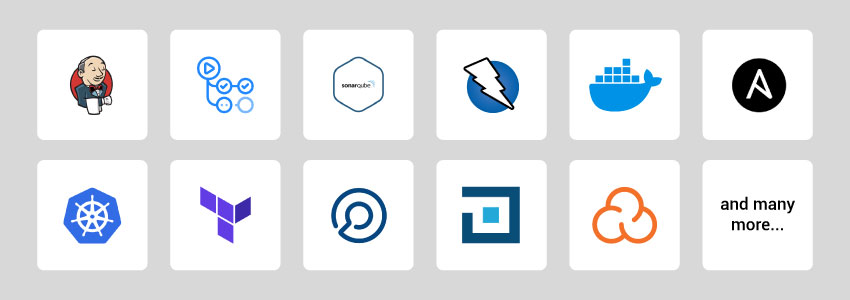
Tools
Course Curriculum
- Module 1: Introduction to the Basics
- What is DevOps?
- What is Continuous Integration (CI) and Continuous Deployment (CD)?
- DevOps vs DevSecOps vs Rugged DevOps
- Why traditional DevOps is not enough
- Introduction to DevSecOps
- Benefits of DevSecOps for enterprises
- DevSecOps lifecycle and shared responsibility model
- Module 2: Introduction to the Tools
- Version Control
- Git fundamentals
- GitHub repository structure, branching, pull requests
- CI/CD Platforms
- GitHub Actions
- Jenkins (overview and comparison)
- Security & Automation Tools Overview
- OWASP ZAP
- Ansible
- Docker
- Kubernetes
- InSpec
- Toolchain architecture for DevSecOps pipelines
- Version Control
- Module 3: Software Component Analysis (SCA) in CI/CD Pipeline
- Introduction to Software Composition Analysis (SCA)
- Risks from open-source dependencies
- Dependency vulnerabilities and license risks
- Integrating SCA into CI pipelines
- Tools Used for SCA
- OWASP Dependency-Check
- RetireJS
- Safety
- Demo / Hands-On
- Scan application dependencies
- Identify vulnerable libraries
- Fail CI pipeline based on severity
- Intermediate Project – 1
- Implement SCA scanning in a CI pipeline with policy-based failure
- Module 4: Static Application Security Testing (SAST) in CI/CD Pipeline
- Introduction to Static Application Security Testing (SAST)
- Shift-left security principles
- Code-level vulnerability detection
- Managing false positives
- Tools Used for SAST
- SpotBugs
- SonarQube
- SonarCloud
- Demo / Hands-On
- Run SAST scans in CI
- Analyze and triage findings
- Enforce quality gates
- Intermediate Project – 2
- Secure application code using SAST with enforced quality gates
- Module 5: Dynamic Application Security Testing (DAST) in CI/CD Pipeline
- Introduction to Dynamic Application Security Testing (DAST)
- Black-box testing concepts
- DAST vs SAST vs SCA
- Tools Used for DAST
- OWASP ZAP
- Demo / Hands-On
- Automated ZAP scans
- Baseline vs full scans
- Interpreting runtime vulnerabilities
- Intermediate Project – 3
- Integrate automated DAST into CI/CD pipeline
- Module 6: Infrastructure as Code (IaC) and Its Security
- Introduction to Infrastructure as Code
- Security risks in IaC
- IaC misconfigurations and cloud attack vectors
- Tools Used for IaC
- Docker
- Ansible
- Terraform
- Demo / Hands-On
- Build infrastructure using IaC
- Identify insecure configurations
- Secure IaC pipelines
- Intermediate Project – 4
- Secure infrastructure provisioning using IaC best practices
- Module 7: Compliance, Audit & Policy as Code
- Introduction to Policy as Code
- Compliance automation concepts
- Mapping infrastructure to compliance standards
- CIS Benchmarks overview
- Tools Used for Compliance / Audit as Code
- InSpec
- OpenSCAP
- Demo / Hands-On
- Implement compliance profiles
- Generate audit reports
- Continuous compliance checks
- Intermediate Project – 5
- Build a compliance-as-code pipeline with automated reports
- Module 8: Vulnerability Management
- Introduction to Vulnerability Management
- Vulnerability lifecycle
- Risk-based prioritization
- DevSecOps vulnerability workflows
- Tools Used for Vulnerability Management
- DefectDojo
- Demo / Hands-On
- Ingest findings from SAST, SCA, DAST
- Triage and manage vulnerabilities
- Track remediation status
- Intermediate Project – 6
- Centralized vulnerability management using DefectDojo
- Module 9: Software Supply Chain Security & SLSA Fundamentals
- Introduction to Software Supply Chain Security
- Real-world supply chain attacks
- Overview of SLSA (Supply-chain Levels for Software Artifacts)
- SLSA levels and trust boundaries
- Provenance and attestations
- SBOM concepts (SPDX & CycloneDX)
- Introduction to VEX
- Module 10: Signing & Verification with Sigstore
- Why artifact signing matters
- Key-based vs keyless signing
- Sigstore architecture overview
- Cosign, Fulcio, Rekor concepts
- Demo / Hands-On
- Generate SBOMs
- Sign container images using cosign
- Verify signatures and attestations in CI
- Module 11: CI/CD Hardening Deep-Dive
- CI/CD threat landscape
- OWASP Top 10 CI/CD Risks
- Common pipeline attack vectors
- Securing GitHub Actions workflows
- Key Topics
- Pinning third-party actions
- Least-privilege GitHub tokens
- Input sanitization
- Secrets exposure prevention
- OIDC-based authentication
- Hands-On
- Exploit an insecure workflow
- Harden and secure the pipeline
- Module 12: Container & Kubernetes Security
- Container security fundamentals
- Kubernetes threat model
- Cluster-level and workload-level risks
- Kubernetes Goat overview
- Hands-On
- Container hardening
- Kubernetes security testing
- CIS benchmark validation
- Module 13: Kubernetes Admission Policies (Policy Enforcement)
- Why “shift-left” is not enough
- Admission controllers overview
- Policy enforcement at deploy time
- Tools Used
- Kyverno
- OPA Gatekeeper
- Hands-On
- Enforce:
- No latest images
- Non-root containers
- Signed images only
- SBOM and vulnerability attestations
- Block non-compliant deployments
- Enforce:
- Module 14: Secrets Management at Scale
- Why secrets remain a top security risk
- Secrets in CI/CD and Kubernetes
- Rotation, auditing, and least privilege
- Tools Used
- HashiCorp Vault
- External Secrets Operator
- Hands-On
- Integrate Kubernetes with external secret managers
- Automatic secret rotation and auditing
- Module 15: Evidence & Attestation (SSDF Alignment)
- Introduction to NIST Secure Software Development Framework (SSDF – SP 800-218)
- SSDF practice groups (PO, PS, PW, RV)
- Evidence collection in DevSecOps pipelines
- Mapping tools and pipelines to SSDF controls
- Overview of CISA Secure Software Development Attestation
- Hands-On
- Create SSDF evidence artifacts
- Dry-run CISA attestation using pipeline outputs
- Module 16: (Elective) AI in DevSecOps
- AI and GenAI in the SDLC
- Risks of AI-assisted development
- OWASP Top 10 for LLM Applications
- NIST AI Risk Management Framework
- Prompt injection and data leakage
- Securing AI-generated code
- Hands-On
- Secure AI usage policy
- Prompt hygiene and guardrails
- CI checks for AI-generated code
Final Capstone Project
Integrating All the Tools into a Single Secure CI/CD Pipeline
- Capstone Objectives
- End-to-end DevSecOps pipeline
- SAST, SCA, DAST integration
- SBOM generation
- Artifact signing and verification
- Kubernetes admission enforcement
- Secrets management
- Vulnerability management
- SSDF evidence pack
Target Audience
- DevOps Engineers
- Security Engineers
- Software Engineers
- System Administrators
- Architects and Product Managers
- Developers
- Testers
- Cloud Architects
- Cloud Infrastructure Specialists
- Platform Engineers
- Site Reliability Engineers (SREs)
- Cloud Security Engineers
Pre-requisites
- Basic knowledge of Linux command-line usage, containerization concepts, and general DevOps practices
- Technical background or B.E/B.Tech degree
Course Objectives
Upon successful completion of the training, participants will be able to:
- Understand DevSecOps principles, benefits, and challenges in modern software pipelines
- Familiarize with Docker and Kubernetes for container and workflow management
- Implement CI/CD pipelines with integrated security and automation
- Perform vulnerability scanning, testing, and AI-assisted security checks in DevSecOps
- Utilize tools for identifying code, infrastructure, and AI model vulnerabilities
- Secure Kubernetes networking, communication, and AI/LLM deployment endpoints
- Authenticate and authorize Kubernetes API Server and AI service access
- Monitor Kubernetes clusters and AI pipelines for security incidents
- Manage secrets and sensitive data, including AI model keys and credentials
- Learn popular secrets management tools like HashiCorp Vault and integrate with AI pipelines
- Explore AI-assisted DevSecOps workflows, prompt hygiene, and AI code security
- Understand security orchestration and automated compliance in hybrid AI-DevSecOps environments


Vision

Goal

Skill-Building

Mentoring

Direction

Support

Success

Projected increase in roles related to DevSecOps over the next decade.
Organizations implementing DevSecOps practices report
of Organizations: Plan to hire professionals certified in DevSecOps.
of Organizations: Committed to training existing staff on DevSecOps practices using open-source tools and frameworks.

Technology

Healthcare

Retail

Government

Manufacturing

Finance




The DevSecOps training was insightful and well-structured. It effectively highlighted the integration of security into the development process emphasizing automation and collaboration. The hands-on exercises were practical and relevant enhancing our understanding.

The DevSecOps session was well-organized and comprehensive. The instructor delivered the material clearly, and the course content matched my expectations. The practical elements were particularly useful for understanding the subject.

Full credit to the mentor for making DevSecOps engaging and easy to understand. The course covered all key areas in depth and helped clarify complex topics with real-life examples and detailed explanations.

The course provided practical, hands-on experience in DevSecOps, allowing real-time application of the concepts. The practical exercises helped reinforce the theory, making it easier to implement in real-world projects.

Frequently Asked Questions
What is DevSecOps?
DevSecOps is a security practice that integrates security initiatives at every stage of the software development lifecycle (SDLC) to deliver robust and secure applications. It extends the DevOps practice, emphasizing collaboration between development and operations teams to shorten the software development cycle and improve software quality.
What is the goal of DevSecOps training?
The course equips participants to implement secure, automated, and scalable DevSecOps workflows, incorporating AI-assisted security, prompt hygiene, and monitoring of software and AI pipelines in real-world enterprise environments
How does DevSecOps differ from traditional development and security practices?
Traditional approaches treat development, operations, and security as separate functions. DevSecOps combines all three into continuous, automated workflows enhanced with AI insights, enabling faster, proactive, and intelligence-driven security in software delivery.
Who should attend this training course?
DevOps engineers, security engineers, system administrators, software architects, cloud specialists, platform engineers, SREs, and professionals responsible for secure, automated, and AI-integrated software pipelines.
What prerequisites or prior knowledge are required to enroll in this course?
Basic Linux command-line skills, familiarity with containerization concepts, DevOps practices, and a technical background (B.E/B.Tech or equivalent) are recommended. Prior exposure to CI/CD pipelines is beneficial.
What skills will I learn during the training?
Participants learn to secure CI/CD pipelines, harden containers and Kubernetes, manage secrets, perform vulnerability scanning, implement AI-assisted security checks, ensure compliance, and safeguard AI-generated code.
Is programming knowledge required for DevSecOps training?
Basic scripting or familiarity with code management is helpful, but hands-on labs and guided exercises allow learners to implement DevSecOps practices and AI-assisted security without advanced coding skills.
What tools and technologies are covered in Practical DevSecOps training?
Git, GitHub, Jenkins, Docker, Kubernetes, Ansible, Terraform, OWASP ZAP, SonarQube, SpotBugs, DefectDojo, Vault, Kyverno, OPA Gatekeeper, Sigstore, and AI/LLM security tools.
What additional bonus topics will be covered in the course related to security orchestration tools?
Security orchestration and automation workflows, AI-assisted detection, prompt hygiene, CI/CD pipeline monitoring, compliance auditing, and AI-driven DevSecOps incident response
Will participants receive any course materials or resources for further learning?
Yes, participants will receive course materials and resources as reference materials for further learning and implementation.
What are the career prospects after completing Practical DevSecOps training?
Roles such as DevSecOps Engineer, Security Automation Engineer, Cloud Security Specialist, Kubernetes Security Expert, AI-Enhanced DevOps Engineer, or Security Architect for enterprise software pipelines.