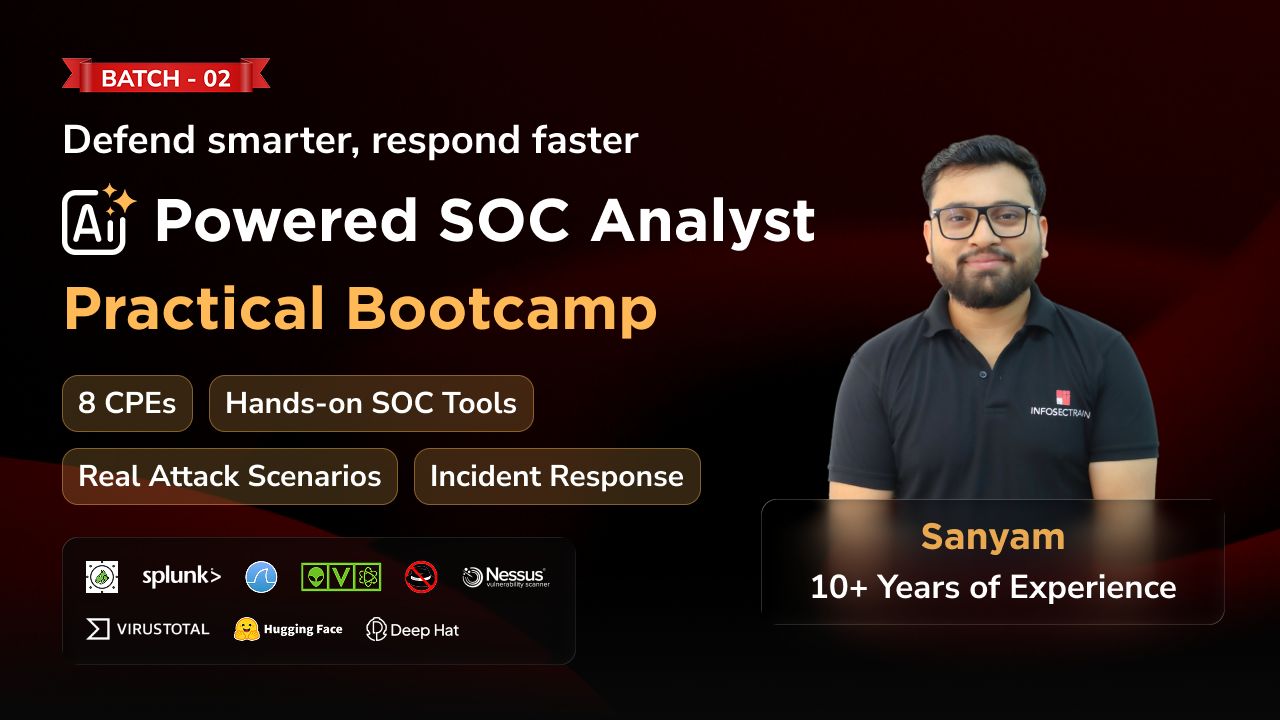
AI Powered Course
AI-Powered Cybersecurity Certification Training
AI-Powered Cybersecurity: Mastering the Future
 26 Jul




Program Highlights
The AI-Powered Cybersecurity Training by InfosecTrain is a future-focused program designed to bridge artificial intelligence with real-world cybersecurity operations. It equips learners with practical skills in AI-driven threat detection, offensive and defensive security techniques, and enterprise-grade AI governance. Through hands-on labs, industry tools, and scenario-based learning, the course builds job-ready capability for modern AI-security roles across SOC, GRC, and security engineering domains.
 40-Hour of Instructor-led Training
  Career-oriented Skill-based Course
  Learn with Real-World Scenarios
  Industry-Standard Tools and Frameworks
  AI + Cybersecurity Hands-On Labs
  Learn from Industry Experts
  Career Guidance and Mentorship
  Extended Post Training Support
  Access to Recorded Sessions
Training Schedule
- upcoming classes
- corporate training
- 1 on 1 training
| Start - End Date | Training Mode | Batch Type | Start - End Time | Batch Status | |
|---|---|---|---|---|---|
| 26 Jul - 20 Sep | Online | Weekend | 09:00 - 13:00 IST | BATCH OPEN | |
| 03 Oct - 15 Nov | Online | Weekend | 09:00 - 13:00 IST | BATCH OPEN |
Why Choose Our Corporate Training Solution
- Upskill your team on the latest tech
- Highly customized solutions
- Free Training Needs Analysis
- Skill-specific training delivery
- Secure your organizations inside-out
Why Choose 1-on-1 Training
- Get personalized attention
- Customized content
- Learn at your dedicated hour
- Instant clarification of doubt
- Guaranteed to run

About Course
InfosecTrain’s AI-Powered Cybersecurity Training is designed to help professionals understand, build, and secure AI-driven systems within modern cybersecurity environments. The program integrates Artificial Intelligence with core security principles to enable learners to detect threats, analyze attack patterns, and respond using AI-based techniques. It also introduces essential Python fundamentals for working with AI applications in cybersecurity, ensuring a practical understanding of data, models, and security workflows. Through hands-on labs, real-world scenarios, and industry-aligned tools, learners gain exposure to both offensive and defensive AI security use cases. The course is designed for cybersecurity professionals, IT practitioners, and aspiring AI security specialists, bridging traditional security practices with emerging AI technologies for real-world applications.
Course Curriculum
Part 1: Understanding and Using AI
-
- Module 1: Introduction to AI and AI in Cybersecurity
- AI and its Evolution
- Components of an AI System
- AI vs ML vs Data Science
- Algorithm vs Model
- Types of Learning – Supervised, Unsupervised, Semi-Supervised, Reinforcement, Federated
- Types Of Models
- AI Use Cases in Cybersecurity
- Risks of AI
- Module 2: Python Basics for Using AI Frameworks
- Python Fundamentals for AI
- Lab Setup: Linux VM, Using Jupyter Notebook
- Python Libraries for Data Analysis and Visualisation – Pandas, NumPy, Matplotlib
- GenAI Platforms: Google Colab, Hugging Face, Ollama, LMStudio, OpenAI Platform, Google AI Studio, Anthropic, Groq
- AI Model Development Lifecycle
- Types of Data and using them for AI Model development
- Secure and Responsible use of Data in AI models and Applications
- Module 3: Using AI for Cyber Offense
- Using AI for:
- Reconnaissance
- Vulnerability Scanning
- System Hacking
- Hands On: ShellGPT, Open-Source Models for Offensive Security
- Hands On: Generating Network Attacks Using AI
- Hands On: Collecting Network Attack Traffic Data: Packets and Logs.
- Using AI for:
- Module 4: Building ML-based Security Controls using Generative AI
- Data Collection
- Data Processing (Including Feature Extraction and Normalization)
- Model Training
- TEVV: Test, Evaluation, Verification, Validation, and Fine Tuning
- Model Deployment, Model Monitoring and Retraining
- Hands On: Using Gen AI tools for Building AI models for Network Security
- Hands On: Building Anomaly Detector using Unsupervised Learning using Gen AI Tools
- User and Entity Behaviour Analytics (UEBA)
- Hands On: Building Keystroke Behaviour Analysis Detector
- Module 5: Natural Language Processing (NLP)
- Text Processing for NLP: Tokenization, Stop words removal
- NLP Feature Engineering Types
- Hands On: Converting Emails and Logs to Vectors
- Hands On: Building a Phishing Mail Detector
- Module 6: Neural Networks and Deep Learning for Cybersecurity
- Perceptron
- Multi-Layer Perceptron (MLP)
- Convolutional Neural Networks (CNN)
- Recurrent Neural Networks (RNN)
- How Deep Learning enables Building Models for Complex Cybersecurity Data
- Hands On: Building Malware Detectors Using CNN
- Module 7: Generative AI and LLMs
- Generative Adversarial Networks
- Transformer Architecture
- Prompt Engineering Techniques and System Prompts
- Foundational model and fine-tuned model
- Retrieval Augmented Generation (RAG)
- Hands On: Building a Gen AI-Based Custom Chatbot
- Hands On: Using Gen AI for Summarizing Threat Intelligence and Vulnerability Reports
- Module 8: SIEM-IDS-Integration, Deployment, and Monitoring of AI Models
- Ingesting IDS Logs into SIEM (ELK Stack)
- Data Parsing using AI
- Setting up the Data and Model Pipelines
- Hands On: FastAPI for Deploying and Serving Models
- Monitoring and Observability
- Dealing with Data Lag and Model Drift
- Secure Retraining Mechanisms
- Hands On: AI Observability with OpenLLMetry + Phoenix
- Module 9: Agentic AI for Security Operations
- Components To Build Agentic AI
- Agentic AI: Autonomous agents, Reasoning, Action: tool use, and multi-agent orchestration frameworks
- Model Context Protocol (MCP): architecture, use cases, and security implications
- Demo: Using Agentic AI for generating Triage Reports
- Agent topology design principles.
- Module 1: Introduction to AI and AI in Cybersecurity
Part 2: Attacking, Governing, and Securing AI
- Module 10: Adversarial Attacks on AI
- Poisoning: Data and Model
- Setting up Backdoor with Trigger-Based Poisoning
- Evasion
- Evading AI-Based Detectors
- Theft: Data and Model
- Inversion and Inference Attacks
- OWASP Machine Learning Security Top 10
- OWASP Top 10 for Large Language Model Applications
- OWASP Top 10 for Agentic Applications
- Hands On: Honeytokens in prompts and vector stores
- Hands On: Automated LLM pentesting using Garak
- Module 11: Security Architecture Principles Applied to AI
- Secure Infrastructure reference architecture for AI Workloads
- Defense-in-depth for AI pipelines
- Zero-trust architecture for AI services
- Role of AI Gateway
- Segmentation of data, model, and inference layers
- Identity and Access Control for AI Systems
- Hands On: Deploying AI Gateway
- Hands On: Shadow AI Discovery using Proxy Server
- Module 12: Data Security in AI Systems
- Data Confidentiality, Integrity, and Availability
- The AI data leakage threat surface
- Secure Data Collection and Ingestion
- Data Sanitization and De-identification Techniques: Data Anonymization, Pseudo-anonymization, Minimization, Masking, Redaction
- Secure Data Processing: Data Classification, Data Quality, and Validation
- Dataset Watermarking
- Privacy Preserving Learning Techniques
- Secure Data Usage During Inference
- Dealing with Data Lag after Model Deployment
- Data Lineage and Provenance Tracking: Audit Logging, Versioning
- Hands On: Using Microsoft Presidio
- Module 13: AI Governance
- AI Ethics
- Properties of a Responsible AI System
- Data Governance
- Model Governance
- Mapping Infosec controls to NIST AI RMF functions (Govern, Map, Measure, Manage) and ISO 42001 Annex A controls
- EU AI Act risk tiers and their implications for security controls.
- Hands On: Governance control mapping exercise
- Module 14: Implementing Governance and Security Controls for AI
- Adversarial Training and Testing
- Techniques to check Sampling and Algorithmic Bias
- Ensuring Explainability in AI Systems
- Data and Model Versioning
- Guardrails for LLMs: System Prompt Hardening, Prompt Firewalls (Input and Output Guards)
- Integrating Prompt Injection Detector with LLMs
- Proprietary and open-source guardrails: LLM-Guard, Nemo Guardrails, Guardrails-AI, LlamaGuard
- Hands On: Deploying a pre-built Prompt Injection Detector and interpreting its alerts
- Applying Rate Limiting and Cost Budgeting in the AI Gateway
- Observability, Monitoring, Evaluation, and Logging Tools for LLMs
- Hands On: Third-party AI Component Supply Chain Assessment
- Building a Governance Evidence Pack for an AI Application
- Threat Modelling Frameworks: MITRE ATLAS, MAESTRO Framework for Agentic AI systems
- Security Roles, Responsibilities & Operating Model for AI
Target Audience
- Beginners in cybersecurity, with coding supported by Generative AI tools
- Security Professionals who want to learn how to leverage Open-source AI tools and LLMs securely in their workflow
- Anyone who wants to understand how AI models are built as security controls
- Anyone who wants to transition to AI security roles
- Cybersecurity Professionals – Security Analysts, SOC Analysts, Security Engineers, Detection Engineers
- Offensive Security Professionals
Pre-requisites
Fundamental knowledge of core cybersecurity concepts is required.
Course Objectives
You will be able to:
- Bridge the gap between traditional cybersecurity and modern AI systems security
- Understand how AI systems work under the hood beyond theoretical concepts
- Apply AI for both offensive and defensive cybersecurity use cases
- Secure AI systems across the full lifecycle: data, model, deployment, and operations
- Gain exposure to real-world attack techniques and defensive security controls
- Bridge the gap between traditional cybersecurity and modern AI systems security
- Bridge the gap between traditional cybersecurity and modern AI systems security


Vision

Goal

Skill-Building

Mentoring

Direction

Support

Success

Global cybersecurity workforce gap underscores high demand for skilled professionals.
Of cybersecurity teams are already utilizing AI in their tools, highlighting the importance of AI proficiency in modern cybersecurity roles.
Cybersecurity professionals report significant skills gaps in their organizations, highlighting the need for training programs.
Tech professionals face an AI security skills shortage, emphasizing specialized training demand in AI-driven cybersecurity.

Technology Firms

Healthcare

Retail

Government

Manufacturing

Finance




I’m grateful to have joined my third training with Infosec Train. The AI-Powered Cybersecurity sessions were comprehensive and well-structured, covering AI, ML, and DL with great clarity and depth.

An excellent and informative session! The AI-Powered Cybersecurity course content kept me engaged throughout. Truly a valuable experience.

The AI-Powered Cybersecurity training was in-depth and covered a wide range of AI topics. The trainer’s instructions were clear and effectively incorporated participant feedback. The coordination and execution of the sessions were seamless, making it a great overall learning experience.
The trainer was amazing and demonstrated in-depth knowledge of the AI-Powered Cybersecurity Training. The sessions were engaging and provided valuable insights into AI concepts, prompts, and practical applications.

The AI-Powered Cybersecurity training was really good and provided valuable insights. It also encouraged a deeper approach to analyzing emerging trends and understanding their practical impact.

Frequently Asked Questions
What is the AI-Powered Cybersecurity Training course?
The AI-Powered Cybersecurity Training is a comprehensive program that integrates artificial intelligence with cybersecurity practices. It equips participants with the skills to leverage AI tools while covering topics such as Python programming, machine learning, adversarial attacks, and endpoint protection, preparing learners to tackle modern cybersecurity challenges effectively.
What career opportunities can this course prepare me for?
- Security Analyst with an AI focus
- AI Security Engineer
- Junior Threat Analyst
- Security Operations Center (SOC) Analyst
- AI-assisted Penetration Tester
- Data Scientist
How can this course support my career transition?
This course bridges the gap between AI and cybersecurity by:
- Establishing a strong foundation in both domains
- Offering hands-on experience with industry-relevant tools
- Teaching current best practices and techniques
This course equips you with essential skills to excel in the growing field of AI-driven cybersecurity.
I have no prior experience with AI or Machine Learning. Will I be able to keep up?
Yes! This course is designed for beginners, starting with fundamental AI concepts and gradually progressing to more advanced topics. The initial modules focus on building a solid foundation, ensuring you can confidently keep up and succeed.
Can I take this course if I'm new to both AI and cybersecurity?
Yes! This course is beginner-friendly and designed to help you get started in both fields. It:
- Covers the fundamentals of AI and cybersecurity, along with introductory Python programming.
- Provides supplementary resources for better understanding.
- Uses practical examples to bridge the gap between the two domains.
Is programming knowledge required?
No, programming knowledge is not mandatory. The course starts with the basics and builds your skills as you progress. Having prior experience may help you understand programming exercises more quickly, but it is not a prerequisite.
Does the course include hands-on training?
Yes! The course perfectly balances theory and hands-on practice with a 50:50 approach. Each module starts with a theoretical foundation, followed by practical applications. Beginning with basic Python exercises, it gradually progresses to real-world problem-solving. Modules include:
- Interactive demonstrations
- Guided lab exercises
- Real-world security scenarios
- Practical tool implementation
Does this course include LLM pentesting?
The course provides a theoretical overview of threats to LLMs, explores the OWASP Top 10 for LLMs, and introduces the basics of performing pentesting on LLMs.
How can I enroll in an AI-Powered Cybersecurity course?
Enroll in the AI-Powered Cybersecurity Training at InfosecTrain:
- Visit the InfosecTrain website, www.infosectrain.com, and navigate the AI-Powered Cybersecurity training page.
- Fill out the registration form.
- You will get a confirmation email with further instructions.
- Book your free demo with Expert.
- You can also directly drop mail with your requirements at sales@infosectrain.com.