AI Powered Course
Certified AI Governance Specialist (CAIGS) Training
AI Governance Specialist Training
 09 Nov




Program Highlights
The Certified AI Governance Specialist (CAGS) Training is a comprehensive, instructor-led program designed for professionals who want to govern AI responsibly, securely, and at scale. Covering the entire AI governance lifecycle—from ethics, regulations, and risk management to architecture, data governance, and auditing—this program blends theory, frameworks, and real-world case studies. By the end of the training, you will be equipped to design and operationalize AI governance programs that ensure fairness, transparency, compliance, and business alignment, while future-proofing your career in the rapidly evolving AI landscape.
 48-Hour LIVE Instructor-led Training
  Hands-on Case Studies
  Real-world AI Projects
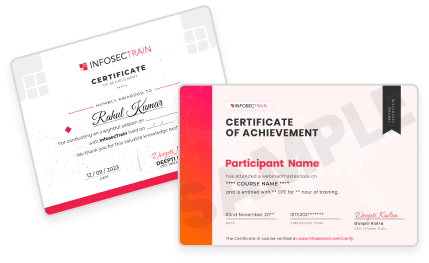
  Globally Recognized Certification
  AI Governance Lifecycle
  Certified Experts
  Dedicated Telegram Support Group
  Career Guidance & Mentorship
  Access to Recorded Sessions
Training Schedule
- upcoming classes
- corporate training
- 1 on 1 training
| Start - End Date | Training Mode | Batch Type | Start - End Time | Batch Status | |
|---|---|---|---|---|---|
| 09 Nov - 17 Dec | Online | Weekday | 19:30 - 22:00 IST | BATCH OPEN | |
| 01 Feb - 04 Mar | Online | Weekday | 19:30 - 22:00 IST | BATCH OPEN |
Why Choose Our Corporate Training Solution
- Upskill your team on the latest tech
- Highly customized solutions
- Free Training Needs Analysis
- Skill-specific training delivery
- Secure your organizations inside-out
Why Choose 1-on-1 Training
- Get personalized attention
- Customized content
- Learn at your dedicated hour
- Instant clarification of doubt
- Guaranteed to run

About Course
Certified AI Governance Specialist (CAGS) is an advanced, end-to-end program
designed to help professionals master the frameworks, tools, and strategies needed to govern Artificial Intelligence systems responsibly, securely, and at scale. This intensive program covers the full lifecycle of AI governance, from ethical foundations, legal and regulatory compliance, data governance, risk management, assessment and model accountability to the integration of AI systems within cloud environments. Participants will gain practical expertise in aligning AI adoption with business goals while ensuring fairness, transparency, security, and compliance with global standards.
By combining theoretical knowledge, real-world case studies, this course equips professionals to design and operationalize trustworthy AI governance programs that are both future-proof and business-ready.
Course Curriculum
- Module 01: AI Foundations
- Types of AI (Functionality and Capabilities)
- Branches and Applications of AI across industries
- AI Technology Stack
- Machine Learning Components, Processes, and Types
- Generative AI, SLMs and Large Language Models (LLMs)
- AI Agents, Agentic AI
- Common AI Attacks and Mitigation
- Ethical Considerations
- Module 02: Ethics, Responsible AI and Societal Impact
- Responsible AI Principles
- Bias, Fairness, and Discrimination
- Privacy, Data Protection and Security Concerns
- Job Displacement and Economic Impact
- Bias: Use Cases
- Types of AI Discrimination
- Addressing algorithmic bias and fairness
- Privacy concerns and data protection
- Responsible AI Development and Deployment
- Key principles of Responsible AI
- Responsible AI Case Studies
- Module 03: Global AI Laws and Regulations
- Overview of existing AI laws and regulations
- Legal and ethical considerations: Data privacy, bias, transparency, accountability
- Emerging trends in AI legislation
- How do AI regulations affect the adoption of AI in different industries
- Categories of AI Laws
- OECD AI Principles: Fairness, transparency, and accountability
- EU AI Act
- ISO/IEC 42001:2021 for Artificial Intelligence
- AI Liability and Accountability
- Assessing the regulatory impact on AI systems
- Copyright and AI-generated content
- Cross-border AI Compliance
- Module 04: Enterprise AI Governance and Governance Operations
- Enterprise AI governance models
- Enterprise AI Governance Vs. Responsible AI Governance
- AI Governance Models (Centralized, Decentralized, Federated)
- Trustworthy AI
- Responsible Artificial Governance (RAG)
- Governance Committees and Operating Model
- Aligning AI with Business Objectives
- Building and Measuring AI Governance Programs
- Identifying and Engaging Stakeholders
- Aligning Stakeholder Interests with Governance Objectives
- AI documentation (Model Cards, AI Impact Assessments, Risk Registers, Policies)
- Governance metrics, KRIs/KPIs and executive reporting
- Governance Maturity Assessment
- Continuous Governance and Monitoring
- Module 05: AI Systems, Models and Lifecycle Governance
- AI architecture and system components (Data, Model, Application, Security)
- Foundation models, LLMs and multimodal models
- Governance in AI Architecture
- Model Governance and Model Registry
- Explainability (LIME, SHAP)
- RAG Fundamentals and Prompt Engineering
- Model Validation and Testing
- Bias, Robustness, Safety and Hallucination Testing
- Model Drift, Data Drift and Continuous Monitoring
- Model Cards and Documentation
- Module 06: Agentic AI Governance
- Introduction to Agentic AI
- AI assistants vs AI agents
- Multi-agent systems
- Enterprise agent architecture
- Agent identity and autonomy
- Governance risks for autonomous agents
- Prompt injection and memory poisonin
- Tool governance and permission management
- Human-in-the-loop controls
- Guardrails, monitoring and kill switches
- Agent lifecycle governance
- Enterprise case study
- Module 07: AI Risk Management
- Introduction To AI Risks
- AI Risk Categories
- NIST AI RMF and MIT AI Risk Repository
- AI Impact Assessment (AIIA)
- AI Risk Register
- EU AI Act Risk Tiers
- Risk Assessment Methodologies (FMEA and FTA)
- Third-Party AI Risk Management
- Governance Maturity Models
- Risk Treatment Strategies
- Practical AI Risk Assessment Case Study
- Module 08: Data Governance for AI
- Data Strategy for AI
- Data Governance Policy
- Data Quality, Data Gathering
- Data Lifecycle
- Data Cleansing and Data Labelling
- Data Privacy and Security, Data Ethics
- Data Validation
- Data Lifecycle Management for AI Projects
- Data Collection, Processing, Storage, And Use for AI Systems
- Data Exfiltration
- Data Anonymization, Pseudonymization, and Differential Privacy Techniques
- Implementing Data Governance Frameworks for AI
- AI Data Security and Pets
- Case Study
- Module 09: AI on Cloud
- Cloud Computing Fundamentals for AI
- AI Hosting Models on Cloud
- Key considerations for choosing CSP for AI Workloads
- Leveraging Native Cloud Security for AI
- Shared Responsibility Matrix
- Integrating AI Governance into Cloud Infrastructure
- Reference architectures
- Case study
- Module 10: AI Security
- AI Threat Landscape
- Security Controls Across AI Lifecycle
- OWASP GenAI risks
- RAG security
- Model theft and data poisoning
- AI Red Teaming
- Incident Response for AI Systems
- Module 11: Auditing AI Systems
- AI Audit Frameworks and Standards
- Key Audit Areas and Techniques
- Audit planning
- Evidence collection
- Control validation
- AI assurance
- Audit reporting
- Continuous assurance
- Audit simulation
- Challenges in AI Auditing (Methodologies, Data Access)
- AI Audit Simulation Exercise
- Module 12: SDLC for AI Systems
- SDLC Methodologies (Agile, DevOps, Waterfall)
- Secure AI SDLC
- Governance in Each SDLC Phase
- Planning, Design, Development, Testing, Deployment, Maintenance
- Change Management
- Model Retirement
Target Audience
This training is ideal for:
- IT and Security Leaders
- Information Security Professionals
- Cloud Security Professionals
- Security Architects and Engineers
- GRC Professionals
- Consultants and Auditors
- Legal, Policy, and Risk Managers
- Data and AI Project Managers
- Business and Technology Leaders
Pre-requisites
- The training has no set prerequisites
Exam Details
| Certification Body | InfosecTrain |
| Exam Format | Multiple-choice Questions and Scenario-based Questions |
| Number of Questions | 30 Questions |
| Exam Duration | 60 Minutes |
| Exam Language | English |
| Passing Score | 70% |
| Testing Mode | Online |
Course Objectives
By the end of this Program, the participants will be able to:
- Understand the AI governance lifecycle, from data and models to risk, ethics, law, and compliance
- Drive Responsible AI Adoption
- Learn how to navigate and comply with fast-evolving global AI regulations
- Utilize frameworks for identifying, assessing, and managing ethical, operational, and compliance risks in AI
- Integrate Governance with Cloud AI


Vision

Goal

Skill-Building

Mentoring

Direction

Support

Success


The AI Governance training was an amazing learning experience. The instructor was thorough and demonstrated strong expertise in the subject. The sessions covered important concepts in a clear and structured way, making them easy to understand. I was truly impressed by how much valuable knowledge and insight was covered throughout the course.

The AI Governance training was very good and well structured. The instructor explained the concepts clearly and ensured that the sessions were easy to understand. The training provided useful insights and practical knowledge that can be applied in real-world scenarios. Overall, it was a valuable and engaging learning experience.

I truly appreciate all the help and support provided throughout the AI Governance training. The instructor explained the concepts clearly and ensured the sessions were engaging and easy to follow. The guidance and assistance provided during the training made the overall learning experience smooth, valuable, and highly beneficial for my professional growth.
The instructor was excellent throughout the AI Governance training. His strong command of both foundational concepts and advanced governance frameworks was clearly evident. What stood out most was his ability to connect theory with real-world scenarios, making complex AI governance principles easier to understand and apply. Overall, it was a highly valuable and insightful learning experience.
The AI Governance training sessions were highly engaging, with interactive discussions and real-time case studies that made the learning experience practical and insightful. The instructor demonstrated strong technical expertise and explained AI concepts in a clear and structured manner, which greatly helped in understanding and grasping the subject effectively.
Very good AI Governance training provided by the instructor. He was very patient throughout the sessions and addressed all our queries effectively. The hands-on training was particularly valuable and will help us implement the concepts in our organizations. Overall, it was a great learning experience. Thank you for the insightful training.

Frequently Asked Questions
What is AI Governance Specialist Training?
he Certified AI Governance Specialist (CAGS) Training is a 48-hour, instructor-led program covering the entire AI governance lifecycle- ethics, risk, compliance, data governance, and auditing- equipping professionals to govern AI responsibly and securely at scale.
Why is AI Governance important for organizations?
It ensures AI adoption is fair, transparent, secure, and compliant with global laws, reducing risks of bias, regulatory fines, and reputational damage while aligning AI with business goals.
Who should attend the AI Governance Specialist Training course?
This training is ideal for IT and Security Leaders, Information Security Professionals, Cloud Security Professionals, Security Architects and Engineers, GRC Professionals, Consultants and Auditors, Legal, Policy, and Risk Managers, Data and AI Project Managers and Business and Technology Leaders.
Does this course cover ISO/IEC 42001 and the EU AI Act?
Yes. The program covers ISO/IEC 42001:2021, the EU AI Act, OECD principles, and other global AI laws and standards to help professionals navigate regulatory compliance.
Does the course include AI risk management frameworks like NIST AI RMF?
Yes. You’ll learn NIST AI RMF, MIT AI Risk Repository, EU AI Act risk tiers, and AI risk registers to effectively assess and mitigate AI risks.
How does the training address AI ethics and bias?
The course teaches bias detection, fairness, discrimination prevention, and algorithmic accountability, along with practical case studies on responsible AI adoption.
Is this course suitable for non-technical professionals?
Yes. While technical aspects are covered, it’s designed for both technical and non-technical professionals such as legal, compliance, and risk managers.
What industries benefit most from AI Governance Training?
Industries like finance, healthcare, telecom, government, and technology that use AI for critical decision-making benefit most, though lessons apply across all sectors.
How does the training prepare professionals for regulatory compliance?
By combining global standards with real-world case studies, the course equips you to integrate compliance into AI systems from design to deployment.
What career opportunities are available after AI Governance Training?
You can pursue roles such as AI Governance Specialist, Responsible AI Officer, AI Risk Manager, Compliance & Ethics Lead, or AI Auditor.
Does this training include case studies and practical exercises?
Yes. The course blends theory with hands-on exercises, governance simulations, and real-world case studies for practical learning.
What are the benefits of enrolling with InfosecTrain?
48-hour live training, real-world projects, a custom course crafted to tackle today’s vast AI landscape, access to recordings, a Telegram support group, and post-training mentorship & career guidance.