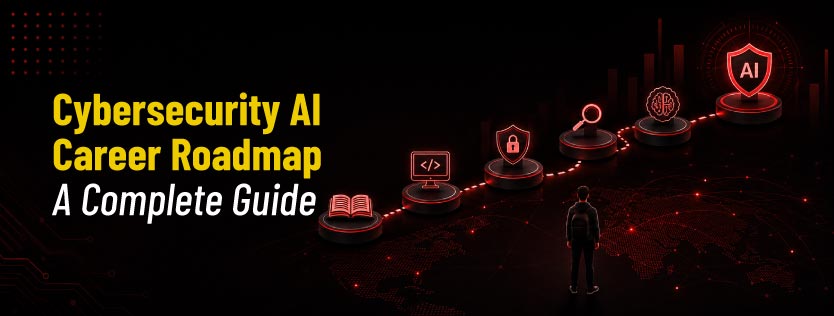
Cybersecurity AI Career Roadmap: A Complete Guide
Quick Insights:
A career in cybersecurity AI can begin with foundational knowledge of cybersecurity, artificial intelligence, machine learning, and AI-related risks. Professionals can then specialize in AI security engineering, AI governance, AI risk management, AI auditing, red teaming, or AI-powered security operations. Certifications such as SecAI+, AAISM, AAIA, AIGP, and C|RAGE address distinct responsibilities and should be selected based on the target role. Practical experience with threat modeling, AI risk assessments, model testing, guardrails, secure AI pipelines, and governance documentation is essential for career progression.
Artificial intelligence is changing both sides of cybersecurity. Security teams are using AI to analyze alerts, automate investigations, identify vulnerabilities, and accelerate incident response. At the same time, organizations must protect AI models, applications, data pipelines, Large Language Models (LLMs), and autonomous agents against emerging attacks.
This combination has created a specialized career path for professionals who can understand traditional cybersecurity, AI technologies, security engineering, risk management, and responsible AI governance. However, entering this field requires more than learning a few AI tools. Professionals must understand how AI systems operate, where they can fail, how attackers manipulate them, and how organizations can govern them throughout their lifecycle.
What Is Cybersecurity AI?
Cybersecurity AI brings together two closely connected areas:
Using AI for Cybersecurity
This involves applying AI-assisted capabilities to improve security activities such as:
- Threat detection and alert triage
- Log and malware analysis
- Vulnerability prioritization
- Phishing detection
- Threat-intelligence enrichment
- Incident-response automation
- Security report generation
- Behavior and anomaly detection
AI can accelerate security operations, but its output still requires validation, contextual understanding, and human oversight.
Securing and Governing AI
This involves protecting AI systems against security, privacy, safety, ethical, and compliance risks. The scope can include:
- Training data and datasets
- Machine learning models
- Model weights and intellectual property
- LLM applications
- Retrieval-Augmented Generation systems
- Vector databases
- APIs and plugins
- AI agents and tools
- MLOps and LLMOps pipelines
- Third-party models and AI services
Professionals may need to address prompt injection, sensitive information disclosure, model theft, data poisoning, insecure integrations, excessive agency, supply-chain risks, output manipulation, and unauthorized access.
What Does a Cybersecurity AI Professional Do?
Responsibilities depend on the selected specialization but may include:
- Discovering and maintaining an AI asset inventory
- Conducting AI threat modeling
- Assessing AI security and privacy risks
- Testing LLM applications for prompt injection
- Evaluating model, data, and pipeline security
- Designing AI guardrails and access controls
- Reviewing third-party AI providers
- Securing MLOps and LLMOps environments
- Establishing AI governance policies
- Conducting AI impact assessments
- Mapping AI controls to standards and regulations
- Auditing AI development and deployment processes
- Monitoring models for misuse, drift, and security events
- Supporting AI incident response
- Using AI to improve security operations
- Reporting AI risks to management
This field is multidisciplinary. Effective AI security often requires collaboration among cybersecurity, data science, engineering, privacy, legal, audit, risk, compliance, and business teams.
Who Should Consider This Career Path?
The Cybersecurity AI pathway may suit:
- Cybersecurity professionals moving into AI security
- SOC Analysts interested in AI-assisted operations
- Application Security and DevSecOps professionals
- Penetration Testers and Red-Team Professionals
- AI and Machine Learning Engineers
- Cloud Security Professionals
- GRC and Risk Professionals
- IT and Information Security Auditors
- Data Privacy Professionals
- Security Managers and Architects
You do not need to begin as a data scientist. However, you should understand basic AI concepts, the AI lifecycle, common model types, data dependencies, and how AI applications interact with infrastructure and users.
Cybersecurity AI Learning Path
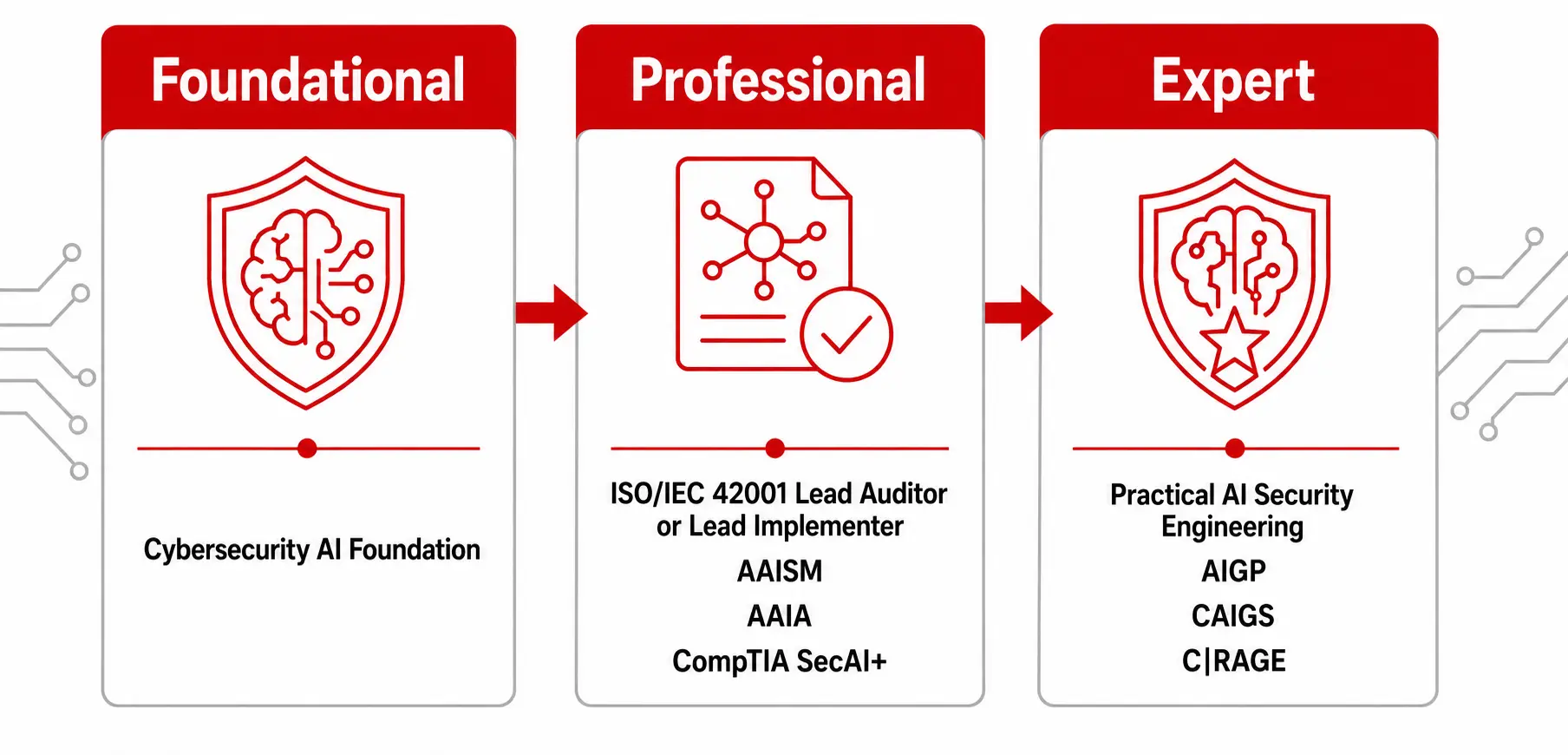
These stages indicate career-development progression within this roadmap. They are not official levels assigned by every certification provider. The programs are recommended options rather than a mandatory sequence.
Stage 1: Build Cybersecurity and AI Foundations
The foundational stage develops the common knowledge needed to understand how AI and cybersecurity intersect.
Cybersecurity AI Foundation
A foundational program should introduce:
- Artificial intelligence and machine learning
- Deep learning, NLP, and Generative AI
- LLMs, RAG, and AI agents
- AI development and deployment lifecycles
- Traditional cybersecurity principles
- AI assets and attack surfaces
- Data, model, application, and infrastructure risks
- Responsible and trustworthy AI
- AI risk and governance fundamentals
- Common AI security frameworks
- AI applications in security operations
Beginners should understand that AI security is not limited to protecting a model. An AI application can depend on datasets, APIs, cloud platforms, vector databases, plugins, identity systems, open-source packages, and third-party providers. Each dependency introduces additional risks.
Fundamental Knowledge to Develop
Before moving into a specialization, build familiarity with:
- Networking and operating systems
- Identity and access management
- Cloud security
- Application and API security
- Data protection and encryption
- Vulnerability management
- Logging and monitoring
- Incident response
- Python and scripting fundamentals
- AI and machine learning terminology
- Secure development principles
Practical Capabilities to Build
At the end of this stage, learners should be able to:
- Explain how an AI system works at a high level
- Identify major components of an AI application
- Map a basic AI data flow
- Recognize common AI security risks
- Distinguish predictive and Generative AI
- Explain prompt injection and data poisoning
- Identify sensitive data used by AI systems
- Prepare a simple AI asset inventory
- Document a basic AI threat model
- Use AI tools responsibly in security workflows
Suitable Starting Roles
Depending on previous experience, possible roles include:
- Junior AI Security Analyst
- AI Governance Analyst
- AI Risk Analyst
- Responsible AI Analyst
- Security Analyst working with AI tools
- Junior AI Compliance Analyst
- AI Assurance Associate
Stage 2: Develop Professional Expertise
At the professional stage, learners should choose a clearer direction: AI security, governance, management, audit, or implementation.
ISO/IEC 42001 Lead Implementer
The ISO/IEC 42001 Lead Implementer pathway is suited to professionals responsible for establishing and operating an Artificial Intelligence Management System. ISO/IEC 42001 specifies requirements for establishing, implementing, maintaining, and continually improving an AIMS. It addresses organizational policies, objectives, processes, responsibilities, risks, and opportunities related to the responsible development or use of AI.
A Lead Implementer should understand:
- Organizational AI context and scope
- AI policies and objectives
- Roles, responsibilities, and accountability
- AI risk and impact assessment
- AI system lifecycle controls
- Data governance
- Third-party AI oversight
- Monitoring and performance evaluation
- Corrective actions and continual improvement
This pathway is appropriate for AI Governance Professionals, GRC Specialists, Risk Managers, consultants, and those implementing an AIMS.
ISO/IEC 42001 Lead Auditor
The ISO/IEC 42001 Lead Auditor pathway focuses on assessing whether an AIMS is appropriately designed, implemented, and maintained.
Professionals should develop skills in:
- Audit planning and scoping
- Audit criteria and sampling
- Evidence collection
- Stakeholder interviews
- Control evaluation
- Audit findings and nonconformities
- Audit reporting
- Corrective-action follow-up
This pathway is more suitable for internal auditors, external auditors, assurance professionals, and consultants evaluating AI governance systems.
CompTIA SecAI+
CompTIA SecAI+ supports professionals who want vendor-neutral knowledge of cybersecurity and AI. It covers the intersection of protecting AI systems and applying AI within cybersecurity activities.
It may suit:
- Security Analysts
- Security Engineers
- SOC Professionals
- Vulnerability Analysts
- AI Security Specialists
- Cybersecurity Consultants
Learners should already have a general understanding of cybersecurity before pursuing specialized AI security topics. SecAI+ should be treated as a professional-stage option rather than a replacement for core security foundations.
AAISM: AI Security Management
ISACA’s Advanced in AI Security Management is intended for experienced security professionals responsible for managing AI-related security opportunities and risks.
AAISM is suitable for:
- Information Security Managers
- AI Security Managers
- CISOs and security leaders
- Enterprise Risk Professionals
- Security Program Managers
- Senior Security Consultants
Candidates must hold an active CISM or CISSP credential to qualify for AAISM certification. The pathway covers areas such as:
- AI governance and program oversight
- AI risk management
- AI security controls
- AI-enabled security operations
- Privacy, trust, and safety
- AI lifecycle security
- Management reporting and accountability
AAIA: AI Audit
ISACA’s Advanced in AI Audit is designed for experienced auditors who assess AI governance, development, deployment, operations, and controls. It is relevant for:
- IT Auditors
- Internal Auditors
- AI Assurance Professionals
- Audit Managers
- Technology Risk Consultants
Candidates must hold CISA or another qualifying audit or accounting designation. Some alternative designations require a focus on IT audit or IT advisory roles.
AAIA supports capabilities such as:
- Planning an AI audit
- Assessing AI governance and accountability
- Evaluating data and model controls
- Reviewing AI development processes
- Assessing testing and validation
- Evaluating monitoring and human oversight
- Collecting sufficient audit evidence
- Reporting AI-related findings
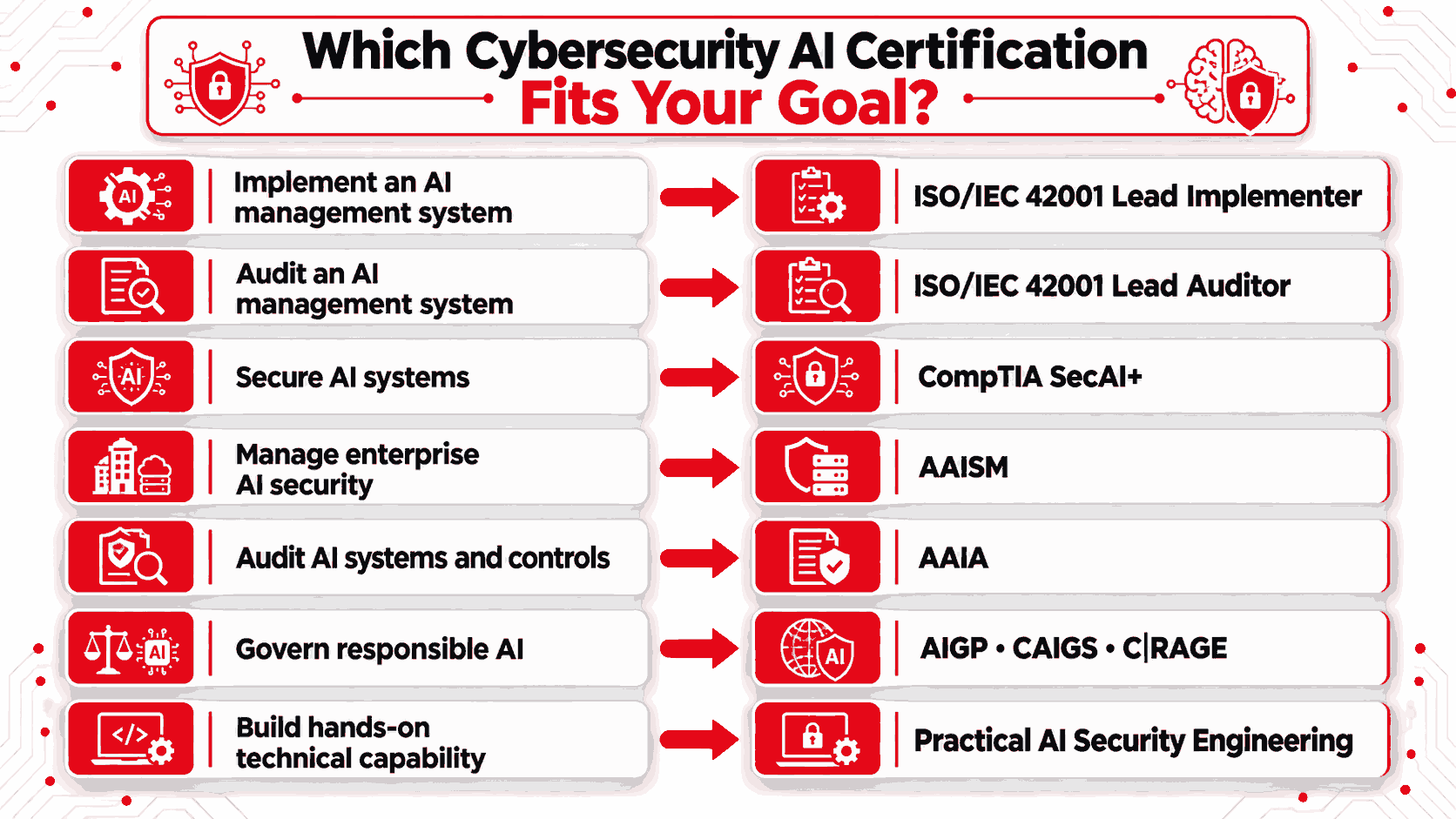
Selecting the Right Professional Pathway
| Career Objective | Recommended Direction |
| Implement an AI management system | ISO/IEC 42001 Lead Implementer |
| Audit an AI management system | ISO/IEC 42001 Lead Auditor |
| Secure AI and use AI in cybersecurity | CompTIA SecAI+ |
| Manage enterprise AI security | AAISM |
| Audit AI systems and controls | AAIA |
Professionals do not need to complete every option. Selection should depend on their current credentials, experience, and intended responsibilities.
Stage 3: Build Expert-Level Capability
Expert-stage professionals must move beyond awareness and certification preparation. They should be capable of designing, testing, governing, and improving enterprise AI systems.
Practical AI Security Engineering
Practical AI Security Engineering develops hands-on capability across the AI lifecycle. It should include:
- AI and ML threat modeling
- Adversarial machine learning
- Data poisoning and model manipulation
- Prompt injection and jailbreaking
- LLM and agentic AI security testing
- Guardrails and LLM gateways
- Secure MLOps and LLMOps pipelines
- Model and data access control
- AI supply-chain security
- AI incident response
- Model monitoring and logging
- Build–attack–defend exercises
This pathway is appropriate for Security Engineers, Application Security Professionals, AI/ML Engineers, DevSecOps Professionals, Red Teamers, and technical security architects.
AIGP: AI Governance
The Artificial Intelligence Governance Professional credential focuses on responsible AI governance and the safe, trustworthy development and deployment of AI systems.
IAPP positions AIGP for professionals responsible for understanding and executing AI governance across industries. It is relevant for:
- AI Governance Professionals
- Privacy and Legal Professionals
- Risk and Compliance Managers
- Responsible AI Specialists
- AI Program Managers
- Policy and Assurance Professionals
AIGP develops knowledge across AI foundations, AI impacts, responsible AI principles, laws, risk management, and governance throughout the AI lifecycle.
CAIGS: Practical AI Governance
Certified AI Governance Specialist Training builds practical capability for operationalizing AI governance. It is relevant for professionals who must translate principles, laws, and frameworks into organizational processes.
Important capabilities include:
- Establishing AI governance structures
- Developing AI policies
- Maintaining an AI inventory
- Classifying AI systems by risk
- Assigning ownership and accountability
- Conducting impact assessments
- Mapping regulations and frameworks
- Governing GenAI, LLMs, and RAG
- Monitoring AI risks and controls
- Preparing for AI audits
C|RAGE: Responsible AI Governance and Ethics
The Certified Responsible AI Governance & Ethics pathway focuses on enterprise AI governance, regulatory compliance, ethics, risk management, and audit readiness.
EC-Council positions C|RAGE around assessing governance maturity, implementing policies and controls, and sustaining oversight through continuous monitoring.
It may suit:
- GRC Professionals
- Data Protection Officers
- CISOs
- Internal Auditors
- AI Program Managers
- Responsible AI Leaders
- Compliance Professionals
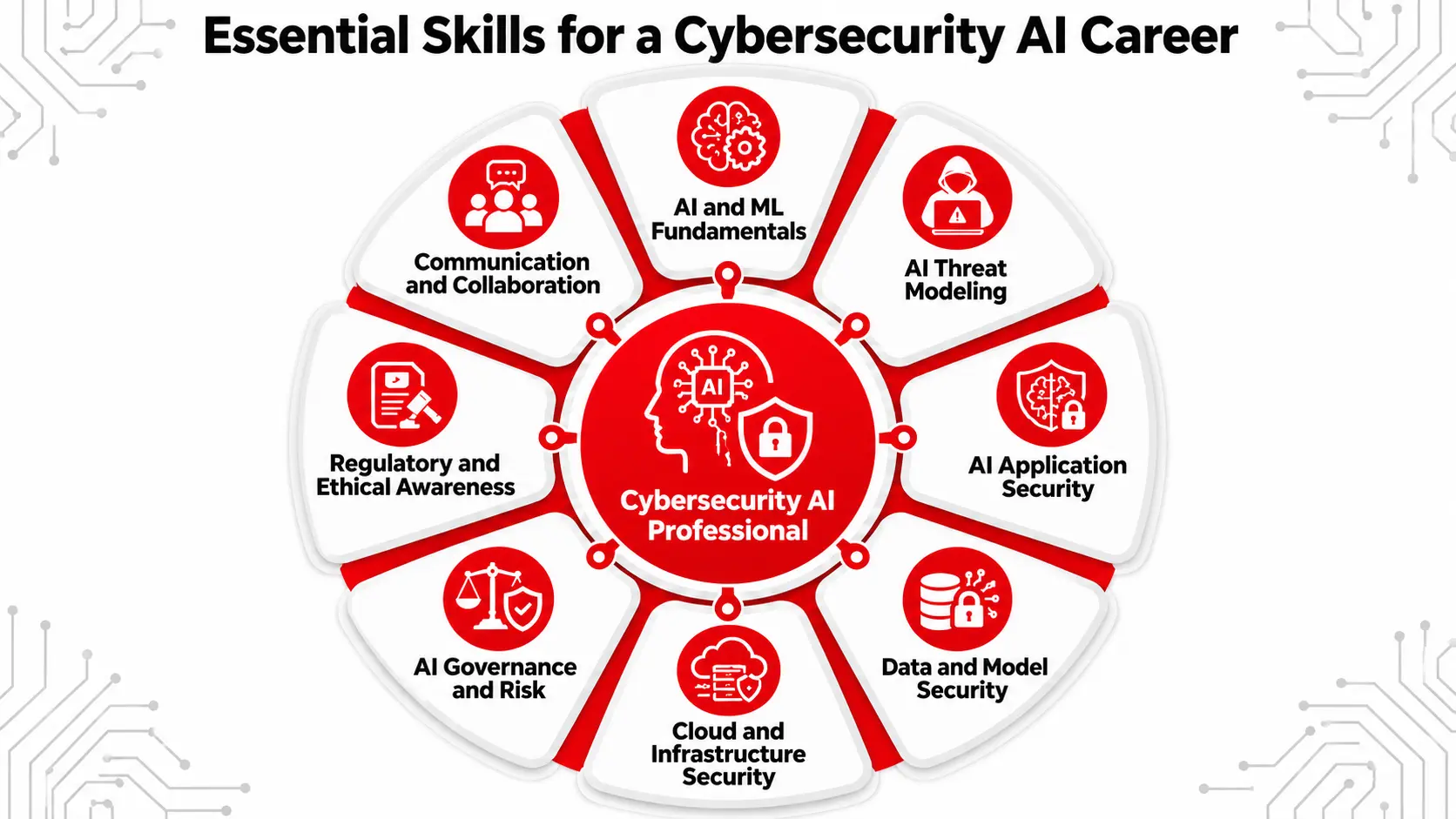
Skills for a Cybersecurity AI Career
1. AI and Machine Learning Fundamentals
Understand datasets, training, inference, models, embeddings, fine-tuning, RAG, LLMs, agents, evaluation, and model deployment.
2. AI Threat Modeling
Identify AI assets, trust boundaries, threat actors, attack surfaces, misuse scenarios, dependencies, controls, and residual risks.
3. AI Application Security
Understand API security, prompt handling, output validation, secrets management, access controls, plugin security, and secure integration.
4. Data and Model Security
Develop knowledge of data poisoning, model theft, model inversion, membership inference, training-data exposure, data lineage, and model integrity.
5. Cloud and Infrastructure Security
AI applications frequently depend on cloud platforms, containers, model endpoints, storage services, GPUs, vector databases, and third-party APIs.
6. AI Governance and Risk
Learn AI inventories, policies, accountability, risk classification, impact assessments, human oversight, and continuous monitoring.
The NIST AI RMF organizes AI risk-management activities around four functions: Govern, Map, Measure, and Manage. Governance operates across the other functions, and risk management should continue throughout the AI lifecycle.
7. Regulatory and Ethical Awareness
Professionals should understand how privacy, fairness, transparency, explainability, intellectual property, safety, and sector-specific requirements affect AI systems.
8.Communication and Collaboration
Cybersecurity AI professionals must communicate with engineers, data scientists, auditors, legal teams, privacy teams, business owners, and executives.
Career Opportunities in Cybersecurity AI
| Career Stage | Possible Roles |
| Entry Level | Junior AI Security Analyst, AI Governance Analyst, AI Risk Analyst |
| Professional | AI Security Analyst, AI Auditor, Responsible AI Specialist, AI Compliance Consultant |
| Technical Specialist | AI Security Engineer, ML Security Engineer, LLM Security Engineer, AI Red Teamer |
| Senior Level | Senior AI Security Engineer, AI Governance Lead, AI Audit Manager, AI Security Architect |
| Leadership | AI Security Manager, Head of AI Governance, Director of Responsible AI, Chief AI Security Officer |
Job titles are still evolving, and many responsibilities may appear under existing security, risk, audit, cloud, privacy, or engineering positions.
How to Gain Practical Experience
1. Build an AI Asset Inventory
Document the models, applications, datasets, APIs, vendors, owners, users, intended purposes, and risk classifications for a fictional organization.
2. Conduct an AI Threat Model
Select an LLM or RAG application and document:
- System components
- Data flows
- Trust boundaries
- Attack surfaces
- Abuse cases
- Existing controls
- Recommended mitigations
3. Test an LLM Application
In a controlled lab environment, evaluate prompt injection, exposure of sensitive information, insecure output handling, excessive permissions, and weak access controls.
4. Perform an AI Risk or Impact Assessment
Assess an AI use case for security, privacy, bias, transparency, human oversight, safety, and regulatory concerns.
5. Design Secure AI Architecture
Create a diagram showing:
- Authenticated users
- AI gateway
- Model endpoint
- Data sources
- Vector database
- Logging
- Guardrails
- Secrets management
- Human approval points
6. Create an AI Incident-Response Playbook
Define procedures for events such as model compromise, prompt injection, sensitive data exposure, poisoned knowledge sources, unauthorized agent actions, or stolen API credentials.
How to Start Your Cybersecurity AI Career
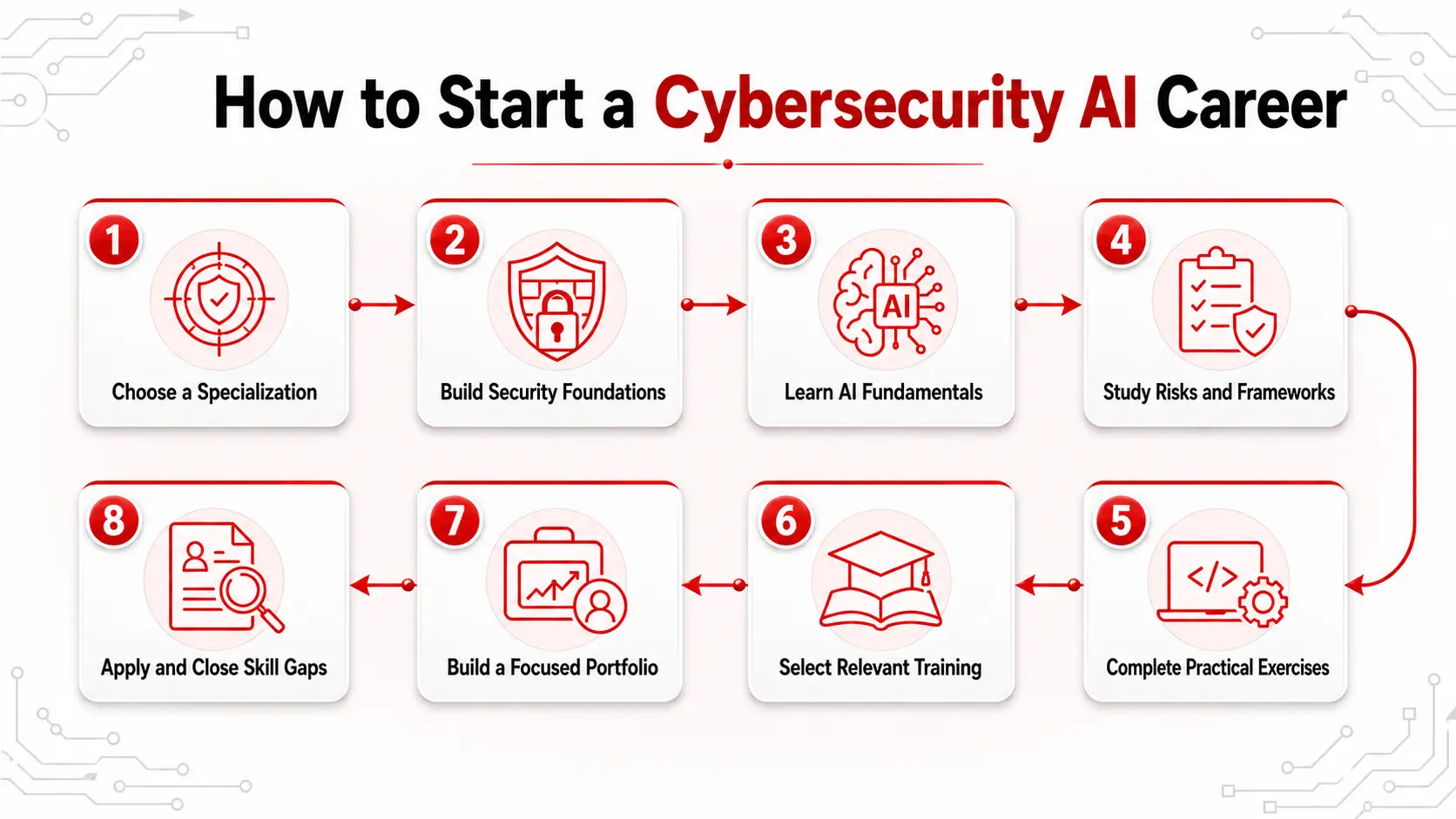
1. Choose a Specialization
Decide whether you are more interested in AI security engineering, AI governance, AI auditing, AI risk, red teaming, or AI-assisted security operations.
2. Build Cybersecurity Foundations
Learn networking, cloud, application security, identity, data protection, vulnerability management, and incident response.
3. Learn AI Fundamentals
Understand how models are trained, deployed, connected to data, and used within applications. Study LLMs, RAG, embeddings, agents, and MLOps at a practical level.
4. Study AI Risks and Frameworks
Explore NIST AI RMF, ISO/IEC 42001, OWASP guidance, AI threat modeling, responsible AI principles, and applicable regulatory requirements.
5. Complete Practical Exercises
Build AI inventories, threat models, impact assessments, risk registers, security assessments, architectures, and incident playbooks.
6. Select Relevant Training
Choose programs that align with your role and experience. Do not pursue advanced credentials such as AAISM or AAIA without checking their prerequisite requirements.
7. Build a Focused Portfolio
Show how you identify, assess, mitigate, govern, or audit AI risks. Explain the context, methodology, evidence, and recommendations behind each project.
8. Apply and Close Skill Gaps
Review AI security, governance, and audit job descriptions. Identify recurring requirements and strengthen the skills most relevant to your target role.
Common Mistakes to Avoid
- Entering AI security without cybersecurity foundations
- Treating AI security as prompt engineering
- Learning tools without understanding AI architecture
- Ignoring data, cloud, API, and supply-chain risks
- Studying governance without understanding the AI lifecycle
- Treating compliance as proof of security
- Pursuing advanced credentials without meeting prerequisites
- Building no practical evidence of capability
- Ignoring privacy, ethics, safety, and human oversight
- Testing AI systems without permission or defined scope
Conclusion
A Cybersecurity AI career begins with a strong understanding of both cybersecurity and AI systems. From there, professionals should choose a specialization and build practical capabilities that align with real responsibilities, whether securing AI applications, managing enterprise AI risk, conducting audits, or establishing responsible AI governance.
Career progression should move from foundations to role-specific expertise and, finally, to advanced capabilities in implementation, engineering, auditing, or leadership. Certifications can support this progression, but practical evidence, sound judgment, and cross-functional communication are what ultimately make a professional job-ready.
How InfosecTrain Can Support Your Cybersecurity AI Career
InfosecTrain offers foundational, certification-oriented, and hands-on learning across Cybersecurity AI, CompTIA SecAI+, ISO/IEC 42001, AAISM, AAIA, AIGP, CAIGS, C|RAGE, and Practical AI Security Engineering. Learners can select a pathway based on their existing experience, preferred specialization, and long-term career objective.
Frequently Asked Questions
Is Cybersecurity AI suitable for beginners?
Yes, but beginners should first build a foundation in cybersecurity and AI before moving into advanced security engineering, auditing, or governance.
Do AI Security Professionals need coding skills?
Technical AI security roles typically benefit from knowledge of Python, APIs, scripting, and cloud services. Governance, risk, and audit roles may require less coding but still need technical awareness.
Which certification should I choose first?
It depends on your role. SecAI+ supports broader AI security; ISO/IEC 42001 supports AIMS implementation or auditing; AAISM supports experienced security managers; and AAIA supports qualified auditors.
What is the difference between AI security and AI governance?
AI security protects systems, models, data, applications, and infrastructure. AI governance establishes accountability, policies, risk oversight, compliance, and responsible-use requirements.
Are certifications enough to secure a job?
No. Certifications should be supported by practical projects such as threat models, security assessments, AI risk registers, impact assessments, architectures, and audit checklists.
Can GRC or audit professionals move into this field?
Yes. GRC Professionals can transition into AI risk and governance, while qualified auditors can specialize in AI assurance and auditing.
Is AI red teaming part of Cybersecurity AI?
Yes. AI red teaming tests models, LLM applications, agents, data flows, and integrations for security, safety, and misuse risks within an authorized scope.