AI for CVE Analysis: Simplifying Vulnerabilities for Security Analysts
Quick Insights:
AI helps Security Analysts simplify CVE analysis by converting complex vulnerability data into clear, prioritized, and actionable insights. It can summarize CVEs, correlate vulnerabilities with internal assets, support threat intelligence mapping, generate remediation guidance, assist with detection queries, and improve reporting. However, AI should not replace human judgment. Analysts must validate AI-generated outputs using trusted sources, asset context, vendor documentation, and real-world business risk before taking action.
Every day, security teams face a familiar problem: too many vulnerabilities, too little time, and not enough clarity on what truly matters. A new CVE appears. Then another. Then hundreds more. Some are theoretical. Some are actively exploited. Some affect critical assets. Some look scary on paper but may not pose an immediate risk to your environment. For a SOC Analyst or Vulnerability Management Team, the real challenge is not just reading CVEs. It is understanding which ones matter, why they matter, and what action should be taken first.
This is where Artificial Intelligence is transforming CVE analysis. AI is helping Security Analysts move from manual CVE reading to faster, smarter, context-aware vulnerability analysis. Instead of spending hours decoding technical advisories, comparing exploit data, checking asset exposure, and preparing reports, analysts can use AI to summarize, prioritize, correlate, and recommend next steps. AI reduces the noise so analysts can focus on judgment, validation, and response.
What is CVE Analysis?
CVE analysis is the process of understanding a publicly disclosed vulnerability and assessing its impact on an organization. A CVE record provides a unique identifier, but analysts need additional context to assess the severity of the risk.
A Security Analyst typically checks:
- What product or version is affected?
- Is the vulnerability remotely exploitable?
- Is exploit code publicly available?
- Is it being actively exploited?
- Does it affect any internet-facing system?
- What is the business impact?
- What patch, workaround, or mitigation is available?
- How urgently should the team respond?
Traditional CVE analysis involves reviewing vendor advisories, NVD data, exploit databases, threat intelligence, asset inventory, scanner results, and internal logs. This can be slow, repetitive, and error-prone in large environments.
AI helps simplify CVE analysis by improving speed, correlation, and contextual understanding in vulnerability management workflows.
Why Traditional CVE Analysis is Difficult for SOC Teams
SOC teams already handle alert triage, log analysis, incident response, threat hunting, and reporting. Adding high-volume CVE analysis to the workflow can quickly overwhelm analysts. The main challenges include:
1. CVE Overload
Thousands of vulnerabilities are disclosed every year, but not all are urgent. Without smart filtering, teams may spend time on low-impact CVEs.
2. Technical Complexity
CVE descriptions often include complex technical terms, attack vectors, privilege requirements, exploit conditions, and mitigation steps that require deeper analysis.
3. Lack of Business Context
A high-severity CVE may not be critical if the affected system is isolated or unused, while a medium-risk CVE on an internet-facing system may be urgent.
4. Manual Correlation
Analysts must connect CVE data with asset inventory, SIEM alerts, EDR logs, cloud assets, firewall logs, and threat intelligence, which slows response.
5. Reporting Pressure
SOC and vulnerability teams must clearly explain technical risks to IT, leadership, compliance, and business teams, which adds to their workload.
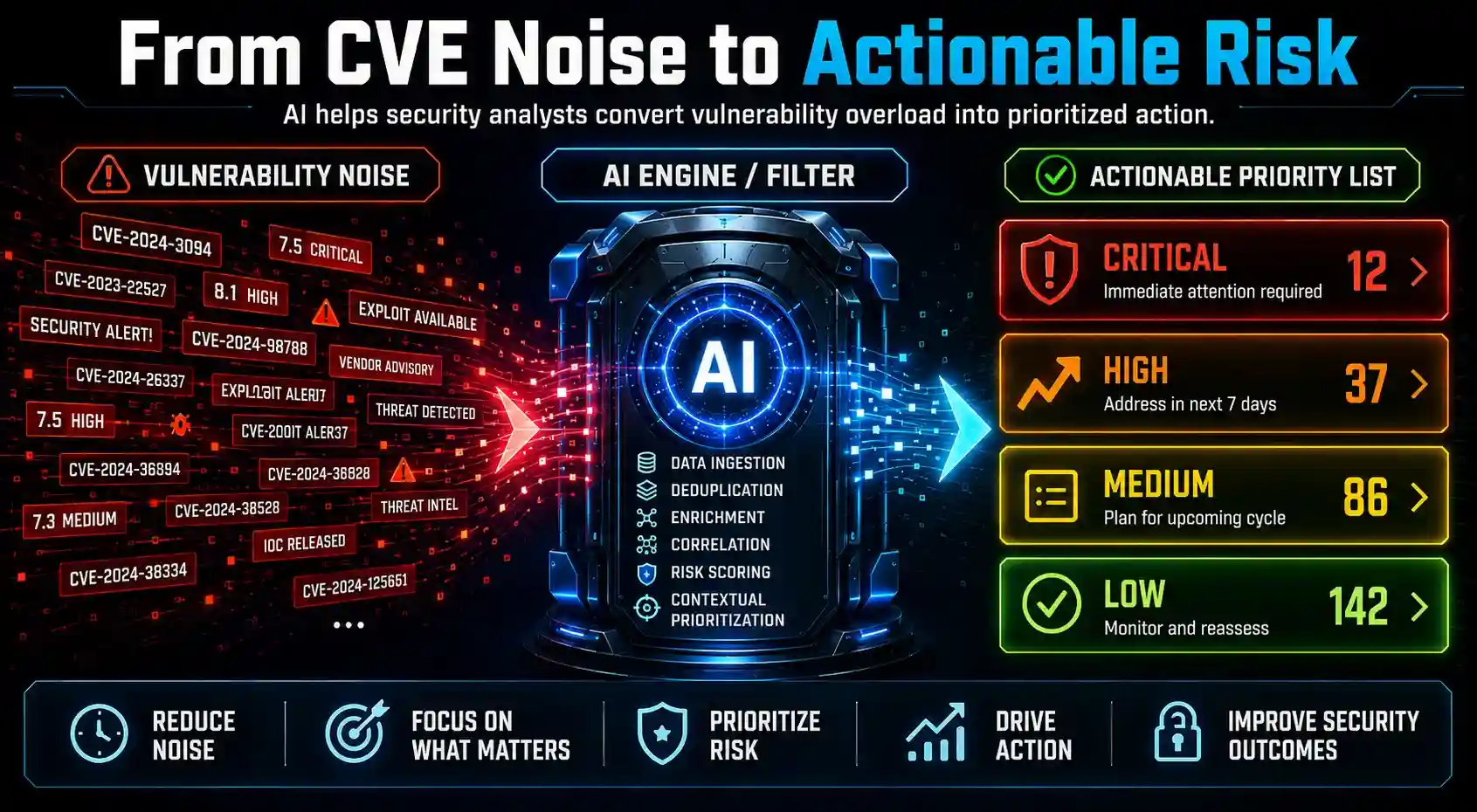
AI can help address these pain points by converting raw vulnerability data into actionable security intelligence.
AI may hallucinate, miss context, or overstate risk, so every output should be verified with trusted sources.
How AI Enhances CVE Analysis
AI improves CVE analysis by making vulnerability data easier to understand, prioritize, and act upon.
1. AI Summarizes Complex CVEs in Plain Language
One of the most useful applications of AI in CVE analysis is summarization. Large Language Models (LLMs) can take a complex CVE description and convert it into a simple, analyst-friendly summary.
For example, instead of reading a long technical advisory, an analyst can quickly understand the vulnerability, affected systems, exploit method, impact, and next steps.
2. AI Helps Prioritize Vulnerabilities Based on Risk
Not every critical CVE deserves the same urgency. AI can combine multiple signals, such as CVSS, EPSS, CISA KEV, exploit availability, threat actor activity, internet exposure, asset criticality, business functions, security controls, and patch availability, to identify which vulnerabilities need urgent attention.
3. AI Correlates CVEs with Internal Assets
A CVE only matters if it affects something in your environment. AI can match CVEs with asset inventory, software versions, cloud workloads, endpoints, containers, and applications to show whether the vulnerability actually affects the organization.
4. AI Improves Threat Intelligence Mapping
AI can connect CVEs with exploit chatter, threat actor activity, malware campaigns, indicators of compromise, advisories, and related attack techniques. This helps to understand whether a vulnerability is being discussed, weaponized, or exploited by attackers.
5. AI Supports Faster Alert Triage
Sometimes, a vulnerability is not just a vulnerability management issue. It becomes a SOC investigation. For actively exploited CVEs, AI can summarize SIEM alerts, identify suspicious patterns, suggest log sources, generate investigation queries, recommend containment steps, and draft incident summaries.
6. AI Generates Actionable Remediation Guidance
AI can help generate patch recommendations, temporary mitigations, configuration changes, detection logic, compensating controls, business-friendly risk summaries, and priority-based remediation plans.
7. AI Makes CVE Reporting Easier
Reporting is a major part of vulnerability management. AI can create different CVE summaries like a technical summary for SOC Teams, a remediation note for IT Teams, a risk explanation for Leadership, a compliance-focused summary for Auditors, and an executive brief for CISOs, making communication faster and more effective. This improves communication and reduces confusion.
Practical Methodologies: How Security Analysts Can Use AI for CVE Analysis
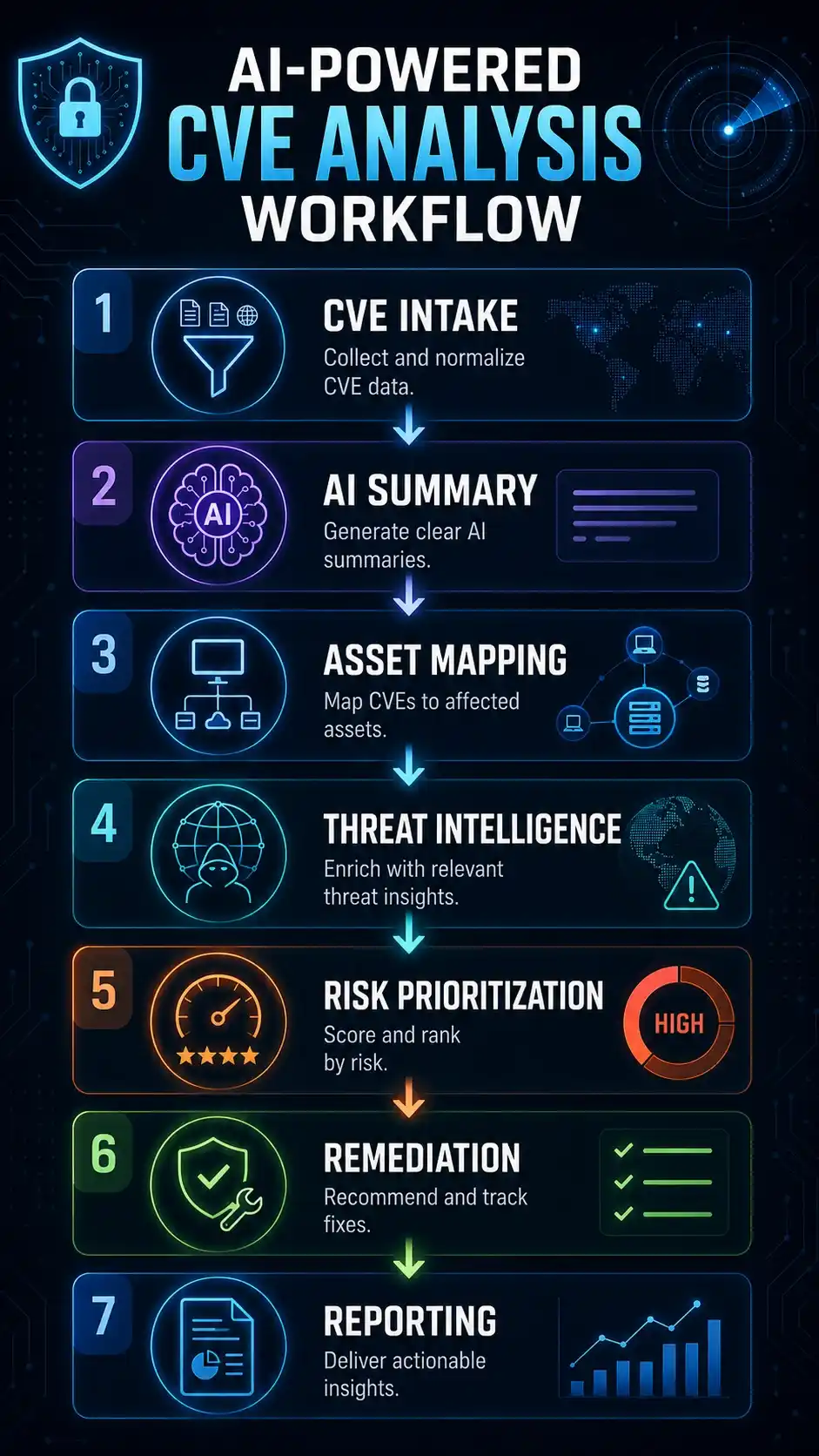
While AI can support multiple parts of CVE analysis, its real value comes when analysts use it within a structured and validated workflow. The following methodology shows how security teams can apply AI in practice, without blindly relying on it.
Step 1: Collect CVE Data from Trusted Sources
Start with trusted sources such as CVE records, NVD, vendor advisories, CISA KEV, EPSS, vulnerability scanners, and threat intelligence platforms. AI should not rely on random internet summaries alone. The quality of AI output depends heavily on the quality of input data.
Step 2: Generate a Plain-Language CVE Summary
Use AI to summarize the vulnerability in a simple format:
- Vulnerability name
- Affected products
- Attack method
- Impact
- Exploitation status
- Recommended action
This gives a quick understanding before a deeper investigation.
Step 3: Add Environmental Context
Check whether the affected product exists in your environment, whether the vulnerable version is present, if the asset is critical or internet-facing, whether related alerts exist, and if immediate patching is possible. This helps AI move beyond generic scoring to organization-specific risk.
Step 4: Prioritize Based on Real Risk
A strong AI-assisted prioritization model should consider severity, exploitability, exposure, asset value, and business impact. A simple priority logic may look like this:
- Critical Priority: Actively exploited, internet-facing, critical asset
- High Priority: Exploit available, important system, limited controls
- Medium Priority: No known exploitation, internal system, patch available
- Low Priority: Not applicable, no affected asset, or strong controls in place
This makes remediation more practical and defensible.
Step 5: Create Detection and Hunting Queries
For high-risk CVEs, AI can help generate detection ideas, SIEM queries, Sigma-like logic, or investigation checklists. Analysts can use it to identify relevant logs, indicators, suspicious behavior, endpoint activity, and network traffic patterns linked to exploitation.
Step 6: Validate AI Output Before Action
AI can speed up CVE analysis, but it should never be the final authority. Analysts must validate AI-generated summaries, remediation steps, and detection logic against trusted sources.
AI can hallucinate, miss context, or overstate risk. Human validation is essential, especially when dealing with production systems, critical infrastructure, regulatory exposure, or active incidents.
Where AI Should Not Be Blindly Trusted
AI is powerful, but it is not perfect. Security teams should be careful in the following areas:
- Patch Recommendations: Always verify patch availability and compatibility with vendor documentation.
- Exploit Claims: Do not assume exploitation is confirmed unless validated through trusted intelligence sources.
- Asset Matching: AI may misread product names or versions. Validate affected assets through scanners, CMDB, EDR, or asset management tools.
- Detection Logic: AI-generated detection rules should be tested before deployment to avoid false positives or missed detections.
- Business Risk: AI can assist with risk scoring, but business context should come from security leaders, system owners, and risk teams.
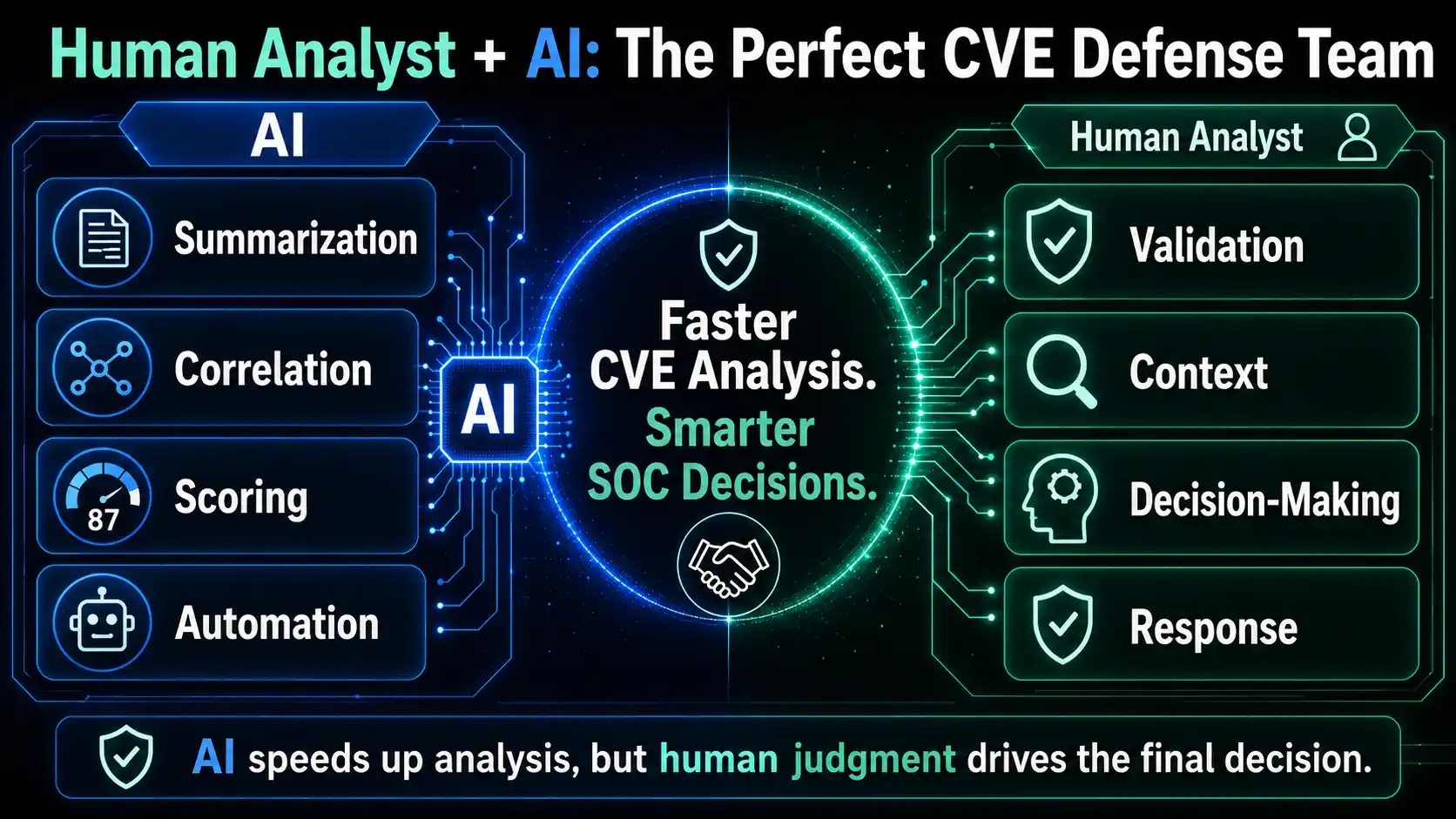
The best approach is human-led, AI-assisted CVE analysis.
In Conclusion
AI for CVE analysis is not about replacing human analysts. It is about making vulnerability intelligence faster, clearer, and more actionable. Security Analysts still need to ask the right questions, validate the data, understand the environment, and make risk-based decisions. But with AI, they can cut through the noise, prioritize more effectively, and respond faster. In a world where vulnerabilities are growing and attackers are moving faster, AI-assisted CVE analysis is becoming a must-have capability for modern SOC teams.
Build AI-Powered SOC Skills with InfosecTrain
Modern SOC teams need analysts who can do more than monitor alerts. They need professionals who can use AI to analyze logs, prioritize threats, investigate incidents, and simplify complex security data.
InfosecTrain’s Advanced AI SOC Analyst Certification Training course is designed to equip learners with practical, job-ready skills for the future of security operations. Through expert-led training and hands-on learning, you can understand how AI supports SOC workflows, threat detection, alert triage, vulnerability analysis, and incident response.

TRAINING CALENDAR of Upcoming Batches For SOC Analyst Training
| Start Date | End Date | Start - End Time | Batch Type | Training Mode | Batch Status | |
|---|---|---|---|---|---|---|
| 29-Nov-2026 | 23-Jan-2027 | 19:00 - 23:00 IST | Weekend | Online | [ Open ] | |
| 23-Jan-2027 | 07-Mar-2027 | 09:00 - 13:00 IST | Weekend | Online | [ Open ] | |
| 20-Mar-2027 | 02-May-2027 | 19:00 - 23:00 IST | Weekend | Online | [ Open ] |
Frequently Asked Questions
How can AI help in CVE analysis?
AI can summarize CVE details, identify affected products, support risk prioritization, and help create detection or hunting queries.
Can AI replace Security Analysts in CVE analysis?
No. AI can speed up analysis, but analysts must validate its output before taking action.
How can AI improve vulnerability prioritization?
AI can combine severity, exploitability, asset value, exposure, and business impact to support more practical prioritization.
Can AI generate detection queries for CVEs?
Yes. AI can help create SIEM queries, Sigma-like logic, investigation steps, and threat-hunting ideas for high-risk CVEs.
Is the CVSS score enough to prioritize CVEs?
No. CVSS is useful, but analysts should also consider exploit activity, asset exposure, business impact, and compensating controls.
What risks should Security Teams consider when using AI for CVE analysis?
AI may hallucinate, miss context, or overstate risk, so every output should be verified with trusted sources.