What IT Auditors Should Know About ISO 27001, ISO 22301, and ISO 42001?
Quick Insights:
Modern IT auditing relies on three essential pillars to ensure a secure and resilient enterprise. ISO 27001 serves as the foundation for Information Security, focusing on a risk-based approach to protect data through organizational and technological controls. ISO 22301 serves as the Safety Net, prioritizing business continuity by auditing recovery deadlines such as RTO and RPO to ensure survival during blackouts. Finally, ISO 42001 represents the New Frontier, governing Artificial Intelligence to prevent algorithmic bias, model drift, and hallucinations. Together, these standards allow auditors to verify that an organization is not only secure but also unstoppable and ethically sound.
In a rapidly evolving digital landscape, the modern IT auditor stands at the intersection of three critical pillars: security, survival, and silicon intelligence. The foundation begins with ISO 27001, acting as a digital vault to ensure sensitive data remains locked away from prying eyes; however, no vault is invincible.
ISO 22301 provides the resilience blueprints needed to keep operations running even during a total system blackout as organizations embrace the power of Artificial Intelligence.
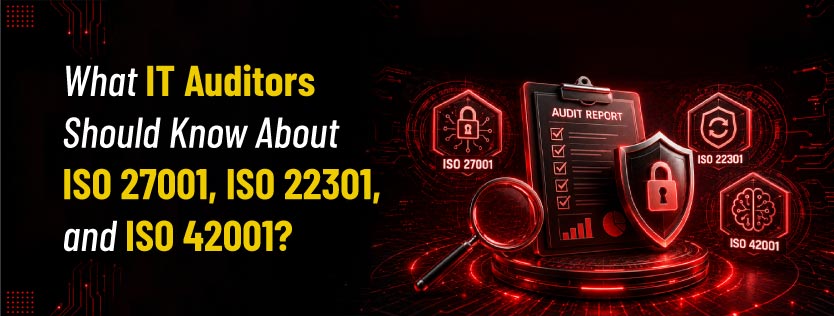
ISO 42001 enters as the essential ethical compass, preventing advanced machines from drifting into biased or uncontrollable territory. To be effective, an auditor must master this Triple Crown, transforming a chaotic sea of data into a secure, unstoppable, and trustworthy enterprise.
Why These Standards Matter for IT Auditors
These three ISO standards address some of the most essential domains in today’s digital ecosystem:
- ISO 27001 → Information Security Management
- ISO 22301 → Business Continuity Management
- ISO 42001 → AI Management Systems and Responsible AI
IT auditors must understand how these systems work, how they integrate, and how to evaluate their effectiveness across people, processes, and technology.
What IT Auditors Should Know About ISO 27001, 22301, and 42001?
ISO/IEC 27001: The Foundation (Information Security)
As an auditor, you are verifying the Information Security Management System (ISMS). This is the brain that tells the organization how to protect its crown jewels.
- Risk-Based Approach: You are auditing the Risk Treatment Plan. You must verify that for every High risk identified (like a data breach or insider threat), there is a corresponding technical control. If a risk is accepted without mitigation, you must see a formal sign-off from senior management.
- The Four Control Themes: Organizational: Focus on Threat Intelligence. Does the company have a process to stay ahead of new hacking trends, or are they just reacting to old ones?
- People: Audit the Onboarding/Offboarding process. Are system permissions actually revoked the moment an employee leaves?
- Physical: Audit Secure Disposal. How are old hard drives and sensitive documents destroyed? Look for certificates of destruction.
- Technological: Audit Vulnerability Management. Don’t just look for a scan; look for the Remediation. If a critical flaw was found 6 months ago and remains unpatched, the ISMS is failing.
- The SoA (Statement of Applicability): This is your master list. You must verify that the organization has a valid reason for every control they claim is Not Applicable.
ISO 22301: The Safety Net (Business Continuity)
This standard is not about security; it’s about Availability. It ensures the business can function even when the IT systems are down.
- BIA (Business Impact Analysis): This is the core of the audit. You must verify the Priority List.
- MTPD (Maximum Tolerable Period of Disruption): The Survival Limit. If a business process (like Payroll) cannot be down for more than 24 hours, but the IT recovery plan takes 48 hours, that is a major audit finding.
- Recovery Objectives:
- RTO (Recovery Time Objective): The Deadline. How quickly can IT get the app back online?
- RPO (Recovery Point Objective): The Data Loss Gap. How much work are they willing to re-enter manually? If the RPO is 1 hour, you must verify that backups occur at least once per hour.
- Testing & Exercising: An auditor must see Evidence of Failure. A perfect test result is suspicious. You want to see the “Lessons Learned” report where the team identified a problem during a drill and updated the plan to fix it.
ISO/IEC 42001: The New Frontier (AI Management)
This is the newest standard for managing Artificial Intelligence Management Systems (AIMS). It addresses risks that traditional security standards often miss.
- Algorithmic Transparency: You are auditing data quality. How does the organization ensure the data used to train the AI is not biased? Look for a Data Lineage document that tracks the sources of information.
- System Integrity: Audit the Monitoring of Model Drift. AI is not static; it changes as it learns. You must see logs showing that the AI is being tested regularly to ensure it has not become less accurate or started hallucinating (making things up).
- Ethics & Governance: Human-in-the-loop: Audit the Overhead/Manual Override. If the AI decides that a customer dispute is valid, is there a clear path for a human to review and change that decision?
- AI Risk Assessment: Look for Adversarial Risk Testing. Has the company tried to break their own AI using techniques like prompt injection to see if it reveals sensitive data?
Conclusion: The Path Forward for IT Auditors
To thrive in today’s regulated digital landscape, auditors must transition from checking boxes to evaluating integrated ecosystems.
- Master the Triple Crown: ISO 27001, 22301, and 42001 are now essential for securing data, ensuring resilience, and governing AI responsibly.
- Bridge the Technical Gap: Move beyond policy review to evaluate practical implementations like access management, incident handling, and SOC 2 readiness.
- Focus on Real-World Resilience: Use BIAs and AI Impact Assessments to ensure paper plans match actual technical recovery capabilities.
- Upskill Professionally: Specialized programs, such as InfosecTrain’s Certified GRC Auditor Training provide the hands-on skills needed for master control testing and professional reporting.
- Drive Strategic Value: Strong GRC practices protect an organization’s reputation and provide the confidence needed to adopt cutting-edge technologies.

TRAINING CALENDAR of Upcoming Batches For GRC Auditor Training
| Start Date | End Date | Start - End Time | Batch Type | Training Mode | Batch Status | |
|---|---|---|---|---|---|---|
| 30-Jan-2027 | 28-Feb-2027 | 19:00 - 23:00 IST | Weekend | Online | [ Open ] |
Frequently Asked Questions
What is the most critical document to review during an ISO 27001 audit?
The Statement of Applicability (SoA) is the master list. It outlines the security controls the organization has implemented and, more importantly, justifies any controls it has labeled Not Applicable.
In ISO 22301, what is the difference between RTO and RPO?
RTO (Recovery Time Objective) is the deadline for how quickly a system must be back online after a failure. RPO (Recovery Point Objective) is the data loss window, defining how much data (e.g., 1 hour of work) the business can tolerate losing.
Why is a perfect test result in Business Continuity (ISO 22301) often a red flag?
Auditors look for Lessons Learned. Real-world recovery is messy; a perfect test result often suggests the drill was not rigorous enough. Auditors prefer to see identified failures that led to updated, improved recovery plans.
How does auditing AI (ISO 42001) differ from traditional IT auditing?
Traditional auditing focuses on static systems, while AI auditing must account for Model Drift. Because AI changes as it learns, auditors must verify that the system is being continuously monitored to ensure it remains accurate and has not started hallucinating or exhibiting bias.
What is Human-in-the-loop in the context of ISO 42001?
It is a governance requirement ensuring that a human can review and override AI decisions. An auditor checks for a clear manual path to change an AI’s output, ensuring that automated machines do not have unchecked authority over critical business decisions.