GRC Career Roadmap: A Complete Guide from Beginner to Expert
Quick Insights:
A GRC career can begin with foundational knowledge of information security, risk management, controls, and ISO/IEC 27001. Professionals can then specialize in auditing, security management, risk and controls, compliance, third-party risk, or security architecture. Certifications such as CISSP, CISM, CISA, and CRISC support different responsibilities and should be selected according to the target role. At the expert stage, professionals need hands-on capabilities in implementation, leadership, architecture, reporting, and decision-making.
Governance, Risk, and Compliance (GRC) connects cybersecurity with business objectives, regulatory obligations, and organizational decision-making. GRC professionals help organizations define security policies, assess risks, evaluate controls, prepare for audits, manage third-party exposure, and communicate security concerns to management.
A successful GRC career requires more than learning frameworks or collecting certifications. Professionals must understand how organizations operate, interpret technical and regulatory requirements, evaluate evidence, and convert security risks into clear business decisions.
What Is GRC in Cybersecurity?
GRC stands for:
- Governance: Establishing direction, accountability, policies, and oversight for information security.
- Risk: Identifying, assessing, treating, monitoring, and communicating risks.
- Compliance: Meeting legal, regulatory, contractual, policy, and framework-based requirements.
GRC helps organizations manage security systematically rather than responding to each issue individually. It connects business objectives with policies, risks, controls, audits, technologies, and management responsibilities.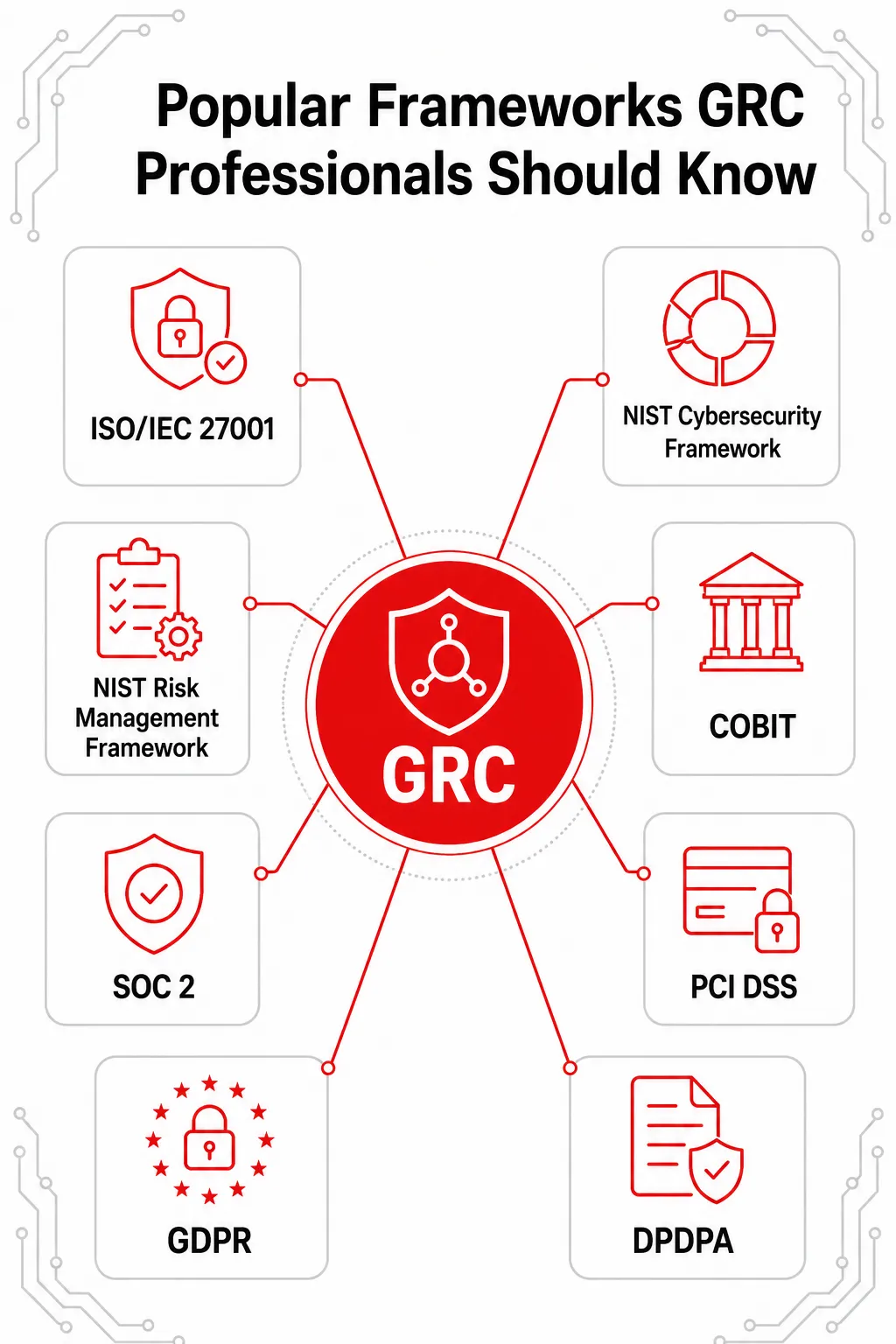
What Does a GRC Professional Do?
Responsibilities vary according to the organization and role, but commonly include:
- Conducting information security risk assessments
- Developing and reviewing security policies
- Maintaining risk and control registers
- Mapping controls across multiple frameworks
- Collecting and evaluating audit evidence
- Performing control-gap assessments
- Supporting internal and external audits
- Assessing third-party and vendor risks
- Monitoring regulatory and contractual obligations
- Tracking risk-treatment and remediation plans
- Preparing security metrics and dashboards
- Reporting risks to management
- Supporting business continuity and resilience
- Coordinating with technical, legal, privacy, and business teams
GRC professionals do not necessarily configure security tools or perform penetration tests. However, they need enough technical knowledge to understand systems, question control owners, evaluate evidence, and identify ineffective controls.
Who Should Consider a GRC Career?
GRC may suit professionals who enjoy:
- Understanding business processes
- Evaluating risks and controls
- Working with policies and frameworks
- Reviewing documentation and evidence
- Communicating with different stakeholders
- Writing structured reports
- Translating technical issues into business impact
- Supporting audits and management decisions
People commonly transition into GRC from:
- Information technology
- Cybersecurity operations
- Internal or external auditing
- Legal and regulatory compliance
- Finance and accounting
- Risk management
- Data privacy
- Quality management
- Business operations
A technical degree is not mandatory for every GRC role. However, foundational knowledge of networks, systems, cloud services, access control, data protection, vulnerabilities, and security operations remains valuable.
GRC Learning Path
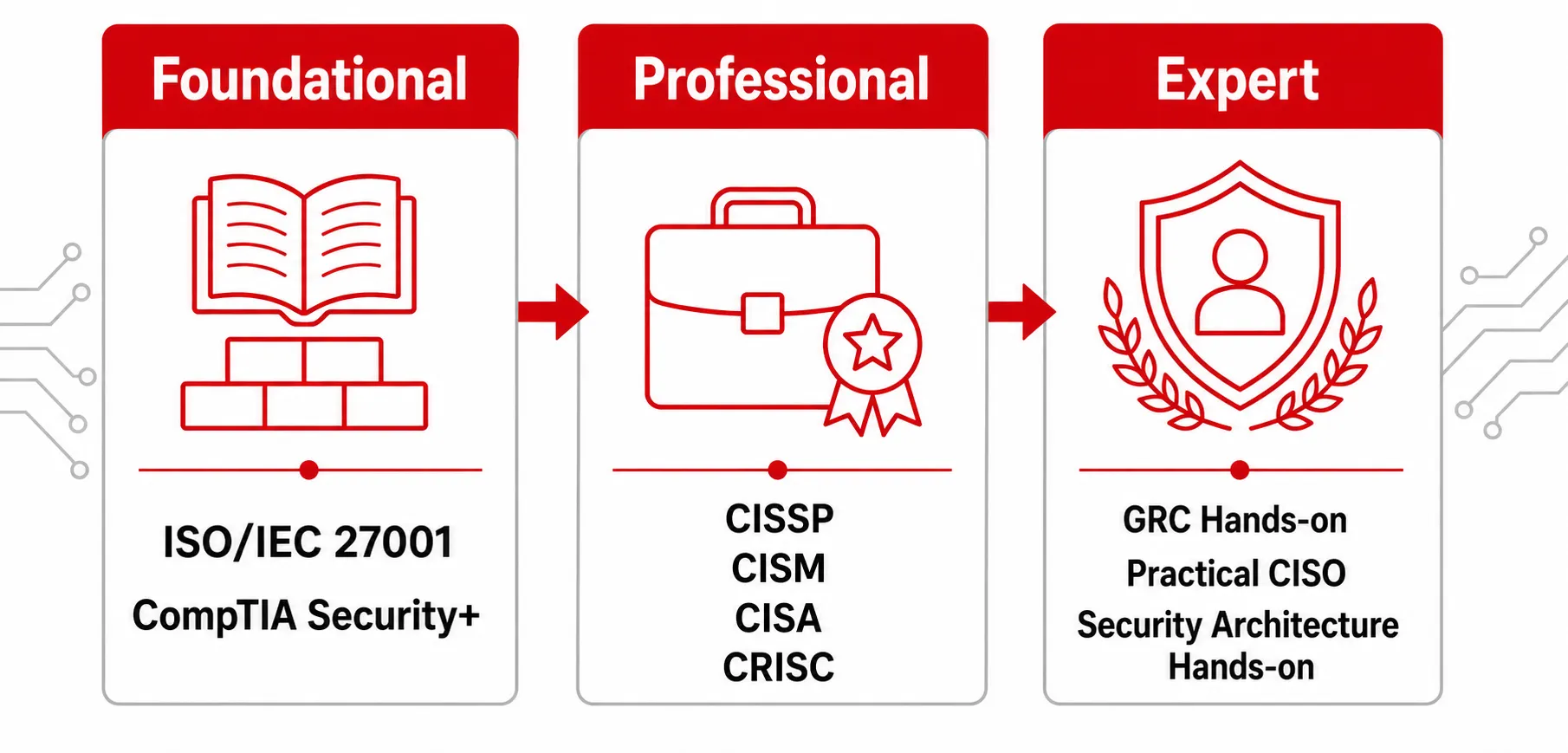 These stages represent career-development levels, not official classifications assigned by certification providers. The programs are recommended options rather than a mandatory sequence.
Stage 1: Build GRC Foundations
The foundational stage should establish a working understanding of cybersecurity, risk, governance, controls, and compliance.
ISO/IEC 27001
ISO/IEC 27001 provides a strong starting point for understanding how organizations establish, implement, maintain, and improve an Information Security Management System (ISMS). It also introduces risk assessment, risk treatment, governance responsibilities, documented information, performance evaluation, and continual improvement.
ISO describes ISO/IEC 27001:2022 as the best-known standard for Information Security Management Systems. It defines ISMS requirements and employs a risk management process tailored to the organization. At this stage, learners should understand:
- ISMS scope and context
- Interested parties and requirements
- Information security policies
- Risk assessment and treatment
- Statement of Applicability
- Security objectives
- Internal audits
- Management reviews
- Corrective actions
- Continual improvement
CompTIA Security+
Security+ can help GRC learners develop broader cybersecurity awareness. It introduces threats, vulnerabilities, architecture, identity, security operations, risk, governance, and incident response. A GRC professional does not need to become an expert administrator or security engineer. However, this knowledge makes it easier to evaluate controls, interpret technical evidence, and communicate with security teams.
Practical capabilities to build
By the end of the foundational stage, learners should be able to:
- Explain governance, risk, control, and compliance
- Identify common information assets and threats
- Prepare a basic risk register
- Differentiate policies, standards, procedures, and guidelines
- Understand control design and operating effectiveness
- Map a requirement to a security control
- Review simple audit evidence
- Write a basic security policy
- Explain technical findings in business language
Suitable Starting Roles
Potential entry-level roles include:
- GRC Intern
- Junior GRC Analyst
- Compliance Analyst
- IT Risk Analyst
- Information Security Coordinator
- Third-Party Risk Analyst
- IT Audit Associate
- ISMS Coordinator
Stage 2: Develop Professional GRC Expertise
The professional stage is where learners should select a role-specific direction. CISSP, CISM, CISA, and CRISC address different responsibilities; professionals do not need to earn all four.
CISSP: Broad Security and Risk Leadership
CISSP supports professionals who need broad knowledge across security and risk management, asset security, architecture, networks, identity, assessment, operations, and software security. It is suitable for professionals progressing toward:
- Senior security consulting
- Security management
- Security architecture
- Enterprise risk oversight
- Security leadership
CISSP requires five years of cumulative professional experience across at least two of its eight domains, although certain education or approved credentials may satisfy up to one year. Candidates without the required experience can explore the ISC2 Associate pathway after passing the examination.
CISM: Information Security Management
CISM is aligned with professionals who manage security governance, risk, and programs, as well as incidents. It is relevant for those responsible for aligning security activities with organizational objectives. It may support roles such as:
- Information Security Manager
- GRC Manager
- Security Program Manager
- Cybersecurity Governance Lead
- Information Security Consultant
ISACA currently requires five or more years of relevant professional experience across at least three CISM domains for certification. Passing the examination alone does not provide the full credential.
CISA: Audit and Assurance
CISA is suited to professionals who assess information systems, controls, governance, operations, acquisition, development, implementation, and protection of information assets. It is particularly relevant for:
- Information Systems Auditors
- IT Audit Consultants
- Internal Auditors
- Control Assurance Professionals
- Compliance Assessors
CISA Certification requires 5 or more years of professional experience in information systems auditing, control, or security, subject to ISACA’s requirements. Candidates can take the examination before meeting the full experience requirement.
CRISC: Risk and Information Systems Controls
CRISC focuses on identifying and assessing IT risk, responding to risk, monitoring risk, and designing or evaluating controls. It is relevant for:
- IT Risk Analysts
- Technology Risk Consultants
- Risk Managers
- Control Specialists
- Third-Party Risk Professionals
CRISC certification currently requires at least 3 years of relevant experience in at least 2 CRISC domains.
How to Select the Right Professional Certification
| Career Objective | Most Relevant Option |
| Broad cybersecurity leadership | CISSP |
| Information security management | CISM |
| IT audit and assurance | CISA |
| Technology risk and controls | CRISC |
Certification selection should follow the target role. Avoid pursuing several credentials before developing the experience and practical capability they are intended to validate.
Stage 3: Build Expert-Level Capability
Expert-level GRC professionals move beyond understanding frameworks and performing assigned assessments. They design programs, advise executives, resolve conflicts, lead audits, guide risk decisions, and connect governance requirements with technical architecture.
Recommended Learning Options
GRC Hands-on
Hands-on GRC Training should help professionals perform activities such as:
- Creating organizational risk registers
- Conducting control-gap assessments
- Writing policies and procedures
- Mapping multiple frameworks
- Planning internal audits
- Reviewing audit evidence
- Assessing third parties
- Developing risk-treatment plans
- Tracking corrective actions
- Preparing management dashboards
The objective is to demonstrate that you can perform GRC work, not merely define GRC terminology.
Practical CISO
A Practical CISO program supports progression from operational GRC work into security leadership. It should address:
- Security strategy development
- Enterprise risk governance
- Policy and program ownership
- Security budgeting and prioritization
- Executive and board communication
- Security metrics and performance
- Regulatory and stakeholder expectations
- Incident and crisis oversight
- Team and vendor governance
This stage is suitable for experienced managers, consultants, GRC leaders, and professionals preparing for broader security leadership.
Security Architecture Hands-on
Security architecture connects governance requirements with technical design. Professionals learn to translate risks, policies, control requirements, and business needs into secure systems and architectures.
Important capabilities include:
- Identifying security requirements
- Reviewing high-level and low-level designs
- Mapping controls to architecture
- Evaluating identity and access models
- Assessing cloud and application designs
- Documenting security exceptions
- Providing risk-based design recommendations
- Validating whether controls are implemented correctly
Architecture knowledge is valuable for GRC leaders because governance decisions must ultimately be implemented through people, processes, and technology.
Essential Skills for a GRC Career
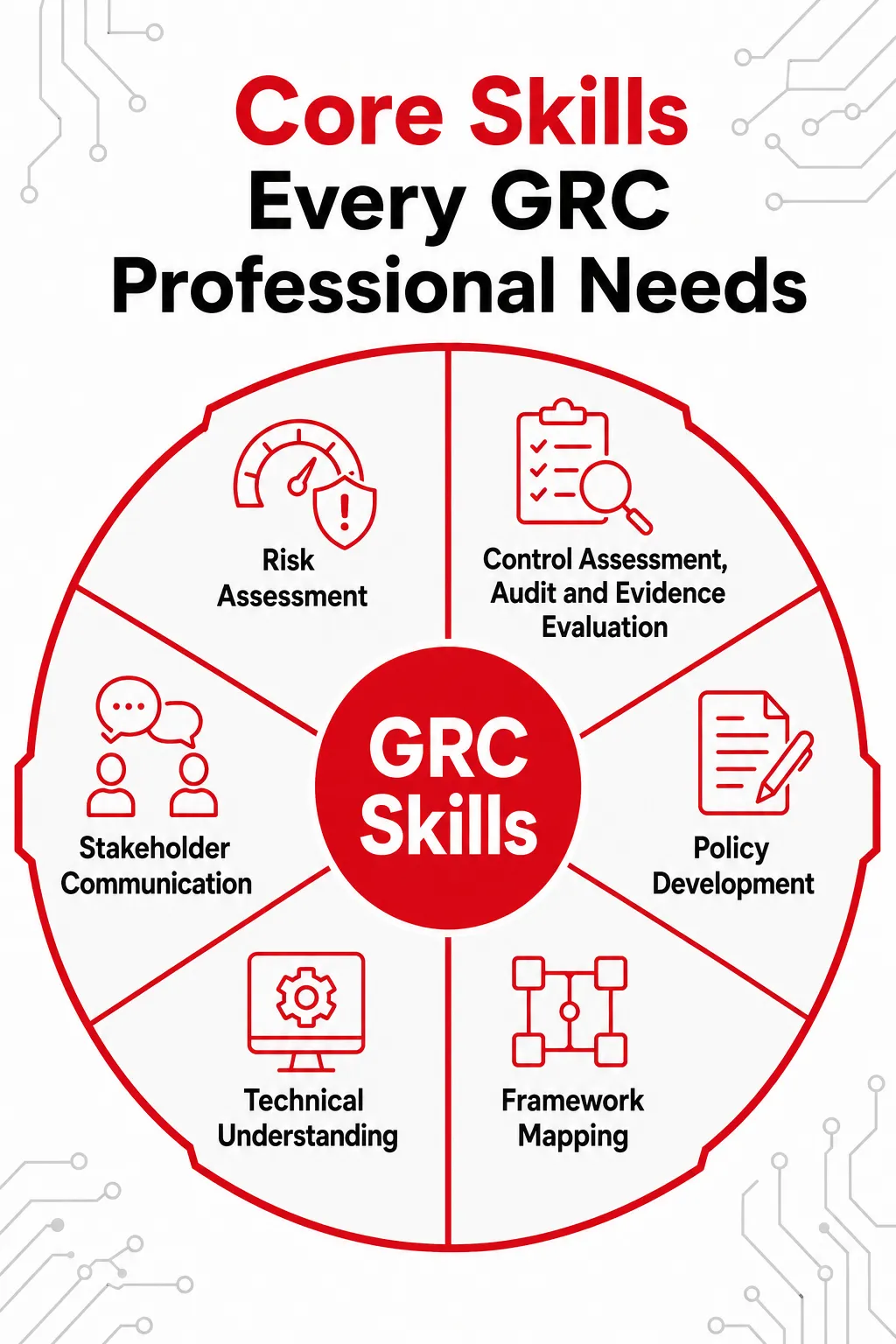
1. Risk Assessment
Professionals must identify assets, threats, vulnerabilities, business impacts, likelihood, existing controls, residual risk, and treatment options.
2. Control Assessment
A GRC professional should distinguish between:
- Control design
- Control implementation
- Control operating effectiveness
- Compensating controls
- Control deficiencies
- Remediation activities
3. Audit and Evidence Evaluation
Professionals must determine whether evidence is relevant, reliable, complete, current, and sufficient to support a conclusion.
4. Policy Development
Strong policy writing requires clear ownership, scope, expectations, responsibilities, exceptions, enforcement, and review requirements.
5. Framework Mapping
Organizations often work with several standards and regulations. GRC professionals should identify overlapping requirements and avoid unnecessary duplication.
6. Technical Understanding
Important areas include:
- Identity and access management
- Network and endpoint security
- Cloud security
- Encryption and data protection
- Vulnerability management
- Logging and monitoring
- Incident response
- Backup and recovery
- Secure development
7. Business Communication
GRC findings should explain:
- What can happen?
- Why does it matter?
- Which business objective is affected?
- How effective are existing controls?
- What action is recommended?
- Who should accept or treat the risk?
GRC Career Progression
| Career Stage | Possible Roles |
| Entry Level | GRC Intern, Junior GRC Analyst, Compliance Analyst, IT Audit Associate |
| Early Professional | GRC Analyst, IT Risk Analyst, Third-Party Risk Analyst, ISMS Coordinator |
| Experienced Professional | Senior GRC Analyst, Information Security Auditor, Risk Consultant, Compliance Manager |
| Senior Level | GRC Manager, IT Risk Manager, Audit Manager, ISMS Manager, Security Architect |
| Leadership | Head of GRC, Director of Information Security, Chief Risk Officer, CISO |
Career progression is not always linear. An auditor may move into risk consulting, a GRC Analyst may specialize in third-party risk, and a security manager may progress toward architecture or CISO responsibilities.
Common Mistakes to Avoid
- Treating GRC as a completely non-technical field
- Collecting certifications without choosing a target role
- Memorizing frameworks without applying them
- Writing policies that do not reflect operations
- Accepting screenshots without evaluating evidence quality
- Reporting findings without explaining business impact
- Treating compliance as proof of complete security
- Ignoring communication and stakeholder-management skills
- Attempting advanced credentials without relevant experience
How to Start Your GRC Career
Starting a GRC career requires security knowledge, business understanding, practical experience, and role-specific learning. Follow a structured path rather than pursuing multiple certifications without a clear career objective.
1. Select a Starting Role: Identify whether you want to work in risk, compliance, IT audit, ISMS implementation, or third-party risk. Common starting roles include:
- GRC Analyst
- IT Risk Analyst
- Compliance Analyst
- IT Audit Associate
- ISMS Coordinator
- Third-Party Risk Analyst
Choose a direction that aligns with your interests and transferable experience.
2. Build Security Foundations: Learn the basics of networks, operating systems, identity and access management, cloud security, data protection, vulnerability management, incident response, and disaster recovery. You need enough technical understanding to assess risks, evaluate controls, and communicate with technical teams.
3. Learn Risk and Control Concepts: Understand assets, threats, vulnerabilities, likelihood, impact, inherent risk, residual risk, and risk treatment. Also learn the difference between control design, implementation, and operating effectiveness.
4. Study ISO/IEC 27001: Learn how an Information Security Management System operates, including ISMS scope, policies, risk assessment, risk treatment, the Statement of Applicability, internal audits, management reviews, corrective actions, and continual improvement.
5. Practice GRC Activities: Use a fictional organization or case study to:
- Build a risk register
- Conduct a control-gap assessment
- Write a security policy
- Prepare an audit evidence checklist
- Perform a third-party risk assessment
- Create a risk-treatment plan
- Draft a management report
This will help you connect GRC concepts with actual workplace activities.
6. Choose a Relevant Certification: Select certifications according to your target role:
| Target Area | Relevant Certification or Program |
| GRC foundations | ISO/IEC 27001, Security+ |
| IT audit | CISA |
| Risk and controls | CRISC |
| Security management | CISM |
| Broad security leadership | CISSP |
| Practical implementation | GRC Hands-on |
| Executive leadership | Practical CISO |
| Technical design | Security Architecture Hands-on |
These are options, not a mandatory sequence. Check the official syllabus and experience requirements before making your choice.
7. Build a GRC Portfolio: Create sanitized work samples, including a risk register, policy, control-mapping matrix, gap-assessment report, audit plan, evidence checklist, vendor assessment, and management dashboard. Briefly explain the scenario, framework, approach, and conclusion for each item.
8. Develop Communication Skills: Practice explaining what was observed, the risk it creates, the evidence supporting the finding, and the required action. Strong GRC reporting should be clear to technical teams and business leaders.
9. Gain Relevant Experience: Experience in IT support, audit, compliance, privacy, vendor management, security operations, business continuity, or project management can support a GRC transition. Look for opportunities to assist with audits, policy reviews, risk assessments, evidence collection, or vendor reviews.
10. Apply and Close Skill Gaps: Review GRC job descriptions, identify recurring requirements, and tailor your résumé to the target role. Highlight practical outcomes and transferable experience. Use application and interview feedback to strengthen any missing skills.
Conclusion
A successful GRC Career begins with strong foundations in information security and risk management. From there, professionals should select a specialization, build practical capabilities, and pursue certifications that align with their actual responsibilities.
Progressing from foundational to professional and expert stages requires more than passing examinations. GRC professionals must be able to assess risks, evaluate controls, interpret evidence, communicate with stakeholders, and support accountable business decisions.
How InfosecTrain Can Support Your GRC Career
InfosecTrain offers certification-focused, hands-on training in ISO/IEC 27001, Security+, CISSP, CISM, CISA, CRISC, GRC Hands-on Training, Security Architecture, and Practical CISO readiness. Whether you are entering GRC, developing role-specific expertise, or preparing for a leadership position, you can choose a program aligned with your experience and career goals.
Ready to build practical GRC capabilities? Explore InfosecTrain’s GRC Training Programs or speak with our experts to identify the right learning path for your next career move.

TRAINING CALENDAR of Upcoming Batches For GRC Training
| Start Date | End Date | Start - End Time | Batch Type | Training Mode | Batch Status | |
|---|---|---|---|---|---|---|
| 12-Dec-2026 | 17-Jan-2027 | 19:00 - 23:00 IST | Weekend | Online | [ Open ] | |
| 20-Feb-2027 | 21-Mar-2027 | 10:00 - 14:00 IST | Weekend | Online | [ Open ] |
Frequently Asked Questions
Is GRC a good career for beginners?
Yes. Beginners can start with security fundamentals, ISO/IEC 27001, risk concepts, and practical documentation before applying for junior roles in GRC, compliance, audit, or third-party risk.
Does GRC require coding?
Coding is not generally a core requirement. However, technical knowledge of systems, cloud, identities, data protection, vulnerabilities, and security controls is important.
Which certification is best for a GRC career?
It depends on the target role. CISA supports auditing, CRISC supports risk and controls, CISM supports security management, and CISSP provides broad knowledge of security and leadership.
Can non-IT professionals enter GRC?
Yes. Professionals from audit, law, finance, compliance, risk, privacy, and business operations can transition into GRC by developing knowledge of cybersecurity and controls.
Are certifications enough to get a GRC job?
No. Practical skills, business communication, and evidence such as risk registers, policies, control assessments, and audit documents should support certifications.
Is GRC less technical than other cybersecurity domains?
GRC usually involves less hands-on engineering than offensive or defensive security, but professionals still require sufficient technical understanding to evaluate risks and controls accurately.
How long does it take to build a GRC career?
There is no fixed timeline. Progress depends on prior experience, practical exposure, role selection, consistent learning, and the experience requirements of advanced certifications.