SOC 1 vs SOC 2 vs SOC 3: Key Differences Explained
Quick Insights:
A SOC report is a third-party audit proving a vendor operates securely and reliably. A SOC 1 report ensures your systems protect a client’s financial accounting data, while a SOC 2 report evaluates operational cybersecurity and data privacy under strict criteria. Because detailed SOC 2 blueprints must remain confidential under an NDA, a simplified SOC 3 report is used publicly as a marketing badge of trust. For these audits, companies choose between a Type I report, which validates control design at a single point in time, and a Type II report, which demonstrates that controls remained effective over a continuous six-to-twelve-month testing window.
Imagine three different clients knocking on your software company’s door.
The Financial Auditor
They process payroll and invoicing through your platform. They need to know your math is accurate so their balance sheets stay correct.
- SOC 1: Focuses entirely on Financial Reporting. It proves your software won’t corrupt a client’s financial books.
The Cybersecurity Expert
They store highly sensitive data on your servers. They demand to see your firewalls, encryption keys, and background checks to ensure hackers can’t break in.
- SOC 2: Focuses on Data Security, Uptime, and Privacy. It is highly detailed and kept confidential under an NDA because it contains your technical blueprints.
The Public Website Visitor
They are a prospective buyer browsing your homepage. They want proof that you are secure before they even talk to your sales team.
- SOC 3: The Public Marketing Version of SOC 2. It offers the same security stamp of approval but strips out all confidential technical details so it can be shared freely.
What are SOC Reports?
A SOC (System and Organization Controls) report is an independent, third-party audit that evaluates an organization’s internal controls, systems, and operational processes. These reports are used by service organizations (such as SaaS providers, cloud hosts, payroll processors, and data centers) to demonstrate to their clients, stakeholders, and auditors that they handle data securely and operate reliably.
What is SOC 1?
A SOC 1 report is focused entirely on a service organization’s internal controls relevant to its clients’ Internal Control over Financial Reporting (ICFR).
Purpose of SOC 1
The primary purpose of a SOC 1 report is to assure your clients’ finance teams and external financial auditors that your services will not negatively impact or misstate their financial statements.
- Who needs it: Any organization that handles financial data, transactions, billing, or monetary processing on behalf of clients.
- Examples: Payroll processors, loan servicing companies, automated clearing houses (ACH), medical billing platforms, and financial SaaS.
- What it contains: Highly customized control objectives designed specifically around the financial workflows of the service being provided.
What is SOC 2?
A SOC 2 report is an operational and technical audit that evaluates an organization’s systems against the AICPA’s predefined Trust Services Criteria (TSC). Unlike SOC 1, it has nothing to do with financial reporting and everything to do with data security and operational integrity.
Purpose of SOC 2
The purpose of a SOC 2 report is to verify that a service provider has strict, effective technical and administrative controls in place to protect sensitive client data. It is the gold standard for enterprise risk management and B2B procurement.
Who needs it: Technology companies, cloud providers, and SaaS businesses that store, process, or transmit customer data in the cloud.
- The 5 Trust Services Criteria (TSC) evaluated:
- Security (The Common Criteria): Protecting systems against unauthorized physical and logical access. (Mandatory for all SOC 2 audits).
- Availability: Ensuring systems are up, running, and accessible as agreed (e.g., uptime monitoring, disaster recovery).
- Processing Integrity: Confirming that system processing is complete, valid, accurate, and authorized (e.g., QA testing, data validation).
- Confidentiality: Protecting data designated as confidential through strict access controls and encryption.
- Privacy: Managing personal information in accordance with the organization’s privacy commitments, applicable laws and regulations, and the Trust Services Criteria privacy requirements.
What is SOC 3?
A SOC 3 report is a high-level, simplified version of a SOC 2 report. It covers the same Trust Services Criteria but strips away all the sensitive, granular operational details.
Purpose of SOC 3
The purpose of a SOC 3 report is to serve as a publicly distributable marketing asset.
- Why it matters: Because a SOC 2 report contains detailed information about an organization’s security controls, operational processes, and auditor testing procedures, companies typically share it only with customers, prospects, or auditors under a Non-Disclosure Agreement (NDA).
- Who needs it: Companies that want to display a compliance badge on their public website, attach a clean auditor’s opinion to a marketing brochure, or share baseline security assurance freely with prospective leads during the early stages of a sales cycle.
Summary Comparison: Type I vs. Type II
For both SOC 1 and SOC 2 audits, organizations can choose between two report types based on the level of assurance their clients and stakeholders require.
- Type I (Point-in-Time): Audits the design of your controls on a specific date. It answers: Are the controls built correctly as of today?
- Type II (Over a Period of Time): It evaluates how well controls are designed and assesses their operational effectiveness over a historical testing window that typically spans 6 to 12 months. It answers: Did these controls actually work consistently over time? Enterprise clients almost universally require a Type II report for formal vendor risk assessments.
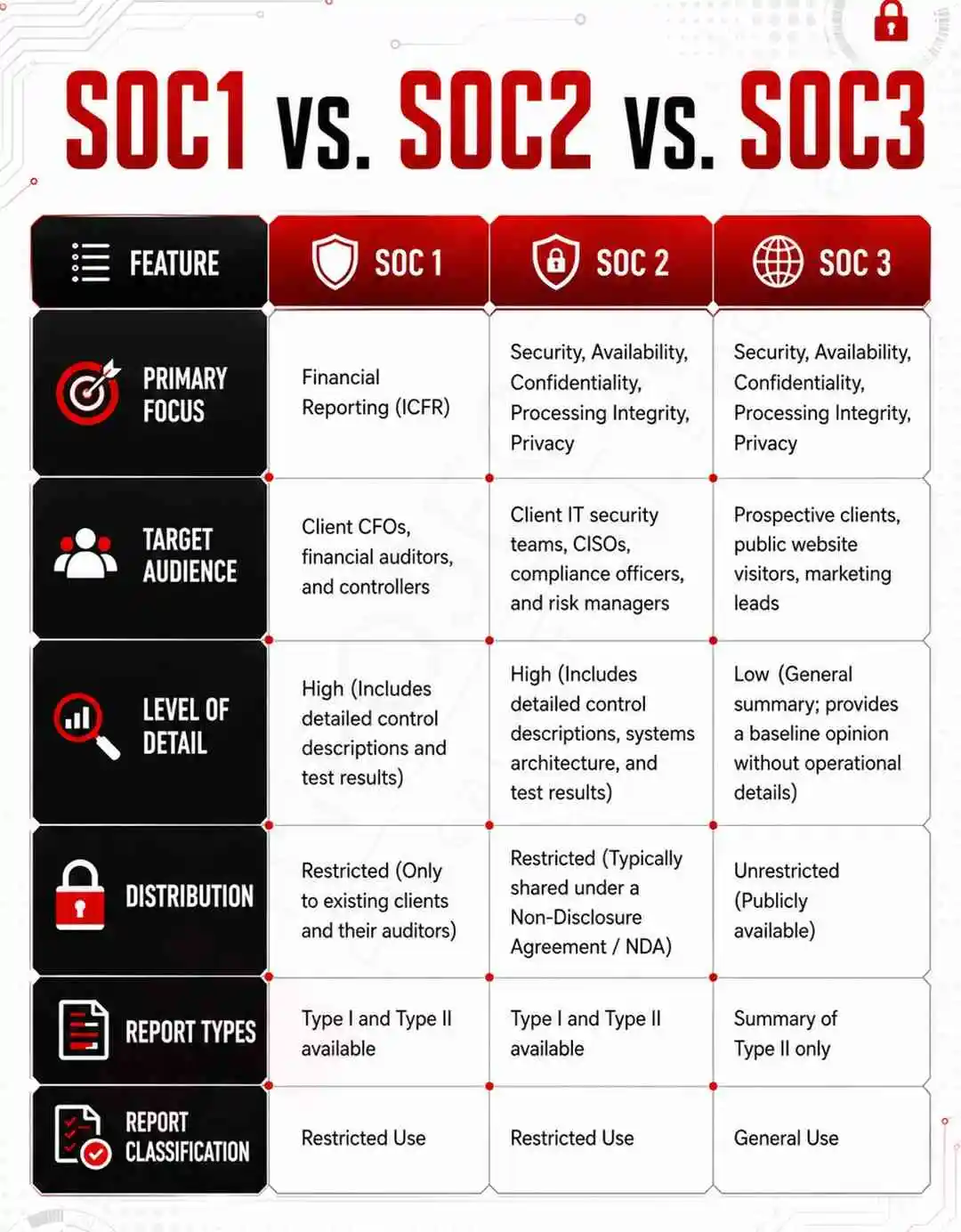
SOC1 vs SOC2 vs SOC3
Conclusion
Choosing the right SOC framework depends entirely on what your stakeholders need to see:
- SOC 1 satisfies financial auditors concerned with accounting accuracy and transaction integrity.
- SOC 2 provides technical risk assessors with a detailed, confidential look at your security, privacy, and uptime posture.
- SOC 3 provides a general-use auditor report that demonstrates compliance with selected Trust Services Criteria while omitting detailed testing procedures and control descriptions.
Mastering these frameworks and understanding how they map to enterprise frameworks requires a strong foundation in risk management and compliance. You can build these critical corporate skills with the GRC IT Auditor Training Program from InfosecTrain, which equips you to successfully manage risks, map complex controls, gather audit evidence, and lead rigorous security assessments.

TRAINING CALENDAR of Upcoming Batches For GRC Auditor Training
| Start Date | End Date | Start - End Time | Batch Type | Training Mode | Batch Status | |
|---|---|---|---|---|---|---|
| 30-Jan-2027 | 28-Feb-2027 | 19:00 - 23:00 IST | Weekend | Online | [ Open ] |
Frequently Asked Questions
What is the main difference between a SOC 1 and a SOC 2 report?
The core focus. A SOC 1 report strictly evaluates controls that impact a client's financial statements and accounting math (Internal Control over Financial Reporting). A SOC 2 report evaluates operational security, availability, processing integrity, confidentiality, and privacy, with zero focus on financial data.
Why can’t a company post its SOC 2 report on its public website?
A SOC 2 report contains detailed descriptions of security controls, system operations, and auditor testing results. Since this information can reveal sensitive aspects of an organization's security program, companies generally restrict distribution and share the report under an NDA.
How does a SOC 3 report solve the confidentiality issue of a SOC 2?
A SOC 3 report covers the same security standards as a SOC 2 report but strips out all sensitive operational data and testing details. It provides a high-level auditor’s opinion and a clean stamp of approval, making it safe for unrestricted public distribution and marketing.
What is the difference between a Type I and a Type II SOC report?
A Type I report is a point-in-time snapshot that verifies that your controls are correctly designed on a specific date. A Type II report is a period-of-time lookback (typically 6 to 12 months) proving that those controls operated effectively and consistently over time.
Which of the 5 Trust Services Criteria (TSC) is mandatory for a SOC 2 audit?
Security (also known as the Common Criteria) is mandatory for every single SOC 2 audit. The remaining four criteria, Availability, Processing Integrity, Confidentiality, and Privacy, are optional and only added based on the specific services you provide to your clients.