What Happens When an AI System Fails Compliance?
Quick Insights:
Artificial intelligence compliance is the process of ensuring that AI systems comply with legal and ethical rules. When a company fails to do this, it faces huge problems. Regulators can issue fines that cost millions of dollars, sometimes taking a large percentage of a company's total global earnings. Beyond money, a compliance failure often means the AI starts making biased or wrong decisions, which can hurt a brand's reputation and lead to lawsuits. The biggest risks in 2026 come from "unseen" failures, like AI models leaking private customer data or "drifting" away from their original goals.
AI is no longer sitting in a lab or a demo deck. It is screening resumes, approving loans, flagging fraud, scoring risk, shaping customer interactions, and helping security teams make faster decisions. The problem is that governance is not moving at the same speed. The latest AI Index from the Stanford Institute for Human-Centered AI says the gap between what AI can do and how prepared we are to manage it is widening. At the same time, McKinsey & Company reports broader AI use, but says most organizations are still working through scaling challenges; only about one-third say they have begun scaling AI across the business, and 23% say they are scaling at least one agentic AI system. AIMultiple adds another telling signal: 77% of companies view AI compliance as a top priority, yet only 4% report having a cross-functional team dedicated to it. That is the tension in one sentence: adoption is racing ahead while control is still catching up.
The Foundation of AI Compliance and the Cost of Ignorance
Artificial intelligence compliance refers to the set of practices and procedures that ensure AI systems adhere to legal, organizational, and technical standards throughout their entire lifecycle. Unlike traditional software, which operates on fixed logic, AI systems are probabilistic. They can develop unforeseen biases, “drift” from their intended behavior, and hallucinate, presenting false information as fact. This inherent unpredictability makes compliance a moving target, requiring continuous monitoring rather than periodic audits.
The 5 Pillars of Compliance Maturity
The industry has moved toward a shared ownership model in which data science, IT, legal, and business departments collaborate on five key areas to prevent compliance failures.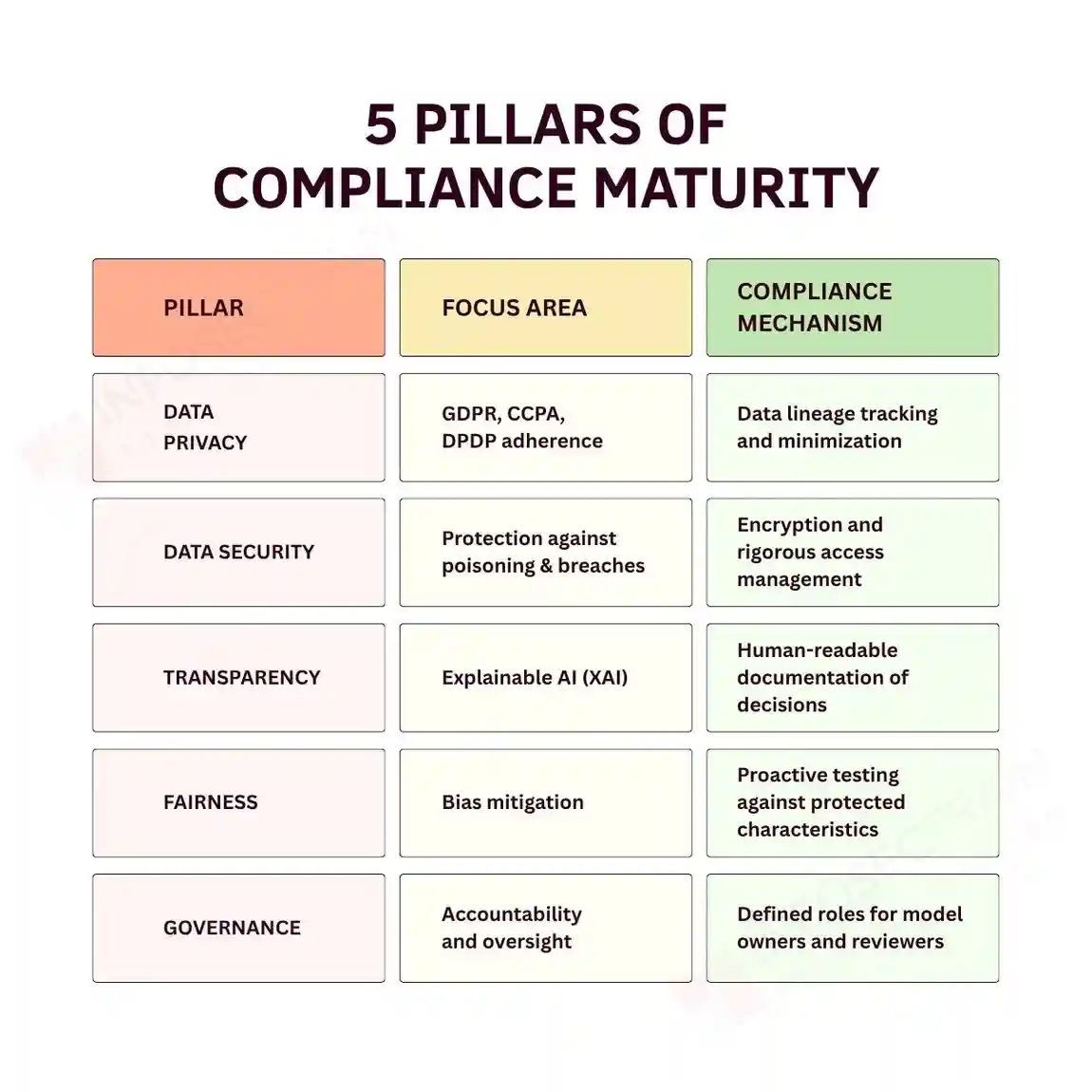 When these pillars fail, the consequences are immediate. Research indicates that organizations that have achieved a high level of governance maturity see a 24.1% improvement in revenue and a 25.4% improvement in cost savings. Conversely, companies that fail their compliance audits experience data breach rates of 31%, compared to only 3% among their compliant peers.
The Global Regulatory
The year 2026 is defined by a shift from “soft” guidelines to aggressive, punitive enforcement. The most significant driver of this change is the European Union (EU) AI Act, which reached full enforcement for high-risk applications on August 2, 2026. This regulation uses a risk-based approach, in which the level of oversight is proportional to the potential harm AI can cause.
1. Penalty Structures and Financial Risks
The financial penalties for non-compliance are designed to be “boardroom-level” concerns. For organizations operating globally, the risk of a single compliance failure can reach into the billions.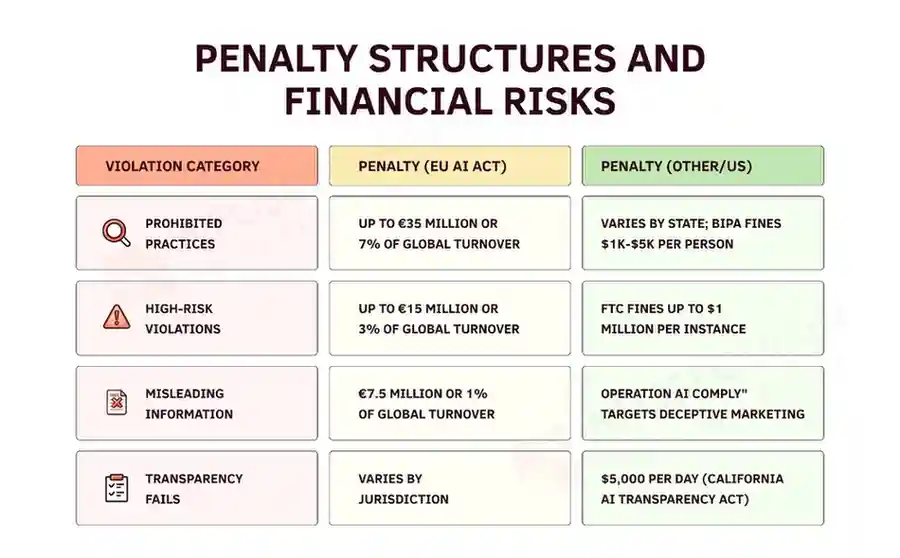 This enforcement is not theoretical. In 2024 alone, over 1,000 companies were fined for AI transparency or data protection violations, with fines in Europe exceeding €1.2 billion. The Federal Trade Commission (FTC) in the United States has also been aggressive, targeting companies like Sitejabber for misrepresenting AI-enabled reviews and Evolv Technologies for false claims about the efficacy of its AI weapons-detection systems.
2. Regional Nuances and the “Legal Gap”
While Europe leads with the AI Act, other regions are navigating their own complexities. In India, for example, there is a recognized “legal gap” regarding AI liability. The existing legal system is built on the assumption of human agency and intention. When an algorithm makes a mistake, the Indian legal landscape currently relies on a fragmented mix of the Information Technology Act (2000), the Consumer Protection Act (2019), and the Digital Personal Data Protection Act (2023).
None of these laws explicitly defines “algorithmic negligence,” making it difficult for victims of biased AI decisions to seek direct remedies. However, the introduction of the Artificial Intelligence (Ethics and Accountability) Bill in 2025 signals a move toward closing these gaps, as courts increasingly turn to “doctrinal improvisation” to hold developers and users accountable.
Technical Failures: The Architecture of Non-Compliance
A compliance failure is rarely the result of a single bad actor; it is typically the outcome of systemic technical debt and poor data management.
1. The Integration Gap and Legacy Systems
The drive toward GenAI has created a massive integration reality gap. Only 28% of enterprise applications are currently connected, while 95% of IT leaders report that integration hurdles are actively impeding their AI implementations.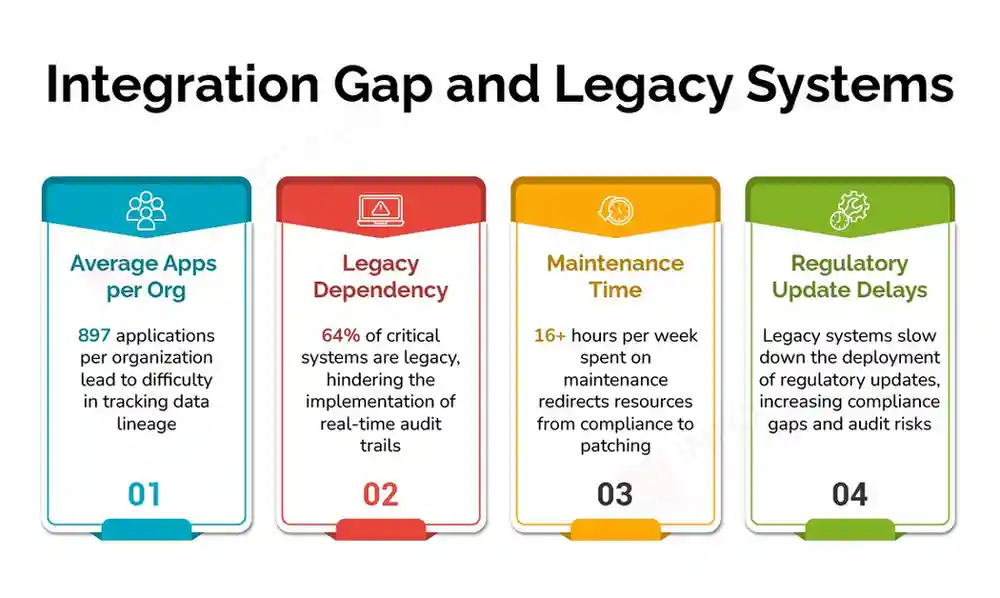 This lack of integration directly leads to the proliferation of “Shadow AI”, unauthorized AI tools used by employees without governance oversight. Approximately 80% of unauthorized AI transactions originate internally, creating massive exposure for data leakage and privacy violations.
2. Data Quality and Model Drift
Gartner estimates that by 2026, nearly 60% of AI initiatives could be discontinued, largely because of issues related to poor data quality. Data quality is not just a performance metric; it is a compliance requirement. If a model is trained on biased, incomplete, or un-anonymized data, the resulting inferences are legally non-compliant.
Furthermore, AI models suffer from “drift,” where their accuracy degrades over time as they interact with new, real-world data. A model that was compliant during its initial deployment may become non-compliant six months later if it begins to produce discriminatory outcomes or loses its explainability. This necessitates the use of MLOps platforms that can automate versioning and provide a “control tower” view of model health.
Real-World Case Studies of AI Compliance Failure
Examining recent incidents and projected 2025/2026 incidents provides a clear roadmap for what to avoid.
1. Privacy Violations and Data Scraping
- Clearview AI: One of the most prominent examples of non-compliance involves facial recognition. Clearview AI was fined over $75 million across multiple jurisdictions for scraping internet content to identify individuals without their consent. In 2024, the Netherlands alone issued a $30 million fine against the company for creating an illegal database.
- LinkedIn: In 2024, LinkedIn was fined €310 million under GDPR for behavioral profiling of users without adequate consent. This case highlighted that AI-powered personalization engines often process data beyond the scope of the original privacy policies.
- X (formerly Twitter): In 2024, X faced scrutiny for quietly enabling Grok, its AI model, to be trained on user posts without a clear opt-out process. This lack of transparency is a direct violation of “privacy-by-design” principles.
2. Bias and Discrimination in High-Stakes Environments
- Amazon’s Hiring Tool: Although discontinued in 2018, the company’s experimental hiring tool remains a primary case study of bias. The AI preferred male candidates because it was trained on resumes submitted over a ten-year period, reflecting the historical male dominance of the tech industry.
- COMPAS Recidivism Tool: This tool misclassified black defendants as “high risk” at nearly twice the rate of white defendants (45% vs 23%). Such failures highlight the dangers of using AI for legal and social scoring without robust human oversight.
- Uber Eats Algorithmic Management: In 2024, EU regulators scrutinized Uber Eats for discriminatory practices in its automated driver management systems, leading to new mandates for human-in-the-loop assessments for any AI affecting livelihoods.
3. Hallucinations and Technical Malfunctions
- Heber City Police (2025): The department tested an AI for transcribing body camera footage and generating reports. One report claimed a police officer had “turned into a frog,” demonstrating the risk of hallucinations in critical government operations.
- Swiss Airline Deepfakes (2025): Realistic AI-generated images of a Swiss plane skidding into a snowdrift went viral, causing immediate reputational damage before the airline could verify the incident as fake. This underscores the liability of platforms in hosting and propagating deepfake misinformation.
Conclusion
The failure of an AI system to comply with global regulations is no longer a localized technical error; it is a catastrophic business event. As we have seen, the financial, legal, and reputational costs are escalating alongside the complexity of the technology itself. With the advent of agentic AI and the shift toward answer engine discovery, the definition of “compliance” has expanded to include technical trust, semantic clarity, and proactive governance.
The data is clear: the integration gap is widening, and those who ignore it are setting themselves up for failure. However, the opportunity for those who get it right is immense. By moving beyond a reactive mindset and embedding compliance into the very design of their AI systems, enterprises can unlock the true potential of this $6 trillion market. If AI failures are costing companies millions, then professionals who can prevent those failures are becoming invaluable.
That’s exactly what the ISO/IEC 42001 Lead Auditor role is built for. You do not just learn theory; you learn how to:
- Audit AI systems for compliance gaps
- Evaluate AI risk across lifecycle stages
- Ensure fairness, transparency, and accountability
- Align AI systems with global regulations
At InfosecTrain, this program is designed to help you move from understanding AI risks → auditing and controlling them in real-world scenarios.
- Hands-on approach to AI governance
- Real-world audit scenarios
- Alignment with global AI regulations
- Career-ready skills for AI GRC roles
Enroll Now in InfosecTrain’s ISO/IEC 42001 Lead Auditor Training and become the professional every AI-driven organization will need in 2026 and beyond.

TRAINING CALENDAR of Upcoming Batches For ISO 42001 Lead Auditor Training
| Start Date | End Date | Start - End Time | Batch Type | Training Mode | Batch Status | |
|---|---|---|---|---|---|---|
| 10-Oct-2026 | 15-Nov-2026 | 19:00 - 23:00 IST | Weekend | Online | [ Open ] | |
| 05-Dec-2026 | 10-Jan-2027 | 09:00 - 13:00 IST | Weekend | Online | [ Open ] | |
| 13-Feb-2027 | 14-Mar-2027 | 19:00 - 23:00 IST | Weekend | Online | [ Open ] |
Frequently Asked Questions
What are the legal penalties if my AI system discriminates against users?
Under the EU AI Act, discriminating against users via high-risk systems can lead to fines of up to €15 million or 3% of global turnover. In the US, companies may face lawsuits under civil rights laws or FTC enforcement actions for "deceptive" or "unfair" practices, with penalties reaching millions of dollars and decades of mandatory oversight.
Can I be held liable if a third-party AI tool leaks my company’s data?
Yes. Organizations are responsible for the data they input into third-party tools. If a tool like ChatGPT leaks sensitive code or personal information because you did not have a proper AI usage policy, your company remains the liable party under GDPR or DPDP.
What is "AI drift" and how does it affect compliance?
AI drift occurs when a model's performance changes over time as it encounters new data. If a drift leads to discriminatory outcomes, the system becomes non-compliant, necessitating constant monitoring and retraining.
Is human oversight mandatory for all AI systems?
Under the EU AI Act and several emerging US laws, human oversight is mandatory for "high-risk" AI systems—those used in employment, healthcare, credit scoring, and essential public services. The goal is to ensure a "human-in-the-loop" can intervene if the AI makes a flawed or harmful decision.
How do I protect my brand from AI hallucinations?
The best defense against hallucinations is a combination of high-quality training data, retrieval-augmented generation (RAG), and human verification. Never publish AI-generated content or reports in high-stakes environments without an expert review. Implementing a "fact-check" layer in your AI workflow is now considered a baseline enterprise risk control.