What are the Principles of Responsible AI (RAI)?
Quick Insights:
Responsible AI (RAI) is about building AI systems that people can trust. It ensures AI is developed and used with fairness, transparency, accountability, privacy, safety, security, accuracy, sustainability, legal compliance, and ethical intent. As AI becomes part of everyday business decisions, these principles help organizations reduce bias, protect data, prevent misuse, improve decision quality, and align AI innovation with human values, regulatory expectations, and long-term trust.
While everyone is rushing to implement AI, most people are forgetting the most important part: Trust. Did you know that global cybersecurity spending is hitting $212 billion this year? Yet, even with all that money being spent, the average data breach still costs a staggering $4.88 million. Organizations are now prioritizing AI in their budgets over cloud security and data protection, with 36% of leaders putting AI at the top of the list. But if you build your AI on a shaky foundation, you are just building a faster way to fail.

That’s where Responsible AI (RAI) comes in. It is a set of ethical and operational guardrails designed to make sure your technology is safe, fair, and trustworthy. If you want to win in 2026, you need to master these 10 principles.
Top 10 Principles of Responsible AI (RAI)
Below are the key principles of Responsible AI (RAI).
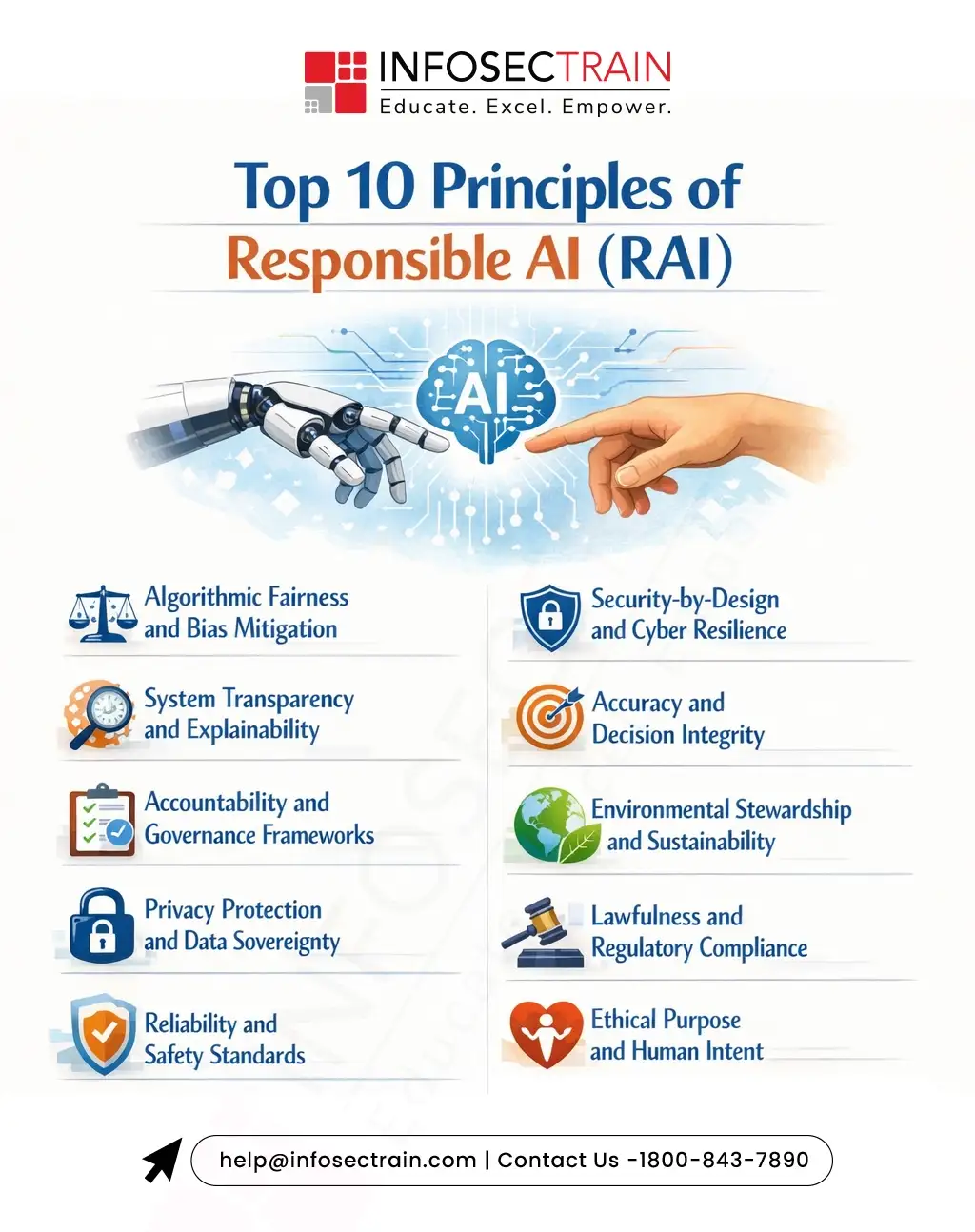
1. Algorithmic Fairness and Bias Mitigation
Fairness in Responsible AI ensures that systems treat all individuals equitably and avoid favoring or discriminating against specific groups based on sensitive traits. To achieve this, you must identify and remove problematic biases, like those based on gender, ethnicity, or religion, within the historical data used to train your models.
As we are aware that AI learns from the past. If your past data is biased, your AI will be too. A famous example is the Amazon resume screener, which had to be shut down because it penalized resumes containing the word “women’s” due to male-biased historical training data.
- The Goal: You need to use diverse datasets that accurately reflect the real world.
- The Action: Design your algorithms with fairness as a primary constraint, not a post-launch fix.
2. System Transparency and Explainability
Transparency requires that AI operations are understandable and traceable, allowing humans to see exactly how a decision was derived. This is often called “Explainable AI” (XAI). It is the opposite of a “black box” where you put data in and get an answer without knowing why. Look, if a bank denies you a loan, you want to know why. If the AI can not explain the rationale, nobody will trust it.
- The Goal: Maintain audit trails and document decision-making pathways so you can explain outcomes to end-users.
- The Action: Provide “Transparency Notes” or documentation that helps users understand the inner workings and limitations of your AI.
3. Accountability and Governance Frameworks
Accountability dictates that the people who design, build, and deploy AI systems remain responsible for the technology’s behavior and its outcomes. You must establish a clear governance structure that assigns ownership throughout the entire AI lifecycle.
Here’s the protocol: You can not blame the machine when things go wrong.
- The Goal: Designate specific roles, such as AI Ethics Officers, and create committees to oversee sensitive use cases.
- The Action: Implement documentation and auditing pipelines to monitor both intended and unintended performances.
4. Privacy Protection and Data Sovereignty
Privacy in AI means respecting data ownership and adhering to strict privacy laws through unambiguous consent and advanced security measures. Because AI models consume massive amounts of data, safeguarding individual privacy rights is a non-negotiable requirement. Wait, there’s more.
You must collect only the minimum data required and ensure that users have full control over their personal information.
- The Goal: Use techniques like data anonymization and “Privacy-by-Design” to protect sensitive information from the very start.
- The Action: Secure your data channels to prevent leaks, especially in customer-facing tools like chatbots.
5. Reliability and Safety Standards
Reliability ensures that AI systems perform consistently and predictably within safe parameters, even when they encounter unexpected conditions. This requires you to put your models through rigorous testing and continuous validation to identify potential threats or errors.
Remember the Boeing 737 MAX failure? That’s a prime example of why human-led design and safety redundancy are crucial.
- The Goal: Develop fail-safe mechanisms so that if a system fails, it does so safely without causing harm.
- The Action: Always keep a “human in the loop” to monitor performance and step in when necessary.
6. Security-by-Design and Cyber Resilience
Security-by-Design focuses on mitigating cyber threats, like prompt injection and data poisoning, to ensure the robustness of the AI infrastructure. In 2025, we saw a 35% increase in vulnerabilities specifically linked to AI.
You need to shift your focus from just protecting databases to protecting the entire machine learning pipeline.
- The Goal: Defend against adversarial attacks that try to trick your model into leaking data or making wrong decisions.
- The Action: Secure your APIs, language models, and Machine Learning Operations (MLOps) as part of your core security strategy.
7. Accuracy and Decision Integrity
Accuracy ensures that AI-generated insights are domain-specific, validated, and contextually appropriate for the task at hand. For your AI to be useful, its outputs must be dependable and trustworthy, meeting industry-leading performance benchmarks.
If your AI is making up facts, what we call “hallucinations”, your brand reputation will tank.
- The Goal: Continuously test your models against real-world scenarios to ensure they are making the right calls.
- The Action: Use “confidence scores” to let users know how sure the AI is about a specific answer.
8. Environmental Stewardship and Sustainability
Sustainability in AI focuses on developing hardware and software that consumes minimal computational resources to lower the carbon footprint. As AI energy demands skyrocket, building efficient systems is not just good for the planet; it is good for your bottom line.
Look, high-performance AI does not have to mean high energy waste.
- The Goal: Transition toward a low-carbon, low-waste future by optimizing your data centers and algorithms.
- The Action: Choose vendors and partners who prioritize energy-efficient hardware, like specialized GPUs designed for sustainability.
9. Lawfulness and Regulatory Compliance
Lawfulness requires that every AI system follows domestic and international laws, including human rights regulations and data protection acts like GDPR. You must evaluate how your products are trained and deployed within specific legal contexts to avoid massive fines.
Did you know that GDPR violations can cost up to €20 million or 4% of your global revenue?
- The Goal: Align your AI framework with global standards like ISO 42001 or the EU AI Act.
- The Action: Regularly audit your processes to ensure you are meeting all legal and industry-specific requirements.
10. Ethical Purpose and Human Intent
Purpose ensures that AI is designed and deployed for positive impact and empowerment, preventing it from being repurposed for harm. You must define clear use cases that align with societal values and monitor your systems to prevent misuse.
Think about the unintended consequences. YouTube’s recommender system was criticized for pushing radical content because it was optimized for engagement rather than intent.
- The Goal: Prioritize human well-being and environmental health during the design phase.
- The Action: Engage with stakeholders and experts to make sure your AI vision actually helps people instead of replacing them.
Certified AI Governance Specialist (CAIGS) Training with InfosecTrain
As AI adoption accelerates across industries, organizations must ensure that innovation does not come at the cost of trust, security, or ethics. The principles of Responsible AI (RAI); such as fairness, transparency, accountability, privacy, security, and reliability, serve as essential guardrails for building trustworthy and compliant AI systems. By integrating these principles into the AI lifecycle, organizations can reduce risks, improve decision integrity, and ensure that AI technologies deliver real value while protecting users and society.
Build Responsible AI Expertise with InfosecTrain
To successfully implement Responsible AI, professionals need the right governance and risk management skills. InfosecTrain’s Certified AI Governance Specialist (CAIGS) Training equips learners with practical knowledge of AI governance frameworks, risk mitigation strategies, and global compliance standards like ISO 42001.
Ready to lead Responsible AI initiatives?
Join InfosecTrain’s Certified AI Governance Specialist (CAIGS) Training and gain the expertise needed to design and govern AI systems responsibly.

TRAINING CALENDAR of Upcoming Batches For Certified AI Governance Specialist (CAIGS) Training
| Start Date | End Date | Start - End Time | Batch Type | Training Mode | Batch Status | |
|---|---|---|---|---|---|---|
| 09-Nov-2026 | 17-Dec-2026 | 19:30 - 22:00 IST | Weekday | Online | [ Open ] | |
| 01-Feb-2027 | 04-Mar-2027 | 19:30 - 22:00 IST | Weekday | Online | [ Open ] |
Frequently Asked Questions
What are the principles of Responsible AI?
The key principles of Responsible AI include fairness, transparency, accountability, privacy, reliability, security, accuracy, sustainability, legal compliance, and ethical purpose. These principles guide organizations in building AI systems that are safe, trustworthy, explainable, and aligned with human values.
What is Responsible AI?
Responsible AI is an approach to designing, developing, and using AI systems in a safe, ethical, transparent, and accountable way. It helps ensure that AI technologies support people, protect data, reduce bias, and deliver reliable outcomes.
Why are Responsible AI principles important?
Responsible AI principles are important because they help organizations prevent harmful outcomes such as biased decisions, privacy violations, security risks, inaccurate results, and misuse of AI systems. They also support regulatory compliance and build user trust.
What are the five key principles of ethical AI?
The five key principles of ethical AI are fairness, transparency, accountability, privacy, and security. Together, they help ensure AI systems are explainable, unbiased, protected from misuse, and governed responsibly.
How can organizations implement Responsible AI?
Organizations can implement Responsible AI by creating clear governance policies, testing AI systems for bias and accuracy, protecting user data, maintaining human oversight, documenting AI decisions, securing AI infrastructure, and regularly auditing AI systems for risks and compliance.