Enterprise Architecture vs. Solution Architecture
Quick Insights:
Enterprise Architecture manages the long-term, big-picture strategy for an organization's entire IT ecosystem, setting global standards for security, data, and compliance. Solution Architecture focuses on a single project, turning those high-level guidelines into concrete technical blueprints with specific tech stacks and APIs. Organizations need both: relying only on Enterprise Architecture leads to great policies but zero execution, while relying only on Solution Architecture creates a fragmented, unmanageable maze of technical debt.
Imagine a growing kingdom where a leader wants to build a great city. To get the job done right, they hire two experts: the City Planner and the Building Architect.
- The Enterprise Architect (The City Planner): Looks at the giant map of the entire kingdom. They don’t design individual houses; instead, they map out the highways, connection grids, and global rules everyone must follow so the city scales in an organized way.
- The Solution Architect (The Building Architect): Focuses entirely on a specific project, like a grand library. They take the City Planner’s rulebook and get to work designing the blueprint, choosing materials, and managing the budget to build that specific structure on time.
Without the City Planner, different teams build mismatched roads, creating an unmanageable maze. Without the Building Architect, you have beautiful maps but no actual buildings. To succeed, an organization needs both: one to provide the global guardrails, and the other to build the structures that bring the vision to life.
What is Enterprise Architecture?
Enterprise Architecture focuses on the big picture. Enterprise Architecture focuses on the strategic design and governance of the organization’s IT ecosystem. They look at the entire corporate landscape, spanning business processes, data governance, application portfolios, and underlying infrastructure, to design a long-term roadmap.
Instead of focusing on a single software application, an EA ensures that the company’s overall technology stack supports its overarching business strategy. They establish the standards, security policies, and architectural frameworks that all internal teams must follow.
Key Responsibilities of an Enterprise Architect
- Aligning IT with Business Strategy: They translate the corporate vision into a concrete technical roadmap, ensuring that technology investments directly drive business outcomes such as revenue growth, market expansion, and operational efficiency.
- Standardizing Technology and Frameworks: They define which programming languages, cloud providers, hardware baselines, and software tools the company adopts. This minimizes chaotic system fragmentation and establishes a unified architecture style guide.
- Reducing Structural Redundancy: They audit the global software portfolio across all business units to eliminate duplicate software licenses, consolidate overlapping vendor contracts, and streamline cross-departmental operations.
- Governing Risk and Compliance: They establish security architecture guardrails and data compliance baselines (such as GDPR, HIPAA, or ISO standards) that protect the entire enterprise network from systemic vulnerabilities and legal exposure.
- Designing the Enterprise Data Blueprint: They define how data flows globally across different business units, creating master data management (MDM) strategies that ensure business leaders have access to a single, accurate source of truth for corporate reporting.
What is Solution Architecture?
While the Enterprise Architect designs the city grid, the Solution Architect builds the actual skyscraper. Solution Architecture focuses on a specific project or a defined business problem.
An SA takes the high-level guidelines established by the Enterprise Architect and applies them to engineer a practical, highly detailed system. They select the specific databases, design application interfaces (APIs), and define the exact data workflows required to deliver a functional product on time and within budget.
Key Responsibilities of a Solution Architect
- Defining Technical Requirements: They analyze complex business challenges, gather non-functional requirements (such as availability, scalability, and latency limits), and design a custom software or infrastructure solution to resolve them.
- Bridging Strategy and Execution: They act as a vital communication bridge, translating high-level enterprise policies, constraints, and business language into clear, actionable technical blueprints for the boots-on-the-ground development and engineering teams.
- Creating Prototypes and Proofs of Concept (PoC): They build functional proof-of-concept models to test system reliability, validate integration points, and benchmark performance metrics under simulated stress conditions before full-scale development begins.
- Selecting Technology Components and Tech Stacks: Within the boundaries set by enterprise governance, they pick the exact database engines, messaging queues, microservices patterns, and UI frameworks needed to meet the specific project’s operational load.
- Overseeing Post-Deployment Performance: They monitor the initial rollout of the solution, analyzing runtime data, error logs, and user traffic behavior to optimize code performance, resolve architectural bottlenecks, and ensure system high availability.
Enterprise Architecture vs. Solution Architecture
Why Organizations Need Both Disciplines
Relying on just one architectural practice creates severe operational blind spots:
- Only Solution Architects: Individual projects succeed, but the overall IT ecosystem suffers. Separate teams choose conflicting cloud vendors, incompatible languages, and duplicate tools. This creates an unmanageable mess of technical debt and fragmented systems.
- Only Enterprise Architects: The company creates beautiful corporate policies and long-term plans, but struggles to execute them. Without a Solution Architect to navigate real-world project constraints, developers take shortcuts that violate enterprise standards to meet tight deadlines.
Together, they form a powerful partnership. The Enterprise Architect provides the global guardrails and the destination, while the Solution Architect builds the specific vehicle to get there safely and on budget.
Conclusion
Enterprise Architecture and Solution Architecture must work in lockstep to drive secure, scalable digital transformation by balancing long-term roadmaps with tactical engineering.
To learn how to embed security into these designs, join the instructor-led Security Architecture Hands-On Training course from InfosecTrain. Through practical labs, you will master enterprise risk management, engineer secure cloud infrastructure, and prepare for specialized cloud security architecture badges.

TRAINING CALENDAR of Upcoming Batches For Security Architecture Training
| Start Date | End Date | Start - End Time | Batch Type | Training Mode | Batch Status | |
|---|---|---|---|---|---|---|
| 14-Nov-2026 | 06-Dec-2026 | 09:00 - 13:00 IST | Weekend | Online | [ Open ] |
Frequently Asked Questions
What is the main difference between Enterprise and Solution Architecture?
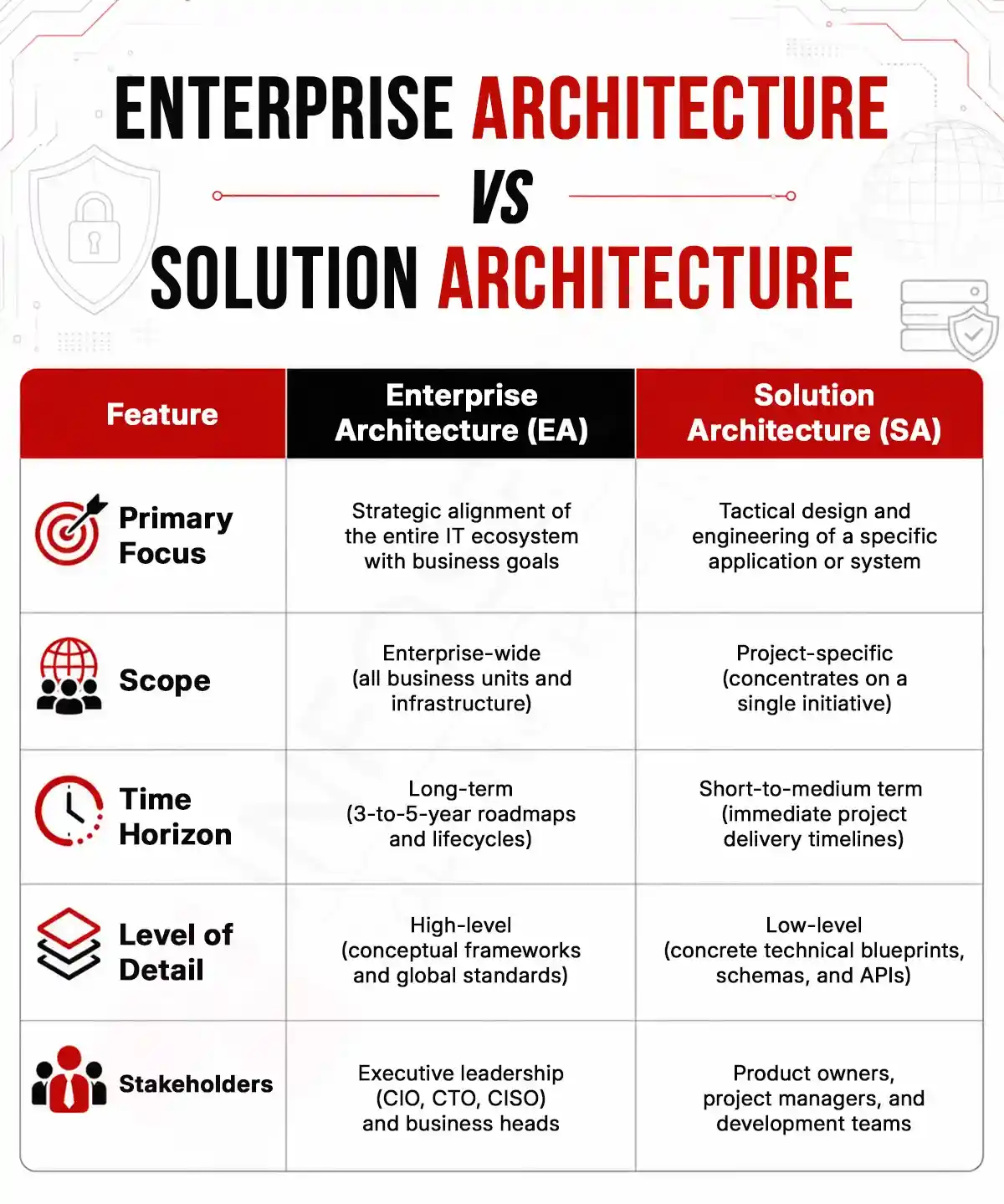
Enterprise Architecture (EA) handles the long-term, high-level strategy and standards for the entire organization's IT ecosystem. Solution Architecture (SA) focuses on the immediate, tactical engineering and low-level design of a single specific project.
Can an organization succeed with only Solution Architects?
No. While individual projects might succeed, the overall IT ecosystem will suffer from massive technical debt. Without central coordination, separate teams end up using incompatible languages, conflicting cloud vendors, and duplicate tools.
Who are the primary stakeholders for each role?
Enterprise Architects work with executive leadership (CIO, CTO, CISO) and business heads to align IT with corporate strategy. Solution Architects work directly with execution teams, including product owners, project managers, and developers.
How does Enterprise Architecture help with risk and compliance?
EA sets global security guardrails and compliance baselines (like GDPR, HIPAA, or ISO standards). This ensures that every new project automatically adheres to the company's legal and security protections.
How do these roles interact during a project?
The Enterprise Architect defines the global guardrails and standards (such as approved cloud providers). The Solution Architect then takes those rules and builds the detailed technical blueprint to deliver the project safely within those boundaries.