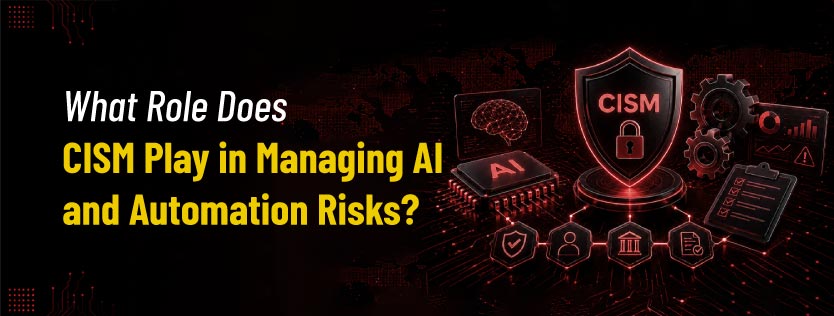
What Role Does CISM Play in Managing AI and Automation Risks?
Quick Insights:
AI and automation improve speed and efficiency, but they also introduce risks such as biased decisions, data privacy issues, automated cyberattacks, and a lack of transparency. ISACA Certified Information Security Manager (CISM) professionals help organizations manage these risks by strengthening governance, securing the AI lifecycle, improving incident response, managing third-party risks, protecting sensitive data, and aligning AI security with business goals. Their role ensures organizations can innovate safely while maintaining trust, compliance, and resilience.
Have you ever wondered what happens when the machines we built to help us start moving faster than we can control them? Imagine a high-speed train representing AI, zooming through a digital city with incredible efficiency but no brakes. Without a skilled conductor, this powerful engine could easily derail, causing chaos through hidden data leaks or unfair decisions. A CISM professional acts as that expert conductor, installing the necessary tracks and safety signals to keep the journey smooth. Their leadership ensures that while the engines of innovation roar, the business stays on the right path, safe and secure.
Understanding AI and Automation Risks
AI and automation introduce speed and efficiency, but they also create complex security challenges:
- Algorithmic Bias: AI systems may produce unfair or inaccurate outcomes if trained on biased data.
- Lack of Transparency: Many AI models operate as black boxes, making decisions difficult to audit.
- Automated Threats: Attackers use automation to scale cyberattacks such as phishing and credential stuffing.
- Data Privacy Risks: AI relies heavily on large datasets, increasing the risk of breaches and misuse.
- System Manipulation: Adversarial attacks can trick AI systems into making incorrect decisions.
What Role Does CISM Play in Managing AI and Automation Risks?
1. Strengthening Governance and Risk Management
CISM professionals ensure that security strategies evolve in step with business goals. In the context of AI, they:
- Establish formal governance frameworks to oversee AI adoption.
- Define specific risk appetite and tolerance levels for automated processes.
- Ensure that every AI initiative adheres to legal, ethical, and regulatory mandates.
2. Embedding Security into the AI Lifecycle
CISM promotes a proactive defense by integrating security checkpoints throughout the entire model lifecycle:
- Design Phase: Early identification of threats like data poisoning or insecure model architecture.
- Development Phase: Enforcement of secure coding standards and rigorous testing of AI logic.
- Deployment Phase: Verification of secure configurations and robust access management.
- Monitoring Phase: Ongoing tracking of model behavior to detect drift or anomalies.
3. Enhancing Incident Management for Automated Environments
In a landscape where attacks happen at machine speed, CISM equips leaders to:
- Tailor incident response playbooks specifically for AI-driven disruptions.
- Utilize real-time detection to identify anomalies caused by automated threats.
- Execute rapid-response protocols to minimize damage and maintain business continuity.
4. Managing Third-Party and Supply Chain Risks
Since most AI solutions rely on external APIs and cloud vendors, CISM provides the tools to:
- Conduct deep-dive security assessments of vendors before integration.
- Enforce strict third-party risk management (TPRM)
- Continuously monitor external dependencies for compliance gaps.
5. Driving Data Protection and Privacy
Because data is the fuel for AI, CISM-certified experts:
- Implement rigorous data classification and technical protection controls.
- Maintain compliance with global privacy regulations (like GDPR or CCPA).
- Champion ethical data practices to minimize unnecessary exposure.
6. Promoting Security Awareness and Culture
AI risk management is a human challenge as much as a technical one. CISM encourages:
- Conducting targeted training on AI-specific threat landscapes.
- Fostering a security-first mindset across all organizational departments.
- Facilitating collaboration between data scientists, security teams, and business leaders.
7. Aligning AI Security with Business Strategy
The hallmark of a CISM professional is the ability to view security through a business lens. They:
- Translate technical AI risks into clear financial and operational impacts.
- Prioritize security investments based on actual risk exposure and ROI.
- Enable safe innovation that maintains both competitive edge and stakeholder trust.
Conclusion
- Strategic Oversight: CISM ensures AI remains a business enabler rather than a liability.
- Modern Resilience: Effective management of automation is the key to surviving the modern threat landscape.
Infosectrain Expertise: To lead these high-level initiatives, the CISM certification course offered by Infosectrain provides the strategic training needed to govern AI and automation with confidence.

TRAINING CALENDAR of Upcoming Batches For CISM Training
| Start Date | End Date | Start - End Time | Batch Type | Training Mode | Batch Status | |
|---|---|---|---|---|---|---|
| 14-Nov-2026 | 06-Dec-2026 | 09:00 - 13:00 IST | Weekend | Online | [ Open ] | |
| 05-Dec-2026 | 10-Jan-2027 | 09:00 - 13:00 IST | Weekend | Online | [ Open ] | |
| 19-Dec-2026 | 17-Jan-2027 | 19:00 - 23:00 IST | Weekend | Online | [ Open ] | |
| 23-Jan-2027 | 14-Feb-2027 | 09:00 - 13:00 IST | Weekend | Online | [ Open ] | |
| 13-Feb-2027 | 07-Mar-2027 | 19:00 - 23:00 IST | Weekend | Online | [ Open ] | |
| 20-Mar-2027 | 11-Apr-2027 | 09:00 - 13:00 IST | Weekend | Online | [ Open ] |
Frequently Asked Questions
How does CISM help in managing AI risks?
CISM provides a structured framework for governance, risk assessment, and control implementation, helping organizations identify and mitigate AI-specific risks like bias, data misuse, and automation-driven threats.
Why is governance important for AI and automation?
AI systems can operate at scale and speed, making uncontrolled risks more impactful. CISM ensures proper governance by defining policies, accountability, and oversight mechanisms.
Can CISM professionals handle AI-specific cyber threats?
Yes, CISM-certified professionals are trained to adapt incident response strategies to automated threats, such as AI-driven attacks, to ensure faster detection and response.
How does CISM support data privacy in AI systems?
CISM emphasizes data classification, protection, and regulatory compliance, ensuring that AI systems use data responsibly and securely while meeting standards like GDPR.
Is CISM relevant to future technologies such as AI and automation?
Absolutely. CISM focuses on risk management and strategic alignment, making it highly relevant for emerging technologies where governance and security are critical.