Where does Architecture lie in SDLC?
Quick Insights:
Software Architecture serves as the blueprint of the SDLC, bridging the gap between requirements and development. It defines how a system will be structured, ensures scalability and security, guides development decisions, shapes testing strategies, and continues to influence deployment and maintenance. Rather than existing in a single phase, architecture plays an active role throughout the entire software lifecycle. By providing a clear technical foundation, it helps teams build reliable applications that align with business goals and can adapt to future growth.
In the Software Development Life Cycle (SDLC), Software Architecture acts as the blueprint and the structural foundation of the entire project. It does not belong to a single, isolated step. Instead, it bridges the gap between understanding a problem and building the solution.

In a standard SDLC model, Architecture sits squarely between Requirements Analysis and Detailed Design/Development.
Here is a quick look at how it fits into the flow:
- The Bridge: Once the business goals and technical requirements are gathered (Requirements Phase), you cannot just start coding right away. You need a high-level strategy. Architecture defines how the system will be structured to meet those requirements.
- The High-Level Blueprint: During this phase, architects define the macro-level structure by choosing the tech stack, selecting design patterns (e.g., Microservices vs. Monolith), and planning how components, databases, and external APIs will interact.
- The Guardrails for Development: Once the architecture is defined, it guides the Detailed Design and Coding phases. It ensures that developers write code within a secure, scalable, and structured framework.
In short, architecture acts as the bridge between requirements and development, converting business needs into a technical blueprint for implementation.
What is Architecture in SDLC
Software architecture defines the overall structure of a system. It establishes how different components interact, how data flows through the application, and how the system meets functional and non-functional requirements. Architecture provides the blueprint that developers, testers, security professionals, and operations teams follow throughout the project lifecycle.
Architecture Across the SDLC Phases
Architecture is not a single, isolated step. It operates across every phase of the Software Development Life Cycle.
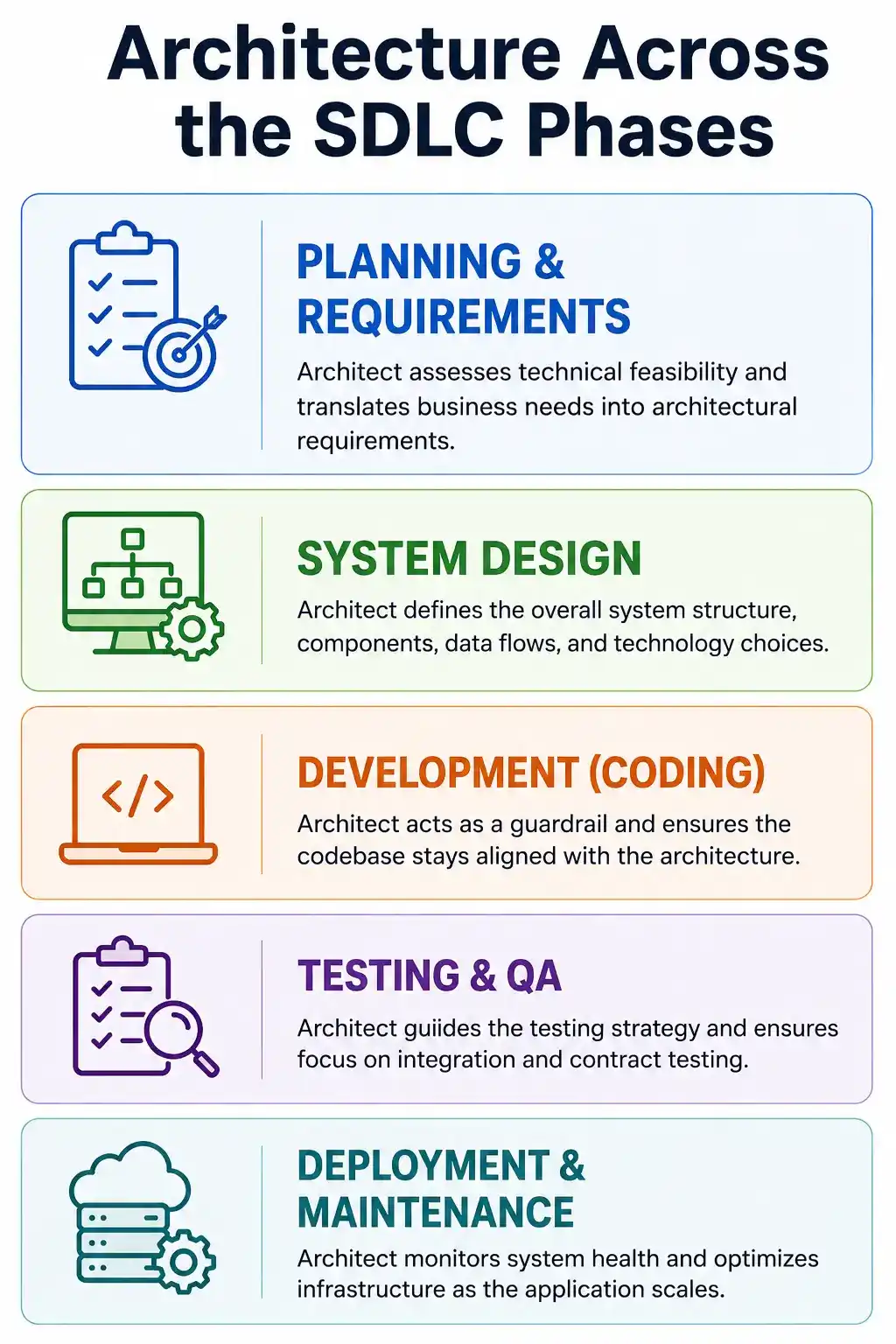
1. Planning & Requirements
- What happens: Product teams gather business requirements.
- The architectural role: The architect assesses technical feasibility. If the business requires real-time updates, the architect translates that need into an event-driven architecture rather than a traditional request-response model.
2. System Design
- What happens: High-level system engineering takes place.
- The architectural role: This is the architect’s main playground. They map data flows, define database structures, select cloud infrastructure, and establish code style and repository patterns for the engineering teams.
3. Development (Coding)
- What happens: Developers build out the features.
- The architectural role: The architect acts as a guardrail. They perform code reviews to prevent architectural drift, which occurs when quick fixes gradually degrade the system’s structural integrity.
4. Testing & QA
- What happens: The QA team identifies bugs and validates system functionality.
- The architectural role: The architecture guides the testing strategy. If the system relies heavily on interconnected microservices, the architect ensures the QA team prioritizes integration and contract testing over simple standalone unit testing.
5. Deployment & Maintenance
- What happens: The app goes live and receives updates.
- The architectural role: The architect monitors system health, performance bottlenecks, and server costs, adjusting the high-level infrastructure configuration as the real-world user base grows.
Best Practices for Integrating Architecture
- Rule 1: Adopt an Agile Architecture Mindset
Modern development practices discourage spending months creating a massive, unchangeable architecture document before development begins. Build a simple, sturdy baseline foundation first, and allow it to adapt as product requirements inevitably change over time.
- Rule 2: Create a Clear Architectural Runway
Ensure that core architectural elements, such as cloud infrastructure, database schemas, and authentication systems, are established one to two sprints ahead of feature development. If developers don’t have a solid framework ready to write code into, they will invent their own temporary workarounds, building up instant technical debt.
- Rule 3: Use the Architecture as Code Principle
Document your structural choices visually and programmatically. Use clear notation tools, such as the C4 Model (Containers, Components, Context, and Code diagrams), so any team member can easily see how the macro-system functions. Additionally, map out infrastructure configuration using code (e.g., Terraform) so your environment setup is readable and repeatable.
Conclusion
Software Architecture serves as the foundation of successful software development, guiding every stage of the SDLC from requirements gathering to maintenance. It helps organizations build secure, scalable, and efficient systems while ensuring technical decisions align with business objectives. By integrating architecture throughout the SDLC, teams can reduce risks, improve system quality, and support long-term growth.
If you want to gain practical experience in designing secure systems and implementing architectural best practices, InfosecTrain’s Security Architecture hands-on training can help you develop real-world skills through expert-led sessions and practical exercises.

TRAINING CALENDAR of Upcoming Batches For Security Architecture Training
| Start Date | End Date | Start - End Time | Batch Type | Training Mode | Batch Status | |
|---|---|---|---|---|---|---|
| 14-Nov-2026 | 06-Dec-2026 | 09:00 - 13:00 IST | Weekend | Online | [ Open ] |
Frequently Asked Questions
Where does architecture fit in the SDLC?
Architecture primarily sits between Requirements Analysis and Detailed Design, but it influences every phase of the SDLC from planning to maintenance. It serves as the bridge that converts business needs into technical solutions.
Why is software architecture important?
It provides a structured blueprint that helps teams build secure, scalable, maintainable, and high-performing systems. Strong architecture also reduces technical debt and future redesign efforts.
What is the architect's role during development?
Architects act as technical guardrails, ensuring developers follow architectural standards and preventing architectural drift. They also review critical design decisions and resolve technical challenges.
How does architecture support software testing?
Architecture helps define testing priorities, including performance, integration, scalability, and security testing based on the system design. This ensures the application meets both functional and non-functional requirements.
What is Agile or Evolutionary Architecture?
It is an approach in which architecture evolves alongside changing business requirements rather than being fixed in a large, upfront design document. This flexibility helps organizations adapt to new technologies and market demands more effectively.