Risk Categories of the EU AI Act
Quick Insights:
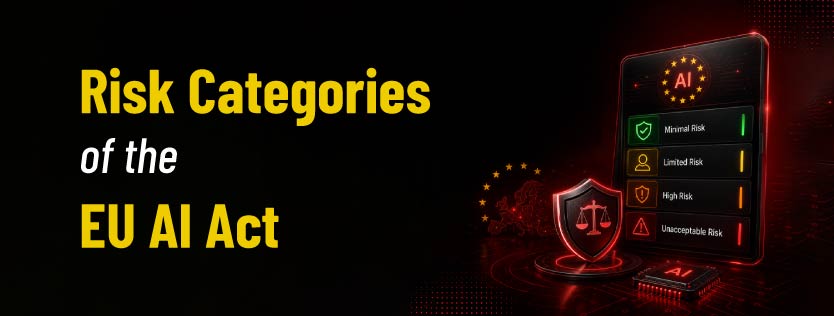
The EU’s new AI regulations sort all AI into four risk tiers: Unacceptable (prohibited), High-Risk, Limited-Risk, and Minimal-Risk. This risk-based approach tailors rules to potential harm. Prohibited AI, like social-scoring or manipulative behavior-analysis, is banned outright. High-risk AI (e.g., medical devices, law enforcement, credit scoring) demands strict oversight and conformity checks. Moderate systems (like chatbots or generative tools) fall under “limited risk” and must only disclose that “AI” is involved. Simple applications (spam filters, video games, recommendations) are minimal risk and face no mandated controls.
Why Does AI Regulations Matters?
AI is not sci-fi anymore; it is in millions of apps and devices. In fact, Microsoft reports 78% of enterprises now use AI technologies, getting about $3.70 in return for every dollar invested. But as AI spreads, so do new risks (fraud, bias, privacy invasion). Regulators realized that one-size-fits-all rules will not work. So the EU introduced the AI Act: a risk-based framework that assigns rules based on potential harm. In simple terms, it is like setting speed limits on a road: only the fastest, most dangerous vehicles get the strictest controls. The Act divides AI systems into four categories: from outright forbidden to almost free use, to keep innovation and public safety on track.
Risk Categories of the EU AI Act
Below are the 4 EU AI act risk categories.
1. Unacceptable (Prohibited) AI Systems
At the top of the danger chart are the “Unacceptable Risk” systems. These AI uses are banned completely because they threaten fundamental human rights or safety. They are like doing outright harm or extreme privacy violations. Examples include:
- Manipulative Social Scoring: AI that evaluates individuals based on behavior or traits, leading to unfair treatment (e.g., a social credit score).
- Exploitative Targeting: systems that prey on vulnerabilities (age, disability, or socioeconomic status) to sway decisions and cause harm.
- Subliminal Manipulation: AI applying hidden or deceptive tricks (e.g., subliminal ads) to distort behavior.
- Unauthorized Biometric ID: real-time facial or voice recognition in public without legal cause.
- Sensitive Trait Inference: categorizing people by race, religion, health, sexual orientation, etc.
- Emotion Detection in Schools/Work: AI reading emotions of people in educational or work settings (unless for medical/safety reasons).
Deploying any prohibited system is illegal, even with safeguards. Penalties are stiff: up to €35 million or 7% of global turnover. The only narrow exceptions allow police to use certain biometric tools for very serious crimes under strict oversight. In short, these applications are the AI Act’s red lines; avoid them entirely or face the highest fines.
2. High-Risk AI Systems
Next comes High-Risk AI, which is allowed but under heavy regulation. High-risk systems have a significant impact on people’s lives (health, jobs, legal status, safety). They fall into two buckets:
- AI in Regulated Products: Any AI built into products already covered by EU safety laws (e.g., medical devices, cars, airplanes, toys).
- Annex III Use-Cases: Specific applications listed in the Act’s Annex III. These include:
- Biometric Identification (face recognition systems).
- Critical Infrastructure Management (AI controlling power grids, transport, water, etc.).
- Education and Job Selection (automated grading, exam cheater detection, hiring software).
- Employment and Worker Management (CV screening, performance monitoring, promotion decisions).
- Access to Essential Services (credit scoring, insurance risk assessment, public benefits eligibility).
- Law Enforcement (recidivism risk scores, evidence assessment, predictive policing).
- Border Control/Migration (document screening, asylum decisions).
- Administration of Justice (AI assisting judges or lawyers in interpreting facts/laws).
AI systems in these areas automatically trigger the high-risk label (unless they are only doing a very narrow, preliminary task). Once labeled high-risk, providers must meet stringent requirements: they need a documented risk management process, rigorous data quality checks, detailed technical documentation, human oversight mechanisms, and registration in an EU database. In practice, this means conformity assessments before use, plus ongoing monitoring for safety. Examples of High-Risk AI Applications:
- AI-powered medical imaging in hospitals (tied to EU medical device rules).
- Autonomous driving or advanced driver-assist features in cars (covered by automotive safety laws).
- Credit scoring engines decide who gets loans.
- Airport security AI for behavior detection.
- Automated recruitment tools that filter or rank job applicants.
Getting high-risk classification right is vital. If you underestimate the risk, you could face fines up to €15 million or 3% of turnover for noncompliance. But the flip side is that properly managed high-risk AI can be certified and legally deployed across the EU.
3. Limited-Risk (Transparency) AI Systems
Limited-risk AI systems sit below high risk. These systems are not banned, but they have enough potential impact that users deserve to know they are interacting with AI. The core requirement is transparency. In practice, this covers:
- Interactive AI and Chatbots: Any chatbot, virtual assistant, or voice helper must clearly inform users that it is not human.
- AI-Generated Content: Synthetic media like deepfake videos, AI-written text, or images (e.g., news deepfakes, AI art) must be labeled as such.
- General-Purpose Models (GPTs, etc.): Large AI models exceeding systemic-risk thresholds have extra duties: evaluating model outputs, reporting incidents, and publishing a summary of training data (to comply with copyright).
- Biometric/Emotion ID (with consent): AI that recognizes identity or emotions is allowed if individuals opt in, but still requires disclosure.
Unlike high-risk systems, limited-risk AI does not require full third-party conformity testing or EU database registration. But Developers must follow basic rules (e.g., avoid illegal content) and be transparent to users.
Examples: Chatbots like customer service assistants, virtual voice helpers, algorithmic trading news bots, all must append a message like “You are talking to an AI system.” Even social media filters or recommendation algorithms fall here if they significantly process personal data in ways people should know about.
4. Minimal-Risk AI Systems
Finally, Minimal-risk AI systems are the broad “everything else” bucket. These are everyday AI applications with negligible harm potential. They include spam filters, basic recommendation engines, AI in video games, and simple office or inventory tools. Because they pose little risk, the Act imposes no specific obligations on them. Companies can use them freely, though they are encouraged to follow ethical AI guidelines and industry best practices on their own initiative.
Examples: An AI suggesting products on an e-commerce site, the NPC behavior logic in video games, or a calendar app that smartly sorts your meetings, these are all minimal risks. They can and should continue innovating without regulatory hurdles. In fact, letting minimal-risk AI flourish is one of the Act’s goals: to protect users without stifling innovation in low-impact tools.
Conclusion
This four-tier system is the heart of the EU AI Act’s risk-based strategy. By sorting AI by potential harm, regulators can focus resources on high-risk areas while keeping rules lightweight for benign tools. For businesses, it means the first step in compliance is classifying your AI. You start by checking if the use case is outright banned (unacceptable). If not, see if it matches any high-risk categories (Annex III or EU product safety laws). If still not high-risk, decide if a transparency requirement applies. Everything else is minimal risk.
Getting it wrong has consequences. The law demands a documented classification: a high-risk AI deployed without checks can cost you millions. But when done right, it provides legal clarity. Organizations know what box their AI sits in and which rules to follow. It is a bit like doing a safety audit: it might be extra work, but it keeps the whole machine running smoothly. In the coming years (the Act is fully enforceable by mid-2026), this classification will guide all AI deployment in the EU. Smart companies will treat it as a checklist: is this feature disallowed? Is it high-risk? If so, assign a compliance lead and document everything. If it is low-risk, maybe just add a disclaimer. The clearer you are, the safer your business.
InfosecTrain’s AIGP Certification Training helps professionals understand AI governance, risk classification, regulatory expectations, and responsible AI practices in a practical way. It prepares learners to confidently align AI systems with global governance requirements, including frameworks like the EU AI Act.
Ready to build your AI governance expertise? Enroll in InfosecTrain’s AIGP Training and learn how to manage AI risks with confidence.

TRAINING CALENDAR of Upcoming Batches For AIGP Training
| Start Date | End Date | Start - End Time | Batch Type | Training Mode | Batch Status | |
|---|---|---|---|---|---|---|
| 14-Nov-2026 | 29-Nov-2026 | 09:00 - 13:00 IST | Weekend | Online | [ Open ] | |
| 05-Dec-2026 | 20-Dec-2026 | 19:00 - 23:00 IST | Weekend | Online | [ Open ] | |
| 09-Jan-2027 | 24-Jan-2027 | 19:00 - 23:00 IST | Weekend | Online | [ Open ] | |
| 06-Feb-2027 | 21-Feb-2027 | 09:00 - 13:00 IST | Weekend | Online | [ Open ] | |
| 06-Mar-2027 | 21-Mar-2027 | 19:00 - 23:00 IST | Weekend | Online | [ Open ] |
Frequently Asked Questions
What are the four risk categories defined in the EU AI Act?
The EU AI Act categorizes AI systems into four levels based on their potential harm. They are: Unacceptable (prohibited): completely banned uses that threaten rights (e.g., social scoring, unauthorized facial recognition); High-Risk: powerful systems in critical fields (e.g., medical devices, credit scoring, law enforcement) requiring strict oversight; Limited-Risk: systems like chatbots or deepfake creators that need transparency (e.g., informing users they are dealing with AI); and Minimal-Risk: everyday tools (spam filters, game AI, recommendations) with no specific obligations.
Which AI systems are considered high-risk under the EU AI Act?
High-risk AI systems are those used in regulated products or sensitive applications listed in the Act’s annexes. In practice, this includes AI for employment and HR (hiring, CV screening, employee surveillance), education (automated exams, admissions), essential services (credit scoring, insurance underwriting), law enforcement and border control (crime prediction, document checks), migration and asylum decisions, judicial assistance, critical infrastructure management (power grids, transport, etc.), and biometric ID systems (face recognition, fingerprint ID).
What AI uses are banned by the EU AI Act?
The Act prohibits any AI practice deemed an unacceptable risk. Key banned examples include: AI that distorts people’s behavior (such as covert brainwashing or social scoring by governments); AI that exploits vulnerabilities of children, the elderly or disabled; unauthorized biometric surveillance (e.g., live face recognition in crowds); inferring sensitive personal traits (like sexual orientation or religious belief) without consent; and emotion recognition in workplaces or schools. These uses are illegal under any circumstances, with only narrow exceptions for law enforcement in dire situations.
What are the transparency requirements for “limited-risk” AI?
For limited-risk AI, the main rule is disclosure. Developers must ensure users know they are interacting with AI. For example, chatbots and virtual assistants should clearly say “I am an AI” at the start of a conversation. Any content generated by AI (images, text, video) must be marked as AI-created. Biometric or emotion recognition tools can be used only with individuals’ consent, and even then, users should be informed. Unlike high-risk AI, these systems do not need formal audits; they just need simple labels and adherence to basic laws (like not producing defamatory content).
What does “minimal-risk” AI mean under the EU AI Act?
Minimal-risk AI refers to applications with very low impact on rights or safety. This covers most consumer and business AI today (outside of the cases above). Examples are email spam filters, recommendation engines (like movie or product suggestions), simple chatbots that do routine tasks, and video game AI opponents. These systems are not subject to any mandatory AI Act obligations. In other words, you can deploy them freely without special compliance work.