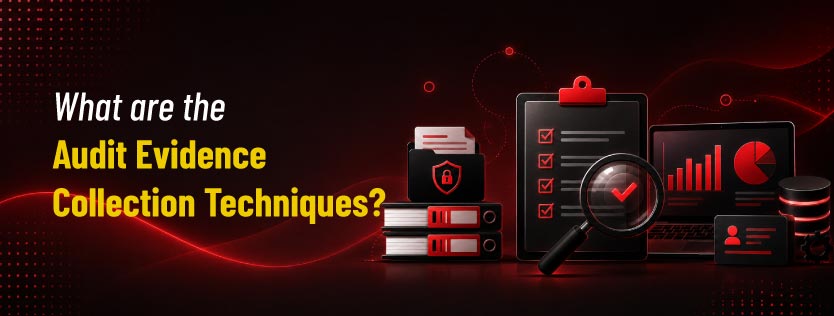
What are the Audit Evidence Collection Techniques?
Quick Insights:
Audit evidence collection techniques are the methods IT auditors use to gather objective evidence to support their compliance and security findings. Auditors combine seven distinct approaches: examining system records (Inspection), watching security staff work (Observation), interviewing technical engineers (Inquiry), pulling compliance reports directly from vendors (External Confirmation), verifying automated metrics (Recalculation), testing system rules in a sandbox (Re-performance), and cross-referencing massive employee files against software databases (Analytical Procedures). Mixing these strategies prevents superficial reviews and provides a legally sound assessment of an enterprise's risk posture.
Audit evidence collection techniques are the structured methods auditors use to gather undeniable proof supporting their compliance and security findings. These techniques enable an auditor to verify whether an organization’s IT systems are stable, secure, and operating in accordance with corporate policy. By utilizing a mix of physical, digital, and visual evidence, auditors ensure that their final evaluations are objective and accurate. Ultimately, mastering these collection methods is what transforms a surface-level checklist into a legally sound, enterprise-grade risk assessment.
Common Audit Evidence Collection Techniques
1. Inspection (Documentary Evidence)
Examining electronic records, hardcopy documents, or physical assets. This is the absolute bread and butter of auditing, serving as the paper-trail baseline for almost every IT control.
- Deep-Dive Methods: Auditors perform vouching (looking backward from a log entry to find its supporting approval ticket) and tracing (looking forward from an approval ticket to ensure it was properly recorded in the logs).
- IT Audit Example: Reviewing the written Change Management policy, analyzing system-generated user access logs from Active Directory, or inspecting physical asset tags on database servers.
- Reliability: High. Reliability increases significantly when logs are system-generated, tamper-proof, and stored in a secure, centralized write-once-read-many (WORM) architecture.
2. Observation (Visual Evidence)
Watching an operational process or security procedure being performed by employees in real-time. This technique helps auditors verify whether daily corporate behavior aligns with written corporate policy.
- Deep-Dive Methods: Walkthroughs are conducted where the auditor tags along during a standard task. It is highly situational and only proves that a control was operating effectively at the exact moment the auditor was standing there.
- IT Audit Example: Standing next to a data center guard to verify they check photo IDs and issue guest badges, or watching an IT admin perform a live tape-backup rotation.
- Reliability: Moderate. It is susceptible to the Hawthorne Effect (people temporarily perform tasks perfectly when they know they are being watched, but may cut corners once the auditor leaves).
3. Inquiry (Oral Evidence)
Seeking information, explanations, or contextual background from knowledgeable personnel inside or outside the organization.
- Deep-Dive Methods: Conducting structured face-to-face interviews, sending out formalized questionnaires, or holding pre-audit kickoff meetings. Inquiry is crucial for understanding the intent and design of an IT process before deep testing begins.
- IT Audit Example: Interviewing a Lead DevOps Engineer to understand how emergency code patches bypass standard approval queues during an active system outage.
- Reliability: Low on its own. Oral evidence is subjective and can be misunderstood. Professional auditing standards dictate that inquiry cannot stand alone; it must always be backed by independent, corroborating evidence.
4. External Confirmation (External Source)
Obtaining a direct, independent written response to the auditor from an objective third party outside the organization.
- Deep-Dive Methods: Sending formal verification letters, secure electronic data requests, or requesting official compliance certifications directly from a vendor rather than accepting a copy from the client.
- IT Audit Example: Reaching out directly to a cloud provider (like AWS, Azure, or Google Cloud) to verify active hosting boundaries, or obtaining an independent SOC 2 Type II report directly from a critical SaaS vendor.
- Reliability: Very High. Because this data originates outside the audited company, the risk of management manipulation, alteration, or internal collusion is drastically reduced.
5. Recalculation (Mathematical Evidence)
Checking and verifying the mathematical and arithmetic accuracy of digital documents, files, ledger totals, or automated system tallies.
- Deep-Dive Methods: Using computer-assisted audit tools (CAATs) to re-sum spreadsheets, recalculate interest/depreciation formulas hardcoded into business logic, or audit database record counts.
- IT Audit Example: Independently calculating data storage capacity thresholds to check if automated low-space alert triggers match reality, or recalculating transactional logs to ensure system data aggregates match financial dashboard outputs.
- Reliability: High. Since the auditor is performing the calculations directly using independent logic, the risk of calculation error is zero.
6. Re-performance (Procedural Evidence)
The auditor independently executes procedures or internal controls originally performed by the company’s IT or security teams to determine whether they yield identical results.
- Deep-Dive Methods: Running a parallel process or dry-run simulation using the company’s operating rules to evaluate the design and operational effectiveness of an automated script or manual review checklist.
- IT Audit Example: Taking a closed user provisioning ticket, looking up the corporate role matrix, and trying to manually recreate that exact user account permission set in a sandbox environment to verify the automated security rules block unauthorized access.
- Reliability: Highest (Internal). This provides direct, hands-on empirical proof to the auditor regarding whether an internal governance control actually works as advertised.
7. Analytical Procedures (Systemic Evidence)
Evaluating financial or operational data patterns by analyzing plausible, logical relationships among both financial and non-financial data sets.
- Deep-Dive Methods: Trend analysis (tracking metric shifts over time), ratio analysis, and anomaly detection. It is used to identify unexpected variances, ghost accounts, or systematic deviations that warrant a deeper investigation.
- IT Audit Example: Comparing the total number of enterprise software licenses purchased against the total number of active user accounts over the past 12 months to detect unmapped license waste, ghost accounts left behind by terminated employees, or unauthorized software usage trends.
- Reliability: High, but dependent. The reliability rests entirely on the integrity, cleanliness, and accuracy of the underlying data sources used in the analysis.
Conclusion
Choosing the right audit evidence collection technique is what separates a superficial baseline review from a highly reliable, legally defensible risk assessment. By balancing documentary inspection with hands-on re-performance and analytical data matching, auditors gather the objective proof required to verify that an enterprise’s IT systems are secure, compliant, and structurally sound.
To master these testing methodologies and build a globally recognized foundation in IT auditing, consider enrolling in the CISA Training Course with InfosecTrain to elevate your career in information systems security and governance.

TRAINING CALENDAR of Upcoming Batches For CISA Training
| Start Date | End Date | Start - End Time | Batch Type | Training Mode | Batch Status | |
|---|---|---|---|---|---|---|
| 31-Oct-2026 | 06-Dec-2026 | 19:00 - 23:00 IST | Weekend | Online | [ Open ] | |
| 28-Nov-2026 | 17-Jan-2027 | 09:00 - 12:00 IST | Weekend | Online | [ Open ] | |
| 07-Dec-2026 | 06-Jan-2027 | 21:00 - 23:00 IST | Weekday | Online | [ Open ] | |
| 30-Jan-2027 | 14-Mar-2027 | 09:00 - 12:00 IST | Weekend | Online | [ Open ] | |
| 27-Feb-2027 | 28-Mar-2027 | 19:00 - 23:00 IST | Weekend | Online | [ Open ] | |
| 27-Mar-2027 | 09-May-2027 | 09:00 - 12:00 IST | Weekend | Online | [ Open ] |
Frequently Asked Questions
What is the difference between Vouching and Tracing?
Vouching looks backward from a system log to find its approval ticket, proving the event was authorized. Tracing follows an approval forward into the system logs, proving the action was fully recorded.
Why can't an auditor rely on Inquiry alone?
Inquiry relies on verbal explanations, which can be subjective, inaccurate, or misunderstood. Audit standards require that interviews be low in reliability and must always be backed up by hard evidence, such as screenshots or system logs.
Why is Observation less reliable than Re-performance?
Observation suffers from the Hawthorne Effect: people act perfectly only while being watched. Re-performance is highly reliable because the auditor independently tests the control logic themselves, removing employee bias entirely.
How do Analytical Procedures catch security threats?
They scan for data anomalies across systems. For example, comparing an HR exit list with active software accounts instantly flags ghost accounts for fired employees that were never deactivated.
Why are system-generated reports highly trusted?
Automated logs eliminate human error and manual tampering. When stored in a secure, write-once-read-many (WORM) setup, they guarantee to the auditor that the evidence has not been altered since it occurred.