Generative AI Misuse: Risks Every Security Team Should Know
Quick Insights:
Generative AI misuse is making cyberattacks faster, cheaper, more personalized, and harder to detect. Attackers can use AI for phishing, deepfakes, synthetic identities, malicious code, prompt injection, data leakage, and unsafe automation. Security teams must focus on AI governance, employee awareness, secure AI usage policies, monitoring, AI red teaming, and practical AI security training to reduce these risks.
Generative AI has quickly moved from being a productivity tool to becoming a serious cybersecurity concern. From phishing emails that sound perfectly human to deepfake calls that imitate executives, attackers are using AI to scale, automate, and personalize cyberattacks. For security teams, the real challenge is not just “AI risk.” It is AI misuse: the use of large language models, AI agents, synthetic media, and automation to make cyber threats faster, cheaper, and harder to detect.

Industry reports already show this shift. Verizon’s 2026 Data Breach Investigations Report notes that threat actors are using AI to work faster across activities such as identifying gaps and writing malware. Microsoft’s Digital Defense Report 2025 also highlights how attackers are using AI to scale phishing, automate intrusions, and misuse deepfakes or AI-generated IDs to bypass verification.
Generative AI Misuse in Cybersecurity
Generative AI misuse refers to the malicious or unsafe use of AI tools to create, enhance, or automate cyber threats. This can include AI-generated phishing emails, malicious code generation, deepfake impersonation, fake documents, synthetic identities, prompt injection, data leakage, and manipulation of AI-powered systems.
The concern is not that AI creates a completely new category of cybercrime every time. The bigger issue is that it makes existing attacks more convincing, scalable, and accessible to low-skilled attackers.
That is why generative AI misuse has become a board-level, SOC-level, and governance-level concern.
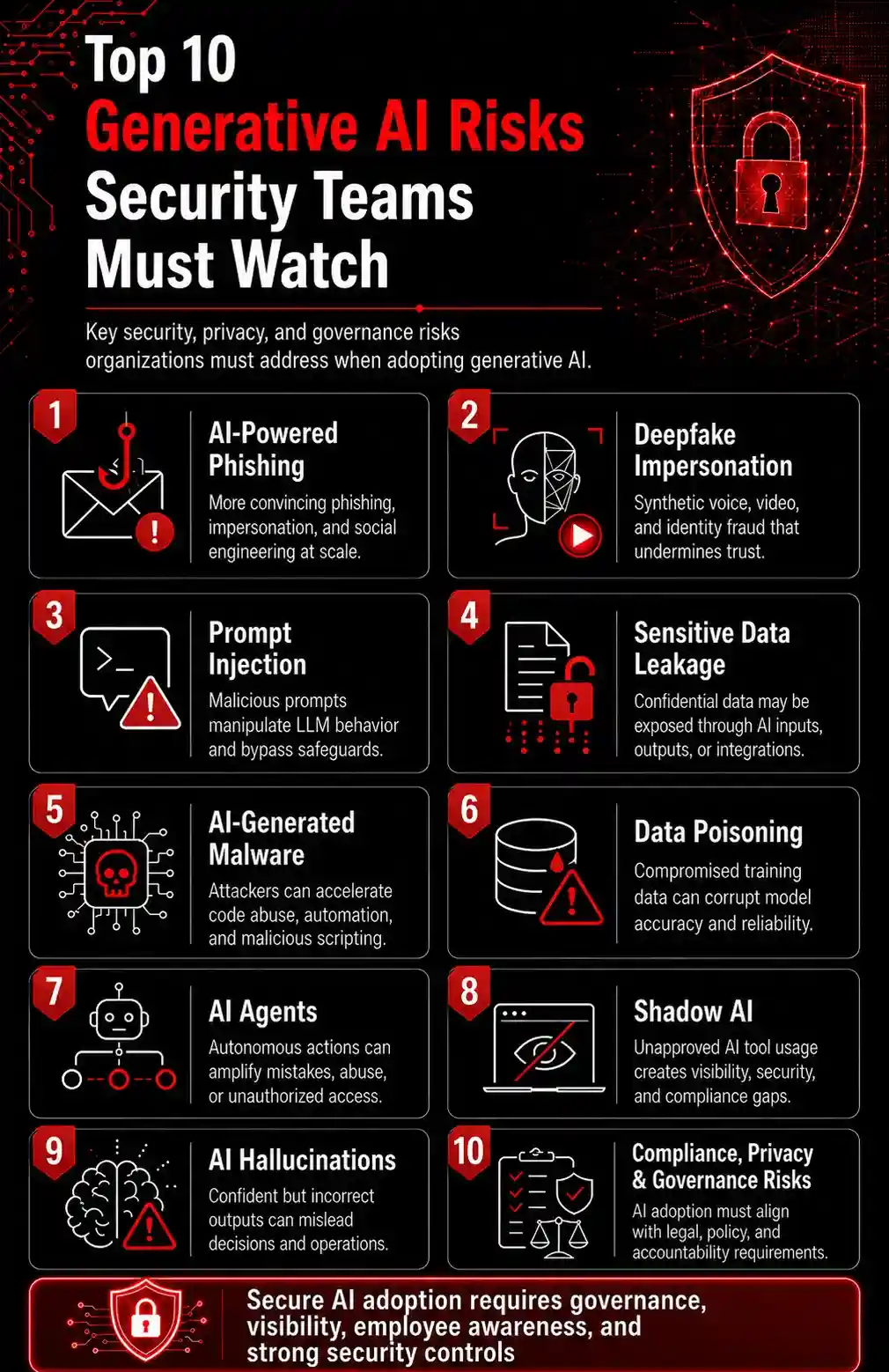
1. AI-Powered Phishing and Social Engineering
Generative AI has made phishing more convincing and harder to detect. Attackers can now create polished emails, LinkedIn messages, WhatsApp texts, fake support replies, and BEC messages that are personalized, emotionally persuasive, and context-aware.
By using job roles, company news, leaked data, or social media activity, AI enables highly targeted phishing attacks, making traditional “spot the typo” awareness training less effective.
Security teams should watch for AI-written spear-phishing emails, fake vendor communications, BEC messages, job scams, multilingual phishing campaigns, and hyper-personalized social engineering.
2. Deepfake Impersonation and Synthetic Identity Fraud
Deepfakes are not only limited to entertainment or misinformation. They are now being used in cybercrime, fraud, hiring scams, executive impersonation, and identity verification bypass. Attackers can use AI-generated audio, video, or images to impersonate CEOs, CFOs, HR teams, vendors, customers, or employees. This creates serious risk for finance teams, helpdesks, recruitment teams, and identity verification workflows.
Common deepfake misuse cases include:
- Fake CEO voice calls requesting urgent payments
- AI-generated video interviews by fraudulent candidates
- Synthetic IDs for account creation
- Fake employee profiles for insider access
- Deepfake customer verification bypass
- Voice cloning for vishing attacks
3. Prompt Injection Attacks on LLM Applications
Prompt injection is one of the most important security risks in generative AI systems. It occurs when a malicious input manipulates an AI model into ignoring instructions, revealing sensitive data, performing unintended actions, or misusing connected tools.
OWASP lists prompt injection as a top risk for LLM and generative AI applications. Prompt injection becomes more serious when AI systems are connected to email inboxes, CRMs, internal documents, code repositories, databases, APIs, plugins, cloud environments, or autonomous agents.
4. Sensitive Data Leakage Through AI Tools
Employees often use generative AI tools to summarize documents, write emails, debug code, create reports, or analyze data. Without proper controls, they may unknowingly paste confidential information into public or unmanaged AI systems. This can expose:
- Customer data
- Source code
- API keys
- Internal policies
- Financial reports
- Legal documents
- Credentials
- Incident response details
- Personally identifiable information
- Regulated data
OWASP identifies sensitive information disclosure as a key LLM risk, warning that failure to protect sensitive information in LLM outputs can lead to legal consequences and loss of competitive advantage.
5. AI-Generated Malware and Code Abuse
Generative AI can assist developers, but the same capability can be misused by attackers. Threat actors may use AI to generate scripts, improve malware logic, write obfuscated code, automate reconnaissance, create phishing kits, or troubleshoot malicious payloads.
The risk is not only advanced malware. The larger concern is attacker acceleration. AI can reduce the time required to build, test, modify, and scale malicious code.
Security teams should be alert to AI-assisted malware development, malicious PowerShell generation, credential theft scripts, obfuscated code, automated vulnerability discovery, and AI-assisted exploit chaining.
6. Data Poisoning and Model Manipulation
Generative AI systems depend heavily on data. If attackers can manipulate training data, retrieval sources, embeddings, documents, feedback loops, or model inputs, they may influence the output of AI systems. This is known as data poisoning or model manipulation.
For organizations using AI in security operations, customer support, fraud detection, hiring, legal review, or compliance, poisoned data can create dangerous consequences. An AI system may start recommending wrong actions, ignoring certain threats, producing biased decisions, or leaking manipulated responses.
7. AI Agents
AI agents can plan, decide, and take actions across tools. This makes them powerful and risky. If an AI agent has access to email, files, ticketing systems, cloud consoles, code repositories, or business applications, a successful prompt injection or permission misuse can have real operational impact.
Risks include:
- Unauthorized email actions
- Accidental data sharing
- Unsafe code changes
- Cloud misconfiguration
- Automated policy violations
- Tool misuse through malicious instructions
- Privilege escalation through connected plugins
8. Shadow AI in the Workplace
Shadow AI refers to the unsanctioned usage of AI tools by employees without approval from security, IT, legal, privacy, or compliance teams. This is one of the fastest-growing AI governance challenges because employees often use AI tools to save time. They may not realize that uploading a proposal, source code, contract, client list, or incident report into an unmanaged AI platform can create data exposure and compliance risk.
Shadow AI can lead to:
- Data leakage
- Unapproved third-party risk
- Regulatory violations
- Loss of intellectual property
- Inconsistent outputs
- Insecure AI-generated code
- Lack of audit trails
9. AI Hallucinations in Security Operations
AI hallucination happens when a generative AI system produces incorrect, misleading, or fabricated information with confidence. In cybersecurity, this can be risky. A hallucinated command, fake CVE explanation, incorrect incident response step, or false compliance interpretation can mislead analysts and delay response.
10. Compliance, Privacy, and Governance Risks
Generative AI misuse is not only a technical issue. It also affects governance, privacy, compliance, audit readiness, and legal exposure. NIST’s AI Risk Management Framework was developed to help organizations manage risks associated with AI across individuals, organizations, and society. For security and governance teams, this means AI risk must be included in:
- Risk assessments
- Vendor due diligence
- Data protection impact assessments
- Acceptable use policies
- Incident response plans
- Third-party risk management
- Access control reviews
- Compliance documentation
- Security awareness programs
Organizations that adopt AI without governance may increase their exposure to data breaches, privacy violations, model misuse, and regulatory scrutiny.
How Security Teams Can Reduce Generative AI Misuse Risk?
Generative AI misuse cannot be solved with one tool. It requires a layered defense strategy covering people, process, technology, and governance.
Security teams should start with these practical controls:
- Create a clear AI acceptable use policy
- Maintain an inventory of approved and unapproved AI tools
- Block or monitor risky AI platforms where needed
- Prevent employees from entering sensitive data into public AI tools
- Apply data loss prevention controls for AI usage
- Train employees on AI phishing, deepfakes, and prompt injection
- Validate AI-generated code before production use
- Use least privilege for AI agents and plugins
- Log and monitor AI system activity
- Red team AI applications before deployment
- Assess AI vendors for privacy, security, and compliance risks
- Include AI misuse scenarios in incident response exercises
- Map AI risks to frameworks such as OWASP LLM Top 10, NIST AI RMF, and MITRE ATLAS
The strongest defense is not fear of AI. It is secure, governed, and responsible AI adoption.
In Conclusion
Generative AI is not just another technology trend. It is a force multiplier for both defenders and attackers. For cybercriminals, it offers speed, scale, personalization, and automation. For security teams, it demands stronger governance, smarter detection, better awareness, and deeper technical understanding of AI-driven threats.
The future of cybersecurity will not be about humans versus AI. It will be about security teams that know how to defend, govern, and use AI responsibly against attackers who are already misusing it. Organizations that take timely action will be better prepared to defend against AI-powered phishing, deepfake fraud, data leakage, prompt injection, model manipulation, and unsafe automation.
Build AI Security Skills with InfosecTrain’s CompTIA SecAI+ Training
Want to understand how to secure AI systems and defend against AI-driven cyber threats?
InfosecTrain’s CompTIA SecAI+ Certification Training is designed for cybersecurity professionals who want to build practical, vendor-neutral expertise in AI security. The training helps learners understand key areas such as AI security fundamentals, securing AI models and systems, AI-assisted cybersecurity, adversarial AI risks, prompt injection, data poisoning, responsible AI usage, and AI governance, risk, and compliance.
Enroll in InfosecTrain’s CompTIA SecAI+ Training and prepare to secure the future of AI-powered cybersecurity.

TRAINING CALENDAR of Upcoming Batches For CompTIA SecAl+ Certification Training
| Start Date | End Date | Start - End Time | Batch Type | Training Mode | Batch Status | |
|---|---|---|---|---|---|---|
| 28-Nov-2026 | 03-Jan-2027 | 09:00 - 13:00 IST | Weekend | Online | [ Close ] |
Frequently Asked Questions
What is generative AI misuse in cybersecurity?
It is the malicious or unsafe use of AI tools to create, automate, or improve cyber threats such as phishing, deepfakes, malware, prompt injection, and data leakage.
Why is generative AI risky for security teams?
It helps attackers create more convincing, scalable, and personalized attacks with less effort.
How can employees create AI security risks?
Employees may unknowingly enter confidential data, source code, credentials, or client information into public or unmanaged AI tools.
What are prompt injection attacks?
Prompt injection attacks manipulate AI systems into ignoring instructions, exposing sensitive data, or performing unintended actions.
How can organizations reduce generative AI misuse risks?
They can use AI policies, approved tool lists, DLP controls, employee training, least privilege access, AI monitoring, vendor reviews, and AI red teaming.