Risk Treatment Strategies Explained
Quick Insights:
Risk treatment means choosing and implementing the most appropriate action to manage a risk after it has been identified and evaluated. The article explains four main risk treatment strategies: risk avoidance, risk transfer or sharing, risk mitigation or reduction, and risk acceptance. It highlights that the right choice depends on factors such as risk appetite, business value, cost, risk ownership, legal obligations, and residual risk.
A risk that is only identified but not treated is like a fire alarm with no emergency plan. You may know something can go wrong, but unless you decide how to respond, the organization remains exposed.
That is why risk treatment options are so important in cybersecurity and business risk management. They help organizations decide what to do after a risk has been identified, assessed, and prioritized. Should the business avoid the activity? Reduce the risk with controls? Share it with a third party? Or accept it because the cost of fixing it is higher than the actual impact?
This guide breaks down the major risk treatment strategies with real-world examples.
What is Risk Treatment?
Risk treatment is the process of deciding and applying the right response to a risk. Once an organization understands the likelihood and impact of a risk, the next step is to decide what action makes the most business sense. This decision is not always technical. It involves cost, business value, legal obligations, operational needs, customer trust, and leadership approval.
A strong risk treatment decision should consider:
- How serious the risk is
- Whether the risk is above or below the risk appetite
- Who owns the risk
- What controls are already in place
- What the treatment will cost
- What residual risk will remain
- Whether the business can justify the decision
Why Risk Treatment Strategies Matter
Every organization faces risk. The goal is not to remove all risk because that is impossible. The objective is to manage risk in a way that supports business objectives.
For example, an e-commerce business cannot avoid online payment risk completely because payments are central to its operations. A hospital cannot avoid patient data processing because it is necessary for care delivery. A SaaS company cannot avoid cloud dependency if its entire business model is cloud-based.
The Four Main Risk Treatment Strategies
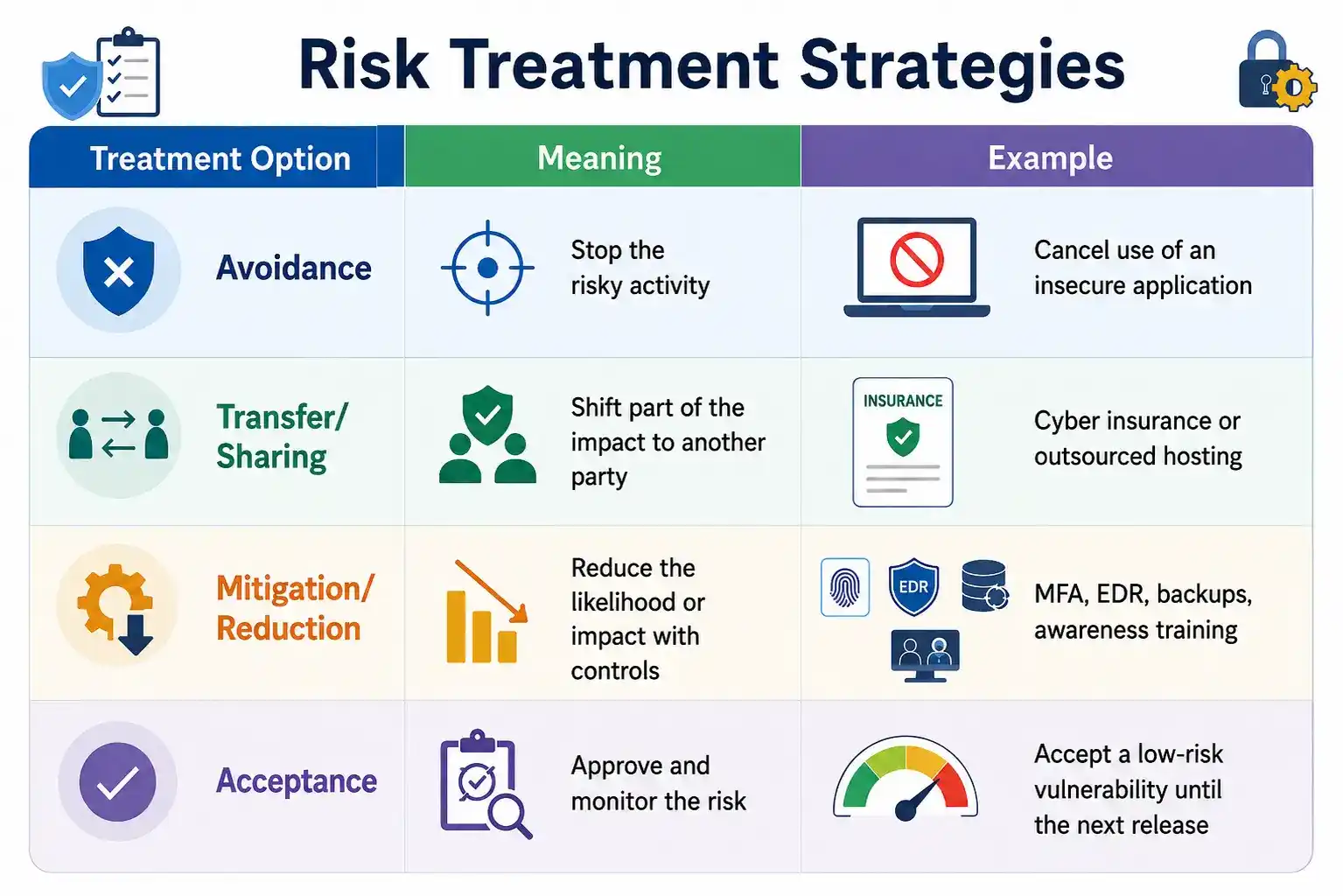
The four primary risk treatment options are:
- Risk Avoidance
- Risk Transfer or Risk Sharing
- Risk Mitigation or Risk Reduction
- Risk Acceptance
Each option has a different purpose. Choosing the right one depends on the risk level, business context, cost, and ownership.
1. Risk Avoidance
Risk avoidance means removing the activity, process, technology, or decision that creates the risk. This is the strongest response because the organization chooses not to take the risk at all. However, it is not always realistic. Avoidance may protect the organization, but it can also stop business growth, delay innovation, or limit operations.
For Example
A company plans to launch a new mobile app that collects sensitive customer data. During assessment, the security team discovers that the app has weak authentication, unclear privacy controls, and insecure API connections.
Fixing these issues would require a complete redesign. Launching the app in its current state could lead to data exposure, regulatory penalties, and reputational damage. The business decides to delay the launch until the app is rebuilt securely. That is risk avoidance.
2. Risk Transfer or Risk Sharing
Risk transfer or risk sharing means moving part of the financial, operational, or contractual impact of a risk to another party. This often happens through:
- Cyber insurance
- Outsourcing
- Cloud service providers
- Managed security service providers
- Vendor contracts
- Service-level agreements
- Liability clauses
But here is the important point: transferring risk does not mean transferring accountability completely. The organization may outsource a process, but it still has responsibility for governance, oversight, vendor due diligence, customer trust, and regulatory compliance.
For Example
A business uses a cloud provider to host customer data. The cloud provider manages physical security, infrastructure uptime, and some technical controls. The company also purchases cyber insurance to reduce financial impact in case of a breach. This is risk sharing or transfer.
However, the business still owns responsibilities such as:
- Access management
- Data classification
- Contract review
- Vendor monitoring
- Compliance obligations
- Incident response coordination
3. Risk Mitigation or Risk Reduction
Risk mitigation means reducing the likelihood or impact of a risk by applying controls. This is the most common risk treatment in cybersecurity. Most security programs rely heavily on mitigation because organizations usually cannot avoid every risk or transfer every responsibility.
Mitigation may include technical, administrative, physical, or procedural controls.
For Example
An organization identifies a high risk of phishing attacks. Instead of accepting the risk, it implements:
- Multi-factor authentication
- Email filtering
- Security awareness training
- Phishing simulations
- Endpoint detection and response
- Conditional access policies
- Incident reporting procedures
These controls reduce the chance of successful phishing and limit the damage if an attack happens. That is risk mitigation.
4. Risk Acceptance
Risk acceptance means the organization decides to live with the risk. This does not mean ignoring the risk. True risk acceptance is a formal and informed decision. It should be documented, approved by the right risk owner, and reviewed periodically.
Risk acceptance is often appropriate when the risk is low, the cost of treatment is too high, or the risk is already within the organization’s risk appetite.
For Example
A company has an internal reporting tool with a minor vulnerability. The application is not internet-facing, contains no sensitive customer data, and is only used by a small internal team.
Fixing the issue would require major redevelopment, but the potential impact is low. The business owner formally accepts the risk until the next planned upgrade. That is risk acceptance.
How to Choose the Right Risk Treatment Strategy
Choosing the right response is not about personal preference. It should follow a structured decision process.
- Compare the Risk Against Risk Appetite: If the risk is below the organization’s risk appetite, acceptance may be suitable. If it is above risk appetite, treatment is usually required.
- Understand Business Value: If the risky activity supports a critical business function, avoidance may not be realistic. The organization may need mitigation, transfer, or both.
- Evaluate Cost vs Benefit: A control should not cost more than the value it protects unless there are legal, safety, or reputational reasons to justify it.
- Identify the Risk Owner: Every risk should have an owner. Security teams can advise, but business owners must be involved in risk decisions.
- Consider Legal and Regulatory Impact: Some risks cannot simply be accepted because laws, contracts, or regulatory obligations require treatment.
- Monitor Residual Risk: Risk treatment is not a one-time exercise. Business conditions, threat actors, technologies, vendors, and regulations change.
In Conclusion
Risk treatment is not about choosing the most aggressive security option. It is about choosing the smartest business response. A strong organization knows when to stop a risky activity, when to reduce exposure, when to share the impact, and when to accept the remaining risk. These choices shape security maturity, compliance readiness, operational resilience, and executive trust.
Ready to Strengthen Your CISM Exam Preparation?
Understanding risk treatment is essential for anyone preparing for the CISM certification, especially because CISM Risk Management focuses heavily on business-aligned decision-making, governance, and practical risk treatment.
InfosecTrain’s CISM Certification Training helps professionals master risk governance, information security program management, incident response, and real-world risk treatment strategies through expert-led training and exam-focused guidance.

TRAINING CALENDAR of Upcoming Batches For CISM Training
| Start Date | End Date | Start - End Time | Batch Type | Training Mode | Batch Status | |
|---|---|---|---|---|---|---|
| 14-Nov-2026 | 06-Dec-2026 | 09:00 - 13:00 IST | Weekend | Online | [ Open ] | |
| 05-Dec-2026 | 10-Jan-2027 | 09:00 - 13:00 IST | Weekend | Online | [ Open ] | |
| 19-Dec-2026 | 17-Jan-2027 | 19:00 - 23:00 IST | Weekend | Online | [ Open ] | |
| 23-Jan-2027 | 14-Feb-2027 | 09:00 - 13:00 IST | Weekend | Online | [ Open ] | |
| 13-Feb-2027 | 07-Mar-2027 | 19:00 - 23:00 IST | Weekend | Online | [ Open ] | |
| 20-Mar-2027 | 11-Apr-2027 | 09:00 - 13:00 IST | Weekend | Online | [ Open ] |
Frequently Asked Questions
What are the four main risk treatment options?
The four main risk treatment options are avoidance, transfer or sharing, mitigation or reduction, and acceptance.
What is the distinction between risk avoidance and risk mitigation?
Risk avoidance stops the activity, while risk mitigation continues the activity while reducing risk through controls.
Does risk transfer remove accountability?
No. Risk transfer may shift part of the impact, but the organization still remains accountable for governance and oversight.
When should an organization accept risk?
Risk may be accepted when it is within tolerance, has a low impact, or costs more to treat than the expected loss.
What is residual risk?
It is the risk that remains after controls or treatment actions are applied.
What is the most common mistake in choosing a risk treatment?
The most common mistake is assuming every risk must be mitigated instead of choosing the response that best fits business value, cost, and risk appetite.