How to Create an AI Risk Register?
Quick Insights:
An AI Risk Register is your organization’s central "black box" for identifying and mitigating threats like algorithmic bias, data leaks, and model hallucinations. By moving from reactive "management by anecdote" to a structured lifecycle approach; defining ownership, scoring impact, and automating controls, leaders can ensure their AI is not just innovative, but resilient and compliant.
AI is revolutionizing business at breakneck speed. 92% of companies plan to boost AI investments in the next three years, yet 60% of S&P 500 firms admit AI introduces material risks to their organization. The global AI market is projected to hit $480 billion by 2026 with a 60% year-over-year spending surge. But here’s the kicker: Gartner predicts 40% of emerging AI projects could be canceled by 2027 due to poor risk controls. In the public sector, 78% of organizations use AI in critical services, but only 31% maintain AI-specific risk registers.
With great power comes great responsibility. As AI systems spread into everything from customer service chatbots to financial decision engines, they bring new pitfalls: biased algorithms, unpredictable “black box” decisions, privacy leaks, and even clever cyber-attacks on AI models. In fact, 73% of business leaders believe generative AI introduces new security risks like data leaks, hallucinations, or biased outputs. If you are an IT or security leader, you can not afford to treat AI risks as an afterthought or rely on scattered emails and hope for the best. You need a plan; enter the AI Risk Register.
What is an AI Risk Register (and Why Do You Need One)?
An AI Risk Register is a living document (or database) that formally identifies, assesses, prioritizes, and tracks mitigation of risks across the AI system lifecycle. In other words, it is your single source of truth for all the “What could go wrong?” scenarios with your AI, from technical glitches to ethical landmines, and how you are handling them. Unlike a one-off audit report or a data science bug tracker, a proper AI Risk Register is continuous and holistic. It is not just about software bugs or cybersecurity; it covers everything: bias, legal compliance, privacy, and reputation, in one place.
Why is this important? Because AI risk does not disappear in the gaps between teams. When risks are handled ad hoc, you end up with “management by anecdote”, scattered tickets, and hallway conversations. This leads to unclear ownership, delayed fixes, and nasty surprises. AI risk that is not tracked centrally compounds in the shadows. A formal risk register brings discipline, accountability, and visibility. It forces your organization to move from reactive firefighting to proactive risk management, much like a seasoned pilot who uses a checklist for safety.
Key Components of an AI Risk Register
To build an effective AI risk register, first understand what it should include. Consistency is key: each risk entry should capture certain core information so nothing falls through the cracks. Here are the typical components of a high-impact AI risk register:
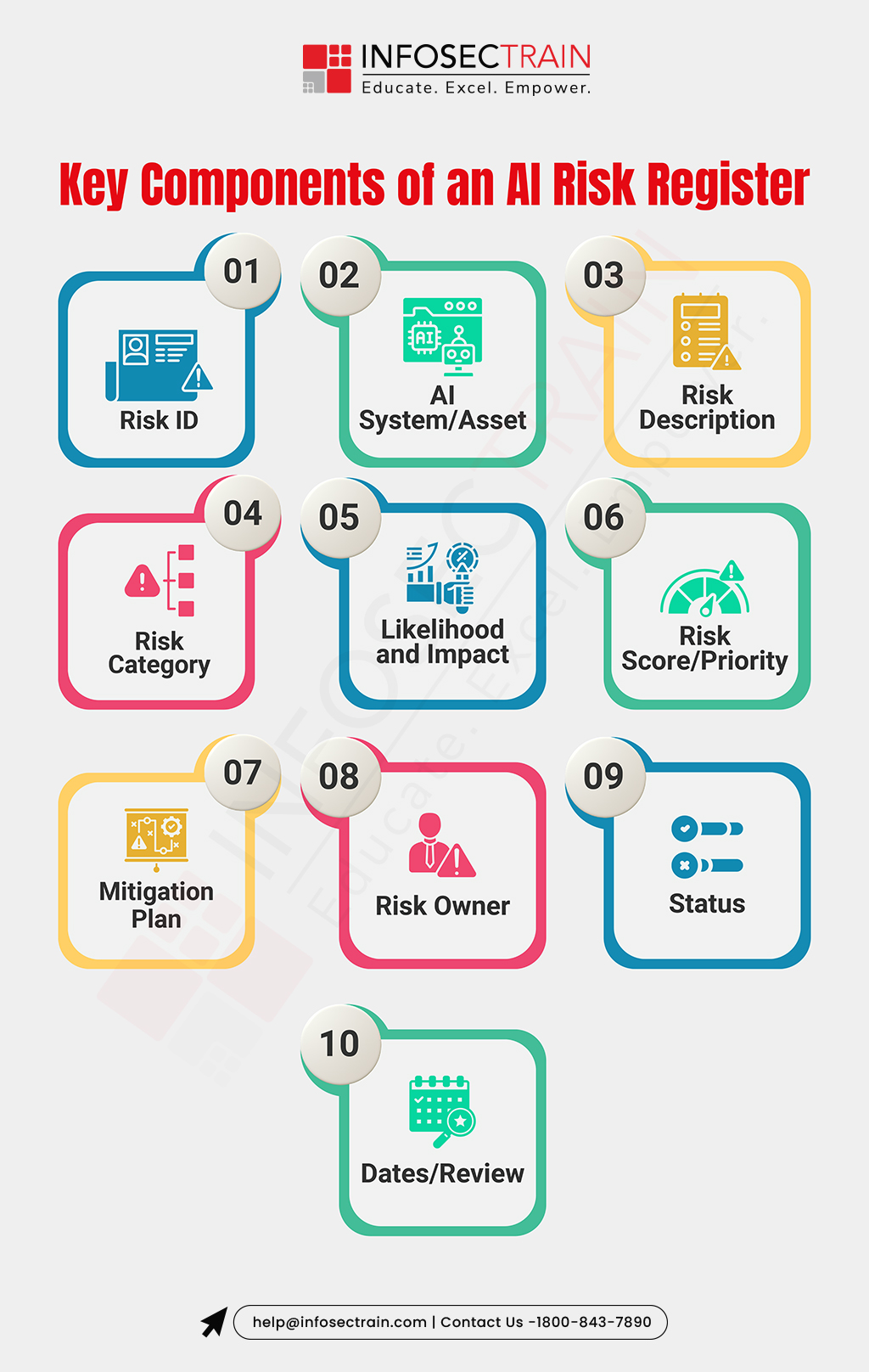
- Risk ID: A unique identifier for each risk (so you can track it easily).
- AI System/Asset: Which AI application, model, or process does this risk relate to? Be specific (e.g., “Chatbot X v2.1 in customer support”).
- Risk Description: A clear, concise summary of the potential issue or failure mode. For example, “Model may produce racially biased outputs due to underrepresentation in training data.”
- Risk Category: The type of risk. You can use a standard taxonomy: Technical/Operational (e.g., model errors, drift, security failure), Ethical/Societal (bias, unfair or unexplainable outcomes),
Legal/Regulatory (compliance violations like GDPR or AI Act issues), Business/Reputational (financial loss, brand damage from AI mistakes), etc. In practice, many organizations map AI risks into these broad quadrants to ensure all angles are covered.
- Likelihood and Impact: An assessment of how likely the risk is to occur and how severe the impact would be. Typically rated on a simple scale (e.g., Low/Medium/High or 1–5) for each dimension. This structured scoring brings objectivity; a minor inconvenience vs. a potential catastrophe should not be treated the same.
- Risk Score/Priority: Often, you will multiply, or matrix, the likelihood and impact to get an overall risk score. This helps rank which risks need urgent attention. For example, a likely-but-low-impact risk might be lower priority than a rare-but-disastrous one.
- Mitigation Plan: The specific actions or controls in place to mitigate the risk. This could be anything from retraining a model on more diverse data, to implementing human review checkpoints, to installing an adversarial attack detection system, whatever concrete steps will reduce either the likelihood of the risk or its impact.
- Risk Owner: A designated person or team responsible for this risk. Assigning an owner (e.g., a Data Science Lead for technical risks, a Compliance Officer for regulatory risks) creates accountability. As the saying goes, a risk without an owner is a risk nobody is managing.
- Status: The current status of the risk is Open (identified but not yet mitigated), In Progress (mitigation underway), Mitigated (controls in place and risk reduced to an acceptable level), or Accepted (recognized but decided to live with it)? This field ensures continuous tracking. Over time, you will update statuses and maybe even close out risks or discover new ones.
- Dates/Review: (Optional but recommended) Fields for when the risk was identified, next review date, and any updates. AI systems change, so you want a built-in reminder for periodic re-evaluation, say quarterly or after any major model update.
How to Build an AI Risk Register: Step-by-Step?
So, how do you go from a blank page to a robust AI risk register? Building it is a cross-disciplinary effort. Here’s a step-by-step approach to do it right:
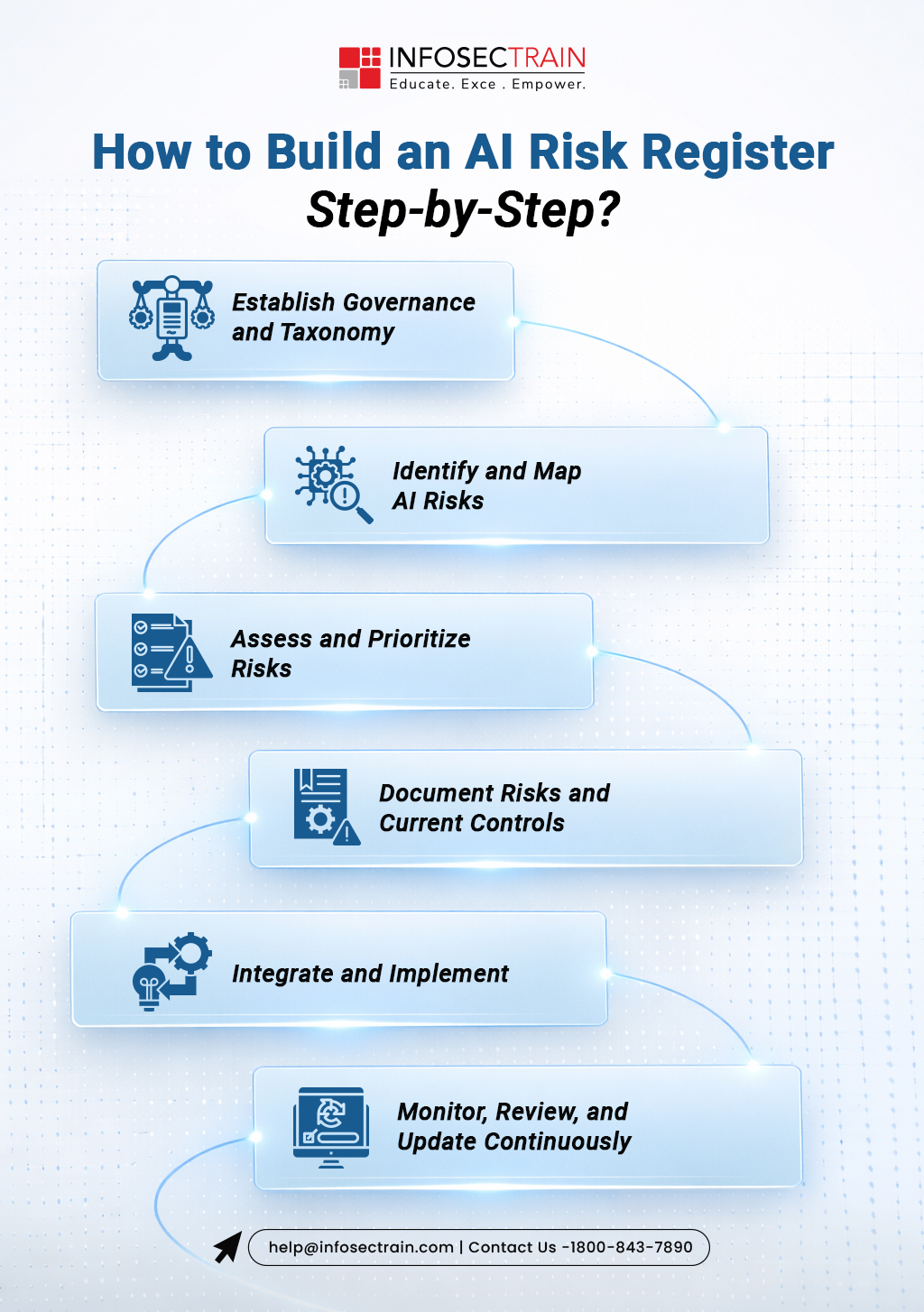
1. Establish Governance and Taxonomy: Start at the top. Form an AI risk governance committee or designate an existing risk committee to oversee AI risks. Include diverse experts: Data Scientists, Security, Compliance/Legal, Business Leaders, and Ethicists, so you have all perspectives in the room. This team will define the scope and risk appetite. Next, develop a standardized AI risk taxonomy; basically, agree on the risk categories and definitions you will use. For example, decide what “High, Medium, Low” impact means in monetary or safety terms, what falls under “ethical risk,” etc. Clear governance and a common language upfront will make the register far more effective. Also, set up reporting and escalation protocols; e.g., serious risks get flagged to senior management, to ensure leadership visibility.
Tip: Also establish guidelines for ethical AI use and a team to lead bias and risk reviews. This builds a culture of risk-aware AI development.
2. Identify and Map AI Risks: With governance in place, it is time to find the risks. This is a brainstorming and discovery phase. Gather stakeholders for workshops, the Data Scientists who built the model, the IT folks deploying it, the business users relying on it, and even external partners if relevant. Map out the AI system’s lifecycle and touchpoints: from data collection and model training to deployment and user interactions. At each point, ask “What could go wrong here?” Encourage open discussion of past incidents or near-misses; bias complaints, model errors, and outages; these are gold mines for risk identification. As you identify risks, categorize them (technical, ethical, etc.) to ensure you are covering all angles. For example, you might list technical risks like “model drift causing accuracy drop,” operational risks like “AI gives wrong decisions leading to process failure,” reputational risks like “AI chatbot says something offensive to customers,” and so on. This comprehensive risk mapping is the heart of your register.
3. Assess and Prioritize Risks: Not all risks are equal. Once you have a list of candidate risks, evaluate their likelihood and impact. This is where a simple risk matrix earns its keep. Rate each risk on how likely it is to occur and how bad it would be if it did. Many organizations use five-point scales or descriptors from “Very Low” to “Very High” for consistency. For example, “Model occasionally gives a slightly biased result” might be Low impact, whereas “Self-driving AI fails to recognize pedestrians” is Critical impact. Similarly, some issues are almost certain each week, while others are once-in-a-blue-moon. By scoring these, you can plot them and calculate a combined risk level. Prioritize the high-impact, higher-likelihood risks for action first. This step brings a data-driven rigor to your register, it helps avoid knee-jerk reactions to flashy but low-priority issues, and ensures serious threats do not get ignored. (Side benefit: This exercise also reveals your organization’s risk tolerance. You might decide certain low-impact risks are acceptable, while others need a “zero tolerance” stance.)
4. Document Risks and Current Controls: Now, start filling in the risk register entries for each identified risk. Use a consistent template (as outlined in the components section) so that every risk entry has all the essential fields. Write clear descriptions that anyone can grasp; avoid only technical jargon or vague statements. Importantly, for each risk, document existing controls or mitigations you already have. You might realize many AI risks have some safeguards in place (for example, maybe your model undergoes bias testing, which is a control for fairness risk). Link each risk to any relevant policies, technical controls, or compliance requirements. For example, if you list “data privacy breach via AI model inversion” as a risk, you need to note if you have data encryption, differential privacy techniques, or GDPR compliance checks as controls. This mapping of risks to controls and obligations not only shows where you are protected, but also highlights gaps where you need new mitigations. At this stage, you may formulate new action items: e.g., “Implement adversarial training to mitigate attack risk” or “Conduct quarterly bias audits”, and add these to the Mitigation Plan field for the risk. Essentially, you are building a roadmap of how each risk will be addressed. Ensure every risk also has an owner assigned at this point (someone responsible for carrying out those mitigation plans). Documentation might sound tedious, but the discipline you invest here pays off tenfold; you are creating a playbook that saves you from chaos later.
5. Integrate and Implement: A risk register should not live in a silo or gather dust on a shelf. Integrate it into your organization’s existing risk management and oversight processes. Merge the AI risk register with your enterprise risk register if you have one, or plug it into your GRC (Governance, Risk, Compliance) system. The idea is to manage AI risks alongside other operational and security risks, not separately. This avoids gaps and conflicting priorities. Many companies extend their internal audit or IT governance committees to review AI risks regularly; that’s a great practice to institutionalize AI risk oversight. Also, implement the mitigation actions you identified: for example, if a risk plan were to add human review for certain AI outputs, put that process in place now. Where possible, automate the tracking: use project management or ticketing tools to log tasks for each risk mitigation and monitor progress. An AI risk register is not a static spreadsheet; it should trigger a real workflow. By integrating it into team routines (e.g., risk owners have tasks and deadlines, management gets periodic reports), you ensure the register drives action.
6. Monitor, Review, and Update Continuously: Creating the register is not a one-and-done deal; it is an ongoing program. Monitor your AI systems and the effectiveness of your controls continuously. Set up alerts or dashboards for key indicators (model accuracy metrics, drift detection, incident reports) that might surface new risks or changes in risk levels. Conduct regular reviews of the risk register, at least quarterly, to update the status of risks and add any new ones. AI is fast-moving, a model update or a new use case can introduce fresh risks, and sometimes mitigations reduce a risk (so maybe its likelihood drops after a fix, record that). Bring your cross-functional committee together in these reviews to discuss what’s working and what’s not. Also, consider scenario testing or red-team exercises periodically: deliberately stress-test your AI (try to provoke failures or bias) to see if your register missed anything and to validate that controls hold up. As your AI matures, so will your risk register. Keep refining the taxonomy, dropping irrelevant risks, and adding emerging ones (e.g., “AI supply chain risk” as use of third-party models grows). Continuous improvement is the name of the game. Over time, a well-maintained risk register becomes a competitive advantage; it is proof that your organization can innovate in AI responsibly. You build trust with customers, Auditors, and your own C-suite because you can show you have got a handle on AI risks and compliance at all times.
Certified AI Governance Specialist (CAIGS) Training with InfosecTrain
AI offers incredible opportunities: efficiency, insight, innovation, but realizing those gains sustainably requires tackling the risks head-on. An AI risk register is your anchor of accountability in the exciting, turbulent sea of AI development. It forces the hard questions to be asked and answered now, rather than after a crisis. By creating an AI risk register and following the steps above, you are doing more than protecting against downside; you are building a foundation of trust. Trust in your AI from customers, employees, regulators, and your own executive team. And trust is a competitive edge in the age of AI.
But here’s the reality: building this level of governance requires the right skills, frameworks, and strategic mindset.
If you are serious about mastering AI governance, risk management, and compliance, Certified AI Governance Specialist (CAIGS) Training is designed for you. This program empowers professionals like Data Protection Officers, AI Architects, GRC leaders, and Security professionals to:
- Design and implement AI risk registers effectively
- Align AI systems with global regulations and governance frameworks
- Identify, assess, and mitigate AI risks across the lifecycle
- Build responsible, transparent, and trustworthy AI systems
Do not just build AI; govern it with confidence.
Do not just manage risks; turn them into strategic advantages.
Enroll in InfosecTrain’s Certified AI Governance Specialist (CAIGS) Training today and become the leader your organization needs in the age of responsible AI.

TRAINING CALENDAR of Upcoming Batches For Certified AI Governance Specialist (CAIGS) Training
| Start Date | End Date | Start - End Time | Batch Type | Training Mode | Batch Status | |
|---|---|---|---|---|---|---|
| 09-Nov-2026 | 17-Dec-2026 | 19:30 - 22:00 IST | Weekday | Online | [ Open ] | |
| 01-Feb-2027 | 04-Mar-2027 | 19:30 - 22:00 IST | Weekday | Online | [ Open ] |
Frequently Asked Questions
What are the essential Components of an AI Risk Register Template?
A robust template includes a Unique Risk ID, Risk Category (Technical, Ethical, Legal), Likelihood/Impact Scores, a detailed Mitigation Plan, and a Designated Risk Owner to ensure accountability throughout the AI lifecycle.
How to Conduct an AI Risk Assessment for Generative AI?
Focus on "Red Teaming" to trigger hallucinations or bias, evaluate data privacy regarding prompt inputs, and classify the system according to regulatory tiers (e.g., EU AI Act) to determine necessary oversight levels.
Traditional IT Risk vs. AI Risk Management
Traditional IT risk manages deterministic failures (crashes/bugs), while AI risk addresses probabilistic failures like model drift, "black box" unpredictability, and ethical biases that emerge silently over time.
What is a step-by-step AI Risk Management Framework Implementation?
Define your governance and taxonomy, identify and score risks using a likelihood/impact matrix, document existing controls, and integrate the register into continuous monitoring workflows for real-time updates.
Why AI Projects Fail & How a Risk Register Helps?
Projects often fail due to unmanaged "trust gaps" and hidden costs; a risk register solves this by providing transparency, documenting compliance for auditors, and forcing early alignment between technical capabilities and business ethics.