How to Create an Information Security Policy for ISO 27001?
In an era of skyrocketing cyber threats, organizations can not afford to be “easy targets.” According to a recent SecureWorks report, global cybercrime is on pace to cost $9.5 trillion in 2024 and will reach $10.5 trillion by 2025. This tidal wave of risk makes ISO/IEC 27001, the international Information Security Management standard, more critical than ever. A strong ISO 27001 framework starts with a clear information security policy, which sets the tone for protecting your data, builds customer trust, and can even cut breach costs by nearly a third. In this article, we’ll break down how to write that policy step by step, with pitfalls to avoid.
What is an Information Security Policy?
An information security policy outlines the organization’s overall approach and commitment to protecting its information assets, setting clear direction and expectations from top management. It establishes “minimum standards of privacy and IT security” and guides everyone on handling sensitive data. In simple terms, it is the rulebook that says what matters and who does what. An effective policy ensures Confidentiality, Integrity, and Availability (the CIA triad) of data by spelling out the organization’s objectives, legal requirements, and employee responsibilities.
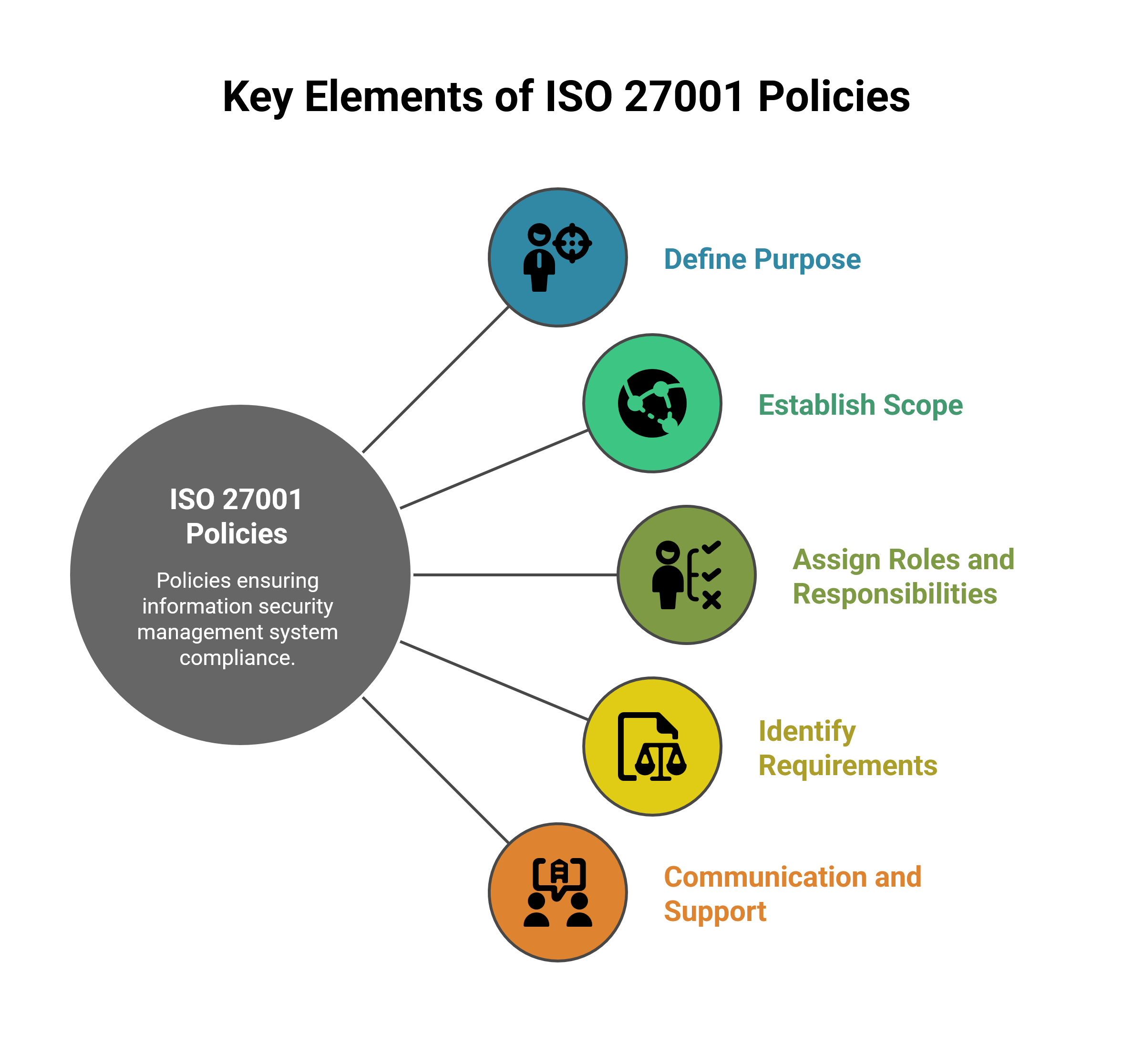
ISO 27001 (Annex A.5.1) mandates that security policies must receive management approval and be effectively communicated to employees and other relevant stakeholders. In practice, a master policy will typically include:
Step-by-Step Guide to Implement ISO Policy
1. Define Your Scope and Objectives
The first step is to decide what you are protecting and why. A common mistake is choosing a scope that is either too narrow or too broad. If it is too broad, you will dilute your efforts; if it is too narrow, you risk leaving gaps. The key is to balance coverage with focus by doing a careful risk assessment. Identify all information assets (data, systems, facilities) and figure out where your greatest vulnerabilities lie. Consider internal operations and external interactions (like suppliers or cloud services) that could affect security.
Once the assets and boundaries are clear, write a scope statement that specifies which locations, departments, and information types are included. For example: “This policy applies to all networked systems and data processing activities in our sales and customer support departments across all our offices.”
2. Secure Leadership Buy-in and Define Ownership
No matter how well-written, a policy will not stick without management support. ISO 27001 is as much a business initiative as a technical one. Involve senior leadership early: explain the ROI of security (reduced breach costs, compliance benefits, customer trust) and how a policy will “integrate the ISMS into the business’s core strategy”. Executives must approve and champion the policy; their backing signals that security is a priority. The policy itself should explicitly “demonstrate management’s commitment” to the ISMS.
That means having the CEO or CISO sign off on it and publicly supporting training or budget for security initiatives. Also, assign a policy owner, a senior role responsible for maintaining and updating it. As one Auditor’s checklist advises: “Assign an owner who’s responsible for keeping the information security policy up to date and ensuring it gets reviewed at least annually.”
3. Outline the Policy Structure (Key Elements)
With scope and buy-in sorted, turn to the content of the policy. ISO 27001 requires that the policy be tailored to the organization, so avoid boilerplate. Write in plain language using a concise structure, a page or two is often enough for a high-level policy. At a minimum, cover these sections (expert sources suggest including purpose, requirements, roles, communication, and support).
- Purpose: State the overall information security objectives. For example, “our goal is to protect customer data from unauthorized access while ensuring systems are reliable and available.”
- Requirements: List the major legal or regulatory requirements the organization must meet (e.g., GDPR, SOX, HIPAA) and any industry standards. This ties the policy to tangible obligations.
- Roles and Responsibilities: Describe who is responsible for the ISMS’s various functions (e.g., risk assessment, security monitoring, incident response). For example, “The CISO is responsible for overall ISMS performance; department heads must ensure their teams follow relevant procedures.”
- Communication: Clarify who needs to read the policy. Mention that it will be shared with all employees and relevant third parties (vendors, contractors) as needed. This ensures no stakeholder is “in the dark” about security rules.
- Support: Note any resources that back the policy (training programs, technical tools, other detailed procedures). For example, “We will support this policy with mandatory annual security training and enforce the related Access Control and Incident Response policies.”
4. Integrate Risk Management
ISO 27001 is fundamentally risk-based, so your policy must reflect the risks you have identified. Use your risk assessment to inform what the policy emphasizes. For example, if your top risk is data leakage from remote workers, the policy might stress rules for remote access and device security. If phishing is a concern, mention controls like MFA or email filtering.
Policy and risk management go hand in hand: “Risk assessments should inform the policies you choose to implement so that they are targeted, effective and aligned with the risks”. When drafting, refer back to the highest-ranked risks in your organization.
5. Engage Employees and Communicate
A policy only works if people know about it and understand it. Build a security-aware culture by communicating the policy clearly to every employee (and new hire). According to ISO 27001 Annex A.6.3, organizations must implement information security and privacy awareness training. Announce the policy with a company-wide email or training session that explains why it matters. Emphasize each person’s role: for example, tell staff, “your responsibility includes reporting suspicious emails,” or “you must lock your workstation when away.”
6. Assign Responsibility and Schedule Reviews
Beyond the policy owner (from Step 2), make sure roles and duties are crystal clear. For example, define who does the risk assessments, who conducts internal audits, and who leads incident response. You can detail these in the policy or reference job descriptions and procedures. Many organizations incorporate security responsibilities into job contracts or handbooks so there’s no ambiguity. The induction process is a perfect time to highlight these roles (e.g., “As a member of the IT team, you will be assigned to our weekly security review meetings”).
Common Pitfalls to Avoid
Building a policy is not without traps. Here are some pitfalls to watch out for:
- Overly Broad or Narrow Scope: Don’t make the scope so broad that it is unmanageable or so narrow that key assets are left out. Do the proper risk scoping up front.
- Lack of Executive Support: Without management buy-in, the policy is just paper. Get leaders involved from the start and have them endorse the policy statements.
- Too Technical or Too Vague: Avoid writing the policy as an IT manual or, conversely, as high-level fluff. Strike a balance: say enough to guide behavior but leave detailed controls to supporting procedures. Focus on “big picture” rules in the policy itself.
- No Owner or Update Plan: A policy left unchecked quickly becomes irrelevant. Assign clear ownership and stick to review timelines.
- Poor Communication: Do not assume employees will read the policy on their own. Many policies fail because staff are not aware of or do not understand them. Invest in training and reminders.
- Siloed Approach: Do not treat ISO 27001 as just an IT project. Security affects the whole company. Involve HR, operations, and other departments so the policy works for everyone.
ISO 27001 Lead Implementer and Lead Auditor Training with InfosecTrain
Creating an information security policy for ISO 27001 is not just paperwork; it is the backbone of a strong security posture. A clear, well-crafted policy sets expectations, aligns with business goals, and proves to Auditors and stakeholders that your organization is serious about data protection.
At InfosecTrain, our ISO 27001 Lead Implementer and Lead Auditor Training equips you with the practical skills to design, implement, and audit robust information security policies that meet global standards. Whether you are building a policy from scratch or refining an existing ISMS, our courses guide you through every critical step.

Step up and shape the future of your organization’s cybersecurity.
Start your ISO 27001 journey with InfosecTrain today.
TRAINING CALENDAR of Upcoming Batches For ISO 27001 Lead Implementer Training
| Start Date | End Date | Start - End Time | Batch Type | Training Mode | Batch Status | |
|---|---|---|---|---|---|---|
| 16-Jan-2027 | 21-Feb-2027 | 09:00 - 13:00 IST | Weekend | Online | [ Open ] | |
| 13-Mar-2027 | 11-Apr-2027 | 09:00 - 13:00 IST | Weekend | Online | [ Open ] |

TRAINING CALENDAR of Upcoming Batches For ISO 27001 Lead Auditor Training
| Start Date | End Date | Start - End Time | Batch Type | Training Mode | Batch Status | |
|---|---|---|---|---|---|---|
| 28-Nov-2026 | 27-Dec-2026 | 09:00 - 13:00 IST | Weekend | Online | [ Open ] | |
| 13-Dec-2026 | 30-Jan-2027 | 09:00 - 13:00 IST | Weekend | Online | [ Open ] | |
| 09-Jan-2027 | 14-Feb-2027 | 19:00 - 23:00 IST | Weekend | Online | [ Open ] | |
| 14-Feb-2027 | 27-Mar-2027 | 09:00 - 13:00 IST | Weekend | Online | [ Open ] | |
| 13-Mar-2027 | 11-Apr-2027 | 19:00 - 23:00 IST | Weekend | Online | [ Open ] |