Is Red Teaming Still Worth It in the AI Era?
Quick Insights:
The blog explains that red teaming remains highly relevant in the AI era, but its scope and methods are evolving. AI is helping Red Teamers accelerate repetitive tasks such as reconnaissance, code analysis, test generation, data analysis, and reporting, allowing more time for strategy, creative attack chaining, validation, and business-impact analysis. At the same time, AI has expanded the attack surface, introducing LLMs, RAG systems, AI agents, models, APIs, and connected tools as new targets for adversarial testing. Risks such as prompt injection, RAG poisoning, excessive agency, unsafe tool usage, data exposure, and agent privilege escalation are becoming part of modern red-team assessments. The blog ultimately emphasizes a human-led, AI-augmented approach: traditional offensive-security fundamentals remain essential, while modern Red Teamers increasingly need AI and LLM security skills to test complex AI-powered environments effectively.
A few years ago, red teaming was mostly a human-versus-human game. Attackers searched for weaknesses, defenders tried to spot them, and both sides relied heavily on experience, tools, and intuition. AI has changed that by accelerating reconnaissance, code analysis, attack generation, and security testing while introducing new targets such as LLMs, RAG systems, and AI agents.

So, is red teaming still worth it in the AI era? Yes, but its role is evolving. Modern red teaming is no longer just about finding vulnerabilities. It’s about connecting weaknesses, bypassing defenses, testing AI systems, and understanding real business impact. AI can make red teams faster, but human expertise still determines what matters, where to look, and what to do next.
What Is Red Teaming?
Red teaming is an authorized security exercise that simulates the techniques and behavior of real-world attackers. Instead of focusing only on individual vulnerabilities, a red team attempts to achieve a defined objective, such as gaining access to sensitive information, compromising a critical system, or testing whether security teams can detect an intrusion.
This is what separates red teaming from routine vulnerability scanning. A scanner might tell you that a weakness exists. A red team investigates whether that weakness can be combined with other security gaps to create a realistic attack path.
A red team engagement may involve networks, web applications, APIs, Active Directory, cloud environments, endpoints, identities, employees, and security monitoring systems. In the AI era, LLMs, RAG applications, AI agents, models, and AI-connected tools are increasingly joining that list.
So, Is Red Teaming Still Worth It?
Yes. Red teaming remains valuable because AI has changed how attacks are performed, but it hasn’t removed the need for realistic adversary simulation. In fact, the growing use of AI has introduced additional systems, integrations, and trust boundaries that organizations need to test.
AI can automate repetitive tasks and help security professionals work faster. However, finding a vulnerability is only part of a red team’s job. The bigger challenge is understanding how an attacker might exploit several weaknesses together, avoid detection, adapt when an approach fails, and eventually reach an important business asset.
For example, an automated tool may identify a weak identity control and an exposed cloud resource as separate findings. A skilled Red Teamer may discover that compromising the identity provides access to the cloud resource, which then exposes credentials that open a path to a critical production environment.
How AI is Changing Red Teaming
AI isn’t replacing the entire red-team process. It is changing how quickly certain parts of that process can be completed. Red Teamers can use AI to process reconnaissance data, understand unfamiliar code, generate test variations, summarize tool output, and organize engagement notes. Tasks that once consumed a large part of an engagement can now be accelerated, giving testers more time to investigate complex attack paths.
The result is a shift in where human effort creates the most value. Instead of spending hours on repetitive work, Red Teamers can focus more heavily on strategy, validation, creative testing, and understanding the environment they are attacking.
Traditional Red Teaming vs. AI-Era Red Teaming
The basic goal hasn’t changed: simulate realistic adversary behavior and discover whether security controls can prevent, detect, and respond to it.
The target has changed considerably.
| Traditional Red Teaming | AI-Era Red Teaming |
| Network exploitation | Network exploitation + AI attack surfaces |
| Web application attacks | Web, API, LLM, and agent attacks |
| Credential attacks | Credential + AI identity/authorization abuse |
| Social engineering | AI-assisted social engineering |
| Privilege escalation | Traditional + agent/tool privilege escalation |
| Data exfiltration | Traditional + AI-mediated data leakage |
| EDR/SIEM evasion | Testing AI-assisted detection workflows |
| Manual reconnaissance | AI-assisted reconnaissance |
| Fixed attack playbooks | Faster adaptive attack generation |
| Human attacker simulation | Human-led, AI-augmented adversary simulation |
The important word here is augmented.
AI should make red teams faster. It shouldn’t remove human judgment from the exercise.
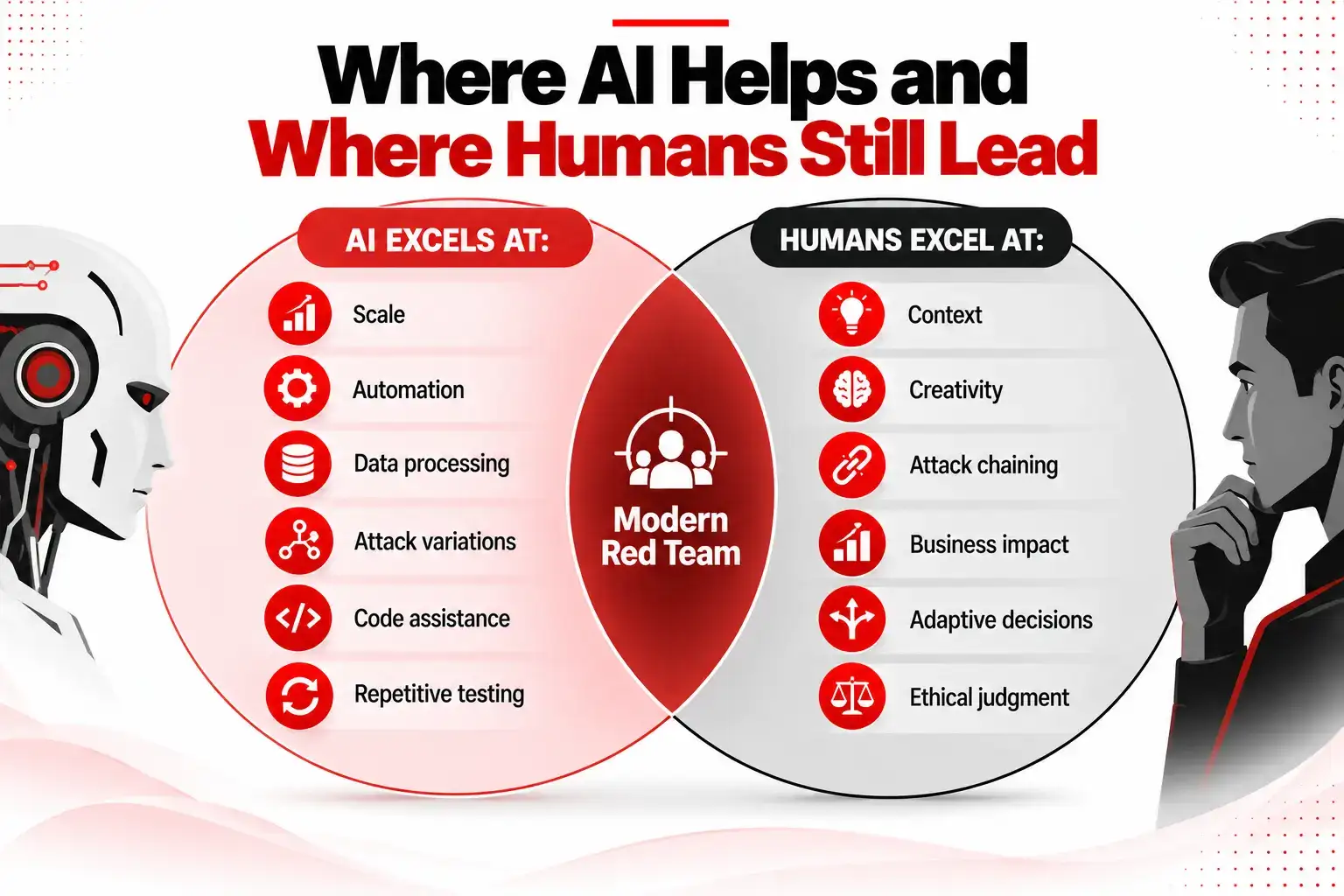
Where AI Makes Red Teams Better
AI is particularly useful when the work is repetitive or involves processing large amounts of information.
1. Faster Reconnaissance
Reconnaissance can produce a huge amount of information, including domains, technologies, exposed services, repositories, identities, and potential attack paths. AI can help organize and summarize this information so Red Teamers can identify areas that deserve deeper investigation.
2. Faster Script and Code Analysis
Red Teamers regularly encounter unfamiliar scripts, source code, APIs, and configurations. AI can help explain what code does, identify potentially interesting areas, or assist with small scripts needed during an engagement.
The output still needs human validation. AI-generated explanations and code can contain mistakes, so using AI effectively also means knowing when not to trust its answer.
3. Testing More Variations
Manual testing has practical limits. A person cannot realistically try thousands of variations of every input during an engagement.
AI-assisted tools can generate and evaluate larger sets of test cases. This capability becomes particularly useful when testing AI applications, where different wording, context, conversation history, and multi-turn interactions can produce different behavior.
4. Analyzing Large Amounts of Data
Red-team exercises generate logs, responses, configurations, screenshots, tool output, and other technical evidence. AI can help summarize this material and highlight relationships that may deserve attention.
This doesn’t mean letting AI decide whether a system is compromised. It means using AI to reduce the time spent sorting information so the tester can spend more time interpreting it.
5. Improving Reporting Workflows
Reporting is necessary, but formatting findings and organizing engagement notes can take considerable time. AI can help create initial summaries, structure technical evidence, and convert raw notes into clearer drafts.
The Red Teamer still needs to verify the technical details, severity, business impact, and remediation guidance before anything reaches the client.
Where Human Red Teamers Still Matter
AI is good at processing information quickly. Red teaming, however, requires more than processing information.
1. Understanding Business Context
Not every compromised system carries the same risk. Access to an internal test environment is different from access to production infrastructure containing sensitive customer information.
A Red Teamer needs to understand what the organization values, which assets matter most, and how a technical compromise could affect operations. Without that context, a technically impressive finding may have little practical significance.
2. Building Creative Attack Chains
Real attacks don’t always depend on a single critical vulnerability. An attacker might begin with publicly available information, compromise an account, abuse weak permissions, move into a cloud environment, discover credentials, and eventually access sensitive data.
Each weakness may appear manageable on its own. The danger becomes clear only when someone connects them. That ability to connect seemingly minor weaknesses into a meaningful attack path remains one of the strongest arguments for human-led red teaming.
3. Adapting to Defenders
Red teams may also test how well an organization’s SOC and incident-response teams respond to realistic attacker behavior. If defenders detect one technique, the red team may change tactics rather than continue following a predetermined script.
This creates a dynamic exercise. Human judgment becomes important because the attacker must constantly decide what to attempt, what to avoid, and how to proceed without creating unacceptable operational risk.
AI Has Also Created a New Target: AI Itself
There are two sides to AI and red teaming. The first is using AI to improve red-team operations. The second is red teaming AI systems themselves. Organizations are connecting LLMs to internal documents, databases, APIs, SaaS platforms, customer information, and business workflows. Some AI agents can even take actions through external tools. Every additional connection creates another potential security boundary.
AI red teaming therefore looks for weaknesses such as:
- Prompt injection
- Jailbreaking
- Sensitive information disclosure
- Insecure output handling
- RAG poisoning
- Model manipulation
- Excessive agency
- Unsafe tool usage
- Agent privilege escalation
- AI supply-chain weaknesses
- Memory manipulation
- Unauthorized API interaction
This changes the scope of offensive security. Red Teamers aren’t only asking whether they can compromise a server or application anymore. They may also need to determine whether an AI system can be manipulated into exposing information or taking an action it shouldn’t.
Agentic AI Makes Red Teaming Even More Important
Traditional chatbots mainly generate responses. AI agents can interact with other systems and take actions, which makes their security implications much broader. Consider an internal AI agent that can search corporate documents, read emails, query databases, and create support tickets. If an attacker successfully manipulates that agent, the impact depends heavily on the permissions and tools available to it.
That changes the security question from “Can someone make the model produce a bad response?” to “What can someone make the AI-powered system actually do?”
For red teams, that means testing the model, the surrounding application, connected tools, identity controls, authorization boundaries, data sources, and logging mechanisms as one system.
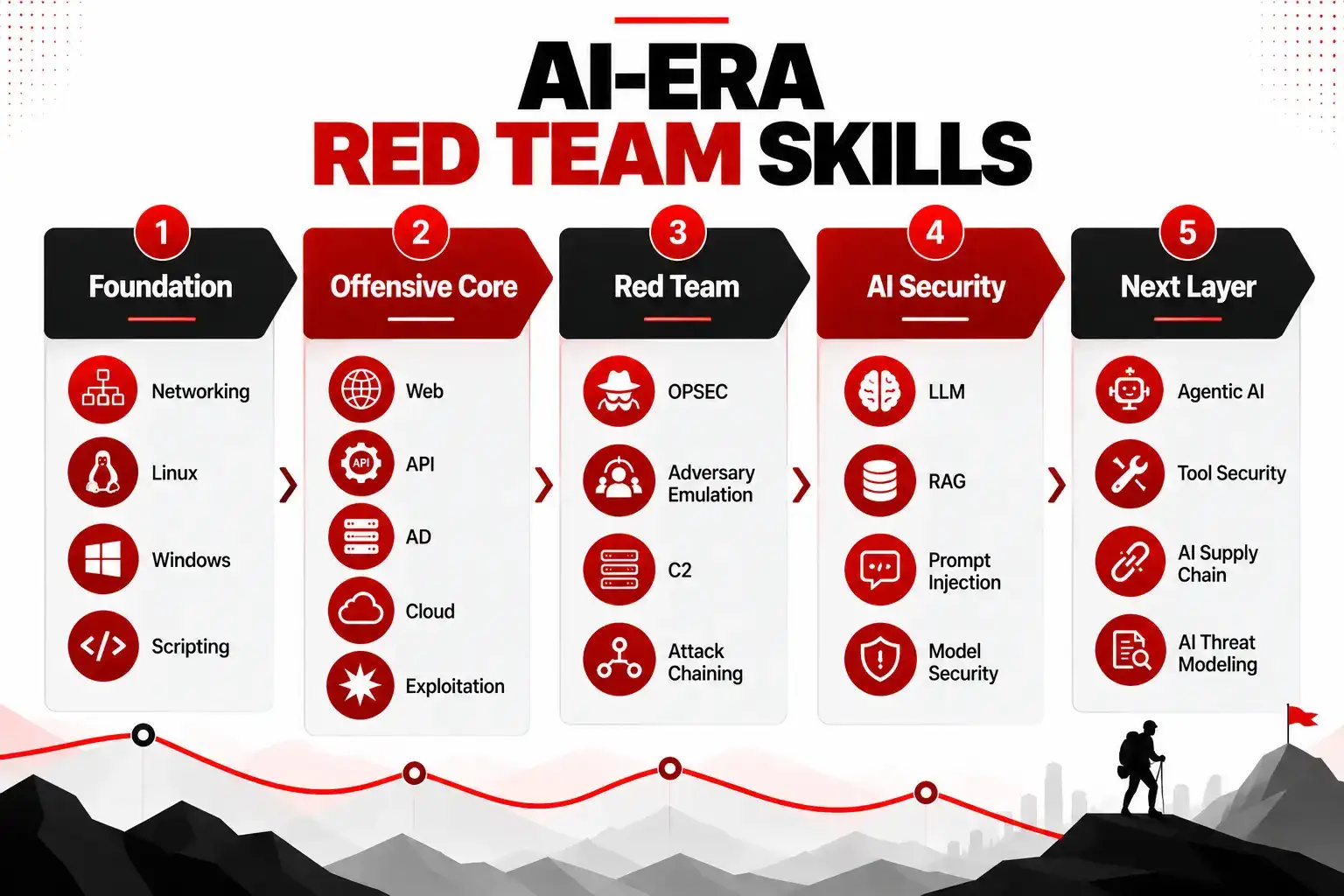
The New Red Team Skill Set
The Red Teamer of the AI era needs broader skills than the Red Teamer of a decade ago. Core offensive-security fundamentals still matter, including Networking, Windows/Linux, Active Directory, OPSEC, Adversary Emulation, etc.
But another layer is emerging:
LLMs, Prompt Injection, RAG, AI Agents, Model Security, AI APIs, etc.
Conclusion
AI hasn’t made red teaming irrelevant. It has changed what good red teaming looks like. Automation can handle more reconnaissance, data processing, test generation, and repetitive work, but organizations still need human expertise to build realistic attack chains, understand business impact, adapt to defenders, and make sense of complex security environments. At the same time, LLMs, RAG systems, and AI agents have created an entirely new set of targets for adversarial testing.
The future of red teaming is therefore not human versus AI. It is a combination of human attacker mindset, AI-assisted automation, AI security testing, and continuous validation.
Build Red Teaming and AI Security Skills with InfosecTrain
The attack surface is changing, and offensive security skills need to change with it. InfosecTrain offers practical learning paths for professionals who want to build expertise across traditional red team operations and emerging AI security.
The Red Team Operations Training covers the red-team engagement lifecycle, adversary emulation, exploitation, etc., and hands-on offensive-security techniques. For professionals moving deeper into AI security, the Practical AI Security Engineering Program includes AI threat modeling, adversarial ML and LLM red teaming, AI supply-chain security, governance concepts, etc.
You can also explore AI Penetration Testing Training for hands-on exposure to adversarial ML, LLM security, AI/ML attack techniques, and defensive controls.

TRAINING CALENDAR of Upcoming Batches For Red Team Training
| Start Date | End Date | Start - End Time | Batch Type | Training Mode | Batch Status | |
|---|---|---|---|---|---|---|
| 05-Dec-2026 | 13-Feb-2027 | 19:00 - 23:00 IST | Weekend | Online | [ Open ] | |
| 06-Mar-2027 | 08-May-2027 | 19:00 - 23:00 IST | Weekend | Online | [ Open ] |

TRAINING CALENDAR of Upcoming Batches For Practical AI Security Engineering Program
| Start Date | End Date | Start - End Time | Batch Type | Training Mode | Batch Status | |
|---|---|---|---|---|---|---|
| 12-Oct-2026 | 16-Nov-2026 | 08:00 - 10:00 IST | Weekday | Online | [ Open ] | |
| 31-Oct-2026 | 13-Dec-2026 | 19:00 - 23:00 IST | Weekend | Online | [ Close ] | |
| 30-Nov-2026 | 04-Jan-2027 | 20:00 - 22:00 IST | Weekday | Online | [ Open ] | |
| 23-Jan-2027 | 28-Feb-2027 | 09:00 - 13:00 IST | Weekend | Online | [ Open ] | |
| 20-Mar-2027 | 25-Apr-2027 | 09:00 - 13:00 IST | Weekend | Online | [ Open ] |

Frequently Asked Questions
Is red teaming still relevant in the AI era?
Yes. AI automates many security tasks, but human Red Teamers remain important for attack strategy, contextual reasoning, attack chaining, and business-impact analysis.
Will AI replace Red Teamers?
AI is more likely to augment Red Teamers than replace them. It can automate repetitive work while humans focus on strategy, validation, and complex decisions.
What is AI red teaming?
AI red teaming is the adversarial testing of LLMs, AI agents, RAG systems, models, and AI applications to uncover security, safety, privacy, and misuse risks.
How is AI red teaming different from traditional red teaming?
Traditional red teaming focuses on enterprise infrastructure, applications, identities, and people. AI red teaming adds AI-specific risks such as prompt injection, RAG poisoning, model manipulation, and unsafe agent behavior.
What is prompt injection?
Prompt injection is an attack that uses malicious or untrusted input to influence an AI system's instructions or behavior.
Can AI automate penetration testing?
AI can automate parts of penetration testing, including reconnaissance, analysis, scripting, and test generation. Human validation remains important for accuracy, safety, and context.
What skills should modern Red Teamers learn?
Red Teamers should combine networking, operating systems, web security, Active Directory, cloud, APIs, scripting, and exploitation with LLM, RAG, agent, and AI security skills.
What is agentic AI red teaming?
It involves testing AI agents for weaknesses such as prompt injection, excessive permissions, unsafe tool usage, data exposure, and manipulation of agent behavior.
Can vulnerability scanners replace red teams?
No. Scanners primarily identify known security weaknesses. Red teams test how weaknesses can be chained and exploited to achieve realistic objectives.
How often should red teaming be performed?
It depends on organizational risk and the rate of system change. Critical systems should also be retested after significant application, infrastructure, identity, or AI changes.
Which frameworks are useful for AI red teaming?
MITRE ATLAS, OWASP GenAI Security guidance, MITRE ATT&CK, and the NIST AI Risk Management Framework are useful resources.
Is red teaming worth learning in 2026 and beyond?
Yes. The field is evolving toward AI-assisted and AI-focused security testing, making a combination of offensive-security fundamentals and AI security knowledge increasingly useful.