CISSP vs. CEH: Which Certification Builds More Cybersecurity Skills?
Quick Insights:
CEH and CISSP develop different cybersecurity skill sets. CEH focuses on ethical hacking, vulnerability assessment, reconnaissance, and offensive security techniques, while CISSP covers broader areas such as security architecture, risk management, governance, IAM, and security operations. Choose based on whether you want to specialize in hands-on offensive security or develop broad enterprise cybersecurity expertise. Both certifications can complement each other by combining attacker-focused knowledge with enterprise security principles. Your choice should depend on your current experience, career goals, and the specific skills you want to strengthen.
Do you want to break systems to make them stronger, or design the frameworks that protect an entire company? Choosing between CEH and CISSP is not about which certification is better; it’s about whether your passion lies in hands-on hacking or big-picture security leadership.
While the Certified Ethical Hacker (CEH) gives you the tactical toolkit to hunt down vulnerabilities and execute real-world exploits, the Certified Information Systems Security Professional (CISSP) equips you with the strategic vision to govern risk, architect resilient networks, and lead security programs. Both are gold standards in cybersecurity, but they forge entirely different career paths.
Understanding where your skills fit and where you want your career to go is the first step toward choosing the right credential.
CISSP vs. CEH: Core Differences
The two certifications differ in their focus, learning approach, and typical career applications.
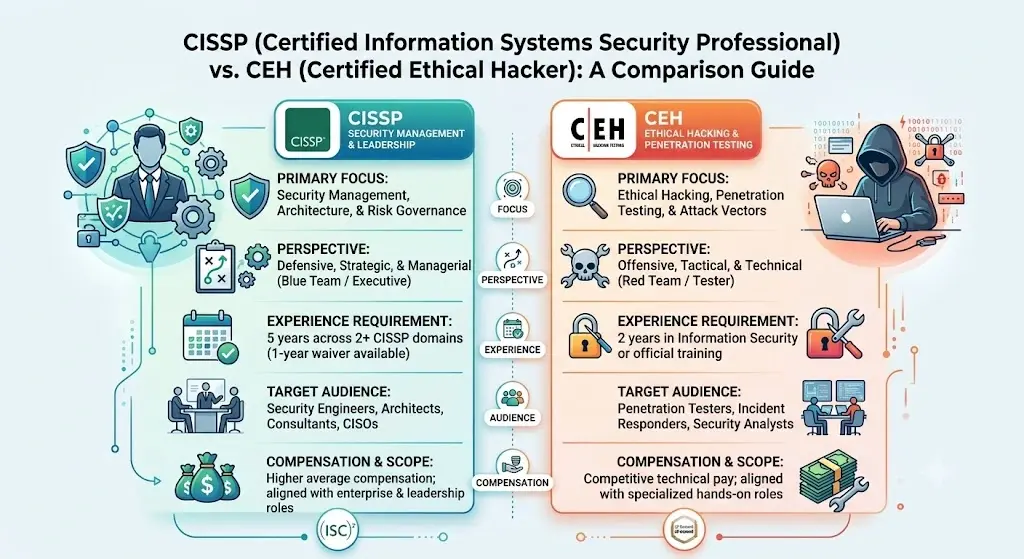
- Primary Focus: CISSP covers AI governance, enterprise security, risk management, architecture, and security operations. CEH focuses on ethical hacking, vulnerability identification, Penetration testing concepts, and attack techniques.
- Security Perspective: CISSP develops a broader, defensive, enterprise-level perspective, while CEH emphasizes an attacker-focused approach to security testing.
- Experience Requirements: CISSP generally requires five years of cumulative full-time work experience in at least two of its eight domains, with certain education or credential waivers available. CEH has its own eligibility requirements, including an experience pathway or official training pathway.
- Career Applications: CISSP knowledge can support roles such as security architect, security manager, security consultant, and security engineer. CEH knowledge can support roles related to ethical hacking, Penetration testing, vulnerability assessment, and security analysis.
- Assessment Approach: CISSP uses a Computer Adaptive Test (CAT) format. CEH uses a multiple-choice knowledge exam, with a separate practical examination available for candidates pursuing the CEH Master credential.
Skills Developed Through CISSP
Building an Enterprise Security Perspective
While CEH focuses heavily on offensive security, CISSP takes a broader approach to cybersecurity. It covers the principles professionals need to design, manage, assess, and govern security programs across an organization.
CISSP covers eight domains within the (ISC)² Common Body of Knowledge (CBK):
- Security and Risk Management: Governance, policies, compliance, risk management, and security principles.
- Asset Security: Data classification, ownership, privacy, retention, and protection.
- Security Architecture and Engineering: Secure design, cryptography, security models, and engineering principles.
- Communication and Network Security: Network architecture, secure communication channels, and network protection.
- Identity and Access Management (IAM): Authentication, authorization, access control, and identity technologies.
- Security Assessment and Testing: Security assessments, audits, testing methods, and vulnerability management.
- Security Operations: Incident response, monitoring, recovery, investigations, and operational security.
- Software Development Security: Secure development practices, application security, and secure SDLC principles.
Key CISSP Skills
- Enterprise Risk Management
CISSP develops knowledge of security risk assessment, business continuity, disaster recovery, and organizational risk management.
- AI Security Architecture and Design
Professionals learn how to apply security principles when designing enterprise environments, networks, systems, and cloud infrastructures.
- Identity and Access Management
CISSP covers authentication, authorization, access control models, federation, and identity management concepts that support modern enterprise security.
- Security Operations and Incident Response
The certification addresses incident management, security monitoring, investigations, disaster recovery, and other operational security practices.
CISSP also connects cybersecurity with organizational governance and regulatory requirements. Professionals learn how frameworks, policies, standards, and risk processes support security programs.
What CISSP Adds to Your Skill Set
CISSP develops broad, strategic, analytical, and architectural security knowledge. It helps professionals understand cybersecurity beyond individual vulnerabilities or tools and consider how different security functions work together across an organization.
Skills Developed Through CEH
Building an Offensive Security Mindset
Certified Ethical Hacker (CEH) introduces learners to cybersecurity from an attacker’s perspective. The certification helps professionals understand how attackers discover weaknesses, analyze targets, and exploit vulnerabilities so organizations can strengthen their defenses.
Key CEH Skills
- Footprinting and Reconnaissance
CEH covers techniques for gathering information about potential targets. These include OSINT, DNS enumeration, network discovery, and other reconnaissance methods.
- Vulnerability Assessment
Learners explore how to identify vulnerabilities, system weaknesses, misconfigurations, outdated components, and potential entry points that attackers could exploit.
- System and Web Application Security
CEH introduces common attack techniques and vulnerabilities, including privilege escalation, SQL injection, cross-site scripting (XSS), malware-related techniques, and social engineering.
- Network and Wireless Security
The certification covers concepts related to network traffic analysis, wireless security, session attacks, firewalls, and other network-level attack techniques.
- Cloud, IoT, and Mobile Security
Modern attack surfaces extend beyond traditional networks. CEH also introduces security threats affecting cloud environments, IoT devices, and mobile platforms.
What CEH Adds to Your Skill Set
CEH primarily develops tactical and operational cybersecurity skills. It helps learners understand how attackers identify and exploit weaknesses and how security professionals can use that knowledge during security assessments.
CISSP vs. CEH: Which Builds More Cybersecurity Skills?
There is no single answer because each certification develops different skill categories.
CISSP for Broad Security Skills
- If your goal is to develop a wider understanding of cybersecurity across risk, architecture, IAM, operations, governance, and software security, CISSP provides broader coverage.
- Its curriculum connects multiple security disciplines and helps professionals understand how organizations build and manage enterprise security programs.
CEH for Offensive Security Skills
- If your primary goal is to develop knowledge of ethical hacking, vulnerability assessment, reconnaissance, and attack techniques, CEH provides focused coverage of these areas.
- It can be particularly relevant for professionals interested in Penetration testing and offensive security.
CISSP vs. CEH
Conclusion
Neither certification is inherently better; each fulfills distinct, essential functions within enterprise cybersecurity. CEH provides the practical, tactical skill set needed to audit systems, uncover vulnerabilities, and master offensive techniques. In contrast, CISSP delivers the macro-level governance, architecture, and risk-management blueprint needed to lead security initiatives and protect entire organizations.
Whether your career goal is to defend the perimeter or lead the team that designs it, aligning your certification path with your professional strengths is key to long-term success.
Build industry-leading tactical and strategic expertise by enrolling in InfosecTrain’s instructor-led CEH (Certified Ethical Hacker) v13 AI and CISSP Certification Training Program, featuring expert mentorship, real-world lab environments, and comprehensive domain reviews.

TRAINING CALENDAR of Upcoming Batches For CEH v13 AI Training
| Start Date | End Date | Start - End Time | Batch Type | Training Mode | Batch Status | |
|---|---|---|---|---|---|---|
| 21-Nov-2026 | 20-Dec-2026 | 09:00 - 13:00 IST | Weekend | Online | [ Open ] | |
| 12-Dec-2026 | 24-Jan-2027 | 19:00 - 23:00 IST | Weekend | Online | [ Open ] | |
| 16-Jan-2027 | 21-Feb-2027 | 09:00 - 13:00 IST | Weekend | Online | [ Open ] | |
| 20-Feb-2027 | 28-Mar-2027 | 19:00 - 23:00 IST | Weekend | Online | [ Open ] | |
| 13-Mar-2027 | 18-Apr-2027 | 09:00 - 13:00 IST | Weekend | Online | [ Open ] |

TRAINING CALENDAR of Upcoming Batches For CISSP Training
| Start Date | End Date | Start - End Time | Batch Type | Training Mode | Batch Status | |
|---|---|---|---|---|---|---|
| 17-Oct-2026 | 29-Nov-2026 | 10:00 - 14:00 IST | Weekend | Online | [ Close ] | |
| 26-Oct-2026 | 01-Dec-2026 | 20:00 - 22:00 IST | Weekday | Online | [ Open ] | |
| 14-Nov-2026 | 20-Dec-2026 | 19:00 - 23:00 IST | Weekend | Online | [ Open ] | |
| 07-Dec-2026 | 25-Dec-2026 | 07:00 - 12:00 IST | Weekday | Online | [ Open ] | |
| 12-Dec-2026 | 24-Jan-2027 | 10:00 - 14:00 IST | Weekend | Online | [ Open ] | |
| 09-Jan-2027 | 14-Feb-2027 | 19:00 - 23:00 IST | Weekend | Online | [ Open ] | |
| 13-Feb-2027 | 21-Mar-2027 | 09:00 - 13:00 IST | Weekend | Online | [ Open ] | |
| 13-Mar-2027 | 18-Apr-2027 | 19:00 - 23:00 IST | Weekend | Online | [ Open ] |
Frequently Asked Questions
What is the main difference between CISSP and CEH?
CISSP focuses on broad enterprise security, including risk, governance, architecture, and operations. CEH focuses more on ethical hacking, vulnerability assessment, and offensive security.
Which certification is better for ethical hacking?
CEH is more directly aligned with ethical hacking because it covers reconnaissance, vulnerability identification, attack techniques, and security testing.
Which certification provides broader cybersecurity knowledge?
CISSP provides broader coverage across multiple cybersecurity disciplines, including risk management, IAM, security architecture, operations, and software development security.
Is CEH suitable for beginners?
CEH can suit learners with foundational IT and cybersecurity knowledge who want to develop ethical hacking skills.
Is CISSP suitable for experienced cybersecurity professionals?
Yes. CISSP is designed for professionals who want to demonstrate broader knowledge across enterprise cybersecurity and meet its experience requirements.
Can I pursue both CEH and CISSP?
Yes. The two certifications can complement each other by combining offensive security knowledge with broader enterprise security concepts.
What skills does CEH develop?
CEH develops skills related to reconnaissance, vulnerability assessment, network and web security testing, attack techniques, and ethical hacking methodologies.
What skills does CISSP develop?
CISSP develops knowledge of security and risk management, asset security, security architecture, IAM, network security, security operations, assessment and testing, and software development security.
Which certification should I choose for Penetration Testing?
CEH is more closely aligned with Penetration testing and offensive security concepts. However, practical Penetration-testing roles may also require hands-on experience and additional technical skills.
Can CEH and CISSP help with different cybersecurity career paths?
Yes. CEH can support paths in ethical hacking, vulnerability assessment, and security testing, while CISSP can support broader roles in security architecture, management, consulting, risk, and enterprise security.