Offensive Security Career Roadmap: A Complete Guide
Quick Insights:
An Offensive Security career begins with strong knowledge of IT systems, networking, Linux, and Windows, then progresses to ethical hacking and penetration testing. Foundational certifications such as CompTIA A+, Network+, and Linux+ prepare beginners for professional learning by providing a foundation for CEH, CompTIA PenTest+, WAPT, and Bug Bounty Hunting. Experienced professionals can then specialize in Red Team Operations, AWAPT, CPENT AI, Active Directory Pentesting, or C|OASP. Certifications provide direction, but career readiness also requires hands-on labs, scripting, ethical testing practices, clear reporting, and a portfolio demonstrating practical security testing capability.
Offensive security attracts people who enjoy understanding how technology fails. It involves approaching systems from an attacker’s perspective, but with authorization, defined boundaries, and a clear objective, to identify weaknesses before malicious actors exploit them.
The field extends far beyond running automated scanners or learning a few Kali Linux commands. Offensive security professionals examine networks, applications, identities, cloud environments, and increasingly AI systems. They validate vulnerabilities, demonstrate business impact, document evidence, and recommend practical remediation. If you are unsure where to begin, the simplest route is to progress through three stages:
- Build a strong foundation in IT, networking, and Linux
- Develop practical penetration-testing skills
- Specialize in advanced areas such as red teaming, web application security, Active Directory, or offensive AI security
This guide explains how to follow that path without collecting disconnected certifications or rushing into advanced tools before understanding the systems behind them.
What is Offensive Security?
Offensive security is the authorized practice of simulating cyberattacks to discover and validate security weaknesses in applications, networks, systems, identities, and infrastructure.
Penetration testing is a security testing method in which evaluators simulate real-world attacks to identify ways around the security controls of an application, system, or network. Offensive security, however, is broader than penetration testing. It can include vulnerability assessment, web application testing, adversary simulation, red teaming, exploit development, wireless testing, cloud security testing, and AI red teaming.
Penetration Testing vs. Red Teaming
These terms are related, but they are not interchangeable.
| Penetration Testing | Red Teaming |
| Finds and validates vulnerabilities | Tests the organization’s overall resilience |
| Usually has a clearly defined technical scope | May cover people, processes, identities, and technology |
| Focuses on discovering exploitable weaknesses | Focuses on achieving an agreed objective |
| Typically prioritizes coverage | Prioritizes realism, stealth, and adversary behavior |
| Produces technical findings and remediation advice | Evaluates prevention, detection, and response capabilities |
Career Opportunities in Offensive Security
Offensive security is not a single job. Depending on your interests and technical strengths, you can work toward roles such as:
- Vulnerability Assessment Analyst
- Junior Penetration Tester
- Web Application Penetration Tester
- Network Penetration Tester
- VAPT Analyst
- Bug Bounty Hunter
- Application Security Tester
- Active Directory Penetration Tester
- Cloud Penetration Tester
- Red Team Operator
- Adversary Simulation Specialist
- Offensive AI Security Professional
- Security Consultant
Beginners often start with vulnerability assessments, junior VAPT, security testing, system administration, or network support responsibilities before progressing into advanced offensive roles.
Offensive Security Learning Path
The proposed learning path is well structured, with a few important clarifications.
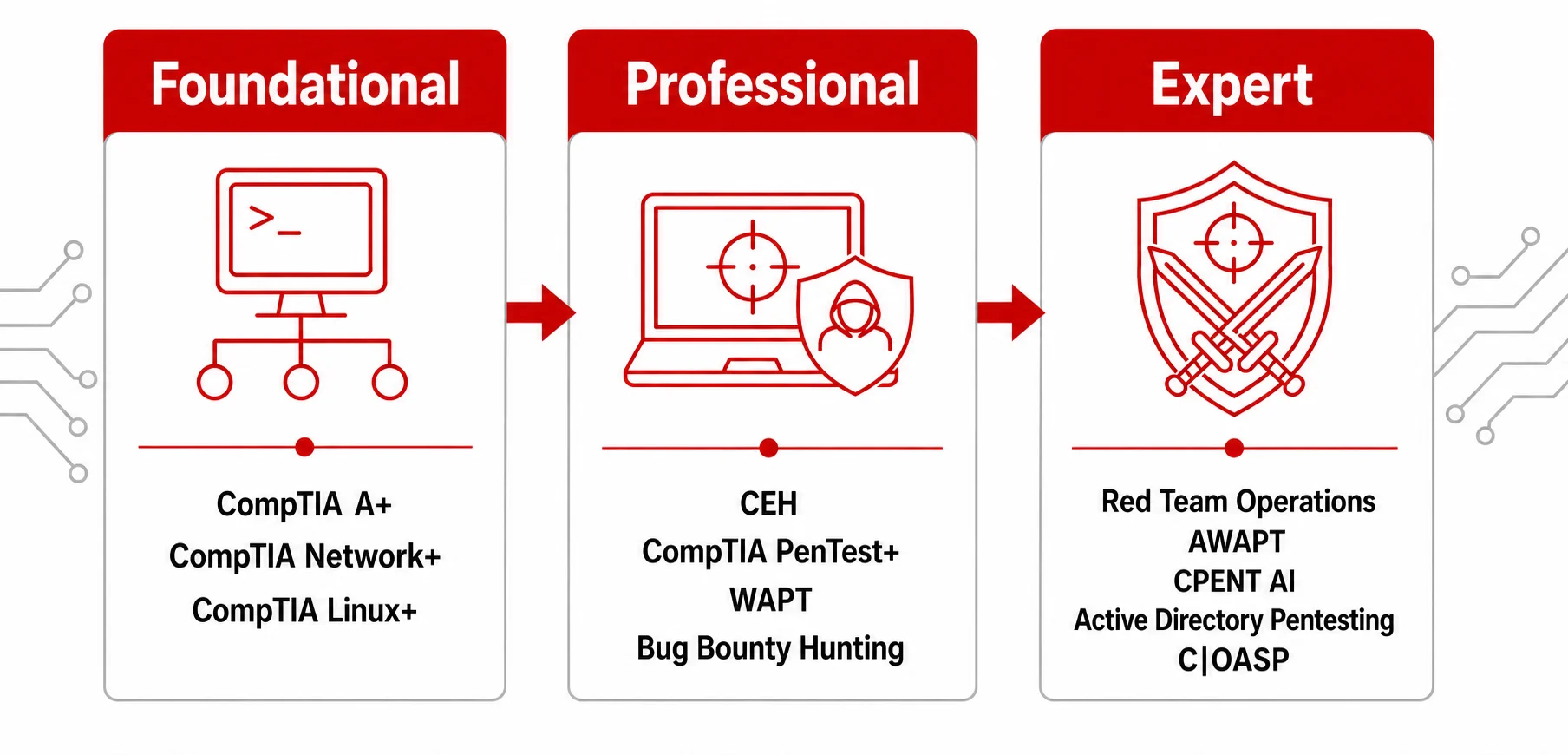
The proposed learning path is well structured, with a few important clarifications. CompTIA A+ is most useful for complete beginners. Someone who already understands operating systems, hardware, troubleshooting, and basic IT administration can begin with networking and Linux.
The expert stage should also be treated as a set of specialization options. You do not have to complete every course. For example, C|OASP is highly relevant to offensive AI security, whereas AWAPT is better suited to someone pursuing advanced application security.
Foundational Stage: Understand the Systems You Will Test
Tools change quickly. Networking, operating systems, authentication, permissions, and protocols do not change nearly as quickly. That is why a strong foundation remains valuable throughout an offensive security career.
CompTIA A+
CompTIA A+ introduces computer hardware, operating systems, troubleshooting, basic networking, virtualization, and security practices. It is particularly helpful if you are entering cybersecurity without previous IT experience. You should understand how Windows and Linux systems are installed, configured, maintained, and troubleshot before attempting to exploit them.
If you already work in technical support, system administration, or IT operations, you may not need to pursue the certification. Review its subject areas and fill any knowledge gaps instead.
CompTIA Network+
Networking is one of the most important foundations for offensive security.
Learn how the following concepts work:
- TCP/IP and the OSI model
- IP addressing and subnetting
- DNS, DHCP, ARP, HTTP, HTTPS, and SSH
- Routing and switching
- Firewalls and network segmentation
- VPNs and wireless networks
- Common ports and services
- Packet capture and traffic analysis
Do not limit yourself to memorizing port numbers. Capture traffic with Wireshark, inspect requests, configure a small network, and observe how devices communicate.
CompTIA Linux+
Linux is used extensively in security testing, servers, cloud platforms, containers, and offensive-security toolsets. You should be comfortable working without a graphical interface.
Focus on:
- Files and directory structures
- Users, groups, and permissions
- Processes and services
- Package management
- Network configuration
- SSH and secure remote access
- Bash commands and scripting
- Logs and scheduled tasks
Build a legal home lab using virtual machines. Practice configuring Linux services, changing permissions, reviewing logs, and troubleshooting connectivity. The objective is to understand Linux as an operating system, not simply as the interface behind Kali Linux.
What You Should Be Able to Do at This Stage
Before moving forward, you should be able to:
- Explain how a browser communicates with a web server
- Interpret basic Wireshark traffic
- Use Windows and Linux command-line tools
- Configure users, services, and permissions
- Identify common network services
- Write small Bash or Python scripts
- Build and maintain a virtual lab safely
Professional Stage: Learn to Conduct Penetration Tests
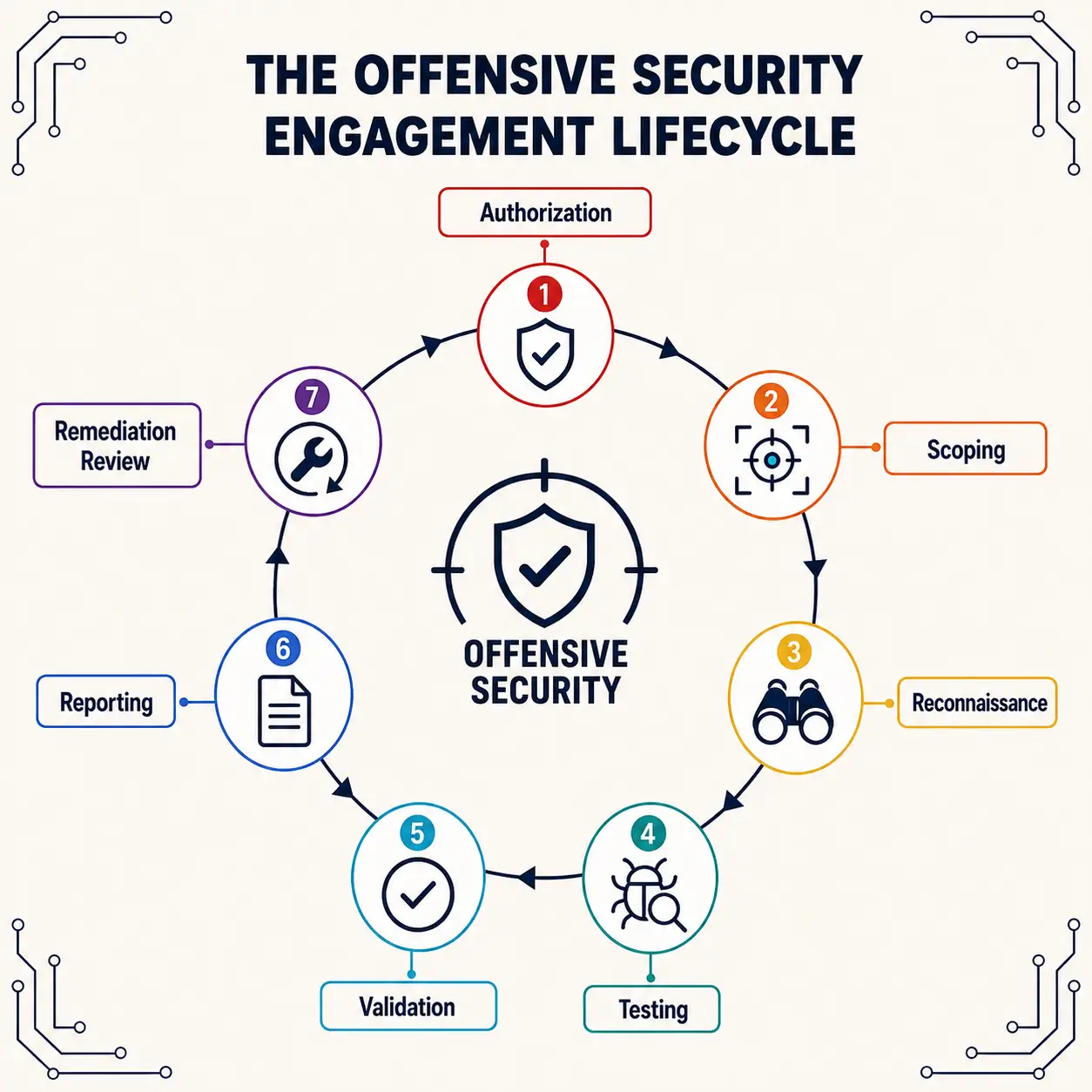
The professional stage converts technical knowledge into a repeatable testing methodology. This is where you learn how to scope an engagement, discover assets, identify vulnerabilities, validate risk, maintain evidence, and write a useful report.
CEH
The current CEH Program introduces ethical-hacking methodologies, attack surfaces, tools, techniques, and AI-supported security workflows. It can help learners build broad exposure across reconnaissance, enumeration, system hacking, web security, wireless security, cloud environments, and other domains.
CEH is useful for developing breadth, but certification preparation alone is not enough. Pair it with labs, vulnerable machines, manual testing, and report writing.
CompTIA PenTest+
CompTIA PenTest+ focuses on the lifecycle of a penetration-testing engagement, including planning, scoping, information gathering, vulnerability discovery, exploitation, reporting, and remediation.
It suits learners who want a structured, vendor-neutral understanding of professional penetration testing. Pay close attention to:
- Authorization and rules of engagement
- Passive and active reconnaissance
- Vulnerability validation
- Network and application attacks
- Evidence collection
- Risk communication
- Remediation recommendations
These non-exploitation skills matter. A technically impressive test can still fail professionally if it exceeds its scope, disrupts production, mishandles sensitive information, or produces an unusable report.
Web Application Penetration Testing
Web Application Penetration Testing, or WAPT, develops skills for testing websites, APIs, authentication systems, session management, access controls, and business logic.
Study HTTP deeply and practice vulnerabilities such as:
- Broken access control
- SQL injection
- Cross-site scripting
- Server-side request forgery
- File-upload vulnerabilities
- Authentication and session weaknesses
- API authorization failures
- Business-logic flaws
Bug Bounty Hunting
Bug bounty hunting teaches persistence, target analysis, responsible disclosure, and the ability to find vulnerabilities that automated scanners miss.
However, it should not be viewed as guaranteed income or a shortcut into cybersecurity. Duplicate reports, out-of-scope testing, low-impact findings, and incomplete evidence are common early challenges.
Approach bug bounty hunting as a controlled learning environment:
- Read every program’s scope carefully
- Test only authorized assets
- Start with a limited vulnerability category
- Record requests, responses, steps, and impact
- Learn to distinguish unusual behavior from a valid security issue
- Write reports that another person can reproduce
What You Should Be Able to Do at This Stage
You should now be able to:
- Define the scope of a basic penetration test
- Perform reconnaissance and enumeration
- Identify and manually validate vulnerabilities
- Use tools without relying entirely on default output
- Explain the impact of a finding
- Collect clear and relevant evidence
- Produce an executive summary and technical report
- Recommend realistic corrective actions
Expert Stage: Select an Offensive Security Specialization
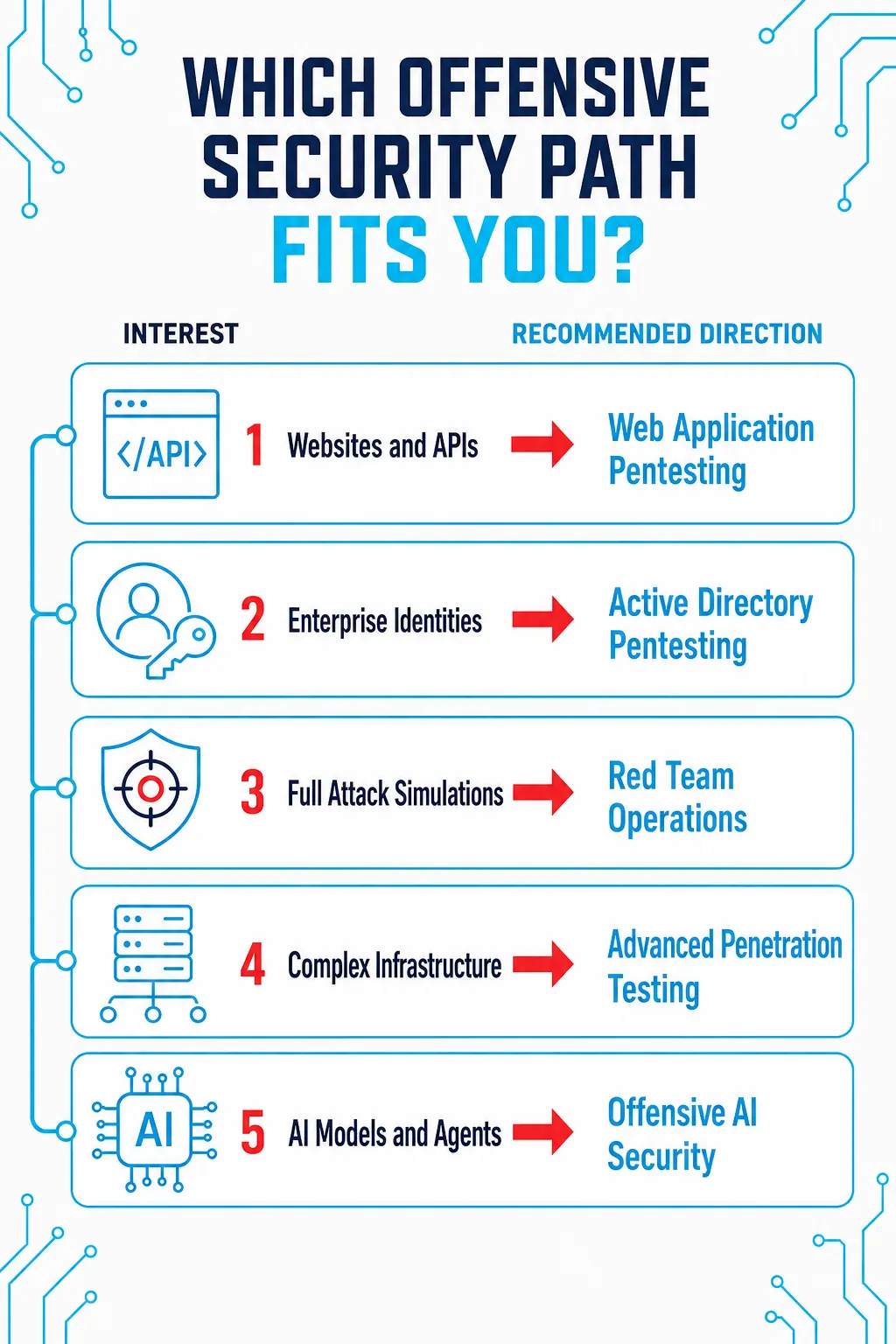
At the expert stage, depth becomes more valuable than covering every possible topic. Choose a direction based on the environments you enjoy testing and the roles you want to pursue.
Red Team Operations
Red team operations go beyond isolated vulnerability discovery. They simulate how a determined adversary may combine weaknesses across endpoints, identities, networks, and people to achieve an agreed objective.
Advanced red team skills can include:
- Initial access and payload delivery
- Command-and-control infrastructure
- Privilege escalation
- Persistence
- Credential access
- Defence evasion
- Lateral movement
- Data-access simulation
- Operational security
- Detection-aware tradecraft
Advanced Web Application Penetration Testing
AWAPT is suitable for professionals who want to move beyond common web vulnerabilities and test complex applications more deeply.
Advanced areas may include:
- Chained vulnerabilities
- Complex authorization failures
- Advanced injection techniques
- API and GraphQL testing
- Request smuggling
- Deserialization weaknesses
- Race conditions
- Web cache attacks
- Cloud-connected application risks
- Exploit development and bypass techniques
At this level, methodology and creativity matter more than running many tools.
CPENT AI
The Certified Penetration Testing Professional, now presented by EC-Council as CPENT AI, focuses on advanced testing across enterprise environments. Its scope includes network segmentation, pivoting, privilege escalation, Active Directory, attack planning, risk evaluation, and professional reporting.
It is most appropriate after you are already comfortable with enumeration, exploitation, post-exploitation, and reporting.
Active Directory Pentesting
Active Directory remains central to many enterprise environments. Misconfigurations involving identities, privileges, trusts, service accounts, and authentication can create attack paths across an organization.
Important learning areas include:
- Active Directory architecture
- Kerberos and NTLM
- LDAP enumeration
- Password and privilege policies
- Service accounts
- Kerberoasting
- Delegation weaknesses
- Access-control relationships
- Domain and forest trusts
- Privilege escalation
- Credential abuse
- Lateral movement
This path is especially valuable for enterprise penetration testers and red team operators.
C|OASP
The Certified Offensive AI Security Professional, or C|OASP, is a specialist path for professionals who want to test AI-enabled applications, models, pipelines, agents, and supporting infrastructure. Its scope includes offensive AI testing, LLM security, adversarial machine learning, prompt injection, tool abuse, model and data-layer weaknesses, and attacks against agentic systems.
C|OASP should not replace core penetration-testing knowledge. It is better treated as an advanced specialization after gaining experience in application, API, cloud, and infrastructure security.
Essential Skills Beyond Certifications
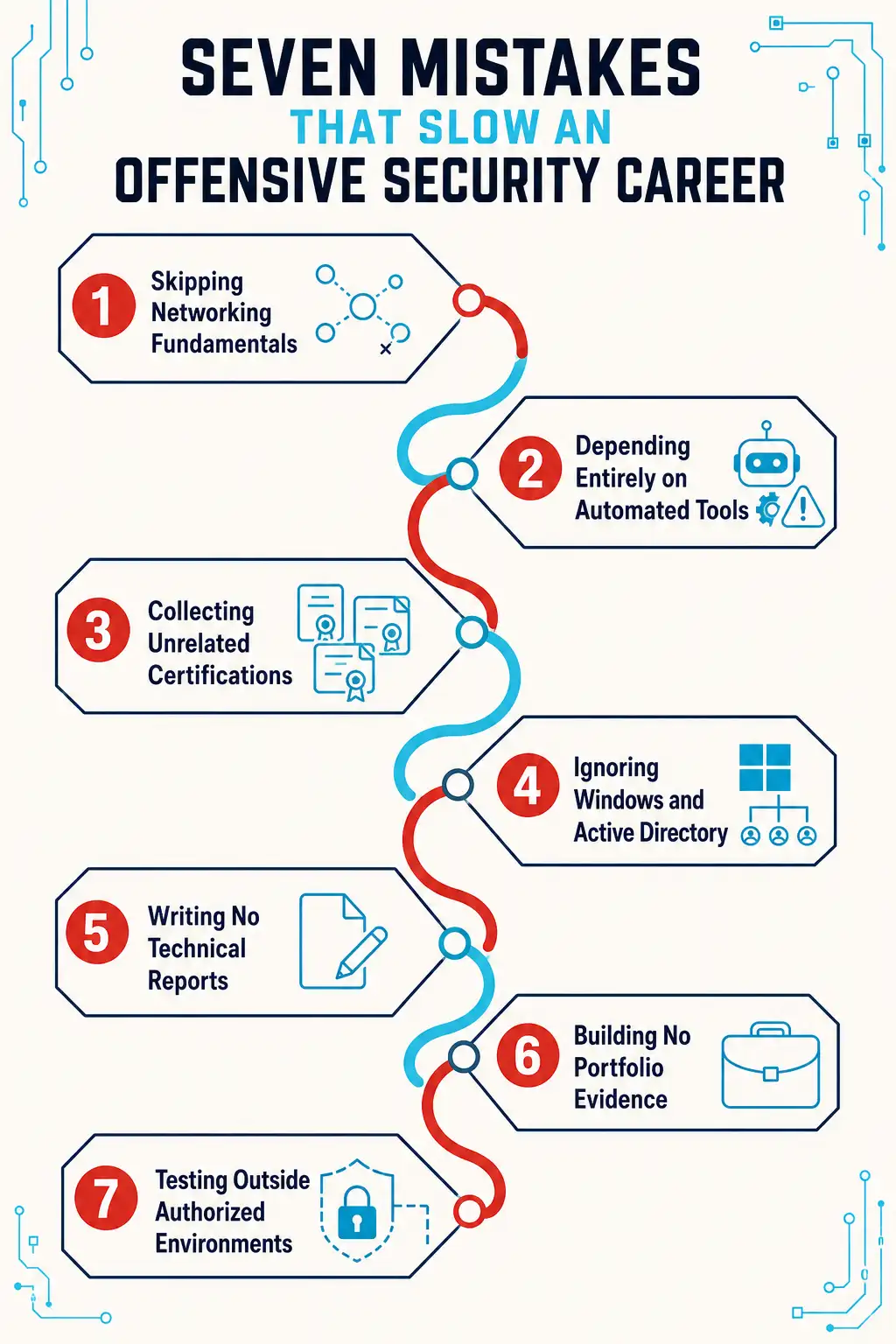
Certifications can structure your learning and validate knowledge, but employers also want proof that you can perform the work.
1. Technical Communication
A vulnerability has little operational value if the affected team cannot understand or reproduce it. Learn to write concise findings with:
- A clear title
- Affected assets
- Reproduction steps
- Supporting evidence
- Technical and business impact
- Risk rating
- Practical remediation
2. Scripting and Automation
You do not need to become a full-time software developer, but you should be able to read and modify code.
Start with:
- Python for automation and API interaction
- Bash for Linux tasks
- PowerShell for Windows environments
- JavaScript for understanding web applications
- SQL for database testing
Use automation to reduce repetitive work—not to replace analysis.
3. Business and Risk Awareness
The most severe technical issue is not always the organization’s greatest risk. A good tester understands what the system does, which data it handles, how exposed it is, and what could happen if it were compromised.
4. Professional Ethics
Authorization, confidentiality, responsible disclosure, evidence protection, and scope discipline are essential. Never test a system simply because it appears vulnerable.
A Practical Progression
Your development can follow this sequence:
- Learn IT, networking, Linux, and Windows fundamentals
- Build a safe virtual lab
- Practice enumeration and traffic analysis
- Study a structured penetration-testing methodology
- Test networks and web applications in legal labs
- Learn to validate findings manually
- Write a report for every major lab
- Build a portfolio showing evidence of your skills
- Apply for junior VAPT, vulnerability-assessment, and security-testing roles
- Specialize in web, Active Directory, red teaming, cloud, or AI security
There is no universal completion time. Someone with existing network or system-administration experience may progress much faster than a complete beginner. Consistent practice is more useful than rushing through an arbitrary schedule.
Conclusion
An offensive security career is built through progression, not shortcuts. Start by understanding the systems you intend to test. Develop a repeatable penetration-testing methodology, practice in authorized environments, and learn to communicate findings clearly. Once those capabilities are reliable, select an advanced specialization that matches your target role.
The strongest candidates do more than list tools and certifications. They can explain what they tested, why a weakness mattered, how they validated it, and what the organization should do next.
Start Your Offensive Security Journey with InfosecTrain
Whether you are building your technical foundation, preparing for a penetration-testing role, or moving into advanced red team and AI security work, InfosecTrain offers instructor-led training aligned with different stages of the offensive security career path.
Explore training in CEH, CompTIA PenTest+, Bug Bounty Hunting, Advanced Web Application Penetration Testing, Active Directory Pentesting, CPENT AI, Red Team Operations, and C|OASP. Build structured knowledge, practice realistic attack scenarios, and develop skills that can be demonstrated beyond the certification exam.
Explore InfosecTrain’s Offensive Security Training Programs and choose the path that matches your career goal.

Frequently Asked Questions
Is offensive security suitable for beginners?
Yes, but beginners should first learn networking, operating systems, Linux, and basic security concepts. Starting directly with advanced exploitation often creates gaps that become difficult to overcome later.
Do I need programming skills for offensive security?
You do not need advanced software-development experience to begin. Basic skills in Python, Bash, PowerShell, JavaScript, and SQL are increasingly valuable for automation, application testing, and exploit analysis.
Which certification should I take first?
Complete beginners can begin with CompTIA A+, Network+, or Linux+. Learners with an existing technical foundation can progress to CEH, CompTIA PenTest+, or practical training in web and network penetration testing.
Is CEH enough to become a penetration tester?
CEH can provide structured exposure to ethical-hacking concepts and techniques, but it should be supported by practical labs, manual testing, scripting, report writing, and a demonstrable portfolio.
Is bug bounty hunting the same as penetration testing?
No. Bug bounty hunters test assets under a program’s defined rules and are generally rewarded for accepted findings. Professional penetration testers work within a contracted engagement and deliver systematic testing, evidence, risk analysis, and reporting.
When should I learn red teaming?
Move into red teaming after you are comfortable with network and application testing, exploitation, privilege escalation, Active Directory, post-exploitation, reporting, and basic detection concepts.
Is C|OASP necessary for every offensive security professional?
No. C|OASP is an advanced specialization for testing AI systems and AI-enabled applications. It is most relevant to professionals pursuing AI red teaming or offensive AI security roles.
Can I enter offensive security without a cybersecurity degree?
Yes. Practical capability, technical foundations, certifications, labs, portfolio evidence, communication skills, and relevant IT experience can all support entry into the field.