Key Components of Secure Network Architecture Using SD-WAN and SDN
Quick Insights:
Modern cloud adoption and decentralized workforces require combining Software-Defined Networking (SDN) and Software-Defined Wide Area Networking (SD-WAN) to build flexible, cloud-first security architectures. Because software-defined networks introduce risks such as centralized targets, vulnerable public links, and direct internet exposure at branches, security must be embedded directly into the network. Essential components of a secure architecture include centralized control planes, end-to-end IPsec/TLS encryption, Secure Access Service Edge (SASE) integration, automated threat quarantine, dynamic performance routing, and continuous telemetry for compliance auditing.
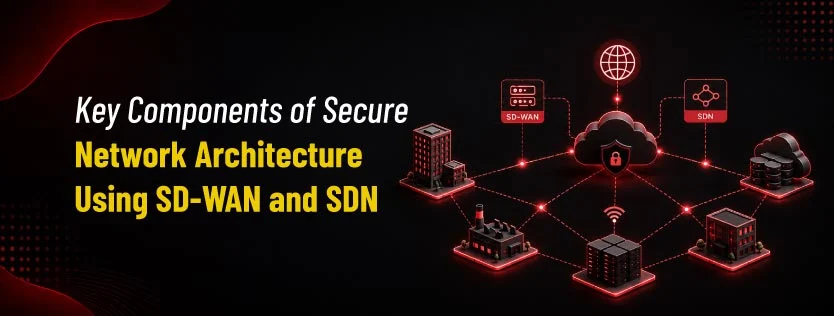
Modern enterprise networks no longer rely on rigid, perimeter-based security models. As cloud adoption expands and remote workforces decentralize corporate boundaries, organizations must combine Software-Defined Wide Area Networking (SD-WAN) and Software-Defined Networking (SDN) to build a flexible, highly secure network architecture.
SDN centralizes control within localized data centers and local networks, while SD-WAN applies those same software-defined principles across wide geographic areas. Together, they form the backbone of modern cloud-first Network security.
Why Network Security Matters in SD-WAN and SDN
- Centralized Controllers are Top Targets: Compromising the central controller gives an attacker full control over global routing and policy rules.
- Direct Internet Access (DIA) Exposes Branches: Local internet breakouts at branch offices bypass centralized data centers, requiring edge-level firewalls and SASE protections against direct cyberattacks.
- Unsegmented Virtualization Invites Lateral Movement: Software-defined environments allow threats to spread easily between virtual machines unless restrained by zero-trust micro-segmentation.
- Public Links Require Mandatory Encryption: Replacing private MPLS lines with broadband or 5G exposes traffic to interception without automated end-to-end IPsec/TLS encryption.
- Software and APIs Create Vulnerabilities: Management software and APIs introduce code-level attack vectors that require continuous patching, API security, and vulnerability management.
In short, SD-WAN and SDN require integrated security; otherwise, they route traffic faster toward potential threats.
Key Components of Secure Network Architecture
Centralized Control Plane and Management
Traditional networks require administrators to configure individual routers and switches manually. SDN and SD-WAN decouple the control plane (which makes routing decisions) from the data plane (which forwards the traffic).
- Centralized Orchestration: A central controller manages policies, routing tables, and security parameters across the entire global network from a single pane of glass.
- Consistent Policy Enforcement: Security teams write access control and routing policies once and deploy them instantly across every endpoint, branch office, and cloud instance, eliminating human configuration errors.
End-to-End Encryption and Secure Tunnels
Protecting data in transit across public internet connections and private links is critical when connecting remote offices to cloud platforms.
- Automated IPsec Tunnels: SD-WAN automatically establishes encrypted IPsec or TLS tunnels between branch offices, data centers, and multi-cloud environments.
- Dynamic Key Exchange: Controllers manage and rotate encryption keys automatically, maintaining strict privacy without creating operational management overhead.
Secure Access Service Edge (SASE) Integration
SD-WAN natively integrates with Secure Access Service Edge (SASE) frameworks, merging WAN networking capabilities with cloud-native security services directly at the edge.
- Next-Generation Firewalls (NGFW): Deep packet inspection, intrusion prevention systems (IPS), and application-level controls sit directly on SD-WAN edge devices.
- Cloud Access Security Brokers (CASB) & Secure Web Gateways (SWG): Web traffic routes through a cloud-based security stack that inspects for malware, data loss, and policy violations before it reaches public internet destinations.
Automated Threat Intelligence and Adaptive Routing
Combining SDN with machine learning enables proactive network protection rather than reactive incident response.
- Real-Time Traffic Inspection: SDN controllers monitor telemetry across data streams to spot anomalous behavior, unauthorized protocol usage, or sudden spikes in traffic.
- Automated Quarantine: When the system detects a compromised device or network segment, the SDN controller updates routing rules instantly to isolate the infected node without disrupting the broader network.
- Performance-Aware Security Routing: SD-WAN evaluates link quality, latency, and security policies dynamically, steering critical or sensitive application traffic over the most secure and reliable paths available.
Continuous Telemetry and Centralized Audit Logging
A secure architecture requires complete visibility into network operations and threat vectors.
- Unified Observability: Administrators track traffic patterns, bandwidth consumption, and security events across all SDN nodes and SD-WAN branch locations in real time.
- Simplified Compliance Auditing: Centralized logging captures detailed audit trails for regulatory standards like PCI-DSS, HIPAA, and ISO/IEC 27001, streamlining reporting and forensics during incident response.
Conclusion
Building a secure network architecture requires moving away from static, hardware-bound perimeters toward a flexible, software-driven framework. By combining the centralized control of SDN with the dynamic transport and edge capabilities of SD-WAN, organizations establish a resilient infrastructure that enforces zero-trust principles, encrypts data end-to-end, and automatically mitigates emerging cyber threats. To master these concepts and build real-world expertise, explore the Security Architecture hands-on training program with InfosecTrain.

TRAINING CALENDAR of Upcoming Batches For Security Architecture Training
Start Date
End Date
Start - End Time
Batch Type
Training Mode
Batch Status
14-Nov-2026
06-Dec-2026
09:00 - 13:00 IST
Weekend
Online
[ Open ]
Frequently Asked Questions
How do SDN and SD-WAN work together in a secure network architecture?
SDN manages local networks and data centers, while SD-WAN extends software-defined principles across broad geographic areas. Together, they allow centralized management of global routing, access rules, and security policies from a single interface.
Why is security essential when deploying SD-WAN and SDN?
Without embedded security, software-defined networks route traffic faster toward potential threats. Key risks include high-value target controllers, exposed branch internet breakouts, unencrypted public links, and software or API vulnerabilities.
How does SD-WAN protect branch offices using Direct Internet Access (DIA)?
When branches bypass central data centers to connect directly to the internet, SD-WAN integrates with SASE frameworks deploying firewalls (NGFW), intrusion prevention (IPS), CASB, and web gateways (SWG) at the edge or in the cloud to inspect traffic.
How are data and communications protected across public internet links?
SD-WAN creates automated IPsec or TLS tunnels between branches, data centers, and multi-cloud environments. Central controllers automatically manage and rotate encryption keys to keep data private without manual effort.
What role does automation play in threat mitigation in software-defined networks?
Combining telemetry with software controls allows real-time traffic monitoring for unusual behavior. When a compromised device is identified, the system updates routing rules automatically to isolate the infected node without disturbing the rest of the network.