How to Prepare for the CISSP Exam: A Complete Guide
Quick Insights:
If you are preparing for the CISSP Certification exam, start by downloading the current ISC2 exam outline and assessing your knowledge across all eight domains. Build a realistic study schedule based on your experience, study concepts rather than isolated facts, practice scenario-based questions regularly, maintain short revision notes, and use full-length practice sessions to improve decision-making and time management. As you prepare, practice looking at security problems from a broader perspective by considering risk, business objectives, policies, people, processes, and technology rather than focusing only on the technical solution.
CISSP (Certified Information Systems Security Professional) is a cybersecurity certification for experienced professionals working across areas, including risk management, security architecture, security operations, network security, asset security, Identity and Access Management (IAM), and software development security.
Preparing for the CISSP exam can be challenging because there is a lot to cover. Even if you have several years of cybersecurity experience, you may be very comfortable with some CISSP domains and less familiar with others. This is why preparing for the CISSP Certification exam requires a proper study plan instead of simply reading a book from beginning to end.
If you are planning to take the CISSP exam, this study guide will help you understand the exam, prepare your CISSP study plan, choose the right study materials, and avoid some common mistakes during your preparation.
CISSP Exam Details
Before starting your CISSP exam study, you should know the current exam format.
The CISSP exam uses Computerized Adaptive Testing (CAT). The exam can contain 100 to 150 items, and candidates get up to three hours to complete it. The passing score is 700 out of 1,000.
Important: Exam details can change, so verify the latest format and policies with ISC2 before scheduling your exam.
CISSP Domains
The CISSP certification course covers eight domains from the (ISC)2 Common Body of Knowledge (CBK).
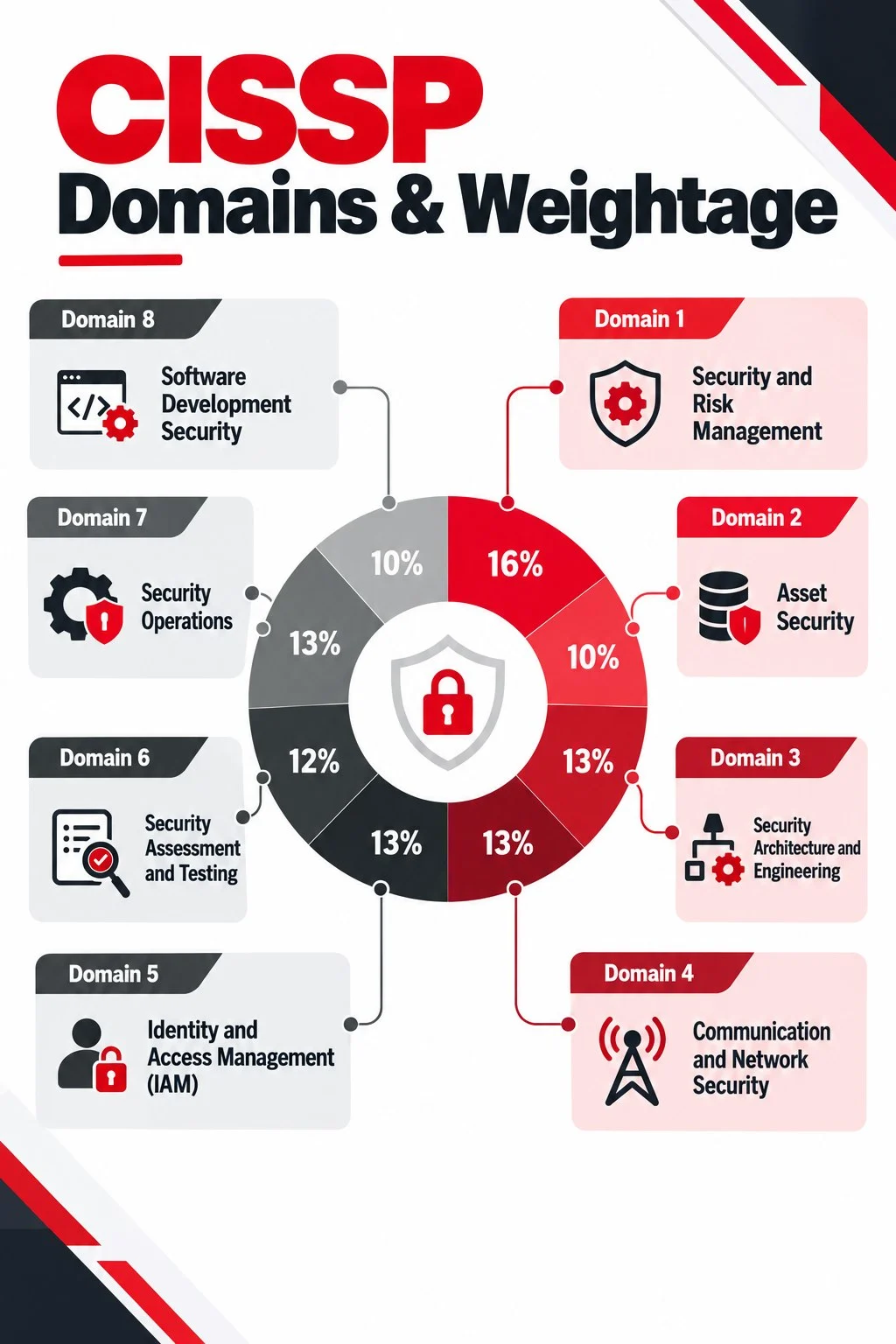
You need to prepare for all eight domains. However, this does not mean you have to spend exactly the same amount of time on every domain. Your experience matters here. If you already work with IAM every day, you may need less time to revise IAM concepts. If software security is completely outside your current role, you may need to spend more time understanding that domain.
How to Prepare For the CISSP Certification Exam?
Passing CISSP requires proper preparation, consistency, and a good understanding of security concepts. You should also be comfortable applying those concepts to different situations.
Here are some practical steps that can help you prepare.
1. Familiarize Yourself with the CISSP Exam Outline
Don’t start your preparation by randomly picking a CISSP book or watching videos. First, understand what the exam actually covers. Go through the CISSP Exam Outline and look at the topics covered under all eight domains. It will give you a clear idea of what you already know and where you need more preparation.
You can make three simple categories:
Strong: Topics you already understand well.
Need Revision: Topics you know but have not worked with recently.
Weak: Topics you have little experience with or find difficult.
Once you do this, creating a focused CISSP study plan becomes much easier.
2. Prepare Your CISSP Study Plan
CISSP has a large syllabus, so studying without a schedule can quickly become confusing. Decide how many weeks you have before your exam and how much time you can realistically study every day. Don’t create a schedule that looks good on paper but is impossible to follow.
If you work full-time, studying for one or two hours regularly may be more practical than planning four or five hours every day and giving up after the first week. You can divide your CISSP exam study into domains and give additional time to the areas you find difficult.
For example, you can spend the first few weeks covering the domains, use the next phase for practice questions, and keep the final week for revision. The important thing is consistency.
The schedule isn’t a rule. A candidate weak in architecture may need twice as much time for Domain 3, while an experienced GRC professional may move through Domain 1 relatively quickly.
3. Choose the Right CISSP Exam Materials
There are many CISSP exam materials available, including study guides, video courses, practice questions, flashcards, webinars, white papers, boot camps, and instructor-led training.
Recommended CISSP Study Guides and Resources
A good CISSP study guide should do more than help you memorize cybersecurity terminology. Instead of collecting random CISSP PDFs, question dumps, and old notes, start with official ISC2 resources. You can then add trusted books, videos, flashcards, practice questions, training, and hands-on resources depending on the areas where you need additional support.
| Study Resource | Best Used For |
| Official ISC2 CISSP Exam Outline | Understanding the eight CISSP domains, current domain weights, and topics you are expected to know |
| ISC2 CISSP Certified Information Systems Security Professional Official Study Guide, 10th Edition | Structured study and detailed coverage of concepts across the eight CISSP domains |
| ISC2 CISSP Official Practice Tests, 4th Edition | Practicing domain-specific questions, identifying weak areas, and becoming more comfortable applying CISSP concepts |
| Official ISC2 CISSP Self-Study Resources | Finding official training, study tools, flash cards, the exam outline, and other preparation resources |
The CISSP Official Study Guide, 10th Edition, by Mike Chapple, James Michael Stewart, and Darril Gibson, is a useful primary book for structured preparation. The Official Practice Tests, 4th Edition, by Mike Chapple and David Seidl, can then be used to check your understanding and identify subjects that need more revision.
You do not need to use every available CISSP resource. Choose one reliable primary study guide, keep the official exam outline beside you, and add practice questions and supplementary resources where necessary.
Recommended Videos for CISSP Preparation
Videos can be particularly useful for CISSP topics that are difficult to understand through definitions alone.
| Video | Best Used For |
| The BEST CISSP Study Materials for Passing in 2026 | Building your study-resource stack |
| Deep Dive into CISSP Domain 1 | Governance, risk, compliance, and security management |
| Deep Dive – CISSP Domain 4 | Network architecture and secure communications |
| Master CISSP Domain 6 | Security assessment and testing |
| Cracking CISSP Domain 7 (Part 1)
Cracking CISSP Domain 7 (Part 2) |
Security Operations review |
| CISSP Exam Hacks from Experts | Exam approach and preparation advice |
One common mistake is collecting too many books, YouTube playlists, question banks, flashcards, and study notes. Candidates can end up spending more time switching between resources than actually studying.
4. Understand Concepts Instead of Just Memorizing Them
CISSP preparation is not only about remembering definitions. You should understand why a security control is required, what problem it solves, and when it should be used. Suppose you are studying access control. Don’t stop after learning the different access control models. Think about where they are used, why an organization would choose one approach over another, and what risks are involved.
Do the same with risk management, cryptography, network security, business continuity, incident response, and other topics. Understanding the reason behind a concept makes it much easier to answer scenario-based questions.
5. Make Short Revision Notes
While preparing for the CISSP exam, keep short revision notes for important concepts. There is no need to rewrite the entire book. Write down things you find difficult to remember, important processes, and topics you repeatedly get wrong in practice tests. Useful formats include:
- One-page domain summaries: Key concepts from each domain on a single page.
- Comparison tables: Useful for concepts that are easy to confuse.
- Process flows: Helpful when order matters.
- Flashcards: Best for short facts, terminology, and quick recall.
- Mistake notes: Brief explanations of concepts behind questions you repeatedly answer incorrectly.
These notes become very useful during the last few days before the exam because you don’t have to go through hundreds of pages again.
6. Practice CISSP Questions and Track Your Mistakes
Practice questions should be part of your CISSP exam study throughout your preparation, not something you save for the final week. After completing a topic or domain, solve related questions to identify areas that need more revision. As you progress, gradually introduce mixed-domain questions and timed practice sessions.
Don’t focus only on your score. Review incorrect answers and identify what went wrong. Ask yourself:
- Did I lack knowledge of the topic?
- Did I misunderstand what the question was asking?
- Did I overlook an important word such as BEST, FIRST, or MOST?
- Did I struggle to choose between two reasonable options?
- Have I made a similar mistake before?
Keep a simple error log for mistakes that reveal knowledge gaps, recurring confusion, or problems interpreting questions. Note the topic, why you got it wrong, and what you need to review. Over time, this will help you identify patterns and focus your revision on the areas that need the most attention.
7. Consider Structured CISSP Training
If you find it difficult to cover all eight domains on your own, structured CISSP training can help. An experienced instructor can explain difficult concepts, connect different domains, answer questions, and help you understand how topics can be applied in practical situations.
Training can be particularly useful if your work experience is concentrated in one area of cybersecurity. For example, a network security professional may already be comfortable with Communication and Network Security but may require more guidance in governance, risk management, software security, or security assessment.
InfosecTrain offers CISSP Certification Training covering the CISSP domains through instructor-led sessions, practice resources, and exam-focused preparation.
8. Join a Study Group
Studying alone works for many people, but sometimes you may get stuck on a concept. A CISSP study group can help you discuss difficult topics with other candidates and understand how they approach a question.
You may also discover areas you have overlooked in your own CISSP exam study. However, study groups should support your preparation rather than become a distraction. You still need your own study schedule and revision plan.
9. Revise Your Weak Areas
As your exam date gets closer, don’t spend all your time studying topics you already know. Go back to your practice tests and study notes. Which topics are still causing problems?
If you repeatedly get questions about security models, risk treatment, IAM, cryptography, disaster recovery, or secure software development wrong, spend additional time on those areas. Your final revision should be based on your actual weaknesses rather than simply reading every chapter again.
10. Use the Final Week for Consolidation, Not Cramming
The final week is not the ideal time to add new books, courses, or large amounts of unfamiliar material. At this stage, your focus should shift from learning new topics to consolidating what you have already studied.
During the final week, focus on short, targeted revision rather than trying to cover the entire CISSP syllabus again. Pay particular attention to:
- Weak topics that still need clarification
- One-page domain summaries
- Important processes and concepts
- Topics that are easy to confuse
- Diagrams, mind maps, and flashcards
- Questions you previously answered incorrectly
- Reasoning patterns you have learned from practice questions
You can also complete timed practice sessions to become more comfortable maintaining focus and managing your time.
As the exam gets closer, reduce the intensity of your study. A light review of your notes and weak areas is generally more useful than trying to cover large amounts of new material at the last minute. Make time for proper rest so that you arrive at the exam ready to concentrate.
11. Prepare for CISSP Exam Day
On exam day, focus on applying what you have learned rather than trying to recall every line from your study materials. Read each question carefully and identify exactly what it is asking. Pay attention to words such as BEST, MOST, FIRST, and LEAST, as they can change what the question requires.
For scenario-based questions, consider the situation before selecting an answer. More than one option may appear reasonable, so think about which choice best addresses the question being asked rather than automatically selecting the most technical answer.
If you encounter a difficult question, avoid letting it affect your concentration on the questions that follow. Focus on the information provided, choose the answer you consider most appropriate, and continue with the exam.
Conclusion
Preparing for the CISSP exam becomes much more manageable when you treat it as a structured process rather than a memorization exercise. Start with the current exam outline, build a realistic schedule around your existing experience, and use practice questions to identify where your understanding needs improvement.
As the exam approaches, shift your attention from covering new material to strengthening weak areas, reviewing mistakes, and applying concepts across different scenarios. You do not need to know everything at once. Consistent study, focused revision, and a clear understanding of how security decisions support organizational risk and business objectives will give your preparation a much stronger foundation.
CISSP Certification with InfosecTrain
If you prefer structured preparation, InfosecTrain’s CISSP Certification Training covers all eight CISSP domains through instructor-led sessions, domain practice, online test simulations, mind maps, recorded sessions, and post-training exam support.
Structured training can be particularly useful when your professional experience is concentrated in only a few CISSP domains or when you want instructor guidance while working through difficult concepts.

TRAINING CALENDAR of Upcoming Batches For CISSP Training
| Start Date | End Date | Start - End Time | Batch Type | Training Mode | Batch Status | |
|---|---|---|---|---|---|---|
| 26-Oct-2026 | 01-Dec-2026 | 20:00 - 22:00 IST | Weekday | Online | [ Open ] | |
| 14-Nov-2026 | 20-Dec-2026 | 19:00 - 23:00 IST | Weekend | Online | [ Open ] | |
| 07-Dec-2026 | 25-Dec-2026 | 07:00 - 12:00 IST | Weekday | Online | [ Open ] | |
| 12-Dec-2026 | 24-Jan-2027 | 10:00 - 14:00 IST | Weekend | Online | [ Open ] | |
| 09-Jan-2027 | 14-Feb-2027 | 19:00 - 23:00 IST | Weekend | Online | [ Open ] | |
| 13-Feb-2027 | 21-Mar-2027 | 09:00 - 13:00 IST | Weekend | Online | [ Open ] | |
| 13-Mar-2027 | 18-Apr-2027 | 19:00 - 23:00 IST | Weekend | Online | [ Open ] |
Frequently Asked Questions
How should I start preparing for the CISSP exam?
Start with the current CISSP Exam Outline and understand the eight domains. Then assess your knowledge in each domain and create a study plan based on your strong and weak areas.
How long should I prepare for the CISSP exam?
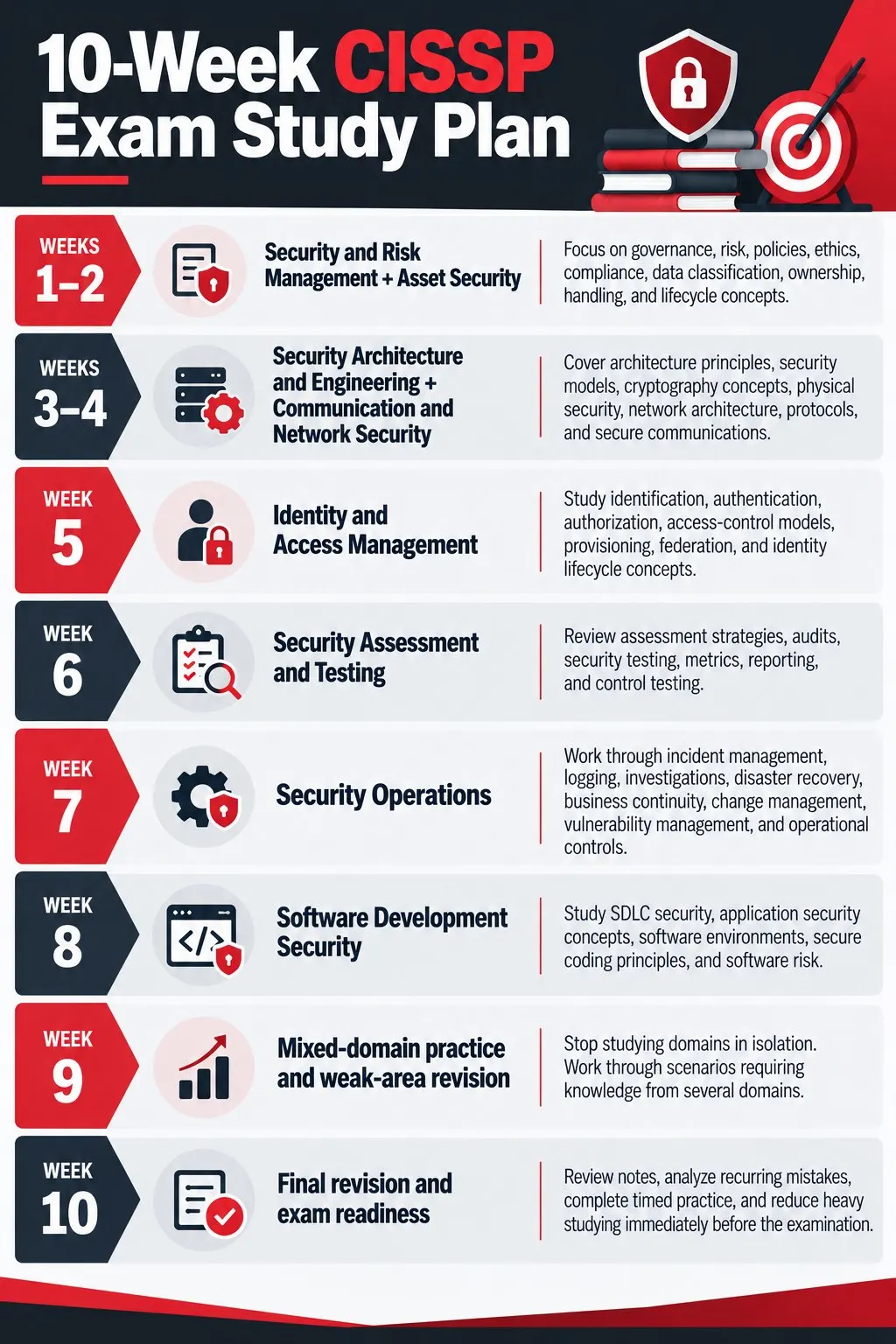
There is no single preparation period that works for everyone. Your study time depends on your experience across the eight domains, weekly study hours, and performance on practice questions. The 10-week plan in this guide can be used as a starting point and adjusted to your needs.
Is the CISSP exam difficult?
CISSP can be challenging because of the breadth of its eight domains and the need to apply security concepts to scenario-based questions. Candidates with deep experience in one area may still need substantial preparation in domains outside their day-to-day work.
Can I prepare for CISSP through self-study?
Yes. Many candidates use study guides, videos, practice questions, and other resources for self-study. Instructor-led training can also be helpful if you want a structured learning plan or need assistance with difficult concepts.
Are CISSP practice tests important?
Yes. Practice tests help you check your understanding, identify weak topics, and become familiar with scenario-based questions. Always review the reason behind incorrect answers rather than focusing only on your final score.
Should I memorize everything for the CISSP exam?
No. Some information needs to be remembered, but understanding the concepts is more important. You should know why a security practice is used and how it applies in different situations.
Is CISSP training worth taking?
It depends on how you prefer to learn. Training can be useful for professionals who want structured preparation, instructor guidance, help with difficult domains, and a regular study schedule.
CISSP vs. CISM: What is the difference?
CISSP covers broad cybersecurity areas such as security architecture, risk, IAM, networks, and operations. CISM focuses more on security management, governance, risk, and security programs.
CISSP vs. Security+: Which is more advanced?
CISSP is designed for experienced cybersecurity professionals and covers security at a deeper technical and managerial level. Security+ focuses more on foundational cybersecurity knowledge.
CISSP vs. CISA: What is the difference?
CISSP focuses broadly on cybersecurity management, architecture, engineering, and operations. CISA focuses primarily on IT auditing, governance, controls, and assurance.
CISSP vs. SSCP: What is the difference?
SSCP focuses more on hands-on security administration and operations. CISSP covers broader and more advanced security, risk, architecture, and management concepts.