CIPP/E Domain 1: Introduction to European Data Protection
Quick Insights:
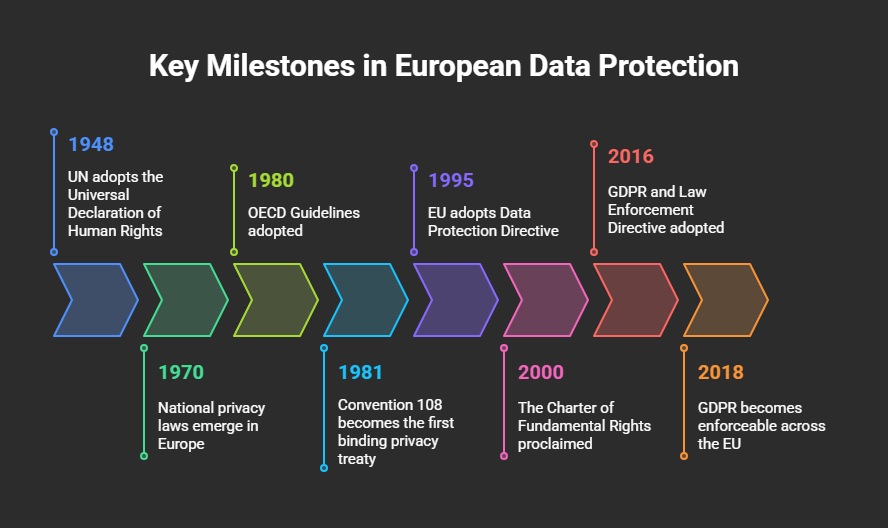
European data protection laws began with human rights frameworks such as the UDHR and the ECHR. Early national laws across Europe created inconsistencies in data protection. Convention 108 introduced the first binding international framework to address this gap. Eventually, the GDPR unified these laws, strengthened individual rights, and ensured accountability for organizations handling personal data.
If you are exploring a career in privacy and gearing up for the CIPPE Certification, understanding the roots of European Data Protection Law is essential. The laws we rely on today, especially the GDPR, did not appear overnight. They evolved from decades of legal, political, and technological changes driven by one key idea: protecting an individual’s personal data while enabling global data flows.

This blog will cover some important topics of Domain 1 in the CIPPE certification: Introduction to European Data Protection.
Why Did Data Protection Become a Legal Priority in Europe?
By the 1970s, computers were being used to collect and process personal information on a massive scale. Governments and businesses built large databases to work more efficiently, but there weren’t many rules about how the data was used. At the same time, trans-border trade, especially within the European Economic Community (EEC), meant that data was often being shared across borders.
The fear? That unchecked digital growth could threaten an individual’s privacy rights, especially when personal data is transferred internationally.
European countries had some legal protections for personal data through privacy, secrecy, tort, and confidentiality laws. However, the rise of automated data storage and cross-border trade demanded new standards to balance privacy with the free flow of information for EEC trade.
Human Rights: The Legal Foundation of Privacy Law
Europe’s data protection framework is built on strong human rights principles:
Universal Declaration of Human Rights (1948)
After World War II, the United Nations introduced the Human Rights Declaration, recognizing the inherent dignity and equal rights of every individual. Two articles are especially relevant to privacy and data protection:
- Article 12: States that “no one should face arbitrary interference with their privacy, home, family, or correspondence, or be subject to attacks on their honor and reputation. Every person is entitled to legal protection against such actions.”
This was the first formal global recognition that privacy is a basic human right.
- Article 19: States that “every individual has the right to freedom of opinion and expression, including the freedom to receive and share information across borders.”
While this supports open communication, it must be balanced with privacy rights to avoid misuse of personal information.
European Convention on Human Rights (ECHR)
This treaty was created by the Council of Europe and came into force in 1953. It builds directly on the Universal Declaration and is legally binding for all member states. Two articles form the privacy framework:
- Article 8: Provides the right to privacy in personal and family life, home, and It allows for government interference only when it is lawful, necessary, and proportionate (for example, for national security or public safety.)
- Article 10: Protects freedom of expression, including the right to share information. However, it also permits lawful restrictions, especially when expression could harm others’ rights, like exposing private data.
Enforcement of these rights is handled by the European Court of Human Rights in Strasbourg. Individuals can bring complaints directly to the court if they believe a state has violated their privacy rights. The court’s decisions are binding and have shaped national privacy laws across Europe.
Early Laws and Regulations
As computers became widespread in the 1970s, concerns about the misuse of personal data grew. European countries like Sweden, Germany, and France introduced national data protection laws. Some, like Austria and Portugal, made data protection a constitutional right. However, differing national laws led to inconsistent protections. To address this, international bodies stepped in:
OECD Guidelines and the Council of Europe: These introduced key privacy principles still relevant today:
- Fair and Lawful Collection: Data must be collected legally, transparently, and with consent when needed.
- Data Quality: Information should be accurate, relevant, and kept up to date.
- Purpose Limitation: Data must be collected for a clear purpose and not used beyond that without consent or legal basis.
- Use Limitation: Data can’t be shared or used for unrelated purposes without permission or legal grounds.
- Security: Reasonable measures must protect data from unauthorized access or loss.
- Transparency (Openness): Individuals must be informed about data use and who handles it.
- Individual Rights: People can access, correct, or delete their personal data.
- Accountability: Organizations must show compliance and take responsibility for data handling.
Convention 108: The First Global Data Protection Treaty
The first legally binding international agreement on data protection was created by the Council of Europe. It required signatory countries to pass domestic laws aligned with its standards. Unlike OECD guidelines, Convention 108 had legal teeth.
Key Components of Convention 108
Convention 108 is structured around three main parts:
- Substantive Law (Chapter II): Sets out core principles like fair processing, purpose limitation, data accuracy, and security, including rights to access and correct personal data.
- Trans-border Data Flows (Chapter III): Allows free data transfer between signatories, with exceptions if adequate protection is not ensured.
- Mutual Assistance (Chapters IV & V): Requires cooperation between national authorities and promotes international enforcement support.
The Need for a Harmonized European Approach
As national laws evolved, the lack of consistency became a problem for both citizens and businesses. The EU decided to standardize rules across member states, resulting in:
Data Protection Directive (1995): This law established a baseline for protecting personal data and ensuring its free flow across EU countries. However, it allowed countries flexibility in implementation, leading to fragmentation and compliance headaches.
The General Data Protection Regulation (GDPR) Era
To modernize data protection and address legal fragmentation, the EU introduced the GDPR in 2016 (enforceable from 2018). Its goals:
- Ensure a unified standard across all EU states
- Enhance individual rights (e.g., data access, rectification, erasure)
- Implement data protection by-design and by-default
- Introduce the concept of accountability
- Apply to any organization, EU-based or not, that targets EU citizens
Key Features of the GDPR
- Stronger individual rights, especially online
- One-stop-shop mechanism for cross-border compliance
- Wider scope, including companies outside the EU handling EU data
- Greater powers for Data Protection Authorities (DPAs)
Supporting Legislation
- Law Enforcement Data Protection Directive (2016): Harmonizes rules for personal data used by police and criminal justice authorities.
- ePrivacy Directive: Covers privacy in electronic communications, complementing the GDPR.
- Charter of Fundamental Rights (2000, binding from 2009): Includes explicit rights to data protection under Article 8.
The Treaty of Lisbon: A Modern Legal Backbone
As EU member countries gained more experience, new ideas emerged to make the European Union more efficient, democratic, and coherent. The Treaty of Lisbon addressed these goals by amending key parts of the EU Treaty and the Treaty of Rome to streamline decision-making and reform EU institutions. One major aim was to cut bureaucracy and speed up processes, especially after the EU expanded.
The Treaty of Lisbon reformed the EU’s constitutional structure and significantly strengthened fundamental rights, including data protection. Its key impact on data protection law:
- Gave binding legal status to the EU Charter of Fundamental Rights, including Article 8, which explicitly guarantees the right to personal data protection.
- Introduced Article 16 of the Treaty on the Functioning of the European Union (TFEU), making data protection a core EU competence and requiring the EU to create laws for both private and public sector data handling.
- Enabled the establishment of the European Data Protection Supervisor, tasked with ensuring that EU institutions comply with privacy rules.
Convention 108+
Convention 108+ is the modernized version of the original Convention 108, adopted by the Council of Europe in 2018. It updates the original treaty to address new challenges like digital technologies, AI, and global data flows.
Key Enhancements in Convention 108+
- Applies to automated and manual processing of personal data
- Introduces stronger accountability obligations for data controllers
- Enhances individuals’ rights, including data portability and objection to processing
- Strengthens rules on data transfers to non-signatory countries by requiring an adequate level of protection
- Expands the role and powers of supervisory authorities and calls for international cooperation
Convention 108+ is open to countries beyond Europe and the world’s only legally binding international treaty on data protection with a global reach.
In Conclusion
The evolution of European data protection law is not just a historical journey; it is the foundation of how modern privacy frameworks operate today. From early human rights principles to the structured governance introduced by GDPR, each stage reflects a growing need to balance individual privacy with technological advancement.
For privacy professionals, this context is key to understanding not just compliance, but why these regulations exist and how to apply them effectively.
To Be Continued: The Roles and Functions of the European Union Institutions
In the next part, explore how EU bodies like the European Commission and Data Protection Authorities enforce privacy laws in practice.
CIPP/E Certification Training with InfosecTrain
Enroll in InfosecTrain’s CIPP/E European Privacy Training to gain a clear understanding of the origins and historical context of data protection law. Led by experienced instructors, this course covers key concepts and prepares you thoroughly for the CIPP/E exam with expert guidance and practical insights.

TRAINING CALENDAR of Upcoming Batches For CIPP/E Training
| Start Date | End Date | Start - End Time | Batch Type | Training Mode | Batch Status | |
|---|---|---|---|---|---|---|
| 16-Nov-2026 | 01-Dec-2026 | 20:00 - 22:00 IST | Weekday | Online | [ Open ] | |
| 05-Dec-2026 | 20-Dec-2026 | 09:00 - 13:00 IST | Weekend | Online | [ Open ] | |
| 04-Jan-2027 | 19-Jan-2027 | 20:00 - 22:00 IST | Weekday | Online | [ Open ] | |
| 06-Feb-2027 | 21-Feb-2027 | 19:00 - 23:00 IST | Weekend | Online | [ Open ] | |
| 01-Mar-2027 | 16-Mar-2027 | 20:00 - 22:00 IST | Weekday | Online | [ Open ] |
Frequently Asked Questions
Why was GDPR introduced?
GDPR was introduced to eliminate fragmentation across EU member states, strengthen individual rights, and create a unified legal framework for data protection.
What is Convention 108 and why is it important?
Convention 108 marked the world’s first binding international treaty on data protection, forming the foundation for modern privacy laws, including GDPR.
How is GDPR different from the Data Protection Directive (1995)?
The Directive allowed flexibility in implementation, leading to inconsistencies, whereas the GDPR is a regulation directly applicable across all EU states, ensuring uniform compliance.
What role does the European Court of Human Rights play?
It enforces privacy rights under the ECHR and allows individuals to file complaints against violations by member states.
How does GDPR impact organizations today?
GDPR requires organizations to follow strict data protection rules, protect user rights, and demonstrate compliance through accountability and transparency.