ITGC Audit vs SOX Audit vs IS Audit
Quick Insights:
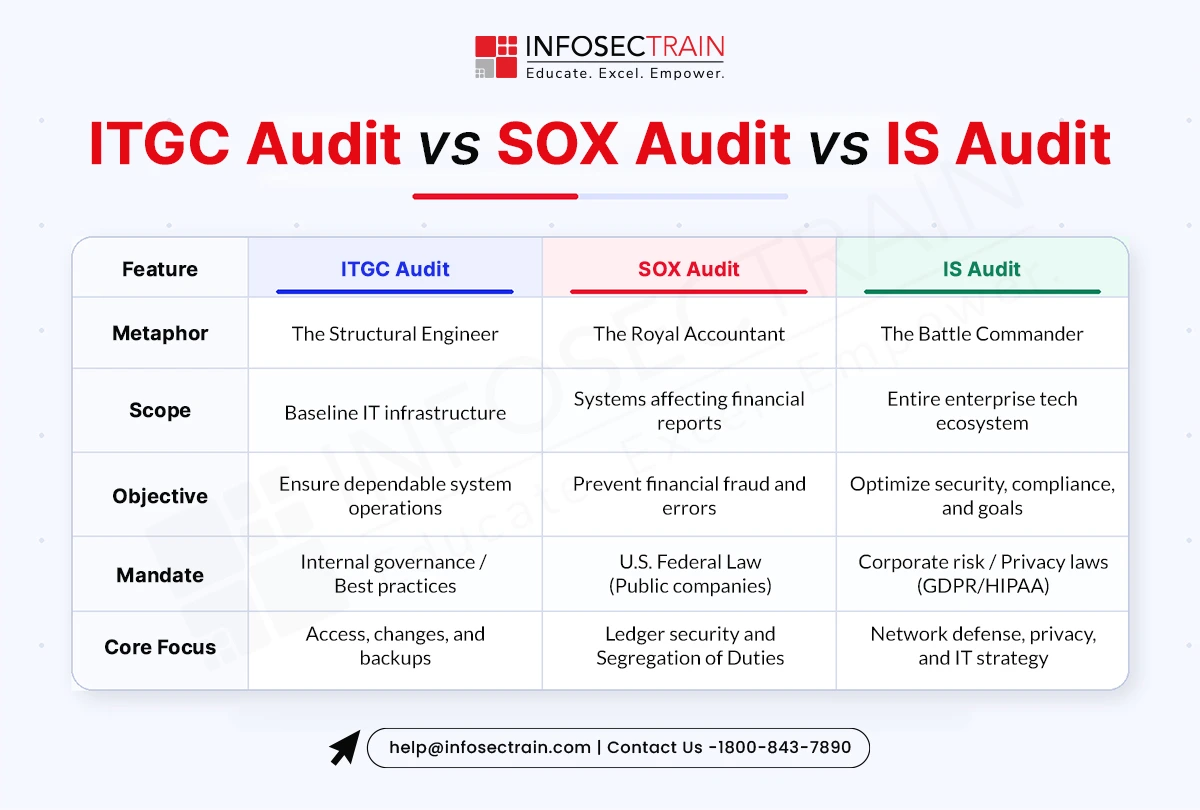
An ITGC Audit acts as a structural engineer by testing foundational infrastructure controls like access management, code deployment workflows, and backups to guarantee a baseline of system dependability across the enterprise; meanwhile, a SOX Audit serves as a specialized royal accountant by inspecting only the software systems and financial ledgers that handle corporate revenue to prevent fraud and reporting errors under U.S. federal law strictly. Finally, an IS Audit operates as an enterprise battle commander by evaluating the overarching network security architecture, data privacy regulations, and broad IT governance to ensure everything runs efficiently and aligns with long-term business goals.
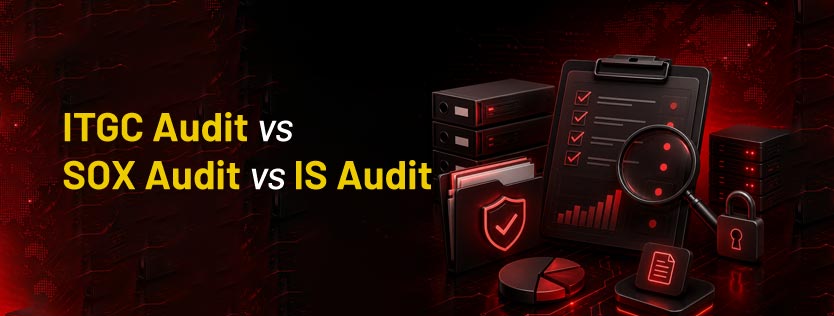
Imagine a digital kingdom housing millions of valuable data files and a vault of revenue. To protect this realm from chaos, three specialized inspectors are brought in, each with a unique focus:
- The Structural Engineer (ITGC Audit): This inspector checks the castle’s foundation by testing door locks (Access Control), protecting construction blueprints (Change Management), and preparing a backup castle for disasters.
- The Royal Accountant (SOX Audit): This inspector focuses entirely on the financial ledger room under strict government regulation, ensuring no one can manipulate the treasure count or commit fraud.
- The Grand Battle Commander (IS Audit): This inspector scans the entire landscape from the highest tower, evaluating radar defenses (Network Security), citizen privacy (Data Governance), and overall operational efficiency.
Together, they ensure the digital kingdom remains structurally stable, fraud-free, and secure against invaders.
ITGC Audit
An Information Technology General Controls (ITGC) Audit inspects the underlying infrastructure and baseline policies that keep corporate applications and data secure. Rather than drilling into day-to-day business transactions, this audit assesses the overall health of the IT environment to confirm that system operations are dependable, predictable, and structurally sound.
Core Focus Areas
- Identity & Access Controls: Confirming user accounts and system permissions align strictly with job responsibilities.
- Authentication Rigor: Checking the deployment of strong password parameters and Multi-Factor Authentication (MFA).
- Change Control Frameworks: Reviewing the documentation, peer reviews, testing, and sign-offs for software updates.
- Operational Continuity: Verifying data backup schedules and disaster recovery preparedness.
- Vulnerability Remediation: Evaluating routine security patching and software vulnerability scans.
- Activity Monitoring: Inspecting system event logging, security alerts, and the physical security of server rooms.
- Separation of Powers: Ensuring conflicting privileges are not granted to a single user account.
Real-World Example: If an organization allows developers to deploy code modifications straight to the live production server without a formal change ticket or managerial sign-off, an ITGC auditor will flag a major deficiency in Change Management, as unvetted updates risk crashing critical business operations.
SOX Audit
A Sarbanes-Oxley (SOX) Audit explicitly tests the internal safeguards that guarantee transparent, fraud-free financial reporting. Mandated for public companies under U.S. law, this audit is highly specialized: it focuses exclusively on the integrity of systems, workflows, and ledgers that feed into the organization’s official financial balance sheets.
Core Focus Areas
- Financial Data Governance: Mapping the collection, compilation, and closing workflows of fiscal records.
- Accounting Software Security: Locking down entry points to accounting ledgers, billing tools, and ERP environments.
- Financial Application Lifecycles: Regulating code modifications specifically within software processing financial transactions.
- Tamper-Proof Audit Trails: Guarding activity logs to prevent transaction histories from being deleted or manipulated.
- Financial Segregation of Duties (SoD): Splitting sensitive monetary tasks across multiple users to prevent insider fraud.
- Automated Calculations: Verifying the logic behind financial macros, automated pipelines, and spreadsheet computations.
Real-World Example: If a ledger clerk holds the systemic capability to both set up a new supplier account and approve outbound check payments within the accounting application, a SOX auditor will issue a severe Segregation of Duties (SoD) violation, because that overlap opens a direct path for financial embezzlement.
IS Audit
An Information Systems (IS) Audit delivers a top-to-bottom evaluation of an organization’s broad technology ecosystem. Far wider in scope than a financial SOX review, an IS audit inspects how well IT investments align with corporate goals, protect digital assets, and optimize overall business performance.
Core Focus Areas
- Information Security Standards: Assessing centralized endpoint defense architectures and overall corporate data handling.
- Perimeter and Infrastructure Defenses: Reviewing live firewall rules, network segmentation, and intrusion detection systems.
- IT Leadership & Strategy: Reviewing how senior leadership manages enterprise-wide cyber risk and budgets.
- Data Privacy Integrity: Validating that data storage and processing adhere strictly to laws like GDPR, HIPAA, or CCPA.
- Resilience and Contingency Planning: Stress-testing systemic failovers and long-term business continuity plans.
- System Value and Performance: Diagnosing whether software deployments add operational efficiency or create bottlenecks.
Real-World Example: An IS auditor will routinely deep-dive into active firewall configuration scripts, check endpoint security compliance scores, and review SIEM alerts to ensure the outer network perimeter can actively repel an ongoing external cyberattack.
ITGC Audit vs SOX Audit vs IS Audit
Conclusion
Mastering ITGC, SOX, and IS Audits is essential for corporate survival. An ITGC audit secures baseline infrastructure, a SOX audit guarantees financial integrity, and an IS audit aligns the entire tech ecosystem with business goals, turning compliance into a strategic driver.
To excel in this field, consider the GRC IT Audit Training Course with InfosecTrain. This program provides the framework expertise needed to navigate global regulations and lead corporate audit strategies with confidence.

TRAINING CALENDAR of Upcoming Batches For GRC Auditor Training
| Start Date | End Date | Start - End Time | Batch Type | Training Mode | Batch Status | |
|---|---|---|---|---|---|---|
| 30-Jan-2027 | 28-Feb-2027 | 19:00 - 23:00 IST | Weekend | Online | [ Open ] |
Frequently Asked Questions
Can an organization combine an ITGC audit and a SOX audit?
Yes. An ITGC audit forms the technological foundation for a SOX audit. Because financial software relies on a secure baseline infrastructure, a SOX audit automatically includes testing the ITGCs of any system processing fiscal records.
What is the main difference between an IS audit and an ITGC audit?
The primary difference is scope. An ITGC audit focuses narrowly on operational basics like system patching, backups, and user access parameters. An IS audit evaluates the bigger picture, including high-level IT governance, network perimeters, and global data privacy compliance.
Who mandates a SOX audit, and does every company need one?
The Sarbanes-Oxley Act of 2002 mandates it under U.S. federal law. This requirement applies strictly to publicly traded companies in the United States to protect investors from financial fraud; private companies are exempt.
Why is Segregation of Duties (SoD) important in both ITGC and SOX audits?
SoD prevents a dangerous concentration of power. In an ITGC context, it stops a developer from pushing code live without a peer review. In a SOX context, it prevents a clerk from both creating a fake vendor and authorizing a payment to them.
What types of real-world evidence do technical auditors look for?
Auditors demand concrete, system-generated proof rather than verbal assurances. They review active user access rosters, signed change management tickets, firewall configuration scripts, and successful data restoration logs.