Red Team Engagement Lifecycle (Complete Guide for 2026)
Quick Insights:
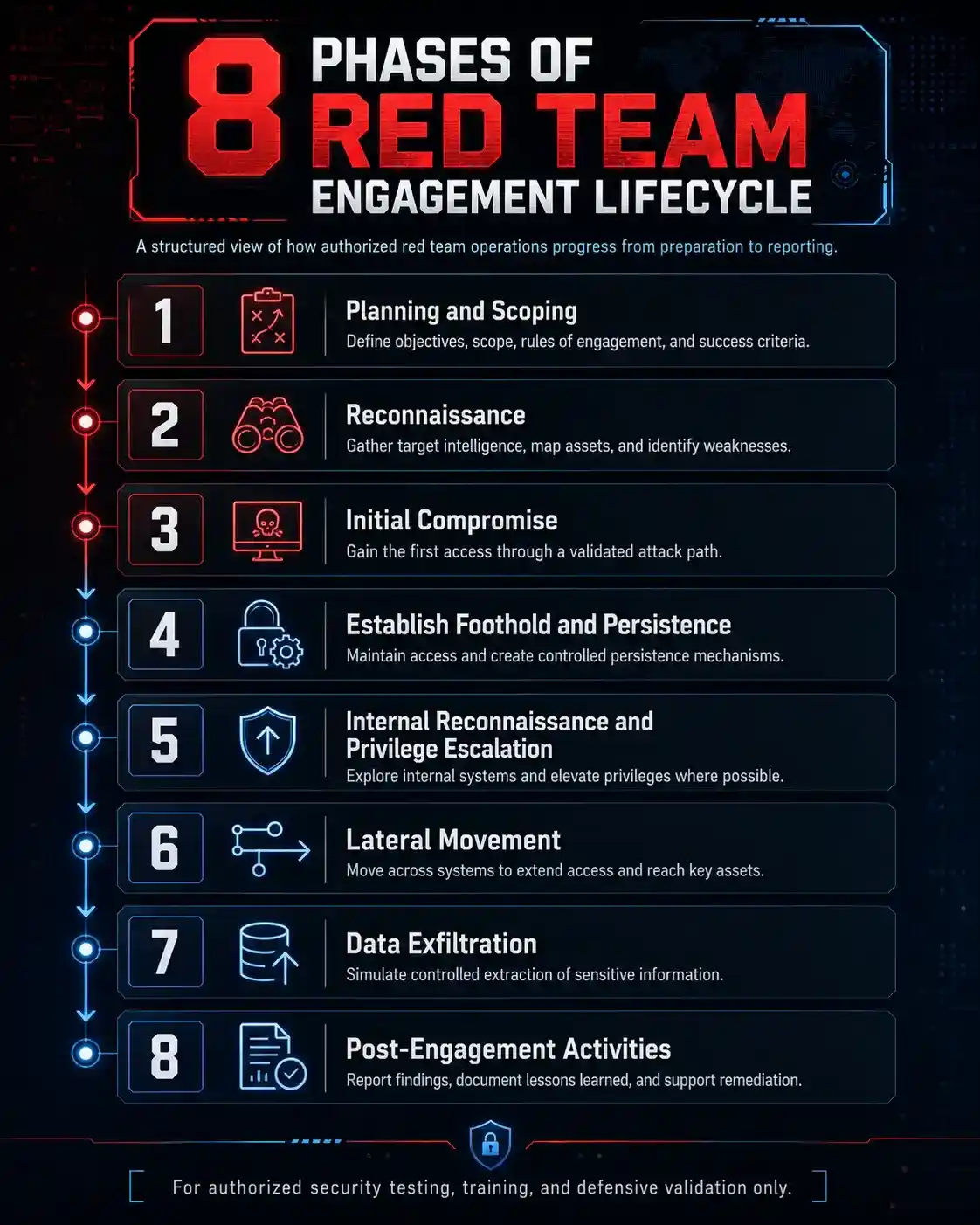
A Red Team Engagement Lifecycle is a structured process for simulating real-world cyberattacks in an authorized and controlled manner. It begins with planning, scoping, and defining Rules of Engagement, followed by reconnaissance, initial compromise, foothold establishment, internal reconnaissance, privilege escalation, lateral movement, and data exfiltration simulation. The engagement ends with cleanup, reporting, lessons learned, and remediation planning. The goal is not just to find vulnerabilities but to test how well an organization can prevent, detect, respond to, and recover from realistic attacks.
Today’s attackers do not follow a straight path. They study the target, find weak entry points, move quietly across systems, abuse identities, and attempt to reach sensitive data before being detected. This is where a Red Team Engagement becomes valuable. It simulates real-world attacker behavior to test how well an organization can prevent, detect, respond to, and recover from cyberattacks.
The Red Team Engagement Lifecycle breaks this process into structured phases, from planning and reconnaissance to compromise, lateral movement, data exfiltration simulation, and final reporting. Each phase helps organizations identify security gaps and improve their overall defense readiness.
What Is the Red Team Engagement?
A Red Team Engagement is a controlled, goal-driven simulated attack where security professionals act like real adversaries to test how well an organization can prevent, detect, respond to, and recover from real-world cyberattacks. It goes beyond identifying vulnerabilities and focuses on how an attacker would actually navigate the environment to reach a defined objective.
What it tests:
- People, process, and technology together
- Realistic attacker behavior, not just technical flaws
- Detection, response, and containment under pressure
A penetration test usually aims to identify and validate vulnerabilities within a specific scope, whereas a Red Team Engagement focuses more on stealth, adversary emulation, and achieving a mission-based objective.
8 Phases of Red Team Engagement Lifecycle
Phase 1: Planning and Scoping
Every successful Red Team Engagement begins with careful planning. This phase defines what will be tested, what is restricted, what success looks like, and how risks will be controlled.
Key Activities
Understanding Objectives
Every engagement must begin with a clear objective. Examples include:
- Can attackers compromise the domain admin?
- Can attackers access customer PII?
- Can attackers bypass MFA through phishing or token theft?
- Can attackers move from a cloud workload to sensitive data storage?
- Can attackers simulate prompt injection attacks?
- Can attackers abuse open-source LLMs in offensive security scenarios?
- Can attackers perform data exfiltration without detection?
The objective shapes the entire Red Team Engagement Lifecycle.
Define Scope
Scope determines what is included and excluded from the engagement. This may include:
- Domains and IP ranges
- Cloud environments
- Applications
- User groups
- Physical locations
- Business units
- Third-party systems
- Social engineering boundaries
Defining Constraints
Constraints define what the Red Team cannot do. These may include:
- No denial-of-service attacks
- No testing against production payment systems
- No physical intrusion
- No social engineering against certain departments
- No destructive malware simulation
- No access to real customer data
- No exploitation of third-party systems
Rules of Engagement
The Rules of Engagement, or ROE, should define:
- Scope and boundaries
- Approved attack windows
- Escalation contacts
- Emergency stop conditions
- Logging and evidence requirements
- Communication protocols
- Data handling rules
- Legal permissions
- Allowed tools and techniques
This is especially important when testing AI-driven defense evasion, ML-based detection bypass, cloud compromise paths, or LLM security assessments.
Phase 2: Reconnaissance
Reconnaissance is the information-gathering phase where Red Teamers study the target’s external footprint, technology stack, employees, exposed systems, and possible attack paths.
Types of Reconnaissance
1. OSINT Reconnaissance
OSINT involves collecting publicly available information. Common OSINT sources include:
- Company websites
- Job postings
- Public documents
- Social media profiles
- Press releases
- GitHub repositories
- DNS records
- Public breach data
- Employee profiles
- Technology references
2. Passive Reconnaissance
Passive recon gathers information without directly interacting with the target systems. This may include:
- Reviewing public domain records
- Studying employee naming conventions
- Identifying third-party vendors
- Analyzing public metadata
- Reviewing exposed cloud storage references
- Mapping public brand assets and login portals
3. Active Reconnaissance
Active recon involves direct interaction with approved target systems. This may include:
- Identifying live hosts
- Mapping exposed services
- Reviewing authentication portals
- Checking external application behavior
- Validating accessible assets
- Testing approved external attack surfaces
Active recon must be carefully controlled, especially when organizations use AI-assisted defenses.
Phase 3: Initial Compromise
Initial compromise is the first successful entry point into the target environment. It tests whether the organization can prevent or detect an attack at its earliest stage.
Depending on the agreed scope and ROE, initial compromise may involve:
- Phishing simulation
- Password spraying
- Credential stuffing
- Exploiting exposed services
- Cloud misconfiguration abuse
- OAuth consent abuse
- API token leakage
- Malicious document simulation
AI-Driven Initial Access
AI is also shaping this phase by helping attackers generate phishing content, summarize OSINT, and plan attack paths, while defenders use AI to detect suspicious behavior.
This creates a new battlefield: AI-driven defense evasion versus AI-assisted detection.
Phase 4: Establish Foothold and Persistence
After initial compromise, the Red Team works to maintain controlled access long enough to meet the engagement objective. Persistence tests whether access can remain available even if a session ends, credentials change, or a system restarts, without disrupting business operations.
Foothold Objectives
At this stage, the Red Team evaluates:
- What level of access has been obtained
- Whether the account is privileged or limited
- Whether access can be maintained safely
- Whether endpoint controls detect suspicious activity
- Whether alerts are generated
- Whether the Blue Team responds effectively
- Whether the mission can continue without disruption
Persistence Testing Areas
Depending on the scope, persistence may test:
- Endpoint monitoring
- Identity and access controls
- Session management
- Cloud account controls
- Privileged access management
- Logging and alerting
- Incident response escalation
Persistence in AI and SaaS Environments
Persistence is expanding into areas that many security teams are still under-monitor:
- SaaS admin accounts
- Cloud service accounts
- DevOps pipelines
- Identity federation
- LLM application plugins
- Agentic AI workflows
- API integrations
Phase 5: Internal Reconnaissance and Privilege Escalation
After gaining access, Red Teams explore the internal environment to understand what an attacker could discover and how easily they could gain higher privileges.
Internal Reconnaissance Activities
- Domain enumeration
- User and group discovery
- Share enumeration
- Cloud IAM review
- Security tool discovery
- Sensitive file identification
- Active Directory attack path mapping
- SaaS permission review
Privilege Escalation
Privilege escalation is the process of moving from limited access to higher-level permissions. This may involve:
- Misconfigured permissions
- Weak service accounts
- Credential reuse
- Kerberoasting
- Token impersonation
- Local privilege escalation vulnerabilities
- Overprivileged cloud roles
- CI/CD secret abuse
- Misconfigured Kubernetes RBAC
- Excessive SaaS admin rights
Phase 6: Lateral Movement
Lateral movement is the process of moving from one system, account, or environment to another after initial access. It shows whether attackers can expand their reach inside the organization.
Common lateral movement paths include:
- Remote Desktop Protocol abuse
- SMB and Windows admin shares
- PsExec-like techniques
- WMI
- PowerShell remoting
- SSH key reuse
- Cloud role chaining
- Kubernetes cluster pivoting
- VPN access abuse
- SaaS-to-cloud pivots
- CI/CD pipeline compromise
- Identity provider abuse
Phase 7: Data Exfiltration
Data exfiltration is the phase where attackers attempt to remove sensitive data from an environment. In Red Team Engagements, this is usually simulated carefully to avoid exposing or mishandling real information. This may include:
- Customer data
- Financial records
- Source code
- Intellectual property
- HR records
- Business strategy documents
- Regulated personal data
- API keys
- Cloud secrets
- AI training data
- Internal knowledge base content
The purpose is to test whether the organization can detect and prevent unauthorized data access or transfer.
What Red Teams May Simulate
Depending on the ROE, Red Teams may simulate:
- Access to sensitive files
- Attempted transfer of dummy data
- Movement toward databases
- Discovery of confidential documents
- Cloud storage access
- Email data access
- Proof-of-access without copying actual data
Red Teams must handle this phase carefully. In ethical engagements, real sensitive data should not be removed. Controlled sample files or harmless test data are used instead.
Exfiltration Techniques
Common exfiltration simulations include:
- Cloud storage downloads
- DNS tunneling simulation
- Encrypted outbound channels
- Email-based exfiltration
- SaaS file sharing abuse
- API-based data extraction
- Compression and staging
- Low-and-slow transfer patterns
- Data transfer through trusted services
Phase 8: Post-Engagement Activities
The post-engagement phase is where the true value of Red Teaming appears. The engagement is not complete when testing ends; it is complete when the organization understands what happened, why it happened, what risks were exposed, and how to improve.
Key Activities of Post-Engagement
1. Technical Cleanup
Before reporting, the Red Team should remove and verify all engagement-related artifacts, such as:
- Test accounts
- Temporary files
- Controlled access mechanisms
- Simulated payloads
- Testing logs or scripts
- Other engagement artifacts
Cleanup must be verified and documented.
2. Executive Debrief
Leadership needs a business-focused summary that explains:
- Engagement objective and outcome
- Business risks demonstrated
- Controls that worked or failed
- Detection and response effectiveness
- Top improvement priorities
3. Technical Report
The technical report should provide clear, evidence-based findings, including:
- Engagement scope
- Activity timeline
- Attack path narrative
- Evidence screenshots or logs
- Mapped MITRE ATT&CK techniques
- Detection gaps and control failures
- Exploited weaknesses
- Risk ratings
- Remediation and retest recommendations
4. Blue Team Debrief
The Blue Team debrief helps improve detection and response by reviewing:
- Alerts that fired or were missed
- Missing logs or visibility gaps
- Suspicious activities observed
- Analyst response and escalation
- Playbook effectiveness
- Detection rules needing improvement
This is where Red Team and Blue Team collaboration becomes most valuable.
5. Lessons Learned Workshop
A lessons learned session converts findings into long-term improvements, such as:
- Security architecture improvements
- Identity and access control enhancements
- Logging and SOC tuning
- Incident response updates
- User awareness improvements
- Cloud security hardening
- Privileged access management
- Network segmentation improvements
6. Remediation Roadmap
The final output should help the organization fix what went wrong through a practical roadmap covering:
- Immediate fixes
- Short-term improvements
- Medium-term security projects
- Long-term strategic investments
- Owners and timelines
- Retesting plan
In Conclusion
The Red Team Engagement Lifecycle is the backbone of modern offensive security validation. Nowadays, organizations need more than compliance checklists and annual penetration tests. They need to know whether their defenses can withstand realistic adversaries across cloud, identity, SaaS, endpoints, AI systems, and human workflows. That is why mastering the complete lifecycle matters.
Planning prevents chaos. Reconnaissance reveals exposure. Initial compromise tests prevention. Persistence tests visibility. Privilege escalation tests control maturity. Lateral movement tests segmentation and identity security. Data exfiltration tests business impact. Post-engagement reporting turns attack simulation into a measurable improvement.
Explore:
- Blue Team Vs Red Team: Which One to Choose?
- Interview Questions for Red Team Expert
- The Importance of Red Team Engagements
Build Real Red Team Capability with InfosecTrain
If you want to master the complete Red Team Engagement Lifecycle, understand advanced Red teaming steps, practice real-world adversary emulation, and learn how offensive operations connect with modern Purple Teaming synergy, enroll in InfosecTrain’s Red Team Operations Professional Training.
This training is designed for professionals seeking practical, instructor-led, hands-on exposure to Red Team operations. We help you develop the skills needed to think, operate, and communicate like a modern Red Team professional.

TRAINING CALENDAR of Upcoming Batches For Red Team Training
| Start Date | End Date | Start - End Time | Batch Type | Training Mode | Batch Status | |
|---|---|---|---|---|---|---|
| 05-Dec-2026 | 13-Feb-2027 | 19:00 - 23:00 IST | Weekend | Online | [ Open ] | |
| 06-Mar-2027 | 08-May-2027 | 19:00 - 23:00 IST | Weekend | Online | [ Open ] |
Frequently Asked Questions
What is the Red Team Engagement Lifecycle?
It is a structured process for planning, executing, and reporting realistic adversary simulation exercises, covering stages like reconnaissance, compromise, lateral movement, exfiltration, and reporting.
How is Red Teaming different from penetration testing?
Penetration testing finds vulnerabilities, while Red Teaming simulates real attacker behavior to test prevention, detection, and response capabilities.
Why is adversary emulation important in 2026?
It helps teams mimic real threat actors using modern tactics such as identity abuse, cloud attacks, automation, and AI-assisted techniques.
What role does AI play in modern Red Team operations?
AI is used in both attack and defense, making Red Teams focus on AI-driven evasion, ML detection bypass, LLM testing, and prompt injection simulations.
Why is Purple Teaming synergy important after Red Teaming?
It turns Red Team findings into stronger detections, better controls, improved SOC response, and measurable security improvements.