CISO vs CTO vs CIO: Who Owns What in Enterprise Security
Quick Insights:
The enterprise security ecosystem relies on a clear split: the CISO acts as the architect, setting the global strategy, policies, and continuous auditing frameworks. The CTO and CIO act as the builders who execute that strategy within their respective domains. The CTO secures external products by embedding safety directly into customer-facing software and development pipelines. In contrast, the CIO secures internal operations by hardening networks, patching systems, and managing employee devices. Ultimately, the CISO designs the blueprint, while the CIO and CTO construct the walls.
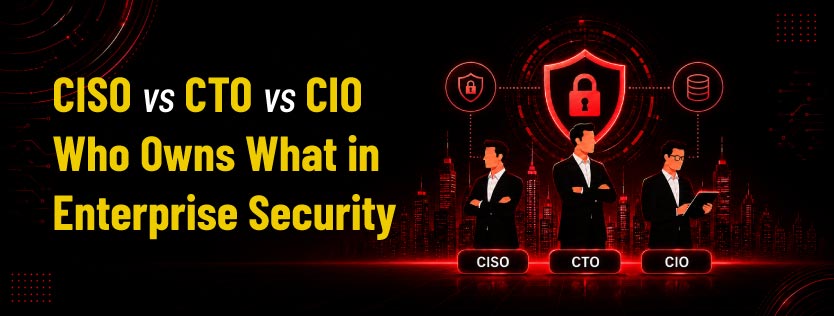
Imagine a massive corporate office building.
The CISO is the independent Chief of Security. They don’t manage operations or build products; instead, they design the master security blueprint, monitor the alarms, and audit the entire building for hidden vulnerabilities.
The CTO is the master engineer overseeing the construction of a high-tech public showroom next door. They focus on delivering company products quickly, innovatively, and customer-ready, while ensuring the software and code pipeline are built securely from the ground up.
The CIO is the head of internal facilities. They keep the corporate lights on, the elevators running, and employee systems functional. When security rules are set, the CIO’s team physically deploys the firewalls, locks the digital doors, and patches the infrastructure.
The Chief Information Security Officer (CISO)
The CISO is the executive who designs and oversees the independent cybersecurity strategy, risk management framework, and data protection policies for the entire organization.
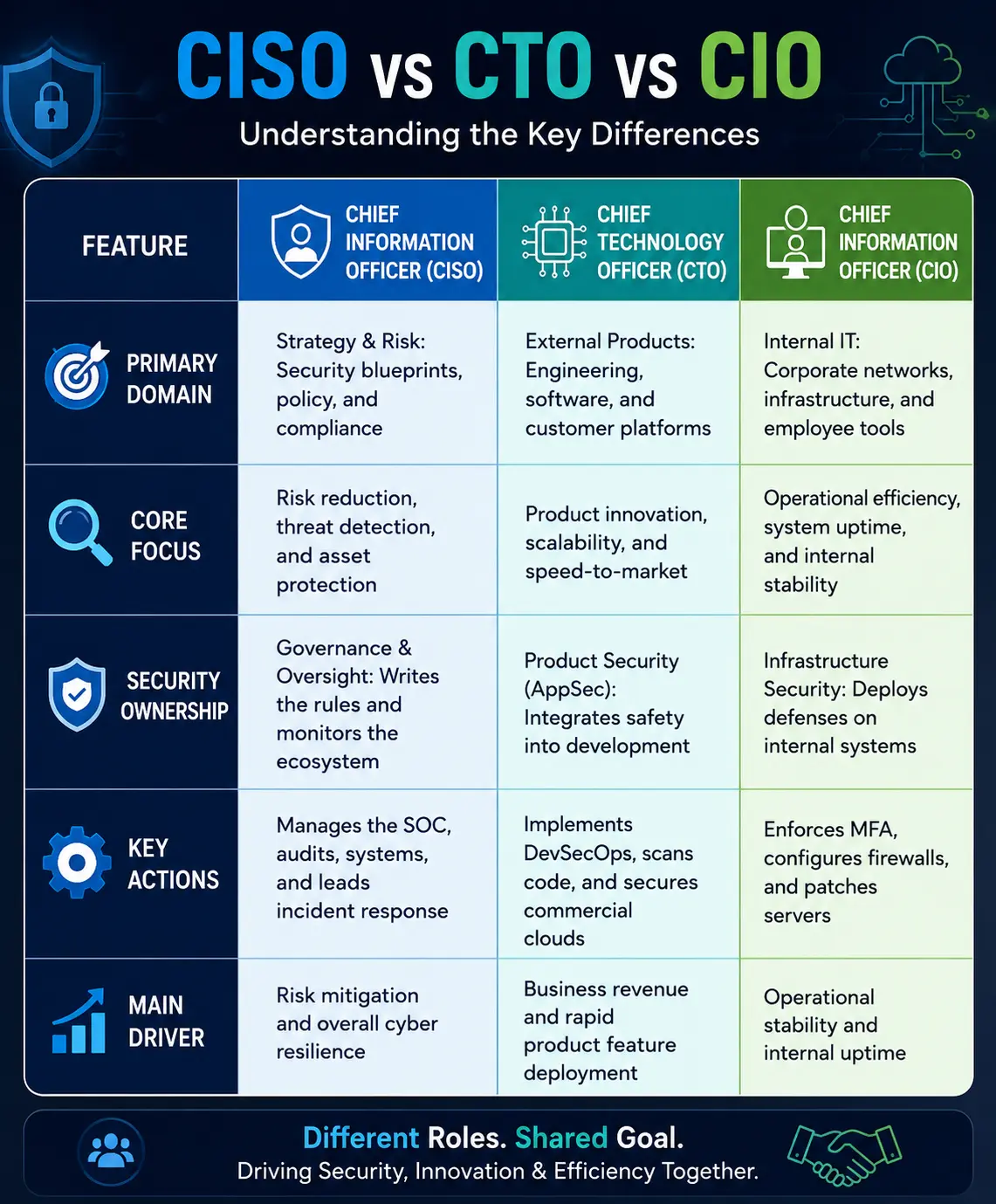
- The Focus: Enterprise risk reduction, active threat detection, and regulatory compliance. The CISO protects the company’s brand, assets, and data from external hackers and internal threats while aligning defenses with the company’s business goals.
- The Connection: They own security governance and oversight, meaning they write the company’s security rulebook, monitor the network for cyberattacks, and audit both the CIO and CTO to ensure compliance.
The Chief Technology Officer (CTO)
The CTO is the executive who leads the engineering, design, and development of the company’s technology products, core architectures, and digital services sold to its customers.
- The Focus: External product innovation, software scalability, and user experience. The CTO prioritizes speed-to-market, competitive technical advantages, and the development of high-performance customer-facing applications that directly generate corporate revenue.
- The Connection: They own application and product security, ensuring that development teams follow secure coding practices, scan software for bugs before launch, and protect customer-facing cloud environments.
The Chief Information Officer (CIO)
The CIO is the executive who manages the internal technology infrastructure, business applications, and data storage systems required to run the day-to-day operations of the enterprise.
- The Focus: Internal operational efficiency, employee productivity, and corporate system stability. The CIO cares about optimizing internal investments, reducing IT downtime, and ensuring that core business applications, such as ERP software, HR systems, and corporate email, run seamlessly.
- The Connection: They own infrastructure security implementation, meaning their team physically deploys the firewalls, enforces multi-factor authentication (MFA) on employee devices, and patches internal servers.
Who Owns What in Enterprise Security?
Enterprise security ownership splits clearly between defining the rules and enforcing them across three major domains:
- The CISO owns Security Governance, Compliance, and Strategy: They act as the independent regulator, writing the security rulebook, managing the Security Operations Center (SOC), and establishing the global guardrails that the entire company must follow.
- The CIO owns Infrastructure and Operations Security Execution: They implement the CISO’s guidelines across internal corporate systems. This includes configuring network firewalls, enforcing multi-factor authentication (MFA) on employee devices, and patching internal servers.
- The CTO owns Application and Product Security Execution: They embed security into the development pipeline (DevSecOps) for customer-facing commercial systems. This includes ensuring developers write secure code, running vulnerability scans on software builds, and protecting production cloud environments.
In short, the CISO owns the blueprint, while the CIO and CTO own the building blocks within their respective networks.
CISO vs CTO vs CIO
Conclusion
While the CISO defines the security blueprint and strategy, they rely entirely on the CTO and CIO to build and maintain the walls. True enterprise resilience is achieved only when the CISO’s governance, the CTO’s secure product engineering, and the CIO’s resilient infrastructure work in total alignment, a balance directly supported by InfosecTrain’s Practical CISO Training & Readiness Program that bridges strategic governance with tactical execution to equip aspiring and current CISOs with the practical skills needed to manage real-world incidents, evaluate infrastructure gaps, and lead enterprise security teams.

TRAINING CALENDAR of Upcoming Batches For CISO Training
| Start Date | End Date | Start - End Time | Batch Type | Training Mode | Batch Status | |
|---|---|---|---|---|---|---|
| 30-Jan-2027 | 21-Feb-2027 | 19:00 - 23:00 IST | Weekend | Online | [ Open ] |
Frequently Asked Questions
Who is responsible if a data breach occurs?
The CISO leads the incident response and regulatory investigation. However, technical responsibility depends on the root cause: an unpatched employee database falls under the CIO, while a buggy customer-facing app falls under the CTO.
How do the CIO and CTO differ in deploying security tools?
The CIO secures internal operations by enforcing tools like multi-factor authentication (MFA) on employee devices and configuring corporate firewalls. The CTO secures external products by embedding automated code scanners directly into the software development pipeline.
Does the CISO have authority over the CIO and CTO?
Yes, from a governance perspective. The CISO serves as an independent auditor, reviewing both the CIO's internal infrastructure and the CTO's digital products to ensure they meet corporate compliance and security benchmarks.
Who owns the enterprise cybersecurity budget?
The CISO controls the budget for enterprise-wide risk management, compliance, and the Security Operations Center (SOC). However, the CIO and CTO fund the actual technical implementation of those security guardrails out of their own departmental budgets.
Why can't a CIO or CTO absorb the CISO's role?
It creates a direct conflict of interest. Because the CIO prioritizes internal uptime and the CTO prioritizes rapid product deployment, an independent CISO is essential to ensure that speed and convenience never compromise data protection.