What is the Open Security Architecture (OSA) Framework?
Quick Insights:
The Open Security Architecture (OSA) framework is a free, open-source library of pre-vetted security blueprints (Design Patterns) created by IT professionals. It bridges the gap between abstract compliance rules (such as ISO or NIST) and the actual technical setup by showing engineers exactly how to build secure systems. By using these standardized, vendor-neutral templates, companies can deploy secure architectures faster, reduce compliance audit time, and improve collaboration between developers and security teams without reinventing the wheel.
Think of standard security rulebooks (like ISO or NIST) as a king’s order: The castle must have a strong front gate and a safe water moat. The king tells you what he wants, but he does not help you draw the plans or build it.

The Open Security Architecture (OSA) framework is like a free book of pre-made building blueprints.
Instead of guessing how to build a safe front gate from scratch, you look at the OSA playbook. It provides a clear drawing showing exactly where the walls go, where the guards should stand, and how visitors get inside safely. Because experts from all over the world share and update these plans for free, any company can use them to build a strong defense without spending a fortune on expensive designers.
What is the Open Security Architecture (OSA) Framework?
The Open Security Architecture (OSA) framework is a community-driven, open-source project that provides free, practical security architecture blueprints and patterns. Unlike high-level compliance frameworks that tell you what to secure, OSA is designed by real-world practitioners to show you how to secure it.
It acts as a bridge between abstract security policies (like ISO 27001 or NIST) and concrete technical implementation.
Key Objectives of the OSA Framework
- Preventing Reinventing the Wheel: Providing a vast public library of pre-vetted design blueprints so security engineers don’t waste time drafting architectures from scratch.
- Standardizing Security Diagrams: Establishing a uniform icon library and visual language so that an architectural blueprint reads the same way to a developer in Tokyo as it does to an auditor in New York.
- Fostering a Threat-Informed Defense: Moving beyond static tick-box compliance by supporting threat-informed security design through mappings to real-world attack scenarios and security control frameworks, often leveraging resources such as MITRE ATT&CK.
- Democratizing Enterprise Security: Providing free, professional-grade security architecture resources to organizations of all sizes, eliminating the financial barriers of proprietary consulting frameworks.
Core Components of the OSA Framework
Security Design Patterns (SP)
These are the core building blocks of the framework. A design pattern is a reusable configuration that solves a specific, recurring security problem. Each pattern includes a technical diagram, a description of the threat context, and a breakdown of the required controls.
- Examples: Secure Internet DMZ, Identity & Access Management (IAM) flows, Public Cloud Integration, or Remote Access VPN.
Controls and Taxonomy
OSA features a comprehensive catalog of security controls. Critically, these controls align with major global standards, including ISO/IEC 27001, NIST, and COBIT. This means implementing an OSA pattern can help organizations align with and demonstrate compliance with relevant requirements, although additional governance, documentation, and validation activities may still be required.
Actors and Assets
To ensure threat modeling is accurate, OSA defines standardized definitions for:
- Actors: The entities interacting with the system (e.g., end-users, system administrators, external attackers, automated service accounts).
- Assets: Items requiring protection (e.g., customer data, hardware, network services).
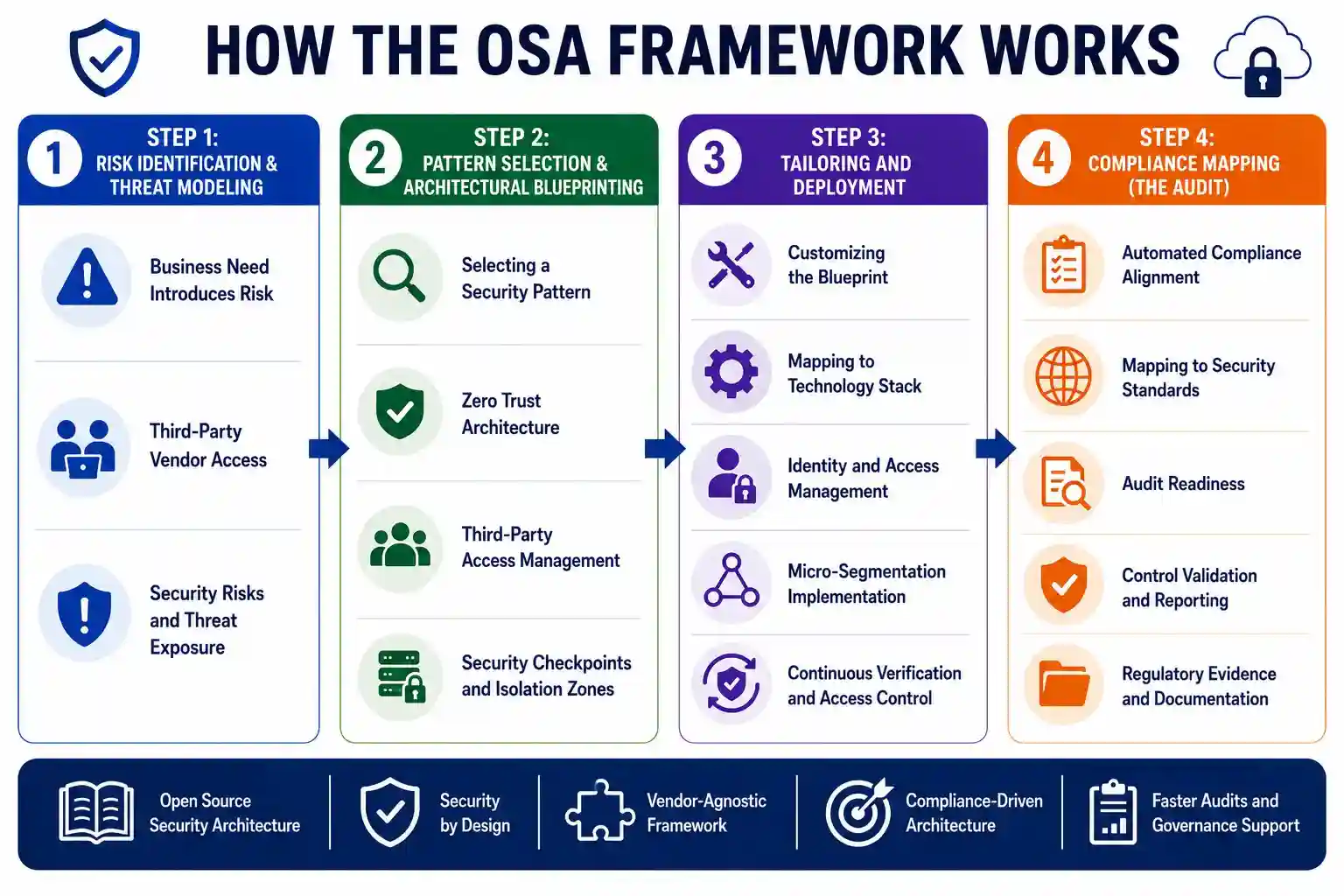
How the OSA Framework Works
Step 1: Risk Identification & Threat Modeling
The process begins when a business need introduces an inherent security risk.
- The Scenario: The company must grant external third-party vendors access to internal databases for analytics reporting.
- The Risk: The architect notes that this opens the door to credential theft, data leaks, or hackers using the vendor’s access to move laterally through the internal network.
Step 2: Pattern Selection & Architectural Blueprinting
Instead of designing a complex solution from scratch, the architect pulls a pre-vetted blueprint from the open-source OSA library.
- Finding the Blueprint: They browse the OSA catalog and select Zero Trust Architecture combined with Third-Party Access Management.
- Analyzing the Layout: The architect downloads the pattern’s visual blueprint. This diagram shows exactly where to place security checkpoints, such as Multi-Factor Authentication (MFA), and isolated data zones, ensuring the vendor never directly touches the core network.
Step 3: Tailoring and Deployment
OSA is vendor-agnostic; it provides a logical blueprint that the team then customizes to fit their actual technology stack.
- Translating to Code: The architect maps the generic OSA diagram to their real tools. Where the pattern says Identity Provider, they configure Okta or Microsoft Entra ID. Where it mandates Micro-segmentation, they write Terraform scripts to isolate their cloud network.
- Enforcing Boundaries: Following the pattern’s guidelines, they set up continuous verification so the vendor’s connection is constantly checked and automatically timed out after the job is done.
Step 4: Compliance Mapping (The Audit)
Once deployed, the organization must prove to regulators and internal stakeholders that the system is safe.
- Automated Compliance: Every OSA pattern includes built-in cross-referencing to global standards such as ISO 27001, NIST, and PCI-DSS.
- The Auditor’s Checklist: When an auditor asks how vendor risk is managed, the architect does not need weeks to prepare spreadsheets. They export the OSA pattern’s control index, instantly proving that the technical setup satisfies specific regulatory requirements.
Benefits of Using the OSA Framework
- Accelerated Time-to-Market: Security teams can rapidly review and approve new architectures by pulling down pre-vetted, community-approved blueprints, significantly reducing project timelines.
- Cost-Effective (Open Source): Because it is open source and free, organizations of any size can leverage enterprise-grade security reference architectures without incurring steep licensing fees.
- Simplified Compliance Audits: The built-in cross-referencing to standards such as ISO 27001 or NIST reduces the time GRC (Governance, Risk, and Compliance) teams spend translating technical setups for auditors.
- Improved Cross-Functional Collaboration: The clean, standardized visual diagrams act as a common language, making it easy for security architects to explain technical requirements to software developers, system engineers, and executive stakeholders alike.
Conclusion
Ultimately, the Open Security Architecture (OSA) framework serves as a practical link between abstract regulatory requirements and real-world engineering. It’s free, community-backed, and vendor-neutral blueprints allow enterprise teams to roll out defensive controls rapidly, integrate cleanly with DevOps workflows, and automatically hit rigorous compliance targets without starting from scratch.
To master these blueprints in practice, InfosecTrain’s Security Architecture Hands-on Training offers a deep-dive, instructor-led program that blends real-world case studies with practical applications of major frameworks like SABSA, TOGAF, and OSA.

TRAINING CALENDAR of Upcoming Batches For Security Architecture Training
Start Date
End Date
Start - End Time
Batch Type
Training Mode
Batch Status
14-Nov-2026
06-Dec-2026
09:00 - 13:00 IST
Weekend
Online
[ Open ]
Frequently Asked Questions
What makes OSA different from frameworks like ISO 27001 or NIST?
High-level frameworks such as ISO and NIST serve as checklists outlining the standards organizations must meet. OSA provides the actual visual blueprints and technical templates that show engineering teams how to build systems that meet those exact standards.
Is the OSA framework free to use?
Yes. OSA is entirely free and open-source under a Creative Commons Creative Commons Attribution-ShareAlike (CC BY-SA 4.0) license. Organizations of any size can download and use its design patterns without paying licensing or consulting fees.
What is an OSA Security Design Pattern?
It is a reusable blueprint designed to solve a specific, recurring security problem (e.g., setting up a secure VPN or an API Gateway). Each pattern contains a technical diagram, its threat context, and the specific controls needed to secure it.
Can an organization use OSA with specific tools like AWS, Azure, or Okta?
Absolutely. OSA is vendor-agnostic. It provides the logical architectural layout (e.g., the Identity Provider Layer), which engineering teams then customize using the specific brands or tools the company already uses.
How does OSA help with compliance audits?
Every OSA design pattern is pre-mapped to global standards such as ISO 27001, NIST, and PCI-DSS. When an auditor asks how a specific risk is handled, exporting the pattern's control index instantly proves compliance.