Data Minimization for AI: How to Train Models Without Over-Collecting?
Quick Insights:
The strategic implementation of data minimization in Artificial Intelligence training serves as a critical defense against escalating cybersecurity risks and regulatory penalties. By adopting Privacy-Preserving Machine Learning (PPML) techniques, such as Federated Learning, Differential Privacy, and Homomorphic Encryption, organizations can achieve high model accuracy while strictly adhering to the principle of "collecting no more than is necessary".
AI is having a growth spurt, and governance is trying to keep up. McKinsey & Company found that 78% of organizations used AI in at least one business function in 2024, up from 72% earlier that year and 55% a year before. At the same time, the Stanford Institute for Human-Centered Artificial Intelligence reported that documented AI incidents rose to 362 in 2025 from 233 in 2024. Add to that Cisco’s 2026 privacy benchmark, which says AI ambition is outpacing readiness, and IBM’s 2025 breach report, which says ungoverned AI systems are more likely to be breached, and the global average cost of a data breach is USD 4.4 million, and the picture gets very clear, very fast. AI is scaling. Risk is scaling with it. That’s exactly how data minimization in AI comes into the picture.
What is Data Minimization in AI?
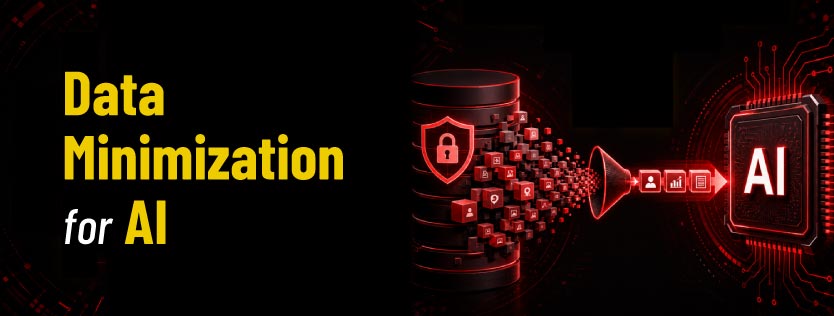
Data minimization means collecting only what you truly need, using it only for a defined purpose, and keeping it no longer than necessary. Experts explain the principle as ensuring personal data is adequate, relevant, and limited to what is necessary for the stated purpose. They also stressed that organizations should periodically review what they hold and delete anything they no longer need.
For AI teams, that changes the question from “How much data can we gather?” to “What is the minimum useful data that still gets the job done?” That is a much smarter question. It forces teams to define the use case first, identify essential features, and design retention and deletion rules before the model ever goes live. Experts say exactly that: review relevance at each stage of development and training, justify retention, and remove irrelevant information before launch.
Why Does Over-Collecting Data Backfire?
More data sounds smart until it becomes your biggest weakness. Sensitive training data can leak in ways many teams underestimate. The National Institute of Standards and Technology defines a membership-inference attack as an attempt to determine whether a data sample was part of a model’s training set. IBM explains that model inversion attacks can reconstruct information about the data a model was trained on. In other words, the model itself can become part of the attack surface. If you over-collect, you are not just storing risk; you are creating it. You may be teaching risk.
There is also a performance myth worth killing: more data does not automatically mean better models. Noisy, duplicative, outdated, or weakly relevant data can dilute the signal, slow training, and increase cost. Microsoft’s phi-1 work is one of the clearest reminders of this. Researchers trained a 1.3B-parameter model on “textbook quality” data and synthetic exercises rather than a giant indiscriminate web-scale corpus, and still reported strong benchmark performance for its size class. That does not mean every team should train tiny models. It does mean quality can beat volume when the data is focused and well curated.
How to Train a Model without Over-Collecting Data?
1. Federated Learning: Decoupling Training from Data Collection
Traditional AI follows a simple rule: Bring all data to one place, then train the model. Federated Learning flips this completely. Instead of moving sensitive data to a central server, the model is sent to where the data already exists, like smartphones, hospital systems, or edge devices. The model learns locally, and only model updates (not raw data) are shared back.
This approach is already used by companies like Google in products like Gboard.
Why it matters for data minimization:
- No centralized storage of raw sensitive data
- Reduced attack surface
- Better compliance with privacy laws
Important: It does not eliminate risk, but it dramatically reduces exposure.
2. Differential Privacy and the Epsilon Budget
Differential Privacy ensures that your AI model cannot reveal whether a specific person’s data was used. It works by adding controlled noise to:
- Training data
- Model outputs
This is controlled using a privacy budget (ε – epsilon):
- Lower ε → Strong privacy, slightly lower accuracy
- Higher ε → Better accuracy, weaker privacy
Why it matters for data minimization:
- Allows use of sensitive datasets without exposing individuals
- Reduces the need to collect excessive personal data
- Enables safe data sharing and analytics
3. Homomorphic Encryption and Secure Multi-Party Computation (SMPC)
Here’s the real challenge in AI: You need data to compute, but exposing data creates risk. Homomorphic Encryption solves this by allowing computations directly on encrypted data.
That means:
- Data stays encrypted
- Processing happens securely
- Results are decrypted only at the end
Now combine that with Secure Multi-Party Computation:
- Multiple organizations can:
- Collaborate on analysis
- Without sharing raw data
Example:
Banks detect fraud patterns without exposing each other’s customer data.
Why it matters for data minimization:
- No need to pool raw datasets
- Limits data sharing across entities
- Supports secure collaboration
4. Feature Abstraction and Data Masking
Here’s where most teams go wrong: They collect full datasets “just in case.” But AI does not need raw identity data; it needs patterns. Instead of:
- Names
- IDs
- Personal identifiers
Use:
- Transaction frequency
- Behavioral patterns
- Time-based signals
Example (AML systems): A model can detect fraud using:
- Sudden transaction spikes
- Geographic anomalies
- Account activity patterns
Without ever knowing who the person actually is.
Why this matters for data minimization:
- Reduces collection of personally identifiable information (PII)
- Improves compliance with regulations
- Minimizes breach impact
Practical Workflows for Automated PII Scrubbing
If there’s one place where data minimization actually fails, it is here: Logs, transcripts, and pipelines quietly storing sensitive data. The fix? Automate PII scrubbing before data is ever stored.
1. Middleware-Based Redaction and Transcription
For systems that process unstructured data, such as customer support transcripts or voice recordings, real-time redaction is essential. The most effective implementation pattern is Intercept → Detect → Scrub → Store. This is known as middleware-based redaction. Here’s how it works:
- Data enters the system
- A middleware layer intercepts it
- PII is detected using NLP
- Sensitive data is replaced before storage
Tools like:
- Microsoft Presidio
- AWS Comprehend
- Google Cloud DLP
can automatically detect:
- Names
- Credit card numbers
- Social security numbers
And replace them with tokens like:
TypeScript
// Conceptual pattern for a redaction middleware layer
const piiRedactionPipeline = async (inputData: string) => {
// Detect entities using a standalone service or local model
const detectedPII = await detectPIIEntities(inputData);
// Scrub the PII before the data is stored in the database
const sanitizedData = redactEntities(inputData, detectedPII);
return sanitizedData;
};
This “intercept and scrub” approach ensures that even if an engineer accidentally logs an object for debugging purposes, the sensitive data has already been removed. This is critical for preventing “hidden” PII exposure, which is frequently found in production logs and distributed tracing systems.
2. OpenTelemetry & Log Filtering
Most organizations secure databases, but forget about logs. Modern systems use tools like OpenTelemetry for monitoring and tracing. But here’s the problem: Logs often capture:
- Function arguments
- API payloads
- Environment variables
Which may contain:
- Credentials + PII
So organizations are now deploying “Span Processors” that scan trace attributes and scrub sensitive information before it is exported to monitoring tools. This ensures that the observability stack does not become a secondary source of data leakage.
3. Audio-Level Redaction and Masking
Text-based redaction is insufficient for organizations that must store audio recordings for legal or quality assurance reasons. In these cases, audio-level redaction techniques are applied:
- Silence Replacement: Replacing sensitive segments of the audio with absolute silence.
- Tone Replacement: Standard in legacy call centers, replacing PII segments with a consistent beep.
- Audio Masking: Applying noise or distortion to the specific frequency bands where the sensitive information is spoken.
While audio redaction adds latency and complexity, it is often necessary for HIPAA compliance in healthcare or PCI-DSS compliance in finance.
Conclusion
As AI adoption accelerates toward 2027, one thing is clear—organizations that treat privacy as a core design principle, not an afterthought, will lead the future of cybersecurity. The shift from data hoarding to data precision isn’t just a technical upgrade; it’s a business survival strategy, especially as breach costs soar into the millions and “shadow AI” expands the attack surface.
This is exactly where InfosecTrain’s AI Governance Professional (AIGP) Training comes in. It equips professionals with the practical skills to implement privacy-first AI, apply data minimization strategies, manage AI risk, and align with global regulations—turning theory into real-world governance capability. If you’re looking to build secure, compliant, and future-ready AI systems while reducing your organization’s risk exposure, now is the time to upskill with InfosecTrain’s AIGP Training and become a leader in responsible AI innovation.

TRAINING CALENDAR of Upcoming Batches For AIGP Training
| Start Date | End Date | Start - End Time | Batch Type | Training Mode | Batch Status | |
|---|---|---|---|---|---|---|
| 14-Nov-2026 | 29-Nov-2026 | 09:00 - 13:00 IST | Weekend | Online | [ Open ] | |
| 05-Dec-2026 | 20-Dec-2026 | 19:00 - 23:00 IST | Weekend | Online | [ Open ] | |
| 09-Jan-2027 | 24-Jan-2027 | 19:00 - 23:00 IST | Weekend | Online | [ Open ] | |
| 06-Feb-2027 | 21-Feb-2027 | 09:00 - 13:00 IST | Weekend | Online | [ Open ] | |
| 06-Mar-2027 | 21-Mar-2027 | 19:00 - 23:00 IST | Weekend | Online | [ Open ] |
Frequently Asked Questions
What is data minimization in AI?
Data minimization in AI means collecting and using only the data necessary for a specific model purpose, reducing privacy risks and unnecessary storage. Simply put, if your AI does not need it, do not collect it.
Why is data minimization important for AI models?
It reduces privacy risks, ensures compliance with laws like GDPR and the Digital Personal Data Protection Act 2023, improves model efficiency, and builds user trust, because better data matters more than more data.
How can AI models be trained with minimal data?
AI models can be trained using feature selection, synthetic data, federated learning, anonymization, and transfer learning to maximize insights while minimizing data exposure.
What are the best techniques for implementing data minimization?
Key techniques include purpose limitation, data masking, access control, retention policies, and edge processing, following a “collect less, protect more” approach.
Does less data reduce AI model accuracy?
Not necessarily, high-quality, relevant data often improves accuracy by reducing noise, and techniques like transfer learning help maintain performance even with smaller datasets.