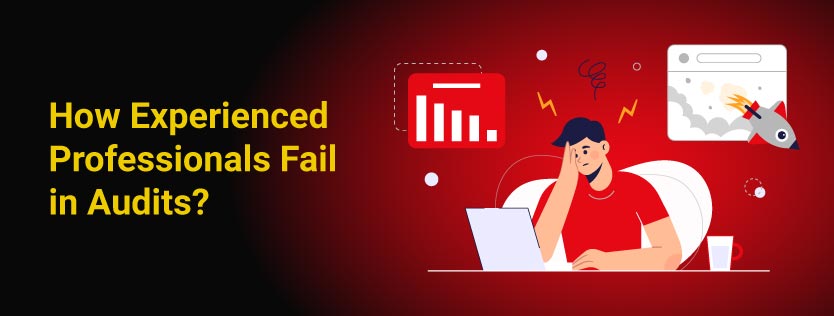
How Experienced Professionals Fail in Audits?
Quick Insights:
Experienced professionals often fail audits not because of poor security, but because they rely on personal mastery instead of verifiable proof. An audit is not a test of how much you know; it is a test of what you can prove. Common pitfalls include neglecting documentation (Tribal Knowledge), assuming expensive tools automatically ensure compliance, and overlooking hidden assets such as APIs or test servers. To pass, experts must stop saying trust me and start showing the blueprints, logs, and fresh evidence that prove their work.
Imagine you are a master builder of the land’s most secure fortress. You know every stone and lock by heart, but when inspectors arrive, the walls alone are not enough to pass.
- The Pro’s Secret: You manage the system perfectly using memory and personal shortcuts, but these secret passages exist only in your head.
- The Missing Paperwork: Auditors don’t value your memory; they want to see the blueprints. If those plans are not on paper, the audit fails.
- The No Record Rule: You may perform maintenance weekly, but without a signed logbook, the auditor must assume the work never occurred.
- The Risky Shortcut: You might use a back door to work faster. While efficient, it is an unrecorded risk that an auditor will eventually flag.
- The Reality Check: The system did not fail because it was weak; it failed because you chose to trust me over here, which is the proof.
How Experienced Professionals Fail in Audits?
The Tribal Knowledge Trap
- Lack of Documentation: Experts often perform tasks perfectly from memory but fail to write down the steps. Auditors follow a strict rule: If it is not documented, it didn’t happen.
- Informal Fixes: Veterans might fix a critical vulnerability on the fly without opening a ticket. While the problem is solved, there is no audit trail to prove to the examiner that a secure process was followed.
- Unwritten Procedures: Relying on a handful of key people who know what to do creates a single point of failure that auditors view as a major operational risk.
Cognitive Biases & Overconfidence
- Assumed Compliance: Experienced managers often assume that having high-end tools, such as AI-enabled firewalls, automatically makes them compliant. In reality, compliance is about how you use the tools, not just owning them.
- Control Illusion: Experts may overestimate their manual oversight and ignore the risk of human error. This overconfidence often leads them to skip automated monitoring, which auditors prefer for its consistency.
Scope Creep and Blind Spots
- Missing Assets: Seasoned pros often focus so much on protecting the main databases that they overlook secondary assets like APIs, test servers, or IoT devices that are still within the audit scope.
- Unmanaged Technology: Long-tenured employees might spin up quick cloud buckets for testing. If these are not added to the official inventory, they become invisible security holes that auditors will eventually find.
Stale Evidence & Reports
- Outdated Testing: Relying on a risk assessment from a year ago is a common mistake. Most standards require fresh evidence within a very specific recent window to prove the network is still secure today.
- Missing Validation: Professionals often fix a problem found in a previous audit but forget to run a final test to prove the fix works. Without a validation report, the auditor will mark it as a repeat finding.
Psychological Resistance
- Viewing Auditors as Enemies: Many experts treat auditors like interrogators. This defensive attitude leads to short, vague answers, which actually make auditors suspicious and encourage them to dig even deeper.
- Fear of Looking Bad: High-level professionals may see an audit finding as a personal failure. This anxiety can lead to rushing through the evidence-gathering phase and accidentally providing the wrong files.
Conclusion
In the world of auditing, technical excellence is not a substitute for administrative discipline. Experienced professionals often fail because they rely on their reputation and personal mastery rather than creating a repeatable, transparent trail of evidence. To pass an audit, a security leader must shift their mindset from securing the system to proving the system is secure. Success is found when every action is documented, every asset is accounted for, and every control is backed by verifiable proof.
Next Steps in your Professional Journey
- Master the Frameworks: Transition from a technical role to a strategic one by learning to bridge the gap between IT operations and corporate compliance with InfosecTrain’s GRC IT Audit Training.
- Become Audit-Ready: Gain the skills needed to design, manage, and lead internal audit programs that meet rigorous international standards and regulatory requirements.

TRAINING CALENDAR of Upcoming Batches For GRC Auditor Training
| Start Date | End Date | Start - End Time | Batch Type | Training Mode | Batch Status | |
|---|---|---|---|---|---|---|
| 30-Jan-2027 | 28-Feb-2027 | 19:00 - 23:00 IST | Weekend | Online | [ Open ] |
Frequently Asked Questions
Why is documentation more important than the actual fix during an audit?
Auditors operate on the principle: If it is not documented, it didn't happen. While a technical fix secures the system, documentation provides the legal and procedural proof that the fix is permanent, authorized, and in compliance with company policy.
How does Tribal Knowledge create a risk for my organization?
Tribal knowledge exists only in the heads of key employees. If those people leave or are unavailable, the process breaks. Auditors see this as a single point of failure, meaning the organization’s security is dependent on individuals rather than a reliable system.
Does having the best security tools (like AI firewalls) guarantee an audit pass?
No. Tools are only evidence of capability, not evidence of compliance. An audit evaluates the processes and governance, how the tools are configured, who monitors them, and how you respond to the alerts they generate.
What is the biggest mistake pros make when talking to auditors?
Being defensive or vague. Treating an auditor as an enemy makes them suspicious. Clear, transparent communication and the provision of specific evidence quickly build trust and usually lead to a smoother, faster audit process.
What is Scope Creep in the context of an IT audit?
It occurs when the audit's boundaries expand or when pros forget that minor assets (such as test servers, APIs, or IoT devices) are still part of the network. If these are not secured to the same standard as your main databases, they will cause an audit failure.