Components of Zero Trust
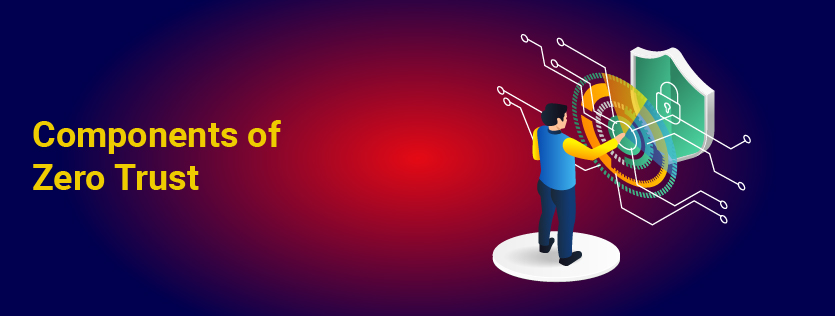
Zero Trust is your digital world’s uncompromising security guard, who operates on the principle of trusting no one, ever. It shatters the outdated notion that being “inside” a network guarantees safety. Instead, Zero Trust assumes every user, device, and application is a potential threat, regardless of their location. So, every single time someone or something tries to access your data, they must prove exactly who they are and that they’re authorized. Companies use this approach to stop hackers dead in their tracks, prevent them from moving around if they do gain access, and significantly strengthen their entire digital defense.
Components of Zero Trust
1. Identity and Access Management (IAM)
IAM serves as the cornerstone of a Zero Trust architecture, fundamentally ensuring that only verified entities gain access. It establishes the identity of a user or device using strong authentication methods, providing critical context for every access decision. This allows access to be dynamically granted on a highly granular, per-session basis, thereby protecting resources even if a user’s credentials are breached. IAM’s robust verification process is essential to the “never trust, always verify” mantra.
- Robust User Authentication: Utilizes methods such as Multi-Factor Authentication (MFA) and Single Sign-On (SSO) to verify identities.
- Contextual Access Decisions: Provides vital information about the user, device, and session for dynamic authorization.
- Granular, Session-Based Access: Ensures access to resources is granted on a strict, per-user, per-device, and per-session basis.
2. Secure Access Service Edge (SASE)
Secure Access Service Edge (SASE) is a modern, cloud-based approach that unifies networking and security services into a single platform. It ensures secure access to applications and resources for any user, anywhere, by delivering security functions at the network edge. This eliminates the need for traditional data center security, protecting organizations from diverse threats, such as malware and phishing, by integrating comprehensive security capabilities.
- Cloud-Native Integration: Combines networking and security functions into a unified, virtualized cloud service.
- Location-Independent Security: Ensures consistent and secure access to resources, regardless of the user’s location.
- Comprehensive Security Features: Includes capabilities like secure web gateways, Firewall-as-a-Service, and Zero Trust Network Access (ZTNA).
3. Data Loss Prevention (DLP)
Data Loss Prevention (DLP) technologies are essential for protecting sensitive organizational data from unauthorized disclosure or exposure. DLP solutions actively monitor and control data both when it’s being transmitted and when it’s stored, ensuring it doesn’t leave the network improperly. This empowers organizations to set and enforce strict policies, thereby preventing critical information from falling into the wrong hands and maintaining data integrity.
- Protects Sensitive Data: Prevents unauthorized disclosure of confidential information.
- Monitors Data Movement: Tracks and controls data both in transit (in motion) and when stored (at rest).
- Enforces Security Policies: Helps organizations define and apply rules to prevent data breaches and leakage.
4. Policy-based Enforcement Points
In a Zero Trust Architecture (ZTA), “Policy-based enforcement points” are the critical gatekeepers that explicitly authorize every single access request to a resource. Initially, these can leverage existing security systems, but they are continuously enhanced to utilize the broader context and signals that a ZTA provides. The goal is to evolve towards dedicated ZTA enforcement points that seamlessly integrate intelligence and enforce comprehensive, consistent policies across the environment, ensuring rigorous “never trust, always verify” decisions.
- Explicit Authorization: Every resource access is individually and explicitly approved by these policy-driven points.
- Contextual Evolution: They are designed to become increasingly intelligent by incorporating diverse contexts and signals over time.
- Consistent Policy Enforcement: Ultimately, they aim to operate on converged intelligence and maintain a comprehensive, unified policy set for all access decisions.
5. Unified Endpoint Management (UEM)
In a Zero Trust Architecture, securing access goes beyond just authenticating the user; it critically depends on the health and posture of their device. Unified Endpoint Management (UEM) platforms are essential for this, as they provide comprehensive control over all user devices. UEM ensures devices are properly provisioned, continuously updated, and adhere to security baselines. It also collects vital telemetry for ongoing assessment and manages devices through their entire lifecycle, including secure retirement.
- Comprehensive Device Lifecycle Management: Handles provisioning, configuration, and secure retirement of devices.
- Continuous Security Posture Assessment: Ensures devices meet security baselines and are kept patched and healthy.
- Telemetry and Reporting: Provides ongoing insights into device state and security compliance.
6. Enterprise Resource Ownership Catalog
For effective Zero Trust access, an “Enterprise Resource Ownership Catalog” is essential. This reliable system meticulously catalogs all organizational resources and, critically, identifies their owners. Serving as a single source of truth, it streamlines workflows for access requests, approvals, and regular attestations. Over time, it provides a definitive answer to “who can access what,” enabling precise authorization and robust audit and compliance.
- Centralized Resource & Owner Data: Acts as a reliable registry of all enterprise resources and their designated owners.
- Streamlined Access Workflows: Facilitates efficient processing of access requests, approval decisions, and periodic attestations.
- Foundation for Authorization & Audit: Provides the definitive information needed for granting access, as well as for compliance and auditing purposes.
7. Security Information and Event Management (SIEM)
Security Information and Event Management (SIEM) Solutions are vital for Zero Trust, as they meticulously collect, aggregate, and analyze security event logs from across the entire infrastructure. This comprehensive data empowers organizations to rapidly detect security incidents, streamline incident response, and gain crucial insights into potential threats. For a Zero Trust Architecture, SIEM’s unique strength lies in its ability to correlate diverse telemetry, significantly enhancing the detection and response to abnormal patterns and ensuring continuous verification.
- Centralized Log Analysis: Collects and analyzes security event logs from various organizational sources to provide a comprehensive view of security events.
- Threat Detection & Response: Facilitates the rapid identification of security incidents and supports efficient response efforts.
- Zero Trust Correlation: Critically correlates telemetry from disparate security systems to detect abnormal patterns.
About InfosecTrain
Understanding the core components of Zero Trust is vital for a robust security posture. By strategically implementing and integrating these elements, organizations can build a strong defense. For those looking to gain this expertise, InfoSecTrain offers specialized training: from their CCZT program for vendor-neutral Zero Trust mastery to their Security Architecture hands-on training for comprehensive secure design, and the CompTIA Security+ (SY0-701) course covering the latest threats and Zero Trust principles, preparing professionals to excel in the evolving cybersecurity landscape.