Exploring Python and Its Significance in Data Science
As the world entered the era of big data in the last few decades, the need for better and more efficient data storage became a significant challenge. Organizations that use big data have primarily focused on developing frameworks that can store large amounts of data. Then frameworks such as Hadoop were developed, which aided in the storage of massive amounts of data.
After resolving the storage issue, the attention turned to processing the data that had been stored. Data science emerged as the way of the future for data processing and analysis at this point. Data science is now an essential component of all organizations that work with large amounts of data. Today’s organizations employ data scientists and professionals to take raw data and turn it into useful information.
What is Data Science?
Finding and exploring data in the real world and applying that knowledge to solve an organization’s problems is the epitome of data science. Here are some examples of the diverse applications of data science:
- Predictions from Customers: A system can be trained to predict the likelihood of a customer purchasing a product based on the customer’s behavior patterns.
- Service Planning: Restaurants can forecast how many customers will visit over the weekend and stock up on food to meet demand.
Now that you understand what data science is, let us discuss the fundamental skills required for data science before delving into the topic of data science with Python. Here are the basic skills:
- Programming Language (Python or R)
- Database and Big Data Skills (SQL)
- Machine Learning Skills
- Mathematics
- Data Visualization
- Statistics
- Big Data
- Data Wrangling

Programming Language for Data Science
A successful data science project necessitates some level of programming language. According to research, Python is the most popular data science programming language with 87 percent of all languages’ popularity. Python is particularly popular due to its ease of use and support for a wide range of data science and machine learning libraries. In this article, we’ll look at Python and how it can help in data science. Python is a widely-used programming language for the following reasons:
- Python is an accessible and highly interpretable programming language. It is open-source software that anyone can use.
- Errors in the code are easy to understand because Python explains the error statement in detail, highlighting the line number where the error occurs.
- Writing Python programs is similar to writing sentences in English. It also facilitates debugging and exception handling.
- Scikit-Learn, NumPy, Pandas, and Matplotlib are examples of Python libraries that can be used to solve data science and machine learning problems.
Why Python?
Python has grown in popularity as a programming language in recent years. Its use in data science, IoT, AI, and other technologies has increased its popularity. Python is a programming language that data scientists recommend because it is user-friendly, has a large community, and has a good library availability. It is one of the primary reasons that python software development company and data scientists all over the world use Python. Other reasons why Python is one of the most popular programming languages for data science include:
- Speed: Python is a relatively fast programming language when compared to other programming languages.
- Availability: There are many packages available that have been developed by other users and can be reused.
- Design Goal: Python syntax roles are intuitive and straightforward to grasp, which aids in developing applications with a readable codebase.
- Choice of Libraries: Python has a massive library like NumPy, Pandas, and SciPy. Many of these collections are also easily accessible in the form of tutorials.
- Visualization and Graphics: Python provides several different visualization options.
Python Libraries for Data Analysis
Python is a simple programming language to learn, and you can do some basic things with it, such as adding and printing statements. However, you’ll need to import specific libraries if you want to do data analysis. Here are a few examples:
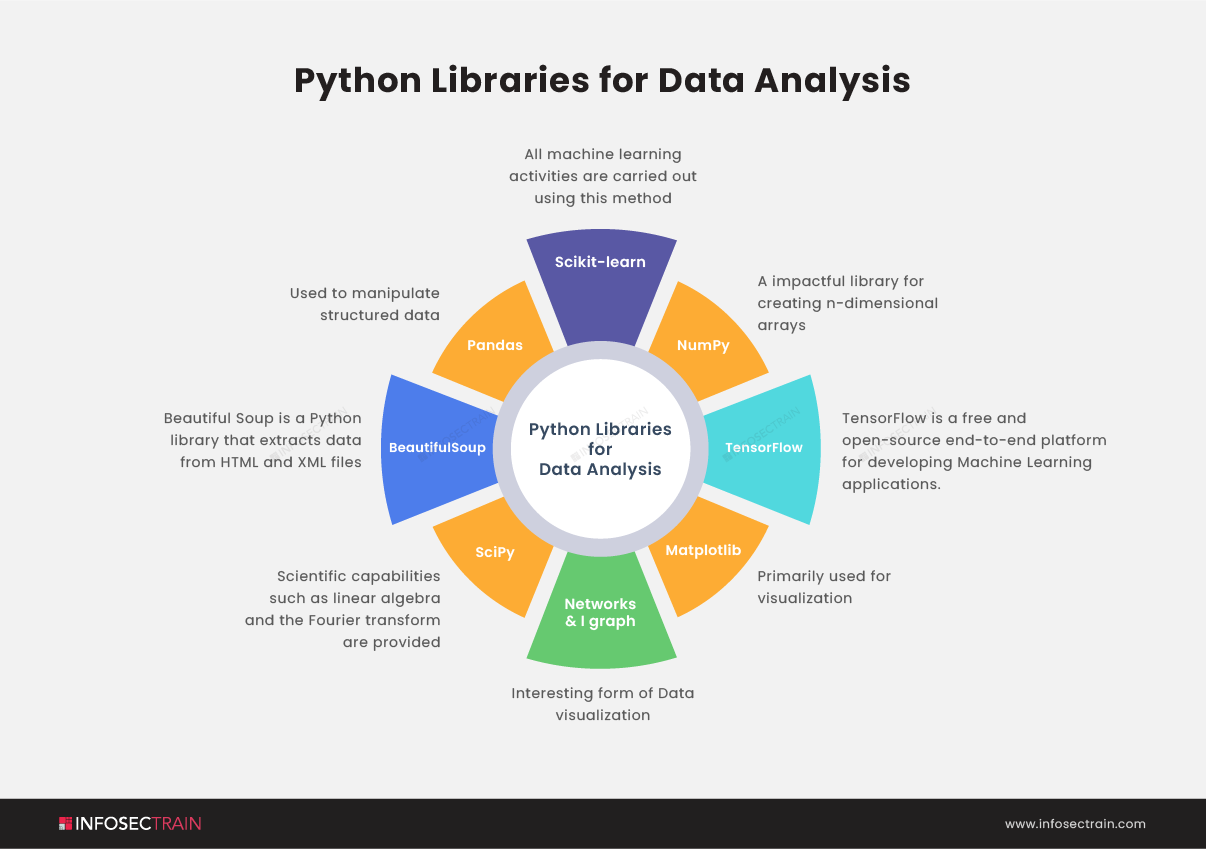
Let’s take a closer look at a few of the most important Python libraries:
NumPy: An essential Python package for scientific computing is NumPy. It includes the following:
- Arry objective with powerful N-dimensional
- C/C++ and Fortran code integration tools
- It has linear algebra, Fourier transform, and random number capabilities that are all useful
SciPy: It’s a scientific library with some unique features, as the name suggests.
- Special functions, integration, ODE solvers, gradient optimization, and other features are available
- It includes fully functional linear algebra modules
- NumPy is used to create it
Pandas: Pandas is used to perform structured data operations and manipulations.
- Python’s most valuable data analysis library
- Contributing to the increased use of Python in the data science community
- Data mugging and preparation are common uses for this tool
Data Wrangling Using Pandas
The process of cleaning and unifying messy and complicated data sets is referred to as data wrangling. Some of the advantages of data wrangling are as follows:
- More data about your information is revealed
- Enhances the organization’s decision-making abilities
- Assists in the collection of valuable and precise data for the organization
In reality, most of the data generated by an organization will be sloppy and contain missing values. There are several options for filling in the blanks. The business scenario will determine which parameters to use when filling them in. To see if your data has any missing values, do the following:
- Dtypes can be used to check the data types for each column.
- Use simple concatenation and merge methods to combine and merge data frames.
Conclusion
Python is an essential tool in the Data Analyst’s toolbox because it is designed to perform repetitive tasks and data manipulation. Anyone who has worked with large amounts of data knows how often repetition occurs. Because a tool handles the grunt work, Data Analysts can focus on their jobs making it more exciting and rewarding.
Get Started
Check out InfosecTrain’s Data Science with Python Certification Course if you want to get a head start in data science. Our Data Science with Python Certification Course will show you how to use Python to master data science and analytics techniques. With this course, you’ll learn the fundamentals of Python programming and gain in-depth, helpful knowledge in data analytics, data visualization, Exploratory Data Analysis(EDA), Statistics, machine learning and deep learning.

Contact Us