Types of Natural Language Processing (NLP) Feature Engineering
Quick Insights:
NLP feature engineering is the process of converting raw text into machine-readable features that AI and machine learning models can understand. In cybersecurity, it helps analyze emails, logs, alerts, threat reports, vulnerability descriptions, malware notes, and other text-based security data. Techniques such as text normalization, Bag-of-Words, TF-IDF, N-grams, word embeddings, FastText, and syntax trees help security teams detect phishing emails, classify alerts, extract indicators of compromise, understand threat intelligence, and identify suspicious language patterns. In simple terms, NLP feature engineering turns cybersecurity text into useful signals for smarter threat detection and faster security analysis.
Cybersecurity teams deal with text everywhere: phishing emails, SIEM alerts, incident tickets, vulnerability descriptions, threat intelligence reports, malware analysis notes, and even dark web discussions. Hidden inside this text are clues that can reveal suspicious behavior, attack patterns, malicious intent, or emerging threats.
But machines cannot understand these clues the way human analysts do. This is where Natural Language Processing (NLP) becomes useful. With the right feature engineering techniques, raw security text can be converted into meaningful signals that help AI and machine learning models detect threats, classify alerts, and support faster security analysis.
Let’s explore the most common types of Natural Language Processing feature engineering and how they apply to cybersecurity.
What is NLP Feature Engineering?
NLP feature engineering is the process of converting raw text into meaningful features that machine learning models can analyze. Since ML models cannot directly understand words, sentences, or reports, text must first be transformed into numerical or structured representations.
These features may include word frequency, important keywords, repeated phrases, semantic meaning, extracted entities, topic patterns, or relationships between words.
For example, a phishing detection model cannot directly process an email subject line like: “Your account will be suspended. Verify now.”
An NLP model can process this sentence by extracting features such as:
- Important words like “account,” “suspended,” and “verify”
- Suspicious phrase patterns like “verify now”
- Frequency of urgency-based terms
- Semantic meaning of the sentence
- Text patterns commonly found in phishing emails
In simple terms, NLP feature engineering helps AI systems turn cybersecurity language into useful data points. These data points allow models to classify, detect, group, and prioritize security-related text more effectively.
Why NLP Feature Engineering Matters in Cybersecurity
Cybersecurity generates a huge amount of text-based data every day. This includes emails, chat messages, incident reports, threat intelligence feeds, SIEM alerts, vulnerability descriptions, malware notes, dark web posts, and customer support tickets.
NLP feature engineering helps security teams extract meaning from this unstructured data. It is commonly used for:
- Phishing Detection: Identifying suspicious email language and social engineering patterns
- Threat Intelligence Analysis: Extracting indicators, attacker behaviors, and malware references from reports
- Security Alert Classification: Grouping alerts based on description and severity
- Malware Analysis: Classifying malware families using textual reports or behavior descriptions
- Sentiment Analysis: Monitoring security news, hacker forums, and public discussions
- Vulnerability Management: Prioritizing CVEs based on descriptions and risk language
Types of NLP Feature Engineering in Cybersecurity
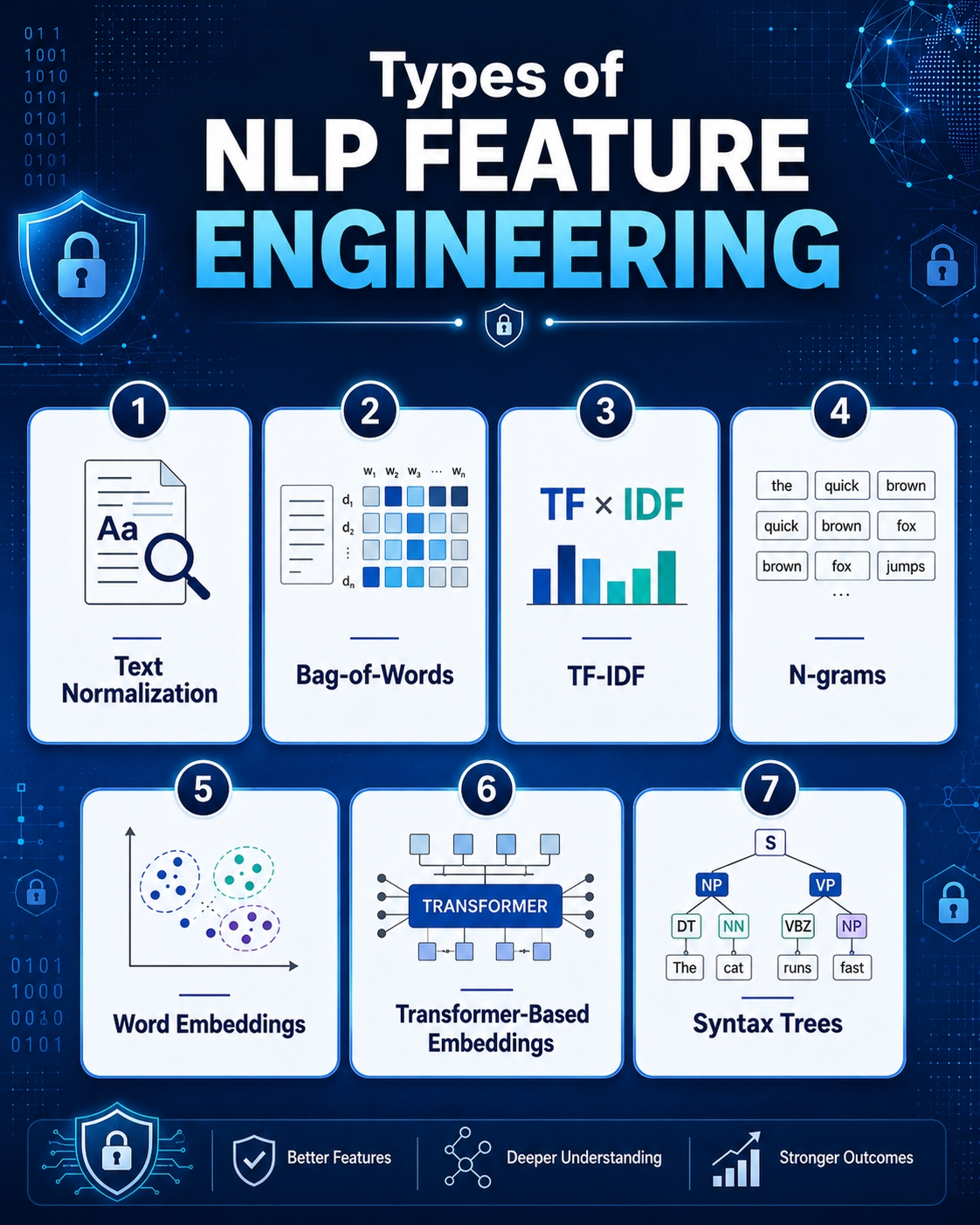
1. Text Normalization
Text normalization is one of the first steps in NLP feature engineering. It prepares raw text by cleaning and standardizing it before feeding it into a model. This may include:
- Converting text to lowercase
- Removing punctuation
- Removing stop words such as “the,” “is,” and “and”
- Stemming words to their root form
- Lemmatizing words to their dictionary form
- Removing unnecessary symbols, URLs, or HTML tags
Example
Original text: “Your Account has been LOCKED! Click here to verify immediately.”
Normalized text: “account locked click verify immediately”
Cybersecurity Application
In phishing detection, attackers often use different writing styles to bypass filters. One email may say “Verify your account,” while another may say “verification required.” Text normalization helps reduce these variations and makes patterns easier for the model to detect.
2. Bag-of-Words: Turning Security Text into Countable Signals
Bag-of-Words, or BoW, is one of the simplest NLP feature engineering techniques. It converts text into a collection of words and counts how often each word appears. It ignores grammar and word order but captures word frequency.
Example
If an email contains words such as “urgent,” “password,” “verify,” and “account,” the model may treat them as important features for phishing detection.
Cybersecurity Application
A phishing detection system can use a bag-of-words to identify common suspicious terms across thousands of emails. Words such as “login immediately,” “payment,” “bank,” “limited time,” and “verify” may appear frequently in phishing attempts.
3. TF-IDF: Finding the Words That Truly Matter
TF-IDF stands for Term Frequency-Inverse Document Frequency. It improves on Bag-of-Words by measuring not only how often a word appears but also how important it is across a collection of documents.
Example
Common words like “user” or “system” may appear in many cybersecurity reports, so they may not be very useful. But terms like “credential harvesting,” “ransomware,” or “command-and-control” may carry stronger meaning.
Cybersecurity Application
In threat intelligence analysis, TF-IDF can help identify important terms in a report. If a report repeatedly mentions “Cobalt Strike,” “PowerShell,” and “lateral movement,” the model can treat these as high-value signals for threat classification.
4. N-grams
N-grams capture sequences of words or characters. Instead of looking at single words only, n-grams help models understand short phrases and patterns. Common types include:
- Unigrams: Single words
- Bigrams: Two-word combinations
- Trigrams: Three-word combinations
Example
Sentence: “reset your password”
- Unigrams: “reset,” “your,” “password”
- Bigram: “reset your,” “your password”
- Trigram: “reset your password”
Cybersecurity Application
In phishing emails, phrases matter. A single word like “account” may not be suspicious, but phrases like “verify your account,” “reset your password,” or “urgent action required” may strongly indicate phishing behavior. N-grams help capture these suspicious linguistic features.
5. Word Embeddings: Understanding Meaning, Not Just Words
Word embeddings convert words into dense numerical vectors. Unlike Bag-of-Words or TF-IDF, word embeddings can capture semantic meaning. Popular word embedding techniques include:
- Word2Vec
- GloVe
- FastText
These methods represent words so that similar words have similar vector values.
Example
Words like “malware,” “trojan,” “ransomware,” and “spyware” may appear close to each other in vector space because they are semantically related.
Cybersecurity Application
A threat detection model can use word embeddings to understand that “credential theft,” “password stealing,” and “account compromise” may refer to similar security risks, even if the exact wording is different. This is especially useful when analyzing threat intelligence reports, incident notes, or attacker behavior descriptions.
6. Transformer-Based Embeddings
Transformer-based embeddings help models understand context more deeply than traditional word embeddings.
Example
The word “dropper” may have a different meaning in malware analysis than in general language.
Cybersecurity Application
Transformer-based models can help classify phishing emails, summarize threat reports, group similar incidents, and extract meaning from long security documents.
7. Syntax Trees: Understanding How Attack Language Is Structured
Syntax Trees analyze the grammatical structure of a sentence. They show how words relate to each other in a sentence.
Example:
A phishing email saying “Your account will be locked unless you verify your password” contains urgency, consequence, and action. Syntax analysis can help identify this pressure-based structure.
Cybersecurity Application:
In phishing and social engineering analysis, Syntax Trees can help identify how attackers structure persuasive or manipulative language. They can also support deeper Text Analysis for detecting intent, commands, and relationships in security documents.
Challenges of NLP Feature Engineering in Cybersecurity
NLP feature engineering is powerful, but it comes with challenges. Cybersecurity text is often noisy, incomplete, multilingual, abbreviated, or filled with technical terms. Attackers may also intentionally misspell words, use obfuscation, insert random characters, or change language patterns to bypass detection. This is why cybersecurity NLP models need domain-specific preprocessing, continuous training, and analyst validation.
In Conclusion
NLP feature engineering helps convert cybersecurity text into signals that machines can analyze. Whether the data comes from phishing emails, SIEM alerts, threat reports, malware notes, or vulnerability descriptions, the right NLP techniques can help security teams classify incidents, extract IOCs, detect suspicious patterns, and prioritize threats faster.
AI-Powered Cybersecurity Training with InfosecTrain
Want to understand how AI, machine learning, and NLP are transforming cybersecurity? InfosecTrain’s AI-powered Cybersecurity Training helps learners explore real-world use cases such as phishing detection, threat intelligence analysis, malware classification, and security automation. With expert-led training and practical learning, you can build the skills needed to understand how AI-driven techniques are shaping modern cyber defense.

TRAINING CALENDAR of Upcoming Batches For Cybersecurity AI Foundation Program
Start Date
End Date
Start - End Time
Batch Type
Training Mode
Batch Status
03-Oct-2026
15-Nov-2026
09:00 - 13:00 IST
Weekend
Online
[ Close ]
14-Nov-2026
20-Dec-2026
19:00 - 23:00 IST
Weekend
Online
[ Open ]
05-Dec-2026
10-Jan-2027
09:00 - 13:00 IST
Weekend
Online
[ Open ]
09-Jan-2027
14-Feb-2027
19:00 - 23:00 IST
Weekend
Online
[ Open ]
27-Feb-2027
04-Apr-2027
19:00 - 23:00 IST
Weekend
Online
[ Open ]
Frequently Asked Questions
What is NLP feature engineering?
NLP feature engineering is the process of converting text into useful features that machine learning models can understand and analyze.
Why is NLP feature engineering important in cybersecurity?
It helps AI models analyze emails, logs, alerts, and reports to detect threats, phishing attempts, and suspicious patterns.
Which NLP technique is useful for phishing detection?
TF-IDF, N-grams, word embeddings, and transformer-based embeddings are commonly used for phishing detection. These techniques help models identify suspicious words, urgent phrases, unusual language patterns, and semantic similarities in phishing emails.
What is the difference between Bag-of-Words and TF-IDF?
Bag-of-Words counts how often words appear, while TF-IDF shows how important a word is in a document.
How is NLP used in phishing detection?
NLP is used to analyze email subjects, body text, URLs, sender language, and suspicious phrases to identify phishing attempts.
Is NLP useful for threat intelligence?
Yes. NLP helps extract indicators of compromise, attack techniques, malware families, vulnerabilities, and threat actor names from security reports and advisories.