Physical Segmentation vs Logical Segmentation vs Micro-Segmentation
Quick Insights:
Network segmentation functions like a Luxury Hotel security strategy: Physical builds separate buildings for total isolation, Logical uses keycard elevators to control floor access via software, and Micro-segmentation creates reinforced vaults for every individual room. While physical segmentation provides maximum security through hardware air-gapping and logical segmentation offers cost-effective organization via VLANs, micro-segmentation is the modern Zero Trust standard. By protecting individual workloads with software-defined policies, it prevents attackers from moving laterally, ensuring the rest of the enterprise remains resilient even if one area is compromised.
Imagine your company is a Luxury Hotel. To keep things safe, you need to control who goes where:
- Physical Segmentation: Separate Buildings
- You build two entirely different buildings, one for guests and one for staff.
- They share no hallways, foundations, or wiring.
- If a fire starts in one, the other is physically unreachable because they are completely disconnected.
- Logical Segmentation: Keycard Floors
- You have one single building, but the elevators require digital keycards.
- Everyone uses the same lobby and stairs, but your card only grants access to specific floors.
- You are separated by virtual rules and software tags (VLANs), even though you are under the same roof.
- Micro-segmentation: Individual Vaults
- Every guest room is treated like a high-tech vault.
- Even if someone breaks into Room 101, the walls and vents are reinforced so they cannot move to Room 102.
- Every device or application is its own private island, preventing threats from spreading laterally across the network.
Physical Segmentation
Physical segmentation is the most traditional security method, where a network is divided into completely separate units using dedicated physical hardware. Each segment operates on its own set of routers, switches, and cables, ensuring there is no physical path for data to travel between them without a manual connection.
Key Features
- Hardware Isolation: Uses separate physical devices and cabling for each network zone.
- Air-Gapping: Can be configured so that networks are not physically connected to the internet or each other, providing maximum security.
- High Complexity to Breach: An attacker would need physical access to the hardware to move between segments.
- Resource Intensive: Requires a significant investment in hardware, space, and maintenance.
Logical Segmentation
Logical segmentation uses software and networking protocols to divide a single physical network into multiple virtual sections. Even though all devices are plugged into the same physical equipment, the traffic is separated at the data link or network layer, typically through VLANs (Virtual Local Area Networks).
Key Features
- VLAN Tagging: Uses software-based tags to keep data packets from different departments or groups separate.
- Cost Efficiency: Reduces the need for additional hardware by enabling multiple virtual networks to run on a single physical switch.
- Flexibility: Administrators can move users between segments via software configurations without changing physical wiring.
- Centralized Management: Allows for easier monitoring and control of the entire network from a single interface.
Micro-segmentation
Micro-segmentation is a modern, granular security approach that creates secure zones around individual workloads or applications. Unlike traditional methods that focus on the perimeter (the edges of the network), micro-segmentation applies security policies to every single virtual machine or process, following the Zero Trust model.
Key Features
- Granular Control: Security policies are applied at the individual workload level rather than the network level.
- Lateral Movement Defense: Specifically designed to prevent attackers from moving sideways through a data center if one server is compromised.
- Software-Defined: Primarily managed through software (SDN), making it ideal for cloud and hybrid-cloud environments.
- Policy-Driven Security: Rules are based on the application’s specific identity and function, not just its IP address.
Physical Segmentation vs Logical Segmentation vs Micro-Segmentation
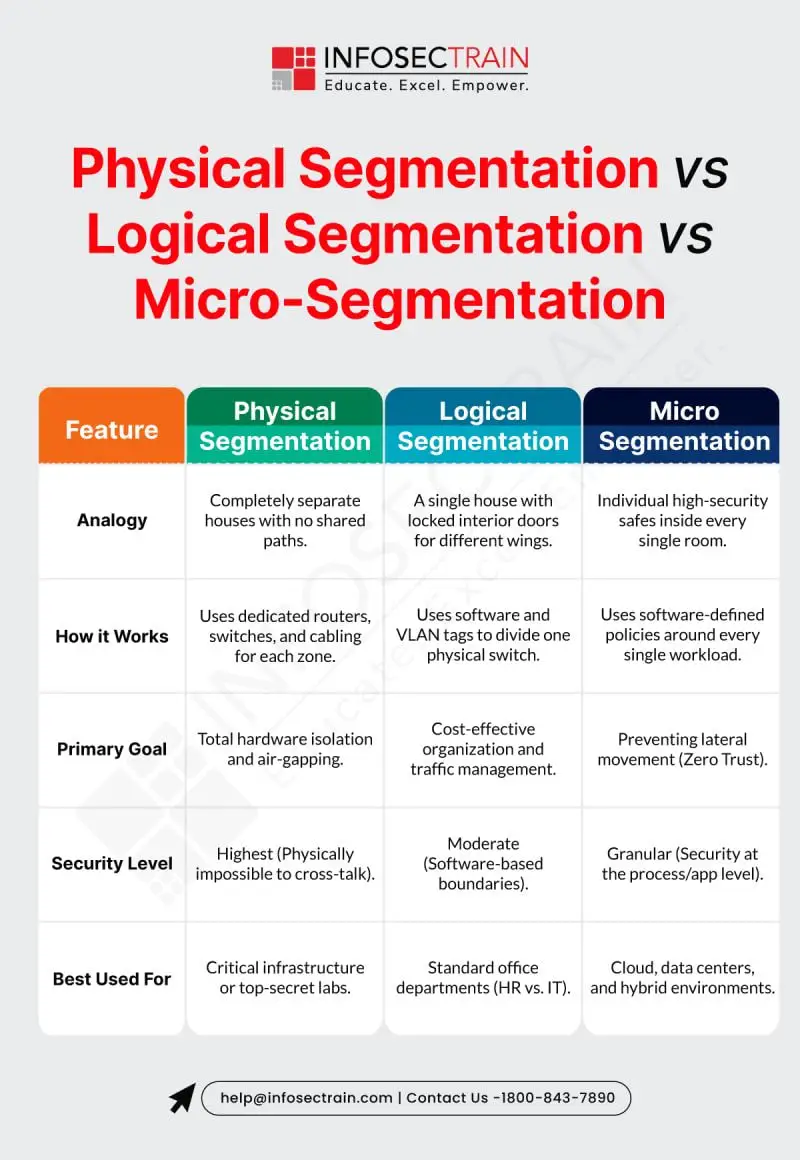
- Strategic Defense: Choose physical for total isolation, logical for cost-effective scale, or micro-segmentation for precise Zero Trust security.
- Reduced Risk: Effective segmentation limits the blast radius of a breach, preventing lateral movement by hackers.
- Modern Resilience: Shifting toward granular, software-defined boundaries is essential for protecting complex cloud and hybrid environments.
- Master the Domain: Deepen your expertise in network security architecture and prepare for the gold standard of certifications with InfosecTrain’s CISSP Certification Training.
.

TRAINING CALENDAR of Upcoming Batches For CISSP Training
| Start Date | End Date | Start - End Time | Batch Type | Training Mode | Batch Status | |
|---|---|---|---|---|---|---|
| 17-Oct-2026 | 29-Nov-2026 | 10:00 - 14:00 IST | Weekend | Online | [ Close ] | |
| 26-Oct-2026 | 01-Dec-2026 | 20:00 - 22:00 IST | Weekday | Online | [ Open ] | |
| 14-Nov-2026 | 20-Dec-2026 | 19:00 - 23:00 IST | Weekend | Online | [ Open ] | |
| 07-Dec-2026 | 25-Dec-2026 | 07:00 - 12:00 IST | Weekday | Online | [ Open ] | |
| 12-Dec-2026 | 24-Jan-2027 | 10:00 - 14:00 IST | Weekend | Online | [ Open ] | |
| 09-Jan-2027 | 14-Feb-2027 | 19:00 - 23:00 IST | Weekend | Online | [ Open ] | |
| 13-Feb-2027 | 21-Mar-2027 | 09:00 - 13:00 IST | Weekend | Online | [ Open ] | |
| 13-Mar-2027 | 18-Apr-2027 | 19:00 - 23:00 IST | Weekend | Online | [ Open ] |
Frequently Asked Questions
Which type of segmentation is the most secure?
Physical segmentation is generally considered the most secure because it creates a physical air gap, making it nearly impossible for a hacker to jump between networks without physical access.
Why is micro-segmentation better for the cloud?
In the cloud, you don't own the physical hardware. Micro-segmentation enables you to create software-defined security perimeters around individual virtual machines, offering greater flexibility and precision than traditional hardware-based methods.
Can I use both Logical and Micro-segmentation together?
Yes! Many organizations use Logical segmentation (VLANs) to organize large departments and then layer Micro-segmentation on top to protect specific, high-value applications within those departments.
What is Lateral Movement, and why does it matter?
Lateral movement is when a hacker breaks into one low-security device and then hops sideways to reach more sensitive data. Micro-segmentation is specifically designed to block these sideways paths.
Is physical segmentation still relevant today?
Absolutely. It is still the gold standard for critical infrastructure (such as power plants) and top-secret government labs where the risk of any digital connection is too high.