Cybersecurity AI Foundation Program Vs. Practical AI Security Engineering Program
Quick Insights:
The Cybersecurity AI Foundation Program is ideal for beginners who want to understand AI and apply it to SOC operations, pentesting, and everyday cybersecurity tasks without needing coding or AI experience. The Practical AI Security Engineering Program is designed for intermediate learners who want hands-on skills to secure AI systems across data, models, applications, pipelines, infrastructure, monitoring, and incident response. Together, they offer a clear learning path from AI-aware cybersecurity practice to specialized AI security engineering.
AI is changing how cybersecurity professionals investigate threats, test systems, manage risks, and respond to incidents. However, learning to use AI for cybersecurity is different from learning to secure AI systems themselves.
That difference is central to InfosecTrain’s two AI security training paths:
- The Cybersecurity AI Foundation Program helps security professionals understand AI and apply it to SOC operations, pentesting, and other cybersecurity activities.
- The Practical AI Security Engineering Program helps learners build, attack, defend, monitor, and secure AI systems across their complete lifecycle.
Both programs are designed for different experience levels, job roles, and career goals.
Cybersecurity AI Foundation Program: Best for Building AI Security Confidence
The Cybersecurity AI Foundation Program is designed for professionals who want to understand AI before moving into advanced AI security engineering.
It explains how AI works behind the scenes and connects those concepts to practical defensive and offensive security tasks. Instead of teaching AI only as theory, the program shows how it can support SOC operations, threat analysis, security testing, and pentesting.
Who Is This Program For?
The program is broad and beginner-friendly. It is suitable for almost anyone working in cybersecurity, including:
- SOC Analysts
- Security Analysts
- Detection Analysts
- Offensive Security Professionals
- Penetration Testers
- GRC and security professionals
- Learners beginning their AI security journey
Prerequisites
- Learners need only a fundamental understanding of security concepts.
- You do not need prior coding experience. You do not need AI or machine learning knowledge. This makes it a strong starting point for security professionals who want to enter the AI security space without feeling overwhelmed by engineering-heavy concepts.
Why This Program Stands Out
The main strength of the Cybersecurity AI Foundation Program is that it teaches AI as a security tool. Learners first develop a clear understanding of AI and then explore how it can support both sides of cybersecurity:
- Defensive security through SOC and security operations
- Offensive security through AI-assisted testing and pentesting
Practical AI Security Engineering Program: Best for Securing Real AI Systems
The Practical AI Security Engineering Program is designed for learners who already understand foundational AI and cybersecurity concepts and want to apply them to secure AI systems.
The program covers the complete AI lifecycle, including:
- Data
- Models
- Applications
- Pipelines
- Infrastructure
- CI/CD security
- Monitoring
- Incident response
Rather than studying attacks only in theory, learners work directly with AI systems. They build them, test their weaknesses, apply defenses, and run security operations around them.
Who Is This Program For?
The program is suitable for professionals who work with security engineering, applications, infrastructure, or AI systems, including:
- Security Engineers
- Security Architects
- Penetration Testers
- SOC Teams
- AppSec Teams
- DevSecOps Engineers
- Data Scientists
- ML Engineers
- LLM Engineers
It is particularly relevant for learners who want to move into specialized AI security roles.
Prerequisites
- Learners should have foundational knowledge of AI and cybersecurity.
- InfosecTrain’s Cybersecurity AI Foundation Program or equivalent knowledge is recommended before taking this program.
- Learners should also be comfortable with the command line interface and GenAI-assisted coding, as the course focuses on practical AI security engineering.
Why This Program Stands Out
A major differentiator is its two-track structure:
- ML/DL Security
- GenAI and Agentic AI Security
The course connects these tracks through a practical engineering journey. Learners work with systems from creation to defense rather than studying disconnected attack examples.
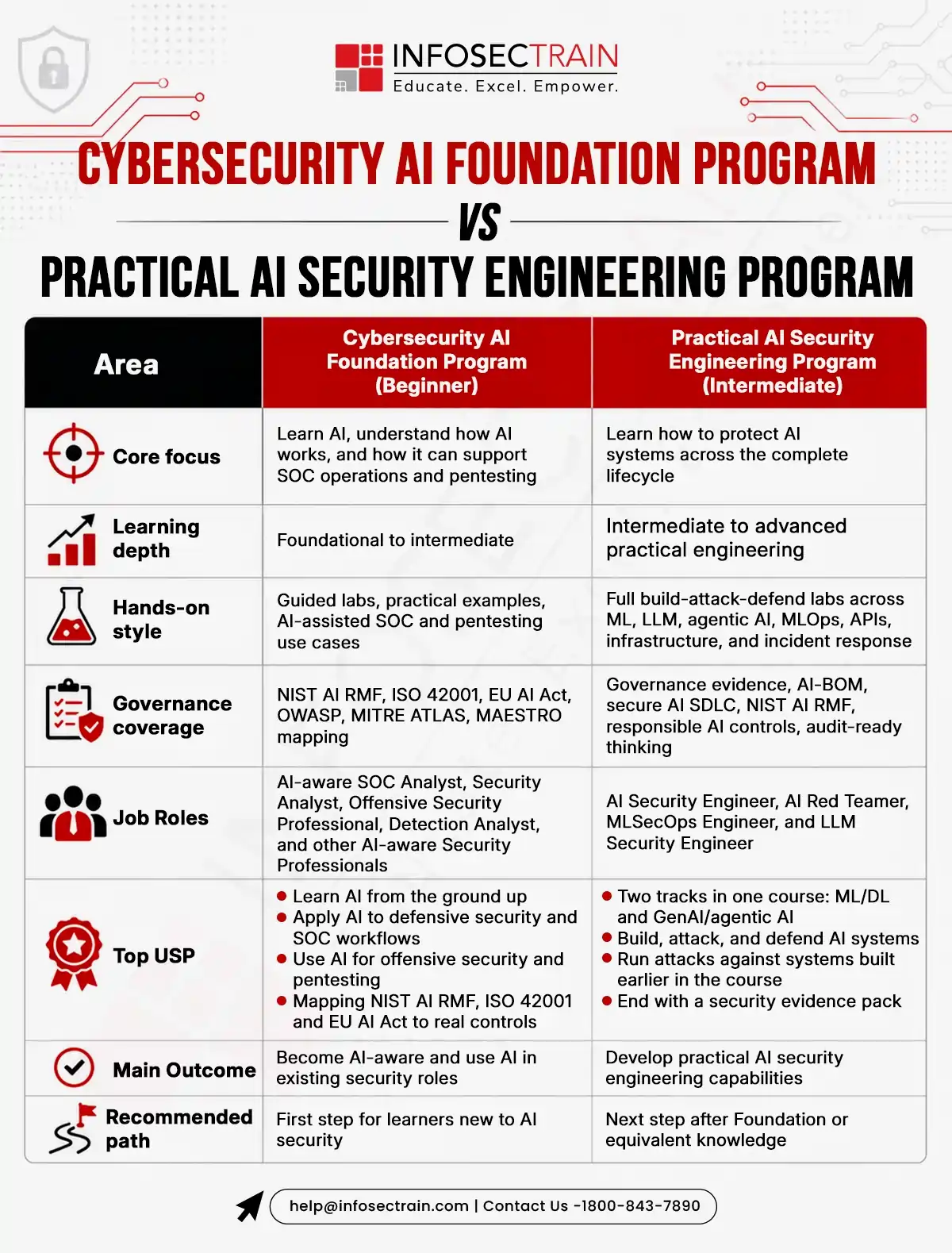
Cybersecurity AI Foundation vs. Practical AI Security Engineering: Key Differences
Which Program Should You Choose First?
If you are unsure, take the Cybersecurity AI Foundation Program first.
That is the safer and smarter route for most learners because it helps you build the language, concepts, and practical understanding needed for advanced AI security. The Practical AI Security Engineering Program itself recommends foundational knowledge in AI and cybersecurity and mentions InfosecTrain’s Cybersecurity AI Foundation Program as a preferred preparation path.
However, if you already have experience with AI concepts, command-line work, security tools, ML/LLM workflows, or secure engineering practices, you may be ready to enter the Practical AI Security Engineering Program directly.
In Conclusion
Both programs complement each other rather than compete. If your goal is to understand AI and apply it in cybersecurity, begin with the Cybersecurity AI Foundation Program. If your goal is to design, test, defend, and monitor AI systems in production, the Practical AI Security Engineering Program is the logical next step. Together, they provide a structured pathway from AI literacy to AI security engineering.
Start Your AI Security Learning Path with InfosecTrain
AI security is becoming a must-have skill for modern cybersecurity professionals. Whether you want to become AI-aware in your current role or move toward specialized AI security engineering, InfosecTrain has a structured path for you.
Start with the Cybersecurity AI Foundation Program if you want to build strong fundamentals in AI security, SOC use cases, AI-assisted offensive security, and AI governance.
Move to the Practical AI Security Engineering Program if you want hands-on expertise in securing AI systems across data, models, applications, pipelines, infrastructure, monitoring, and incident response.
Talk to InfosecTrain’s training advisors today and choose the AI security program that matches your current skill level and career goal.

TRAINING CALENDAR of Upcoming Batches For Cybersecurity AI Foundation Program
| Start Date | End Date | Start - End Time | Batch Type | Training Mode | Batch Status | |
|---|---|---|---|---|---|---|
| 26-Jul-2026 | 20-Sep-2026 | 09:00 - 13:00 IST | Weekend | Online | [ Close ] | |
| 03-Oct-2026 | 15-Nov-2026 | 09:00 - 13:00 IST | Weekend | Online | [ Open ] | |
| 09-Jan-2027 | 14-Feb-2027 | 19:00 - 23:00 IST | Weekend | Online | [ Open ] |

TRAINING CALENDAR of Upcoming Batches For Practical AI Security Engineering Program
| Start Date | End Date | Start - End Time | Batch Type | Training Mode | Batch Status | |
|---|---|---|---|---|---|---|
| 29-Aug-2026 | 11-Oct-2026 | 19:00 - 23:00 IST | Weekend | Online | [ Open ] | |
| 31-Oct-2026 | 13-Dec-2026 | 19:00 - 23:00 IST | Weekend | Online | [ Open ] | |
| 09-Jan-2027 | 14-Feb-2027 | 09:00 - 13:00 IST | Weekend | Online | [ Open ] |
Frequently Asked Questions
Which AI security program is best for beginners?
The Cybersecurity AI Foundation Program is the better option for beginners. It requires only fundamental cybersecurity knowledge and no prior experience in coding, AI, or machine learning.
Do I need coding knowledge for the Cybersecurity AI Foundation Program?
No. Coding knowledge is not required. The course is designed to help security professionals learn AI concepts and apply them to cybersecurity from the ground up.
Which program is better for SOC Analysts?
SOC Analysts who are new to AI should begin with the Cybersecurity AI Foundation Program. It focuses on AI-assisted SOC operations and broader security use cases. Analysts who already understand AI and want to secure production AI systems can progress to the Practical AI Security Engineering Program.
Which program is better for becoming an AI Security Engineer?
The Practical AI Security Engineering Program is more closely aligned with AI Security Engineer roles because it covers AI data, models, applications, infrastructure, CI/CD security, monitoring, and incident response.
What is the recommended learning sequence?
The recommended sequence is: Cybersecurity AI Foundation Program -> Practical AI Security Engineering Program The first program develops foundational understanding and AI-assisted cybersecurity skills. The second develops hands-on AI security engineering capabilities.