AI Vendor Risk Assessment: What Should You Check Before Using Third-Party AI?
Quick Insights:
Using third-party AI can help a business move faster, but it also brings new risks around security, privacy, and compliance. Regular checks like SOC 2 reports and penetration testing are still important, but AI adds its own concerns, such as data leaks, hallucinations, prompt attacks, and changes to the model behind the service. A good vendor review should look at how your data is used and stored, which models and third parties are involved, how the AI is tested, and what happens if something goes wrong. The level of review should depend on how the tool is being used, and it should be revisited whenever the technology or regulations change.
Third-party AI lets a business move fast. A team can add a chatbot, automate document analysis, summarize customer calls, generate code, spot fraud, or roll out an AI assistant without spending years building a model of its own. Then, once the excitement settles, a harder question shows up: what happens to your data once it leaves your hands and enters someone else’s AI system?
That’s only the start. When you adopt an external AI platform, API, foundation model, agent, or AI-powered SaaS product, you take on part of the vendor’s security, privacy, compliance, operational, and governance risk. Traditional vendor reviews ask about encryption, penetration testing, and SOC 2 reports. Those questions still matter, but they don’t go far enough for AI. You also need to know:
- Are prompts stored, and is customer data used for training?
- Which models and subprocessors sit behind the service?
- How are hallucinations handled, and can the system leak sensitive information?
- What happens when the underlying model changes?
- Can the vendor explain how its AI is tested?
That’s why an AI vendor risk assessment has become essential.
What is an AI Vendor Risk Assessment?
An AI vendor risk assessment is a structured evaluation of the security, privacy, compliance, governance, technical, and operational risks associated with using an external artificial intelligence product or service. The real goal is not to decide whether a vendor is secure. It is to decide whether you can safely use their AI for your own job, with your own data, and within your own rules.
NIST’s AI Risk Management Framework covers security, privacy, transparency, accountability, reliability, explainability, safety, and bias across the AI lifecycle. Its Generative AI Profile also calls out risks from third-party datasets, models, and software libraries in the generative AI value chain. That makes AI vendor assessment much broader than conventional third-party risk management.
Why Third-Party AI Creates a Different Kind of Vendor Risk
Imagine that an employee enters a confidential acquisition document into an AI assistant and asks: “Summarize the financial risks in this document.”
The application may appear straightforward.
Behind that single prompt, however, several systems could be involved:
Employee → SaaS application → AI provider → foundation model → cloud infrastructure → logging/monitoring system → additional subprocessors
Data could potentially pass through several organizations.
Now consider another scenario. Your company buy an AI customer-support platform, and six months later the vendor quietly swaps the underlying model. Responses change, performance shifts, and security behavior differs. You didn’t touch your software, but your risk profile changed anyway.
That’s why AI vendor management can’t be a one-time procurement exercise. OWASP flags the AI/LLM supply chain as a major security concern, with risks coming from third-party models, datasets, libraries, platforms, fine-tuning components, licensing issues, outdated models, and compromised dependencies.
What Should You Check Before Using a Third-Party AI Vendor?
Before bringing an AI vendor into your business, don’t focus only on features. You also need to understand what the tool does with your data, how secure it is, and what could go wrong.
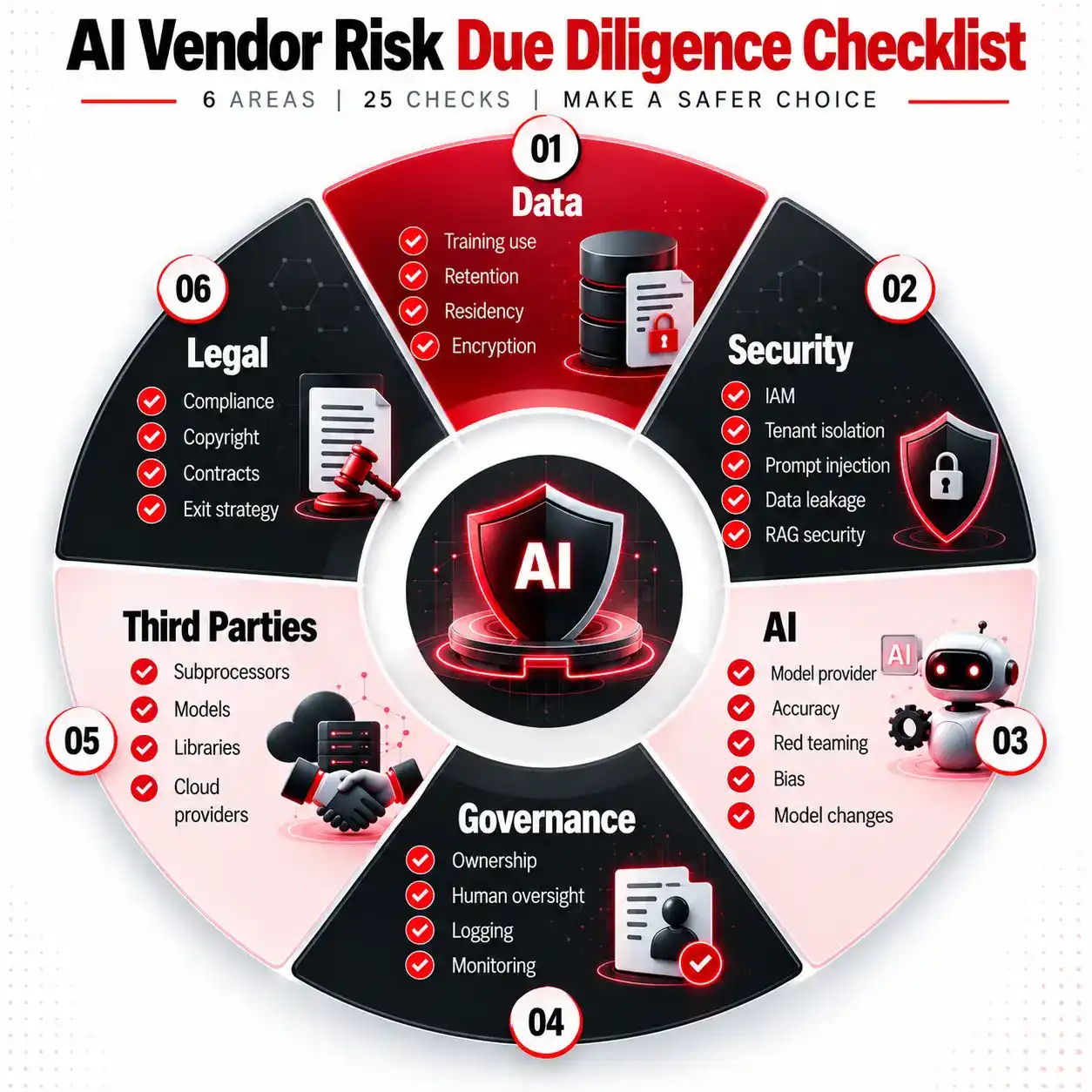
1. Know What AI You’re Buying
Start with the basics.
- What model does the product use?
- Who built it?
- Does it use RAG, agents, plugins, or several third-party models?
If the system can access files, email, databases, or other tools, understand exactly what it can do and what permissions it has.
2. Find Out What Happens to Your Data
Find out what happens to prompts, uploaded files, responses, logs, metadata, recordings, and conversation history. One of the most important questions is whether your data is used for training, testing, fine-tuning, or model evaluation. This includes any third-party model providers the vendor relies on.
3. Check Retention and Deletion
A vendor may say it doesn’t train on your data, but that doesn’t mean it deletes it quickly. Ask how long data is stored, whether backups are included, whether retention can be changed, and what happens to your information when the contract ends.
4. Know Where Your Data Goes
Check where the vendor stores and processes data, including backups and third-party services. This matters even more if your company operates in several countries or has data residency requirements.
5. Review Security Basics
Data should be encrypted both while it is being transferred and while it is stored. Also look at key management, access controls, MFA, single sign-on, RBAC, SCIM provisioning, user deprovisioning, session controls, and audit logs.
One question that is often missed: can the vendor’s administrators read customer prompts or uploaded files?
6. Check Customer Isolation
Most AI platforms are shared by many customers. Ask how one company’s data is separated from another’s. This should include databases, vector stores, logs, and other shared infrastructure. The vendor should also be testing for cross-customer data leaks.
7. Ask About Prompt Injection
Prompt injection can cause an AI system to follow instructions it should not follow. The risk becomes more serious when the AI can access email, documents, APIs, internal systems, payment tools, or developer platforms.
Ask how the vendor handles malicious prompts, poisoned files, hidden instructions, tool abuse, and system prompt leakage.
8. Check for Sensitive Information Disclosure
AI systems can accidentally expose confidential information from uploaded documents, internal databases, connected applications, logs, or previous conversations.
Useful protections include PII detection, data loss prevention, prompt redaction, secret detection, output filtering, and permission-aware retrieval.
9. Look Closely at Vendor’s RAG Security
If the product uses company documents to answer questions, existing access permissions should still apply. For example, an employee who cannot open a finance document normally should not suddenly be able to retrieve its contents through the AI assistant.
Ask how permissions, embeddings, document updates, and retrieval logs are handled.
10. Understand the Supply Chain
An AI product may rely on several outside services, models, libraries, datasets, plugins, and cloud providers. Ask the vendor what it depends on and whether customers are informed when an important model or provider changes.
11. Test Accuracy Yourself
AI can sound confident even when it is wrong. Vendor benchmarks are useful, but they don’t tell you how well the product will perform in your environment. Test it using your own workflows, documents, questions, and edge cases. For important use cases, decide what level of accuracy is acceptable before rollout.
12. Ask How the System Is Tested
A mature vendor should test for more than normal functionality. That may include prompt injection, jailbreaks, data leakage, hallucinations, bias, unsafe outputs, unauthorized actions, adversarial inputs, and service disruption.
Ask whether they conduct AI red-team exercises and whether any testing is done independently.
13. Don’t Ignore Normal Cybersecurity
AI doesn’t replace the need for basic security. Review vulnerability management, penetration testing, secure development, patching, monitoring, incident response, backups, recovery, and business continuity. Depending on the risk, you may also want SOC 2, ISO 27001, penetration-test results, or other security evidence.
14. Check AI Governance
Ask who is responsible for AI risk inside the vendor’s organization. They should be able to explain how models are approved, tested, monitored, updated, and escalated when something goes wrong. Frameworks such as the NIST AI RMF and ISO/IEC 42001 can help when reviewing this area.
15. Review Privacy and Fairness
AI vendors often handle large amounts of personal or sensitive data, so it’s important to understand how that information is managed. Look at how they handle consent, collect only the data they need, delete information, manage international data transfers, work with subprocessors, and respond to data privacy requests.
Fairness is just as important when AI is used to make decisions about people, especially in areas like hiring, lending, insurance, healthcare, education, or employee reviews. Don’t rely on general claims that the system is “fair.” Ask the vendor to show how they test for bias and what they do when problems are found.
16. Keep Humans in the Loop
Not every AI decision should be automatic. For higher-risk situations, people should be able to review the result, see supporting information, override the system, and escalate questionable decisions. In general, the greater the impact of a decision, the more human oversight you need.
17. Make Sure Activity Is Logged
If something goes wrong, you need to know what happened. Useful logs may include the user, prompt, model version, retrieved documents, tools used, output, timestamp, and administrative changes. Check whether those logs can be sent to your SIEM and how long they are retained.
18. Plan for Model Changes
AI services can change quickly. A new model version may improve some things while changing accuracy, security behavior, latency, or output quality.
Ask whether the vendor gives notice before major changes and whether customers can test updates before they reach production.
19. Review Incident Response
If customer prompts or files are exposed, how quickly will you be told?
The contract should clearly define notification periods, investigation responsibilities, evidence preservation, customer communication, and corrective action. Specific timelines are better than vague language such as “promptly.”
20. Know the Subprocessors
The vendor may rely on several other companies to provide model inference, hosting, analytics, logging, support, or storage. Ask for the subprocessor list and understand which providers can access your information.
You may also want advance notice when an important subprocessor changes.
21. Clarify Ownership and IP
Make sure you know who owns generated content, uploaded material, custom prompts, configurations, and fine-tuned models. Also clarify whether your content can be reused for training and who carries the risk if generated material creates a copyright or intellectual-property dispute.
22. Evaluate Regulatory Compliance
AI regulation depends on how and where the system is used. Privacy laws, industry requirements, contracts, and AI-specific regulations may all apply.
The key is to assess the actual use case rather than assuming a product is compliant simply because the vendor says it is.
23. Think About the Exit
Before adopting the platform, understand how you would leave it.
- Can you export your data?
- What about embeddings, prompts, configurations, or fine-tuned models?
- How quickly can the vendor delete your information, and how long will backups remain?
It is much easier to answer these questions before the platform becomes deeply embedded in your business.
The goal is simple: make sure the AI tool is not only useful, but also secure, manageable, and appropriate for the way your organization plans to use it.
AI Vendor Risk Scoring Model
Organizations can also classify vendors into three broad levels.
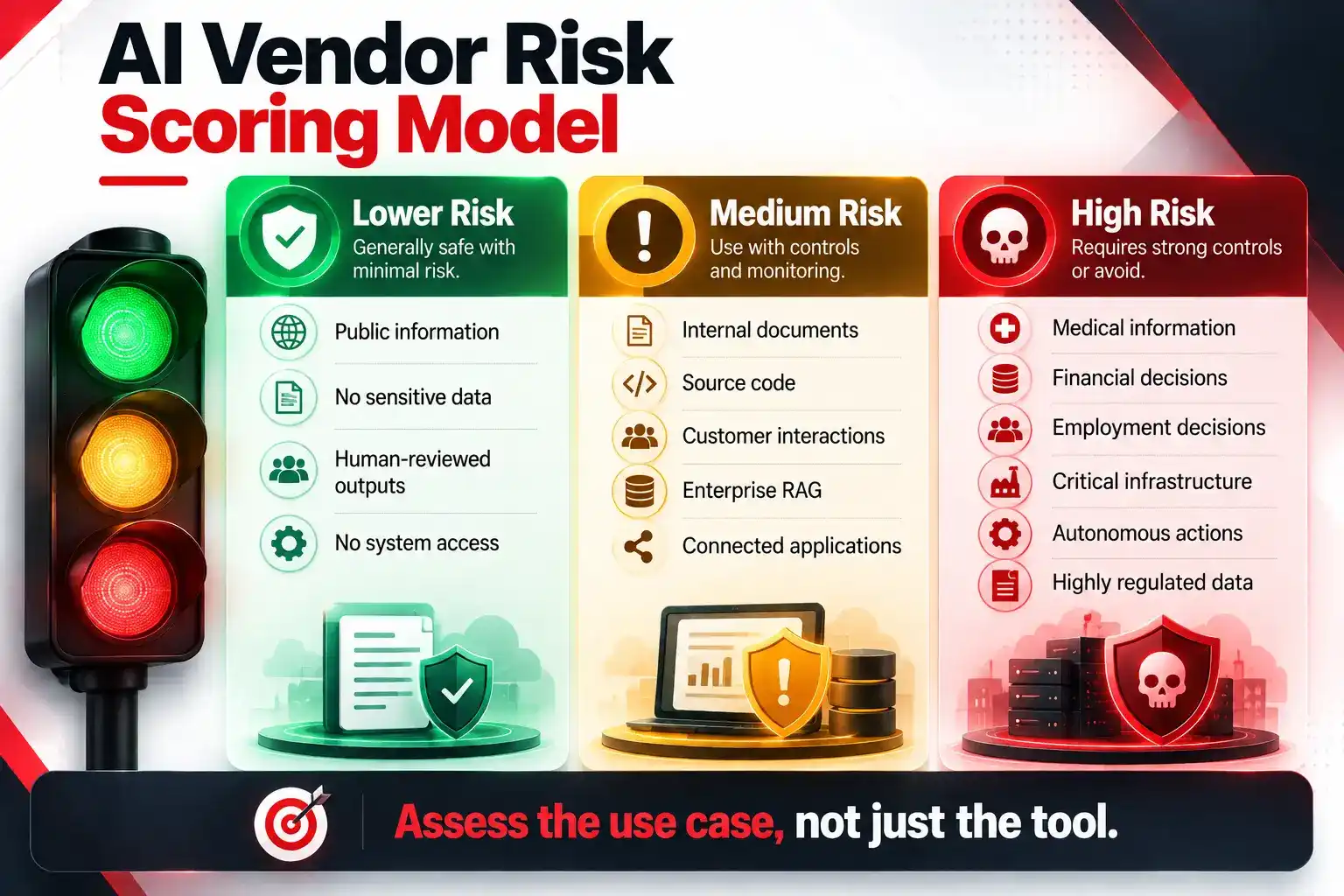
These deployments deserve extensive due diligence, legal and compliance review, red-team testing, continuous monitoring, and clear human oversight.
The same AI product may fall into different risk categories depending on how your organization uses it.
Common AI Vendor Risk Assessment Mistakes
Even organizations with mature third-party risk programs can struggle with AI assessments.
- Treating AI Like Ordinary SaaS: Standard cybersecurity questionnaires often miss model-specific risks. Add AI-specific questions.
- Trusting Certifications Alone: SOC 2 or ISO certification may provide useful assurance, but it does not automatically tell you whether an AI model hallucinates, leaks information, handles prompt injection, or produces biased results.
- Reviewing Only the Vendor: Review critical upstream models and subprocessors too.
- Ignoring the Use Case: Risk cannot be determined from the technology alone.
- Using an AI assistant for brainstorming is different from allowing it to approve loans.
- Conducting the Assessment Only Once: AI platforms change quickly. Risk assessments should be revisited when:
- Models change
- Vendors introduce agents
- New integrations are added
- Data sensitivity increases
- Regulations change
- Significant incidents occur
Third-party AI risk management should be continuous.
What Evidence Should You Request From an AI Vendor?
Depending on the risk level, organizations may request evidence such as:
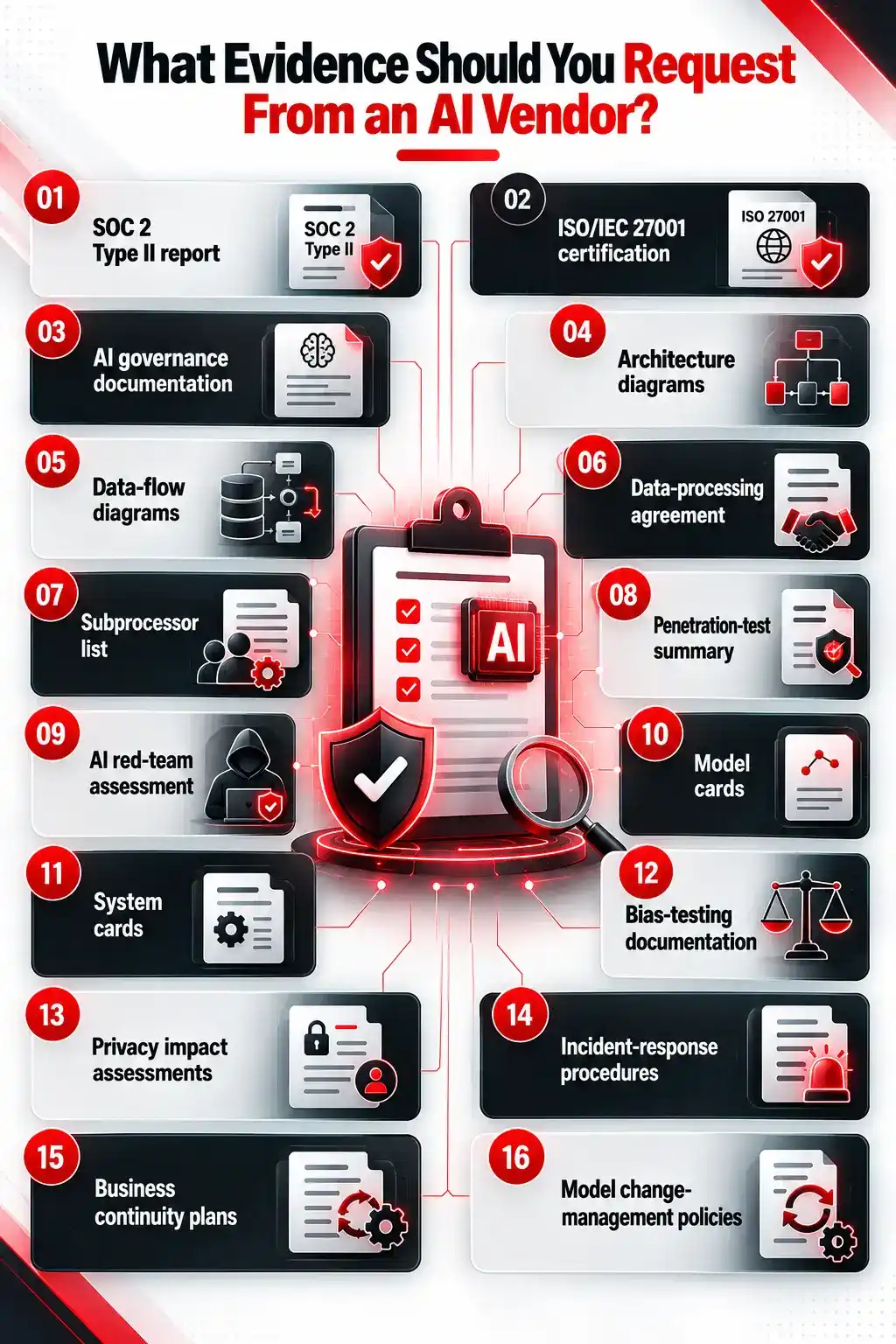
You do not necessarily need every document for every vendor. The level of evidence should be proportional to the potential impact.
Conclusion
Third-party AI offers real benefits, but it also brings risks around data, security, compliance, accuracy, and operations. A strong vendor assessment should go beyond certifications and basic security checks. Organizations should understand which models are used, where data goes, how long it is stored, and whether it is used for training. They should also review third-party dependencies, AI-specific testing, model changes, and incident response. Vendor approval should always reflect the intended use and level of risk.
As AI becomes part of everyday business, careful vendor assessment will become a core part of cybersecurity and third-party risk management.
Advanced in AI Risk (AAIR) Training with InfosecTrain
AI is now part of the enterprise attack surface, and conventional application security knowledge no longer covers it. Security teams also need to understand LLM risks, prompt injection, AI supply chains, sensitive data exposure, insecure integrations, unpredictable model behavior, and responsible AI governance.
InfosecTrain’s AAIR Certification Training gives security professionals, risk teams, developers, and organizations the hands-on skills to assess and secure modern AI environments. Whether you’re strengthening your AI security knowledge, preparing your team for emerging AI threats, or building an enterprise AI governance program, structured hands-on training can help turn AI risk from a vague concern into something your organization knows how to manage.

TRAINING CALENDAR of Upcoming Batches For Advanced in AI Risk (AAIR) Certification Training
Start Date
End Date
Start - End Time
Batch Type
Training Mode
Batch Status
05-Dec-2026
10-Jan-2027
09:00 - 12:00 IST
Weekend
Online
[ Open ]
Frequently Asked Questions
What is AI vendor risk assessment?
AI vendor risk assessment is the process of evaluating the cybersecurity, privacy, compliance, governance, operational, and AI-specific risks associated with an external AI product, model, API, or service before and during its use.
Why is AI vendor assessment different from normal third-party risk assessment?
AI assessments include traditional security and privacy checks, plus risks such as hallucinations, prompt injection, bias, model behavior, training practices, governance, and model changes.
What is the biggest risk when using third-party AI?
There is no single biggest risk. Common concerns include data exposure, hallucinations, insecure integrations, prompt injection, regulatory issues, and overreliance on AI decisions.
Should companies allow employees to enter confidential data into public AI tools?
Only if the AI service has been formally approved for that type of data and has suitable contractual, retention, access, and data-use controls.
What certifications should an AI vendor have?
Depending on risk, look for SOC 2, ISO/IEC 27001, and possibly ISO/IEC 42001. Certifications should support, not replace, technical risk assessment.
What is AI supply-chain risk?
It is the risk introduced by third-party models, datasets, libraries, cloud services, plugins, vector databases, and other dependencies.
How often should an AI vendor be reassessed?
Reassess based on risk, especially when models, integrations, regulations, data sensitivity, or business use change, or after major incidents.
What is prompt injection, and why should vendors be tested for it?
Prompt injection uses malicious instructions to influence AI behavior. It is especially risky when AI can access external content, tools, files, databases, or business systems.
Should organizations test an AI vendor independently?
Yes, especially for medium- or high-risk use cases. Independent testing can cover security, privacy, hallucinations, adversarial behavior, and red-team scenarios.
Who should be involved in approving an AI vendor?
AI procurement should typically involve cybersecurity, privacy, legal, compliance, procurement, AI governance, and the relevant business owner. Higher-risk AI applications may require additional executive, risk, or regulatory oversight.