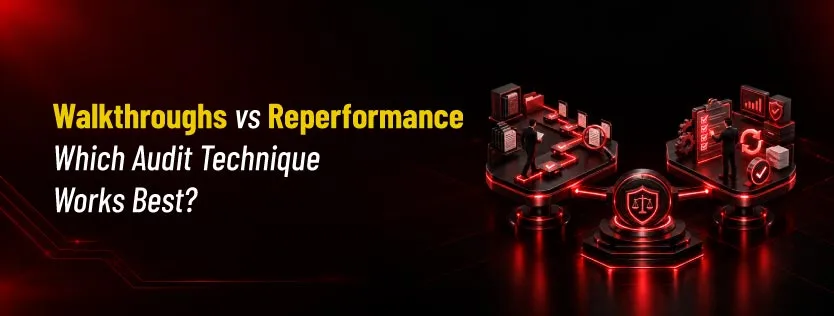
Walkthroughs vs Reperformance: Which Audit Technique Works Best?
Quick Insights:
Walkthroughs and Reperformance serve complementary roles across different stages of an audit. A Walkthrough tests control design (TOD) by tracing a single transaction to confirm how a process should work. Reperformance tests operational effectiveness (TOE) by independently repeating procedures across sample populations to prove controls actually function over time. Effective audits execute walkthroughs during initial planning, followed by reperformance for high-risk or automated controls.
Imagine preparing for a long road trip. First, you pop the hood, look over the engine, and check that every hose and wire is connected properly. That is a Walkthrough, checking the blueprint to make sure the vehicle is built right.
Next, you take the car onto the open highway, step on the gas, and hit the brakes to see how it performs under real conditions. That is Reperformance testing the engine to prove it actually works when driven.
When evaluating IT systems, financial processes, or security controls, auditors ask the same simple question: Do we inspect the blueprint, or do we test-drive the system? The answer is both. Knowing when to look under the hood and when to hit the gas is what makes an audit successful.
What is a Walkthrough?
A Walkthrough traces a single transaction from its origin through every stage of authorization, processing, and reporting. The auditor combines inquiry, observation, and document inspection to confirm their understanding of the workflow and verify that internal controls are properly designed.
Core Focus: Test of Design (TOD) evaluating whether a control is conceptually sound and capable of preventing, detecting, or correcting material errors, security risks, and compliance breaches.
Primary Goal: Verify that a control exists, operates as documented, addresses targeted risks, and establishes a clear baseline for subsequent audit procedures.
Key Objectives
- Confirm Process Understanding: Validate that the auditor’s documented flowchart matches operational realities.
- Identify Control Design Gaps: Pinpoint missing approvals, weak segregation of duties, or unmitigated risk points in the workflow.
- Determine Testability: Assess whether controls produce sufficient audit trails and evidence to support subsequent operating effectiveness testing.
Sample Size: Typically a sample of one transaction (“Test of One”) per process path.
Key Components
- Inquiry: Interviewing key personnel involved at each operational stage to evaluate process clarity, role understanding, and procedural consistency.
- Observation: Watching staff execute routine control duties in real time to ensure actual practices match official documentation and policy manuals.
- Inspection: Reviewing system logs, authorization signatures, time stamps, and supporting documents for the selected transaction.
- Process Mapping: Diagramming data pathways to uncover hidden dependencies, manual workarounds, shadow IT usage, and single points of failure.
Primary Value: Identifies control gaps, missing safeguards, or workflow bottlenecks early in the audit cycle before detailed testing begins, saving time and resources.
What is Reperformance?
Reperformance requires the auditor to independently execute a procedure or control originally performed by the client. Rather than simply watching a staff member or reviewing logged approvals, the auditor recalculates figures, re-executes reconciliations, or reruns automated workflows to ensure consistent results.
Core Focus: Test of Operating Effectiveness (TOE) evaluating whether a control functions consistently, accurately, and without deviation throughout the entire audit period.
Primary Goal: Provide high-assurance, objective proof that controls operate effectively over time and consistently generate accurate, compliant outputs across high-volume transactions.
Key Objectives
- Validate Consistency: Prove that the control operated correctly across the entire audit period without unauthorized exceptions.
- Eliminate Bias: Generate direct, auditor-produced evidence independent of client statements or self-reported logs.
- Verify Automated Logic: Test that automated system parameters, access rules, and scripts enforce controls without calculation errors or bypasses.
Sample Size: Larger, statistically representative sample populations evaluated across the entire audit timeframe.
Key Components
- Independent Execution: Re-running business logic or calculations without using client outputs to eliminate potential confirmation bias.
- Data Matching: Re-performing three-way matches between purchase orders, receiving reports, and vendor invoices to confirm system accuracy.
- System Validation: Re-executing automated batch scripts, parameter configurations, or segregation of duties (SoD) access restriction checks inside ERP environments.
- Substantive Recalculation: Re-calculating complex financial figures, tax provisions, depreciation schedules, or interest accruals to verify mathematical precision.
Primary Value: Delivers the highest level of audit assurance, demonstrating that internal controls operate reliably and consistently across hundreds of daily transactions without human error or systemic failures.
Strengths and Strategic Use Cases
When to Use Walkthroughs
Auditors execute walkthroughs during the initial planning, scoping, and risk assessment phases of an engagement.
- Mapping New Systems or Processes: Tracing data flows when auditing updated cloud infrastructure, legacy software migrations, or restructured business units.
- Pinpointing Control Gaps: Locating unmitigated risks, missing authorization checkpoints, or segregation of duties (SoD) violations before investing effort in testing operational history.
- Establishing Baseline Testability: Evaluating whether controls generate sufficient system logs, audit trails, and documentation to support detailed effectiveness testing.
- Verifying Process Documentation: Ensuring that official policy manuals and procedural flowcharts accurately reflect what personnel execute on a day-to-day basis.
When to Use Reperformance
Auditors apply reperformance during the execution phase when seeking high-assurance evidence for high-risk operations or automated systems.
- Testing Automated IT Controls: Rerunning automated calculations, access rule enforcements, input validations, or three-way matching scripts directly within ERP environments.
- High-Risk Financial Assertions: Independently recalculating complex accounting schedules, tax provisions, interest accruals, or bank reconciliations.
- Substantiating High-Reliance Controls: Providing definitive, auditor-generated proof when regulatory mandates or compliance standards require maximum assurance.
- Evaluating High-Volume Transactions: Testing large operational datasets where automated scripts can re-execute controls across wide populations efficiently.
Which Audit Technique Works Best?
Walkthroughs: Best for Test of Design (TOD)
A walkthrough traces a single transaction from initiation through authorization, recording, and reporting.
- When It Works Best: During the planning, scoping, and risk assessment phases.
- Primary Objective: Verifies that a control exists, is conceptually sound, aligns with system architecture, and addresses target risks before committing testing resources.
- Key Evidence Gathered: Inquiry, observation, inspection of a single sample (Test of One), and process mapping.
- Limitation: A walkthrough proves a control path exists, but it cannot prove staff follows that path consistently across thousands of daily transactions.
Reperformance: Best for Test of Operating Effectiveness (TOE)
Reperformance requires the auditor to independently execute a procedure, recalculation, or automated logic originally performed by client systems or personnel.
- When It Works Best: During the detailed execution phase on high-risk assertions, automated system controls, and complex calculations.
- Primary Objective: Provides high-assurance, objective proof that a control functions accurately and without deviation across the entire audit timeframe.
- Key Evidence Gathered: Direct auditor-produced testing over statistically representative sample populations.
- Limitation: Executing reperformance without a prior walkthrough risks wasting time testing the operational consistency of a control that was flawed from inception.
Walkthroughs vs Reperformance
| Feature | Walkthrough | Reperformance |
| Audit Focus | Test of Design (TOD) | Test of Operating Effectiveness (TOE) |
| Audit Phase | Initial planning & risk assessment | Detailed execution & control testing |
| Sample Size | Single transaction (“Test of One”) | Representative population sample |
| Primary Method | Inquiry, observation, & tracing workflow | Independent execution & recalculation |
| Assurance Level | Moderate (confirms design exists) | High (provides direct auditor evidence) |
Conclusion
Neither technique functions as a standalone solution; Walkthroughs and Reperformance represent a two-phase audit strategy.
A walkthrough confirms that a control is designed correctly and addresses target risks from the start. Reperformance delivers the high-assurance, objective proof required to verify that the control operates without deviation across high-volume daily operations. Executing a walkthrough first guarantees that testing resources are spent evaluating sound controls, while deploying reperformance provides the defensible evidence needed for compliance reporting. InfosecTrain’s expert-led Certified GRC IT Auditor training equips cybersecurity and audit professionals to master control evaluations, lead Test of Design (TOD) and Test of Operating Effectiveness (TOE) assessments, and implement enterprise governance frameworks.

TRAINING CALENDAR of Upcoming Batches For GRC Auditor Training
| Start Date | End Date | Start - End Time | Batch Type | Training Mode | Batch Status | |
|---|---|---|---|---|---|---|
| 26-Sep-2026 | 31-Oct-2026 | 19:00 - 23:00 IST | Weekend | Online | [ Open ] | |
| 30-Jan-2027 | 28-Feb-2027 | 19:00 - 23:00 IST | Weekend | Online | [ Open ] |
Frequently Asked Questions
What is the core focus of a Walkthrough versus Reperformance?
A Walkthrough focuses on the Test of Design (TOD) to confirm a control is built properly. In contrast, Reperformance focuses on the Test of Operating Effectiveness (TOE) to confirm it operates consistently over time.
Why is a Walkthrough called a "Test of One"?
It typically uses a sample size of a single transaction per process path because its objective is to verify workflow design rather than measure operational volume or frequency.
When should an auditor perform a Walkthrough?
Auditors execute Walkthroughs early in the engagement during the initial planning, scoping, and risk assessment phases.
What are the key techniques used during a Walkthrough?
A Walkthrough combines inquiry (interviews), observation (watching real-time work), inspection (document and log reviews), and process mapping.
Why is Reperformance considered high-assurance audit evidence?
Because the auditor independently re-executes the procedure, generating direct evidence that eliminates reliance on client self-reporting or confirmation bias.
What is the main limitation of relying solely on a Walkthrough?
A Walkthrough confirms that a control path exists on paper and in design, but it cannot prove that staff follows that path consistently across daily operations.
What is the risk of performing Reperformance without a Walkthrough?
Skipping a Walkthrough risks spending time testing the operational execution of a control that was flawed or missing key safeguards from inception.
How is Reperformance applied to automated IT and ERP systems?
Auditors rerun automated calculations, verify parameter configurations, test segregation of duties (SoD) access rules, and check three-way matching logic.
What are typical use cases for Reperformance in financial auditing?
Independently recalculating complex schedules, tax provisions, interest accruals, bank reconciliations, and high-volume dataset processing.
How do these two techniques work together in a complete audit?
Auditors use a Walkthrough first to verify control design and testability, then use Reperformance on representative samples to substantiate long-term operating effectiveness.