Cloud Security Career Guide: Skills, Certifications, and Job Roles
Quick Insights:
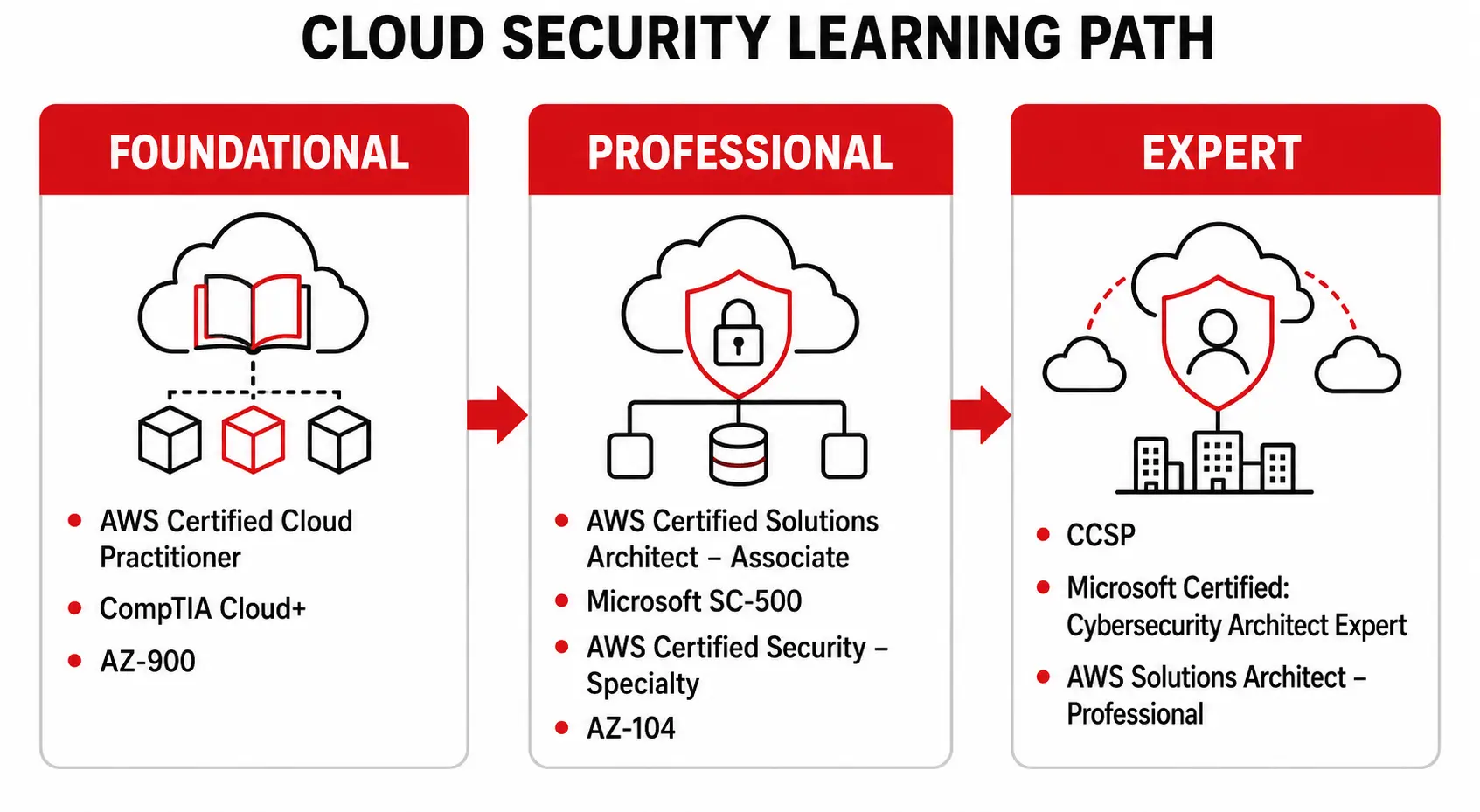
Cloud security professionals protect applications, data, identities, networks, infrastructure, and workloads from threats and misconfigurations. The learning path begins with AWS Cloud Practitioner, CompTIA Cloud+, or AZ-900; progresses to AWS Solutions Architect – Associate, SC-500, AWS Security – Specialty, or AZ-104; and advances to CCSP, Microsoft Cybersecurity Architect Expert, or AWS Solutions Architect – Professional. Certifications provide direction, but practical skills in IAM, networking, encryption, logging, automation, containers, and incident response are essential for job readiness.
The cloud has changed how organizations build applications, store data, support employees, and deliver services. Instead of relying entirely on physical data centers, businesses now use platforms such as Amazon Web Services, Microsoft Azure, and Google Cloud to deploy infrastructure on demand. This flexibility helps organizations innovate quickly, but it also changes the security model.
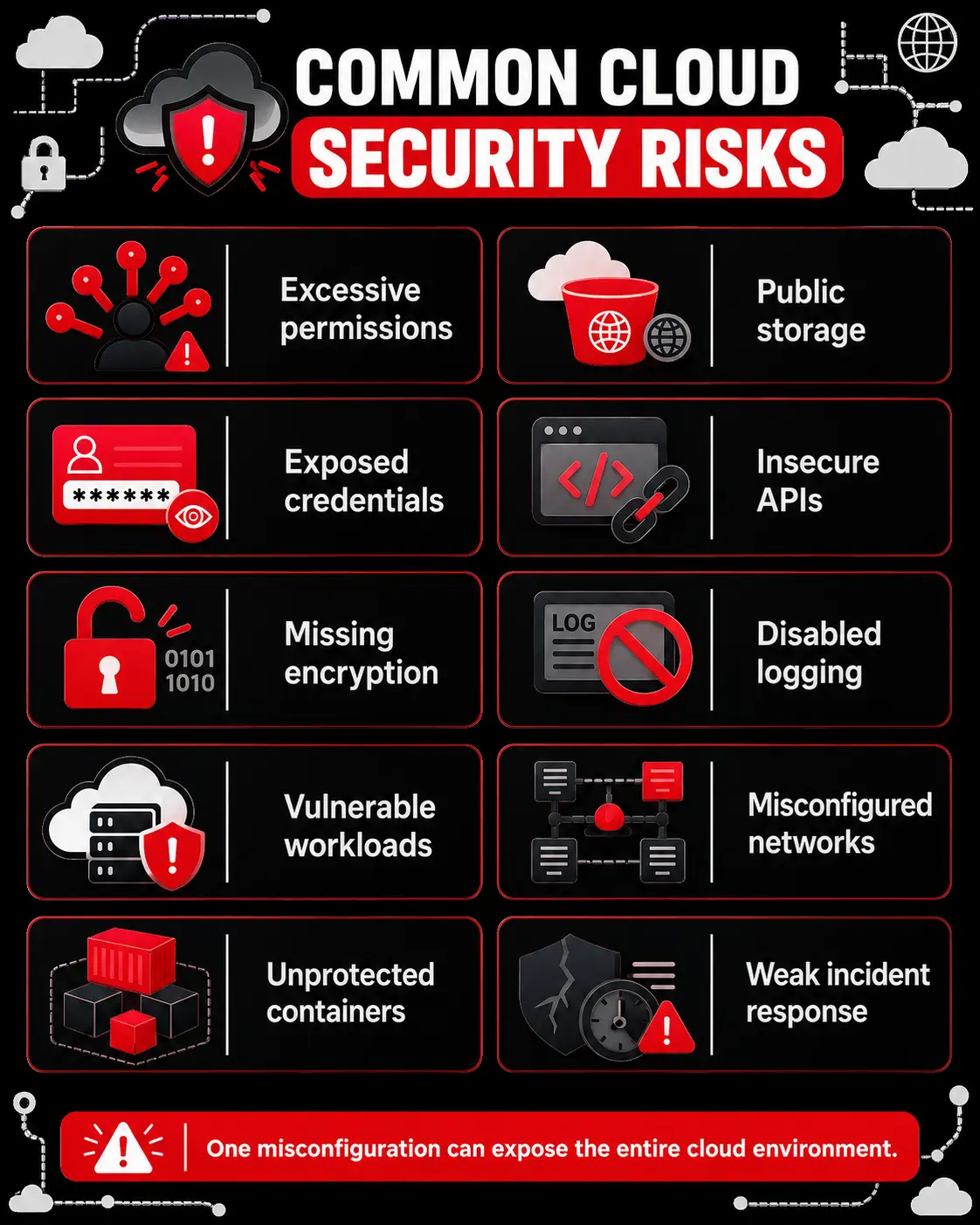
A single excessive permission, exposed storage service, leaked API key, vulnerable workload, or poorly configured network can create significant risk. Cloud environments are also highly dynamic. Resources may be created automatically, identities may interact across multiple services, and applications may depend on containers, APIs, serverless functions, third-party platforms, and artificial intelligence services.
Cloud security professionals help organizations manage this complexity. However, entering the field can feel overwhelming. Should you learn AWS or Azure first? Is cloud administration necessary before cloud security? Which certifications matter? How much networking, scripting, and cybersecurity knowledge do employers expect?
This Cloud Security Career Roadmap provides a structured path from cloud fundamentals to professional cloud security engineering and expert-level security architecture.
What Is Cloud Security?
Cloud security is the practice of protecting the data, applications, identities, workloads, networks, and infrastructure that operate in cloud environments. That includes areas such as:
- Identity and access management
- Network and data security
- Application, workload, and API security
- Encryption and key management
- Configuration and vulnerability management
- Logging, monitoring, and threat detection
- Incident response
- Compliance and governance
- Business continuity
- Supply-chain risk
- Container and Kubernetes security
- Infrastructure as Code
- AI workload security
Cloud security differs from traditional cybersecurity because cloud platforms introduce unique services, architectures, access models, automation, and shared responsibilities.
What Does a Cloud Security Professional Do?
Responsibilities vary by role and organization, but commonly include:
- Securing identities, permissions, networks, storage, databases, and compute resources
- Managing encryption, secrets, logs, and security events
- Detecting misconfigurations and suspicious activity
- Assessing cloud architectures, applications, containers, and serverless workloads
- Implementing policies, security controls, and compliance requirements
- Investigating incidents and creating response playbooks
- Automating security and reviewing Infrastructure as Code
- Advising developers and DevOps teams
- Designing secure multi-cloud and hybrid-cloud environments
- Communicating cloud risks to technical and business stakeholders
Cloud security requires understanding cloud platforms, service interactions, and shared security responsibilities, not just security tools.
The Cloud Shared Responsibility Model
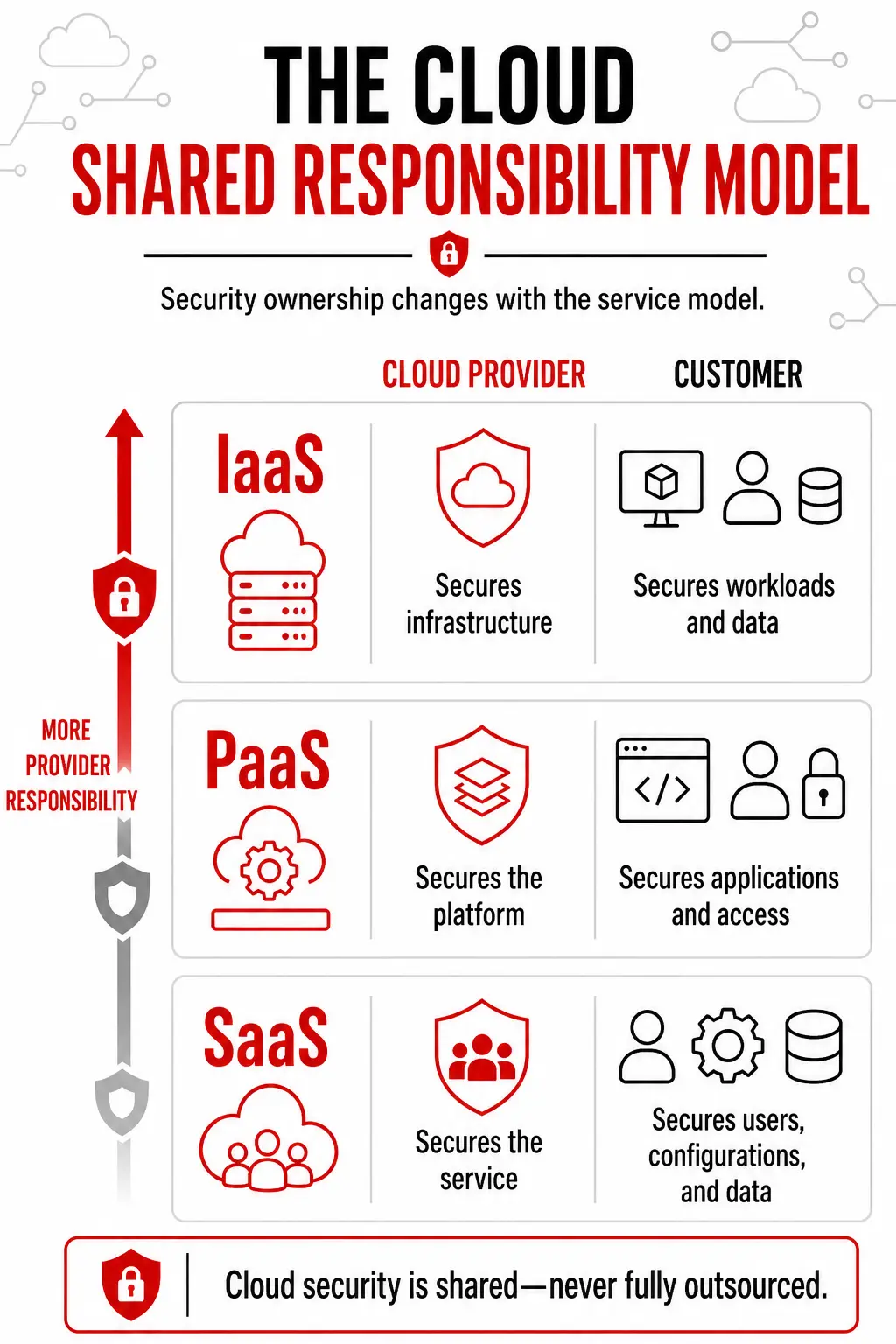
One of the first concepts every cloud security professional should understand is the shared responsibility model. Using a cloud provider does not mean handing over every security responsibility to that provider. The provider protects certain parts of the environment, while the customer remains responsible for others. Exactly where that line sits depends on the type of cloud service being used.
A common cloud-security mistake is assuming that moving data or workloads to the cloud transfers all security responsibility to the provider. It does not.
Cloud Security vs. Traditional Security
| Traditional Security | Cloud Security |
| Protects mostly organization-owned infrastructure | Protects provider-hosted and customer-configured environments |
| Infrastructure changes relatively slowly | Resources may be created or removed automatically |
| Network perimeter receives significant attention | Identity often becomes the primary control boundary |
| Hardware access is controlled directly | Physical security is managed by the provider |
| Manual configuration may be common | Automation and Infrastructure as Code are widely used |
| Logs are collected from owned systems | Telemetry comes from multiple cloud services and control planes |
| Capacity is planned in advance | Resources can scale dynamically |
| Security teams control most infrastructure layers | Responsibility changes according to the cloud service model |
The underlying security principles remain valuable, but cloud environments require different implementation methods.
Why Choose a Career in Cloud Security?
Cloud security may suit professionals who enjoy combining cybersecurity, networking, systems, architecture, automation, and problem-solving.
It offers several specialization options:
- Cloud Security Analyst
- Cloud Security Engineer
- Cloud Administrator
- Cloud IAM Engineer
- DevSecOps Engineer
- Cloud Incident Responder
- Cloud Detection Engineer
- Cloud Security Consultant
- Container Security Engineer
- Cloud Compliance Specialist
- Cloud Security Architect
- Multi-Cloud Security Architect
The field can also suit professionals moving from:
- Network administration
- System administration
- Cybersecurity operations
- Software development
- DevOps
- IT auditing
- Governance, risk, and compliance
- Identity and access management
- Cloud architecture
A learner does not need to master every cloud provider at the beginning. Building depth in one platform while learning transferable security concepts is usually more practical.
Cloud Security Learning Path
There is no universal sequence that every cloud security professional must follow. The stages below are simply a practical way to organize your learning from beginner concepts through professional engineering and, eventually, architecture. You also do not need every certification mentioned in this roadmap.
Select a pathway according to:
- Your target cloud platform
- Existing technical experience
- Intended job role
- Current skill gaps
- Employer requirements
- Whether your focus is administration, engineering, security, or architecture
Stage 1: Build Cloud and Infrastructure Foundations
Before securing cloud environments, learners should understand how cloud resources are created, connected, administered, and billed.
Core Knowledge to Develop
At the foundational stage, concentrate on:
- Cloud service models
- Public, private, hybrid, and multi-cloud environments
- Regions and availability zones
- Virtual machines and containers
- Storage types
- Virtual networking
- Databases
- Identity and access management
- Cloud management interfaces
- High availability and scalability
- Backup and disaster recovery
- Cloud pricing and cost management
- Basic security and compliance
- Shared responsibility
- Windows and Linux fundamentals
- Networking and common protocols
AWS Certified Cloud Practitioner
AWS Certified Cloud Practitioner is designed to validate overall knowledge of the AWS Cloud without being tied to a specific technical role. Its current exam domains include cloud concepts, security and compliance, cloud technology and services, and billing, pricing, and support.
It may suit:
- Complete cloud beginners
- Students and graduates
- IT professionals moving toward AWS
- Business professionals working with cloud teams
- Aspiring cloud administrators
- Aspiring cloud security professionals
The certification is helpful for learning AWS terminology, but do not stop at terminology. Open an AWS environment and practice the basics. Work with IAM, storage, networking, compute, logging, and security configurations so that the services start making practical sense.
CompTIA Cloud+
If you do not want your early learning to revolve around one vendor, CompTIA Cloud+ offers a broader approach.
It covers areas such as:
- Cloud architecture
- Deployment models
- Cloud networking
- Cloud storage and compute
- Security controls
- Automation
- Cloud operations
- Performance monitoring
- Disaster recovery
- Troubleshooting
That vendor-neutral perspective can be valuable for system administrators, network professionals, infrastructure specialists, IT support professionals, and learners who expect to work across multiple cloud platforms.
Microsoft Azure Fundamentals: AZ-900
If Azure is the platform you are most likely to work with, Microsoft Azure Fundamentals (AZ-900) is a logical starting point. It introduces cloud concepts, Azure architecture, Azure services, management, security, and governance.
AZ-900 may suit:
- Azure beginners
- Students and graduates
- IT and business professionals
- Aspiring Azure Administrators
- Aspiring Azure Security Engineers
- Professionals working with Microsoft environments
Practical Capabilities to Build
By the end of the foundational stage, learners should be able to:
- Explain IaaS, PaaS, and SaaS
- Describe the shared responsibility model
- Create a cloud account securely
- Configure multi-factor authentication
- Create a user or role with limited permissions
- Launch a virtual machine
- Create and protect a storage resource
- Configure a basic virtual network
- Review cloud activity logs
- Explain common cloud-security risks
- Identify an exposed or misconfigured resource
- Apply basic encryption settings
- Create a simple cloud architecture diagram
- Estimate the security responsibilities of a cloud service
Suitable Starting Roles
- Cloud Support Associate
- Junior Cloud Administrator
- Cloud Operations Intern
- Junior Infrastructure Analyst
- Cloud Security Intern
- Junior Cloud Analyst
- IT Support Specialist
- Cloud Governance Associate
Stage 2: Develop Professional Cloud Security Skills
The professional stage moves from understanding cloud services to securely implementing and operating them.
Learners should become comfortable with:
- Identity and access
- Network architecture
- Compute and storage security
- Logging and monitoring
- Vulnerability management
- Threat detection
- Governance and automation
- Incident response
AWS Certified Solutions Architect – Associate
AWS Certified Solutions Architect – Associate training validates secure, resilient, high-performing, and cost-optimized AWS architecture. It helps professionals develop the architecture knowledge needed to evaluate:
- Identity design
- Network segmentation
- Secure service integration
- High availability
- Data protection
- Resilience
- Logging
- Backup
- Recovery
- Cost-aware security decisions
Architecture knowledge is essential because security controls depend on how workloads, identities, data, and services interact.
Microsoft Certified: Cloud and AI Security Engineer Associate — SC-500
For professionals working with Microsoft cloud environments, SC-500 focuses on implementing security across cloud, hybrid, and AI workloads.
Important areas include:
- Identity, access, and governance
- Azure Key Vault
- Storage and database security
- Network security
- Compute security
- AI workload security
- Compliance controls
- Security posture management
- Monitoring
SC-500 replaces the retired Azure Security Engineer Associate pathway associated with AZ-500.
SC-500 may suit:
- Azure Security Engineers
- Cloud Security Engineers
- Security Administrators
- Cloud and AI Security Specialists
- DevSecOps Professionals
- Infrastructure Security Engineers
AWS Certified Security – Specialty
AWS Certified Security – Specialty training focuses on AWS identity, logging, monitoring, infrastructure protection, data protection, and incident response.
Learners should gain practical experience with:
- AWS IAM
- AWS Organizations
- Service Control Policies
- CloudTrail
- CloudWatch
- GuardDuty
- Security Hub
- AWS Config
- Inspector
- KMS
- Secrets Manager
- VPC security
- Web Application Firewall
- Data encryption
- Incident investigation
Microsoft Azure Administrator Associate — AZ-104
AZ-104 focuses on implementing, managing, and monitoring Azure environments. It covers identities, governance, storage, compute, virtual networking, monitoring, and maintenance.
AZ-104 is not solely a security certification, but it develops valuable operational knowledge. Security engineers need to understand how Azure resources are administered before they can secure them effectively.
It may suit:
- Azure Administrators
- Cloud Operations Professionals
- Infrastructure Engineers
- Aspiring Azure Security Engineers
- System Administrators moving to Azure
Practical Capabilities to Build
Learners should be able to:
- Implement least privilege
- Review permissions
- Secure networks, storage, and databases
- Manage keys and secrets
- Centralize logging and monitoring
- Identify exposed resources
- Assess security posture
- Investigate suspicious activity
- Review Infrastructure as Code
- Secure containers and serverless workloads
- Automate security checks
- Document findings
- Develop incident-response procedures
Suitable Professional Roles
- Cloud Security Analyst
- Cloud Security Engineer
- Azure Security Engineer
- AWS Security Engineer
- Cloud IAM Engineer
- DevSecOps Engineer
- Cloud Infrastructure Engineer
- Cloud Incident Response Analyst
- Cloud Vulnerability Analyst
- Cloud Security Consultant
Stage 3: Build Expert-Level Cloud Security Capability
Expert professionals design security strategies across complex cloud, hybrid, and multi-cloud environments. They must connect technical architecture with:
- Business requirements
- Regulatory obligations
- Risk management
- Governance
- Security operations
- Resilience
- Cost
- Organizational maturity
CCSP
The Certified Cloud Security Professional credential focuses on advanced cloud-security knowledge. This demonstrates the technical skills and knowledge required to design, manage, and secure cloud data, applications, and infrastructure using established practices, policies, and procedures.
Relevant knowledge areas include:
- Cloud concepts and architecture
- Cloud data security
- Platform and infrastructure security
- Cloud application security
- Cloud security operations
- Legal, risk, and compliance considerations
CCSP may suit:
- Cloud Security Architects
- Senior Cloud Security Engineers
- Cloud Security Consultants
- Security Managers
- Cloud Governance Professionals
- Enterprise Architects
Microsoft Certified: Cybersecurity Architect Expert
The Microsoft Certified: Cybersecurity Architect Expert pathway is aligned with the SC-100 exam. It focuses on translating cybersecurity strategy into capabilities across identities, devices, applications, data, AI, networks, infrastructure, DevOps, governance, compliance, security operations, and posture management.
It may suit:
- Cybersecurity Architects
- Cloud Security Architects
- Enterprise Security Architects
- Senior Security Engineers
- Security Consultants
- Zero Trust Architects
AWS Certified Solutions Architect – Professional
AWS Certified Solutions Architect – Professional validates advanced skills in designing complex AWS solutions while optimizing security, performance, cost, and operational efficiency. This pathway can help experienced professionals develop the architectural judgment required for:
- Multi-account environments
- Complex networking
- Hybrid connectivity
- Enterprise migration
- Organizational governance
- Resilient architecture
- Secure service integration
- Large-scale cloud operations
Practical Capabilities to Build
At the expert stage, professionals should be able to:
- Design enterprise cloud-security architecture
- Establish multi-account or multi-subscription governance
- Define cloud landing-zone security
- Design Zero Trust architecture
- Evaluate multi-cloud risk
- Develop cloud-security standards
- Design centralized logging and detection
- Build cloud incident-response strategies
- Integrate security into DevOps pipelines
- Establish cloud-security metrics
- Evaluate regulatory requirements
- Design resilient architectures
- Review high-risk cloud migrations
- Communicate architecture decisions to leadership
Suitable Expert Roles
- Senior Cloud Security Engineer
- Cloud Security Architect
- Enterprise Security Architect
- Cybersecurity Architect
- Multi-Cloud Security Architect
- Cloud Security Manager
- Principal Cloud Security Consultant
- DevSecOps Architect
- Head of Cloud Security
- Cloud Security Practice Lead
Choose the Right Cloud Security Specialization
Cloud security includes several career directions.
| Specialization | Primary Focus | Possible Roles |
| Cloud Security Engineering | Security controls, hardening, posture management, workload protection, and automation | Cloud Security Engineer, Azure Security Engineer, AWS Security Engineer |
| Cloud Identity and Access Management | Identities, permissions, federation, privileged access, secrets, and authentication | Cloud IAM Engineer, Identity Architect, Privileged Access Specialist |
| DevSecOps | Secure development pipelines, Infrastructure as Code, containers, and automation | DevSecOps Engineer, Cloud Security Automation Engineer, Application Security Engineer |
| Cloud Security Operations | Monitoring, threat detection, investigation, threat hunting, and incident response | Cloud SOC Analyst, Cloud Detection Engineer, Cloud Incident Responder |
| Cloud Governance and Compliance | Policies, regulatory requirements, configuration standards, audits, and cloud risk | Cloud GRC Analyst, Cloud Compliance Specialist, Cloud Risk Consultant |
| Cloud Security Architecture | Enterprise strategy, Zero Trust, multi-cloud design, and architectural risk | Cloud Security Architect, Cybersecurity Architect, Enterprise Security Architect |
Skills You Need for a Cloud Security Career
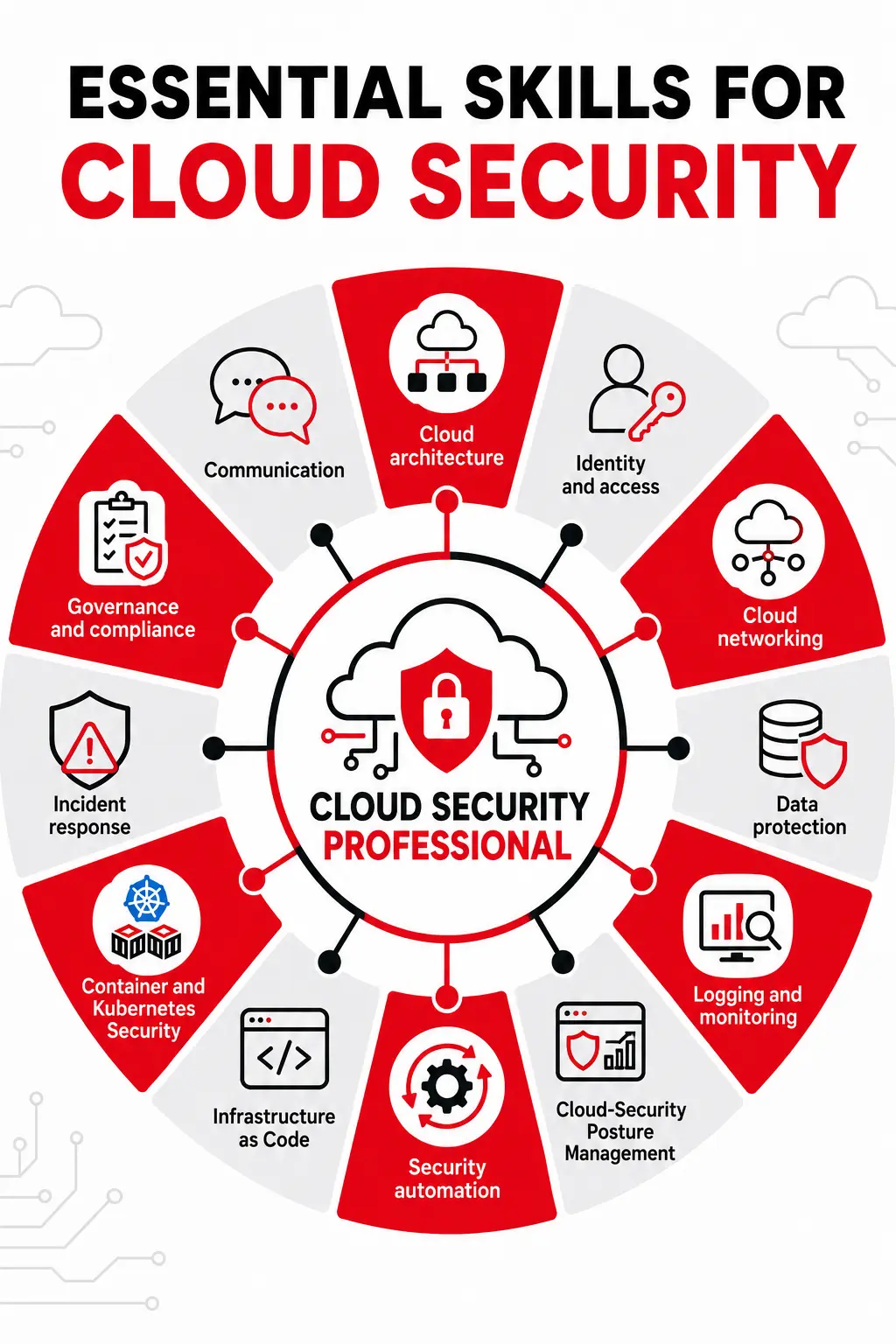
Certifications provide structure, but practical skills are essential for cloud security roles. Focus on:
1. Cloud Architecture
Understand how compute, storage, databases, networking, APIs, containers, and serverless services work together.
2. Identity and Access Management
Learn users, roles, authentication, service identities, privileged access, and least-privilege policies. Pay close attention to excessive permissions.
3. Cloud Networking
Build knowledge of subnets, routing, firewalls, security groups, private endpoints, VPNs, DNS, and hybrid connectivity.
4. Data Protection
Learn data classification, encryption, key management, backups, retention, and data-loss prevention. Understand who can access data and how access is monitored.
5. Logging and Monitoring
Work with authentication events, cloud activity, resource changes, application logs, and security alerts to support detection and investigation.
6. Cloud Security Posture Management
Identify exposed resources, excessive permissions, missing encryption, disabled logging, and policy violations. Learn to prioritize risks effectively.
7. Scripting and Automation
Develop basic skills in Python, PowerShell, Bash, JSON, YAML, and cloud command-line tools. Start by automating repetitive security checks.
8. Infrastructure as Code
Learn to review Terraform, CloudFormation, Bicep, ARM templates, and Kubernetes manifests for security risks before deployment.
9. Container and Kubernetes Security
Understand image security, registries, secrets, permissions, network policies, runtime activity, and workload protection.
10. Incident Response
Practise investigating cloud logs, identity events, API activity, temporary credentials, snapshots, and resource history.
11. Governance and Compliance
Understand how cloud security connects with policies, regulations, audits, risk management, and data residency.
12. Communication
Be able to explain security risks, business impact, recommended changes, and available alternatives to both technical and non-technical audiences.
Cloud Security Tools and Services to Explore
| Category | Examples |
| Identity | AWS IAM, Microsoft Entra ID |
| Posture Management | AWS Security Hub, Microsoft Defender for Cloud |
| Threat Detection | Amazon GuardDuty, Microsoft Defender |
| Logging | AWS CloudTrail, Amazon CloudWatch, Azure Monitor |
| Policy and Configuration | AWS Config, Azure Policy |
| Key Management | AWS KMS, Azure Key Vault |
| Infrastructure as Code | Terraform, CloudFormation, Bicep |
| Container Security | Trivy, Falco, cloud-native container services |
| SIEM | Microsoft Sentinel, Splunk, Elastic Security |
| Code and Template Scanning | Checkov, tfsec, Terrascan |
| Kubernetes Security | kube-bench, kube-hunter |
| Vulnerability Management | Amazon Inspector, Microsoft Defender for Cloud |
Learners do not need to master every tool. Begin with the services used by the target cloud platform and role.
How to Gain Practical Cloud Security Experience
Build a Secure Cloud Account
Configure:
- Multi-factor authentication
- Limited administrative access
- Secure billing alerts
- Centralized logging
- Account recovery controls
- Separate user and administrator identities
Create a Secure Virtual Network
Build:
- Public and private subnets
- Controlled internet access
- Security groups
- Network logging
- Restricted administrative connectivity
Protect Cloud Storage
Test:
- Public access prevention
- Encryption
- Versioning
- Logging
- Retention
- Access policies
- Backup and recovery
Perform an IAM Review
Identify:
- Excessive permissions
- Unused accounts
- Long-lived access keys
- Privileged roles
- Missing multi-factor authentication
- Risky trust relationships
Create a Cloud-Security Baseline
Define minimum requirements for:
- Identity
- Networking
- Encryption
- Logging
- Vulnerability management
- Backup
- Incident response
- Resource tagging
Review Infrastructure as Code
Inspect a Terraform, CloudFormation, or Bicep template for exposed services, excessive permissions, missing encryption, and disabled logging.
Investigate a Cloud Incident
Create a fictional scenario involving:
- Compromised credentials
- Public storage
- Suspicious API activity
- Unauthorized resource creation
- Data exfiltration
- Cryptocurrency mining
Build a timeline and document the containment actions.
Secure a Container Workload
Scan an image, reduce unnecessary privileges, protect secrets, apply network restrictions, and enable runtime monitoring.
Cloud Security Career Progression
A possible career ladder is:
Cloud Support Associate -> Cloud Administrator -> Cloud Security Analyst -> Cloud Security Engineer -> Senior Cloud Security Engineer -> Cloud Security Architect -> Head of Cloud Security
A DevSecOps path may progress as:
Developer or System Engineer -> Cloud Engineer -> DevOps Engineer -> DevSecOps Engineer -> DevSecOps Architect
A governance-focused path may progress as:
GRC Analyst -> Cloud Risk Analyst -> Cloud Compliance Specialist -> Cloud Security Consultant -> Cloud Governance Manager
Career paths are not always linear. Existing experience in networking, systems, cybersecurity, IAM, software development, audit, or compliance can provide a valuable starting point.
How to Start a Cloud Security Career
- Choose a Cloud Platform: Begin with AWS or Azure according to your target roles and market.
- Build Core IT Foundations: Learn networking, Windows or Linux, virtualization, identities, and basic cybersecurity.
- Understand Cloud Architecture: Study compute, storage, databases, networking, regions, availability, and shared responsibility.
- Complete Foundational Learning: Select AWS Cloud Practitioner, CompTIA Cloud+, or AZ-900 according to your needs.
- Build Administration Skills: Practice deploying, managing, monitoring, and troubleshooting cloud resources.
- Develop Security Capability: Learn IAM, encryption, secure networking, posture management, logging, and incident response.
- Select a Professional Pathway: Consider AWS Solutions Architect – Associate, SC-500, AWS Security – Specialty, or AZ-104.
- Create Practical eEvidence: Build projects involving architecture, IAM, Infrastructure as Code, posture assessment, and incident response.
- Advance into Architecture: Pursue CCSP, Microsoft Cybersecurity Architect Expert, or AWS Solutions Architect – Professional when your experience supports it.
- Study Job Descriptions and Apply: Identify repeated skill requirements and close the most relevant gaps.
Conclusion
A cloud security career develops through increasing technical depth: start with cloud fundamentals, networking, identity, storage, compute, and administration; then build skills in architecture, security controls, monitoring, automation, and incident response; finally advance into enterprise architecture, multi-cloud governance, Zero Trust, DevSecOps, and leadership.
Certifications such as Cloud Practitioner, Cloud+, AZ-900, Solutions Architect – Associate, SC-500, AWS Security – Specialty, AZ-104, CCSP, and advanced architecture credentials can provide structure. However, employability depends on practical evidence: build secure environments, review permissions, investigate activity, automate controls, document architecture, and explain security decisions.
Build Your Cloud Security Career with InfosecTrain
InfosecTrain offers structured cloud and cloud-security training across AWS, Microsoft Azure, CompTIA, ISC2, administration, security engineering, and architecture pathways.
Whether you are entering cloud computing, moving from IT into security, developing platform-specific expertise, or preparing for an expert-level architecture role, our learning advisors can help you select training aligned with your current capabilities and target career.
Having a successful career in Cloud Security depends on constant learning, experience, and the capability of securing more and more complex cloud environments. One should start learning from cloud basics, networking, IAM, and cybersecurity, which then leads to gaining expertise in such areas as security engineering, automation, monitoring, incident response, and cloud architecture. You can get all the necessary knowledge and experience through the right Cloud Security Training that will also help you in getting certified. With good technical skills, project experience, and continuous learning, you will be able to build a successful career in Cloud Security.
Build cloud foundations. Secure real environments. Advance toward cloud-security leadership.
Frequently Asked Questions
Is cloud security suitable for beginners?
Yes. Start with networking, operating systems, cloud concepts, identity, and basic cybersecurity. AWS Cloud Practitioner or AZ-900 can provide structure.
Do I need cybersecurity experience before learning cloud security?
No. Experience helps, but cloud administration, networking, system administration, software development, DevOps, audit, and compliance are also relevant backgrounds.
Should I learn AWS or Azure first?
Choose the platform most relevant to your target employers or current organization. Both share core security principles but differ in services and terminology.
Is CompTIA Cloud+ useful for a cloud security career?
Yes. It provides vendor-neutral knowledge of cloud architecture, operations, security, DevOps, and troubleshooting before specialization.
What is Microsoft SC-500?
SC-500 is the exam for Microsoft Certified: Cloud and AI Security Engineer Associate. It covers security for cloud, hybrid, and AI workloads, including identity, data, networking, governance, and posture management.
Is AZ-104 a cloud security certification?
No. AZ-104 focuses on Azure administration but builds useful knowledge of identity, networking, storage, compute, governance, and monitoring.
Do cloud security professionals need coding skills?
Not always. Python, PowerShell, Bash, JSON, YAML, APIs, and Infrastructure as Code are valuable for automation, investigations, and control implementation.
Which certification is best for an experienced cloud security professional?
It depends on the role. CCSP supports broad expertise, Microsoft Cybersecurity Architect Expert suits Microsoft-focused architecture, and AWS Solutions Architect – Professional supports advanced AWS design.
How can I gain cloud security experience without a job?
Build a cloud lab and practice IAM, secure networking, encryption, logging, posture assessment, Infrastructure as Code, containers, and incident investigation.
Are cloud security certifications enough to secure a job?
No. Employers also value practical evidence, risk analysis, investigations, documentation, control implementation, and clear architecture explanations.