Defensive Security Career Roadmap: A Complete Guide
Quick Insights:
Defensive security focuses on protecting systems, detecting malicious activity, investigating alerts, responding to incidents, and strengthening controls based on evidence. A structured career path begins with networking, operating systems, and cybersecurity fundamentals through credentials such as ISC2 CC and CompTIA Network+. It then advances into professional security operations with CompTIA Security+, CySA+, and AI-assisted SOC capabilities before progressing to threat hunting, DFIR, CHFI, and ECIH. Certifications provide valuable direction, but practical experience with SIEM, EDR, log analysis, threat intelligence, detection rules, incident playbooks, and forensic investigations is equally important. Aspiring professionals should choose a target role, build hands-on projects, document their findings, and develop the judgment and communication skills needed to make evidence-based security decisions.
Every cyberattack creates two stories. One is the attacker’s path: the account compromised, the malicious process executed, or the data targeted. The other is the defender’s response: the alert that revealed the activity, the analyst who connected the evidence, the engineer who contained the risk, and the team that prevented the same technique from succeeding again.
Defensive security professionals write that second story.
A career in defensive security is not limited to watching alerts in a Security Operations Center (SOC). It can begin with network fundamentals and log analysis, then expand into incident response, threat hunting, digital forensics, detection engineering, cloud security, security architecture, or blue-team leadership. The challenge is knowing which skills to develop first and how each role connects to the next.
This defensive security career roadmap provides that structure. It explains the major blue team careers, the practical skills employers expect, the cybersecurity certifications that support each stage, and the projects that can turn learning into credible evidence of ability. Whether you are entering cybersecurity for the first time or moving from IT into a specialist security role, the goal is the same: build the right capabilities in the right order.
What is Defensive Security?
Defensive security, often called blue teaming, is the practice of protecting systems, detecting malicious activity, responding to incidents, and improving controls based on what defenders learn. It combines people, processes, and technology across the security lifecycle.
In practical terms, defensive teams work to:
- Reduce the organization’s attack surface
- Monitor networks, endpoints, identities, applications, and cloud environments
- Detect suspicious behavior and validate security alerts
- Investigate the scope, cause, and impact of incidents
- Contain threats and help restore normal operations
- Convert attack knowledge into better detections and controls
- Preserve evidence when forensic investigation is required
- Communicate risk and response decisions to technical and business stakeholders
Offensive Security vs. Defensive Security
| Offensive Security | Defensive Security |
| Simulates attacker behavior | Detects and responds to attacker behavior |
| Identifies exploitable weaknesses | Monitors systems for signs of compromise |
| Conducts penetration tests | Investigates alerts and incidents |
| Tests security controls | Operates and improves security controls |
| Reports attack paths | Contains threats and supports recovery |
The two disciplines complement each other. Offensive security reveals how an attacker might gain access, while defensive security determines whether the organization can detect, investigate, and stop that activity.
You can also explore Offensive Security Career Roadmap: A Complete Guide.
What Does a Defensive Security Professional Do?
Responsibilities vary by role and experience, but may include:
- Monitoring SIEM, EDR, network, cloud, and identity alerts
- Reviewing authentication, endpoint, DNS, firewall, and proxy logs
- Validating whether alerts represent genuine threats
- Enriching indicators such as IP addresses, domains, URLs, and hashes
- Investigating phishing emails and malicious attachments
- Building timelines of attacker activity
- Mapping behavior to the MITRE ATT&CK framework
- Containing compromised accounts and endpoints
- Creating detection rules and investigation playbooks
- Conducting proactive threat hunts
- Collecting and preserving digital evidence
- Performing malware triage and forensic analysis
- Documenting incidents and recommended actions
- Communicating risk to technical and business stakeholders
- Using AI to summarize evidence, prioritize alerts, and accelerate investigations
Defensive security is therefore more than watching dashboards. It requires analytical thinking, technical curiosity, disciplined investigation, and clear communication.
Why Choose a Career in Defensive Security?
Defensive security suits people who enjoy investigation, problem-solving, continuous learning, and work that directly protects an organization. It also offers multiple entry points. A Network Administrator can move toward network defense. A System Administrator can specialize in endpoint security or incident response. A Cloud Engineer can move into cloud detection and security engineering. A beginner can start in a junior SOC role and gradually build depth.
Blue team careers also reward more than technical knowledge. Strong defenders are curious, methodical, calm under pressure, and able to explain what happened without exaggeration. They distinguish evidence from assumptions. They know when to escalate. Most importantly, they learn from every incident.
Defensive Security Learning Path
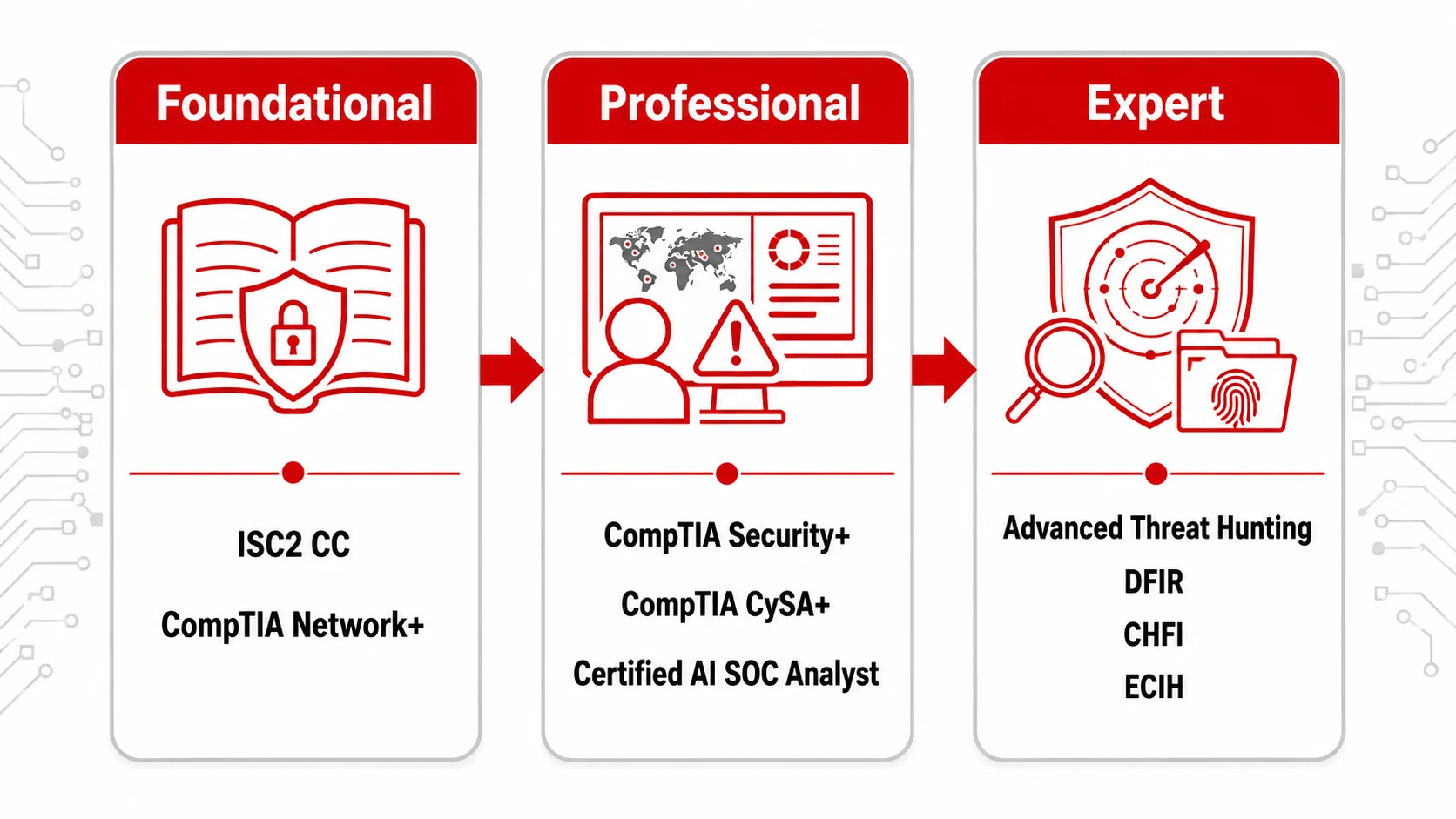
These stages represent progression within this roadmap. They are not official levels assigned by every certification provider, and learners do not need to complete every program. Training should be selected according to current experience, skill gaps, and the intended role.
Stage 1: Build Strong Technical Foundations
Defensive security begins with understanding how normal technology works. It is difficult to identify malicious behavior without first recognizing normal network, system, identity, and application activity.
Core Knowledge to Develop
At the foundational stage, concentrate on:
- Networking models and protocols
- IP addressing and subnetting
- Common ports and services
- DNS, DHCP, HTTP, HTTPS, and email
- Windows and Linux fundamentals
- Users, groups, permissions, and authentication
- Security principles and access controls
- Common cyber threats and vulnerabilities
- Encryption and data protection
- Logging and monitoring concepts
- Incident response fundamentals
- Business continuity and disaster recovery
ISC2 Certified in Cybersecurity
ISC2 positions its Certified in Cybersecurity credential as a resource for newcomers seeking foundational knowledge for entry-level and junior cybersecurity roles. Its subject areas include security principles, access controls, network security, security operations, incident response, business continuity, and disaster recovery.
ISC2 CC may be suitable for:
- Complete beginners
- Students and graduates
- Career changers
- IT professionals exploring cybersecurity
- Aspiring junior security analysts
The certification can provide structure, but learners should support it with practical exercises involving networks, operating systems, logs, and basic investigations.
CompTIA Network+
Network traffic is one of the richest sources of security evidence. Defensive professionals must understand how systems communicate before they can recognize scanning, command-and-control activity, unauthorized connections, or data exfiltration.
Important networking capabilities include:
- Interpreting IP addresses and ports
- Understanding TCP and UDP
- Following DNS and HTTP activity
- Recognizing common network services
- Reading basic packet captures
- Understanding routers, switches, firewalls, and VPNs
- Troubleshooting connectivity
- Differentiating normal and suspicious traffic
CompTIA Network+ can help learners build the networking knowledge needed for later SOC, threat detection, and incident response work.
Practical Capabilities to Build
By the end of the foundational stage, learners should be able to:
- Navigate Windows and Linux systems
- Explain how devices communicate across a network
- Identify common ports and protocols
- Review basic authentication and firewall logs
- Capture and inspect simple network traffic
- Recognize common indicators of compromise
- Explain the purpose of SIEM and EDR platforms
- Document a basic security incident
- Create a small virtual cybersecurity lab
Suitable Starting Roles
Possible roles include:
- Junior Security Analyst
- Security Operations Intern
- Junior SOC Analyst
- Cybersecurity Support Analyst
- IT Security Technician
- Vulnerability Management Associate
Stage 2: Develop Professional Security Operations Skills
The professional stage moves from understanding security concepts to investigating real activity. Learners should become comfortable working with security telemetry, prioritizing alerts, collecting evidence, and explaining whether an event is benign, suspicious, or malicious.
CompTIA Security+
CompTIA Security+ develops broad knowledge across threats, vulnerabilities, architecture, operations, identity, governance, and incident response. Within this roadmap, Security+ can help learners connect foundational IT knowledge with practical cybersecurity responsibilities. It is particularly useful for professionals who need a broader understanding before specializing in security operations.
Key capabilities include:
- Identifying threats and vulnerabilities
- Applying appropriate security controls
- Understanding secure architecture
- Supporting incident response
- Managing identity and access
- Recognizing governance and risk requirements
- Communicating security findings
CompTIA CySA+
CompTIA CySA+ is more closely aligned with security analyst responsibilities. It validates capabilities in continuous monitoring, malicious activity analysis, vulnerability management, incident response, threat intelligence, and reporting.
CompTIA describes CySA+ as an intermediate certification focused on helping professionals monitor, detect, and respond to threats. Relevant roles include SOC Analyst, Threat Hunter, Vulnerability Management Analyst, and Incident Response Analyst.
Professionals pursuing CySA+ should practice:
- SIEM investigation
- Endpoint analysis
- Alert validation
- Threat-intelligence enrichment
- Vulnerability prioritization
- Incident-response procedures
- Security reporting
Certified AI SOC Analyst
Modern SOC Analysts increasingly use AI to summarize logs, enrich indicators, create investigation queries, prioritize alerts, draft reports, and accelerate repetitive workflows. A Certified AI SOC Analyst pathway should combine traditional SOC capabilities with responsible AI-assisted operations, including:
- SIEM and EDR fundamentals
- Alert monitoring and triage
- Phishing and malware investigation
- Threat-intelligence enrichment
- Incident documentation
- Root-cause analysis
- AI-assisted log summarization
- AI-supported detection development
- Prompt validation and output verification
- Privacy and hallucination awareness
AI should support an analyst’s judgment, not replace it. Every AI-generated conclusion, query, classification, or recommendation must be validated against reliable evidence.
Practical Capabilities to Build
At the professional stage, learners should be able to:
- Triage and prioritize alerts
- Investigate suspicious authentication activity
- Analyze phishing emails
- Review endpoint and process telemetry
- Enrich indicators using threat intelligence
- Build an incident timeline
- Map attacker behavior to MITRE ATT&CK
- Create and tune basic detection rules
- Follow escalation procedures
- Prepare investigation and incident reports
- Use AI responsibly within SOC workflows
Suitable Professional Roles
- SOC Analyst
- Cybersecurity Analyst
- Security Monitoring Analyst
- Incident Response Analyst
- Vulnerability Management Analyst
- Endpoint Security Analyst
- Threat Intelligence Analyst
- AI-Powered SOC Analyst
Stage 3: Build Expert-Level Defensive Capability
Expert-level professionals move beyond reactive alert handling. They investigate complex attacks, search proactively for hidden threats, collect forensic evidence, coordinate incident response, and improve defensive architecture.
Advanced Threat Hunting
Threat hunting is the proactive search for malicious activity that has not been detected by existing alerts. Advanced Threat Hunters develop hypotheses using:
- Threat intelligence
- MITRE ATT&CK techniques
- Organizational risk
- Known attacker behavior
- Endpoint and network anomalies
- Identity and cloud telemetry
- Previous incident findings
Important capabilities include:
- Hypothesis-driven hunting
- Baseline and anomaly analysis
- Behavioral detection
- Endpoint telemetry analysis
- Long-term log correlation
- Detection-gap identification
- Threat-hunt reporting
- Converting hunt findings into detections
DFIR (Digital Forensics and Incident Response)
DFIR combines two connected disciplines:
- Digital forensics collects, preserves, examines, and interprets digital evidence.
- Incident response coordinates the identification, containment, eradication, and recovery of security incidents.
Advanced professionals may analyze:
- Disk images
- Memory captures
- Windows artifacts
- File systems
- Browser history
- Registry data
- Event logs
- Network traffic
- Cloud activity
- Malware behavior
CHFI (Computer Hacking Forensic Investigator)
The CHFI credential focuses on digital forensics investigation. It can support professionals who need structured knowledge of evidence collection, forensic analysis, attack reconstruction, and investigation reporting.
EC-Council describes CHFI as developing practical forensic capabilities across areas such as malware, cloud environments, the dark web, social media, and other digital systems.
It may suit:
- Digital Forensics Investigators
- SOC Analysts moving into DFIR
- Incident Responders
- Cybercrime Investigators
- Forensic Consultants
ECIH (EC-Council Certified Incident Handler)
The ECIH pathway focuses on preparing for, managing, and recovering from security incidents. Its scope includes planning, triage, notification, containment, evidence gathering, forensic analysis, eradication, recovery, and post-incident improvement. It may suit:
- Incident Handlers
- Incident Response Analysts
- SOC Professionals
- Security Engineers
- Cybersecurity Consultants
- DFIR Professionals
Suitable Expert Roles
- Senior SOC Analyst
- Tier 3 SOC Analyst
- Threat Hunter
- Detection Engineer
- Digital Forensics Investigator
- Incident Responder
- DFIR Consultant
- Malware Analyst
- Security Operations Lead
- Incident Response Manager
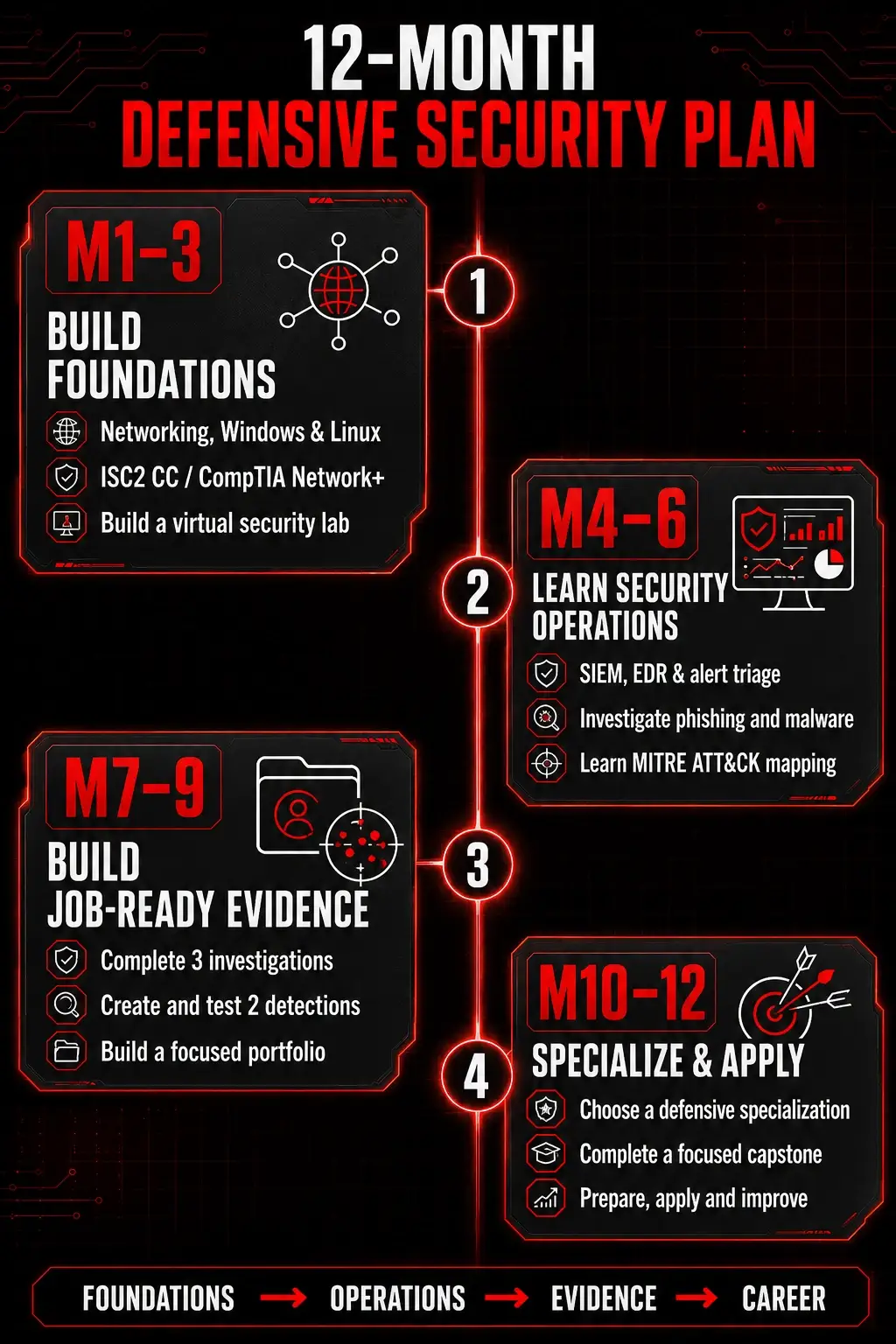
Tools Defensive Security Professionals Should Explore
Learners do not need to master every tool. Begin with the tool categories most relevant to the target role.
| Category | Examples |
| SIEM | Splunk, Microsoft Sentinel, Elastic Security, Wazuh |
| Network Analysis | Wireshark, Zeek, tcpdump |
| Endpoint Monitoring | Microsoft Defender for Endpoint, CrowdStrike, Sysmon |
| Threat Intelligence | VirusTotal, MISP, AlienVault OTX |
| Forensics | Autopsy, FTK Imager, Volatility |
| Detection Engineering | Sigma, YARA, Suricata |
| Case Management | TheHive |
| Scripting and Automation | Python, PowerShell, Bash |
Tools change, but the underlying investigative method remains valuable: form a question, collect evidence, test assumptions, document findings, and recommend action.
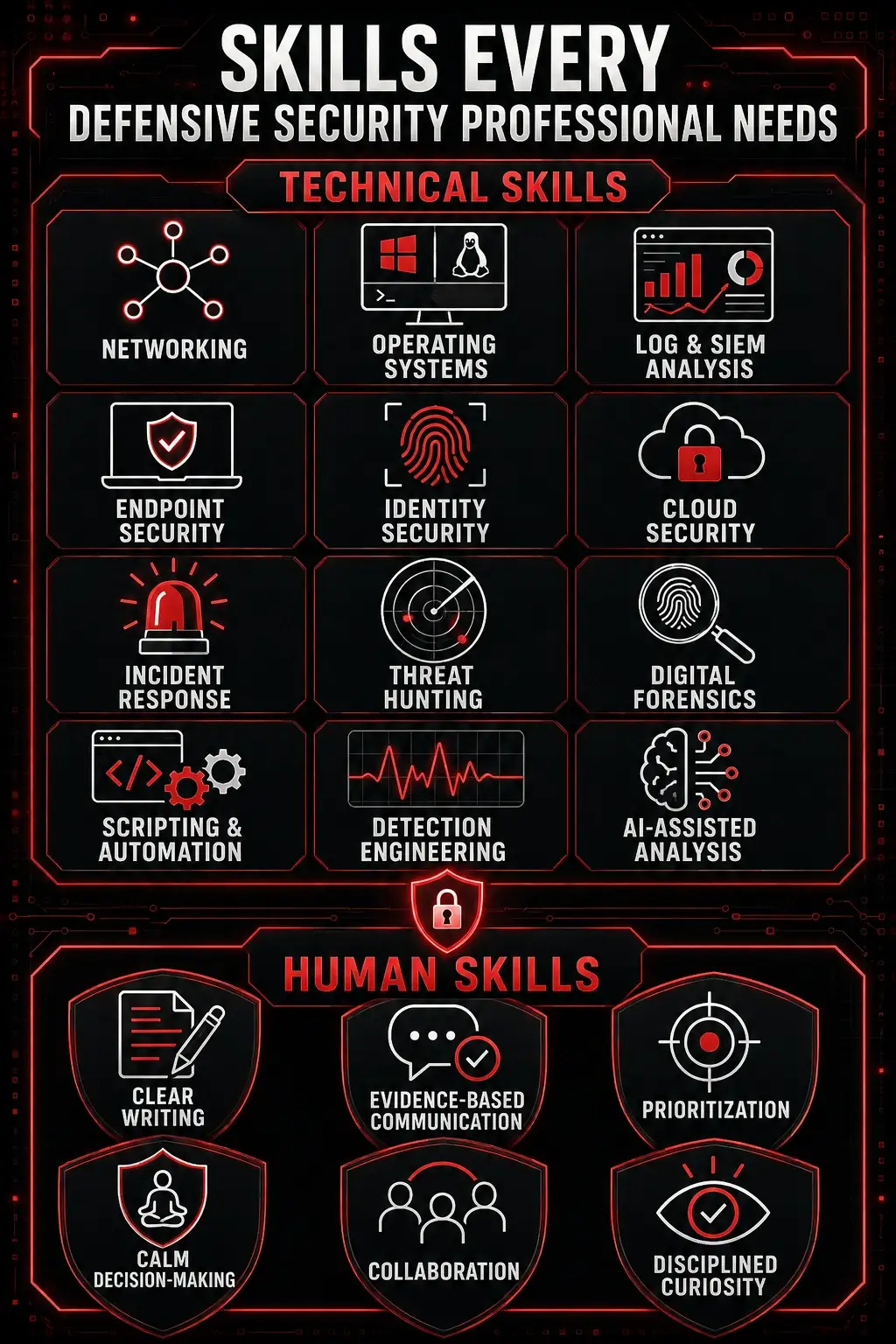
How to Start Your Defensive Security Career
- Choose a starting role: Decide whether you are targeting SOC monitoring, incident response, threat intelligence, vulnerability management, or DFIR.
- Build technical foundations: Learn networking, Windows, Linux, identity, cloud, and security principles.
- Develop investigation skills: Practice reading logs, validating alerts, enriching indicators, and building timelines.
- Learn security tools: Gain practical experience with a SIEM, a network analyzer, endpoint telemetry, and a threat intelligence platform.
- Select relevant certifications: Follow the learning path that matches your role and current experience.
- Create practical evidence: Build investigation reports, detections, playbooks, threat hunts, and forensic case studies.
- Study real job descriptions: Identify frequently requested skills and close the most relevant gaps.
- Apply broadly and improve: Consider adjacent titles rather than waiting for an ideal role.
Common Mistakes to Avoid
- Learning tools without understanding networks or operating systems
- Collecting certifications without practical investigation experience
- Treating every alert as a confirmed incident
- Relying on indicators without examining context
- Ignoring identity, cloud, and application telemetry
- Memorizing queries without understanding the evidence
- Using AI-generated conclusions without validation
- Publishing sensitive lab or workplace information
- Focusing only on ideal job titles
- Neglecting communication and report-writing skills
Conclusion
A defensive security career is built in layers. Networking and operating systems help you understand normal behavior. Security operations teach you to recognize and investigate suspicious activity. Incident response develops judgment under pressure. Threat hunting, DFIR, detection engineering, and security engineering turn that experience into specialist expertise.
The most effective defensive security roadmap therefore combines three elements: structured learning, repeated hands-on practice, and evidence that you can make sound decisions. Cybersecurity certifications can guide the journey, but your real differentiator will be the investigations you can explain, the detections you can improve, and the response actions you can justify. Start with the stage that matches your current capability. Build one project at a time. Then move toward the blue team career where your curiosity, technical strengths, and preferred way of solving problems create the most value.
Build Practical Defensive Security Skills with InfosecTrain
Reading a defensive security roadmap can show you the destination. Practical, instructor-led training helps you build the capability to reach it.
InfosecTrain’s defensive security courses support learners across the career journey, from foundational cybersecurity and networking to job-ready SOC operations, AI-assisted investigation, advanced threat hunting, incident handling, and digital forensics. Learn through expert guidance, realistic tools, structured labs, and scenarios designed around the work defenders perform.
Whether your goal is to become a SOC Analyst, Incident Responder, Threat Hunter, Cybersecurity Engineer, Detection Engineer, or DFIR professional, choose the learning path that matches your current level and target role.
Frequently Asked Questions
Is defensive security suitable for beginners?
Yes. Beginners should start with networking, operating systems, cybersecurity principles, and basic log analysis before moving into SIEM operations and incident investigation.
Which certification should I pursue first?
ISC2 CC can suit complete beginners, while CompTIA Network+ is useful for learners who need stronger networking knowledge. Choose according to your existing skills.
Is CompTIA Security+ required before CySA+?
It is not always a mandatory prerequisite, but Security+ knowledge provides a useful foundation before pursuing the more analyst-focused CySA+ pathway.
Do I need coding skills for defensive security?
Coding is not essential for every entry-level role. However, Python, PowerShell, Bash, regular expressions, and query languages become valuable for investigation and automation.
What is the difference between a SOC Analyst and a Threat Hunter?
A SOC Analyst primarily monitors and investigates alerts. A Threat Hunter proactively searches for attacker activity that may have bypassed existing detections.
Are certifications enough to secure a defensive security role?
No. Certifications should be supported by practical evidence such as investigations, detection rules, threat hunts, incident playbooks, and forensic reports.
Will AI reduce the need for entry-level SOC Analysts?
AI will change entry-level work by accelerating enrichment, summarization, query drafting, and repetitive analysis. It does not remove the need to validate evidence, understand business context, manage sensitive data, make escalation decisions, or take accountability for containment. Entry-level analysts should learn both core investigation skills and responsible AI-assisted workflows.
Can AI support defensive security operations?
Yes. AI can help summarize logs, enrich indicators, prioritize alerts, generate queries, and draft reports. Analysts must still validate every output.
How can I gain practical defensive security experience?
Build a home lab and practice phishing analysis, alert investigation, log correlation, detection creation, threat hunting, and incident-response documentation.
Are certifications enough to secure a defensive security job?
No. Certifications should be supported by practical evidence such as investigation reports, detection rules, threat hunts, incident playbooks, and forensic case studies.