
Program Highlights
The AI Security Expert Training Program is an intensive, hands-on learning pathway that takes participants from foundational AI concepts to advanced AI security engineering. Learners progressively build ML, LLM, RAG, and agentic AI systems, attack them using modern adversarial techniques, implement layered defensive controls, secure production pipelines, and monitor AI environments in operation. The program combines offensive, defensive, engineering, operations, and governance perspectives to provide practical exposure across the complete AI security lifecycle.
 80-Hour LIVE Instructor-Led Training
  Beginner-to-Advanced AI Security Pathway
  AI-Powered SOC & Offensive Security
  Build, Attack & Defend AI Systems
  ML, LLM & Agentic AI Security
  Progressive AI Red Teaming Labs
  Secure MLOps & LLMOps Pipelines
  Full-Stack AI Defense-in-Depth
  Dual Offensive & Defensive AI Expertise
Learning Schedule
- upcoming classes
- corporate training
- 1 on 1 training
Looking for a customized training?
REQUEST A BATCHWhy Choose Our Corporate Training Solution
- Upskill your team on the latest tech
- Highly customized solutions
- Free Training Needs Analysis
- Skill-specific training delivery
- Secure your organizations inside-out
Why Choose 1-on-1 Training
- Get personalized attention
- Customized content
- Learn at your dedicated hour
- Instant clarification of doubt
- Guaranteed to run
Can't Find a Suitable Schedule? Talk to Our Training Advisor!

InfosecTrain’s AI Security Expert Training Program combines Cybersecurity AI Foundations with advanced AI Security Engineering to create a complete learning path from fundamentals to production-level security.
Learners understand how AI, ML, LLMs, RAG, and agentic systems work, apply AI across cybersecurity operations, and progress into building, attacking, defending, monitoring, and governing real AI systems.
- Phase 1: Cybersecurity AI Foundation Program
Part 1 – AI Fundamentals
-
- Module 1: Introduction to AI
- What is Artificial Intelligence: AI, Machine Learning, Deep Learning
- Components of an AI System
- Brief history and evolution: from rule-based systems to modern deep neural networks
- How Machines Learn: Supervised learning, Unsupervised learning, Reinforcement learning
- Types of AI Models and What They Do: Classification models, Regression models, Clustering models, Language models
- AI Model development lifecycle
- AI Tools Landscape: Huggingface, OpenWebUI, GenAI platforms, Open-source model platforms for running models locally: Ollama, LM Studio
- Prompt Engineering Techniques
- Module 2: Python Basics for Using AI Frameworks
- Python Fundamentals for AI
- Lab Setup: Linux VM, Using Jupyter Notebook
- Google Colab: free cloud compute for coding and AI/ML experiments
- Python Libraries for Data Analysis and Visualisation: Pandas, NumPy, Matplotlib
- Types of Data and using them for AI Model development
- Secure and Responsible use of Data in AI models and Applications
- Module 3: Machine Learning for Security
- Libraries and frameworks for Machine Learning and Deep Learning
- Data Collection
- Data Processing (Including Feature Extraction and Normalization)
- Algorithm selection and Model Training
- TEVV: Test, Evaluation, Verification, and Validation and Fine Tuning
- Model Deployment, Model Monitoring and Retraining
- Practical Lab: Building AI (ML and DL) models for Network Security by using GenAI
- Module 4: Natural Language Processing (NLP)
- Libraries and frameworks for NLP
- Text Processing for NLP: Tokenization, Stop words removal, Embeddings
- NLP Feature Engineering Types
- Converting Emails and Logs to Vectors
- Practical Lab: Building a Phishing Mail Detector
- Module 5: Generative AI, LLMs and Agentic AI
- Generative Adversarial Networks
- Transformer Architecture
- System Prompts and User Prompts
- Prompt Engineering Techniques
- Foundational model and fine-tuned model
- Retrieval Augmented Generation (RAG)
- Agentic AI: Autonomous agents, Planning, Reasoning, Action: tool use, and multi-agent orchestration frameworks
- Agentic AI Frameworks: Langchain, CrewAI
- Model Context Protocol (MCP)
- Practical Lab: Building a Gen AI Based Custom Chatbot and Agent
- Module 1: Introduction to AI
Part 2 – AI Security and Governance
-
- Module 6: Attacking AI
- Poisoning: Data and Model Poisoning
- Backdoor Attacks with Trigger-Based Poisoning
- Evasion Attacks: Evading AI-Based Detectors
- Model and Data Theft
- Inversion and Membership Inference Attacks
- OWASP Machine Learning Security Top 10
- Prompt Injection: Direct and Indirect
- Jailbreaking Techniques
- OWASP Top 10 for Large Language Model Applications
- OWASP Top 10 for Agentic Applications
- Practical Lab: Automated LLM Pentesting using Garak
- Module 7: Securing AI
- Threat Modelling: MITRE ATLAS, MAESTRO Framework
- Defense-in-Depth for AI
- Secure Infrastructure Architecture for AI Systems
- Data Security in AI Systems
- Adversarial Training and Bias Checking
- Guardrails for LLMs: System Prompt Hardening, Input and Output Guards
- Open-Source Guardrail Tools: LLM-Guard, Guardrails-AI, LlamaGuard
- AI Gateway: LiteLLM
- Monitoring and Observability for AI Systems: MLFlow, Arize Phoenix
- Rate Limiting & Cost Budgeting
- Data and Model Versioning
- Access control for AI
- Data and Model Integrity
- AI Supply Chain Security
- Practical Lab: Integrating guardrails with AI models
- Module 8: AI Governance
- AI Ethics & Properties of a Responsible AI System
- Data Governance & Model Governance
- NIST AI RMF (Govern/Map/Measure/Manage) and ISO 42001 Annex A Controls
- EU AI Act risk tiers
- Security Roles & Operating Model for AI
- Practical Lab: Governance control mapping exercise
- Module 6: Attacking AI
Part 3 – Security Operations and Offensive Security using AI
- Module 9: Offensive Security using AI
- AI in the Penetration Testing Lifecycle: Reconnaissance, Scanning, Exploitation, Reporting
- Reconnaissance using AI: OSINT Tools, AI-Generated Recon Scripts
- Intelligent Scanning and Enumeration: Nmap with AI, AI-Generated Scan Profiles
- AI-Enhanced Password Attacks: Wordlist Generation, Brute Force Automation
- Web Application Pentesting with AI
- Social Engineering with AI: AI-Generated Phishing Emails
- Covering Tracks and Maintaining Access with AI-Generated Scripts
- Practical Lab: AI-Assisted Reconnaissance, Network Scan, Exploitation, and Pentest Report Writing
- Module 10: Security Operations using AI
- Security Operations: Structure, Roles, and Core Functions
- Signature based detection principles
- AI Integration in Security Operations
- Using ML+Signatures for best results
- AI for Log Analysis: Windows Event Logs, Network Logs
- AI for Alert Triage and False Positive Reduction
- Threat Intelligence: IOCs, MITRE ATT&CK, AI-Assisted IOC Correlation
- Vulnerability Management with AI: CVE Explanation, Prioritization, Remediation
- Incident Response Lifecycle with AI-Guided Playbooks
- User and Entity Behaviour Analytics (UEBA)
- Malware detection using AI
- Using AI with SIEM tools (ELK Stack)
- Practical Lab: Analysis of IDS Logs using Generative AI and Agentic AI
PART 1: FOUNDATIONS & BUILDING AI SYSTEMS
-
- Module 1: Introduction to AI Security Engineering
- AI Introduction: Types of AI learning algorithms, components of AI systems and Use Cases (Predictive, Generative and Agentic)
- Model Development Lifecycle
- NLP and Generative AI: Understanding Tokens, Context Windows, System Prompts, and Model Responses
- Limitations of AI: hallucination, bias, explainability gaps, non-determinism, data privacy concerns, overreliance
- Understanding How AI Applications Are Different from Traditional Applications
- Overview of the AI Threat Landscape: emerging attack classes unique to AI systems
- Introduction to AI Security Engineering: what the discipline covers and how it differs from traditional AppSec/InfoSec
- AI Application Attack Surface Overview: prompt risk, data risk, model risk, API risk, pipeline risk, infrastructure risk
- Defense-in-Depth for AI: introducing the layered model (data, model, application/pipeline, infrastructure, governance/monitoring)
- Responsible AI Concepts and the Difference Between AI Safety, AI Security and AI Governance
- Practical Exercises:
- Mapping a simple AI application architecture
- Identifying AI assets, entry points, and data flows in a sample system
- Identifying where prompt injection and data leakage may occur in that system
- Module 2: ML System Architecture and Engineering
- ML system architecture: data pipeline, feature store, training pipeline, model registry, serving/inference layer, monitoring layer
- ML lifecycle stages: collection→ preprocessing→ training→ validation→ deployment→ monitoring→ retraining
- Trust boundaries applied to ML systems: data, model, pipeline, infrastructure boundary
- Python and core ML libraries overview: NumPy, Pandas, Scikit-learn, TensorFlow/Keras, NLTK
- Common security data formats: network logs, Windows Event Logs, email headers, binary file features
- Basic feature extraction concepts: flow statistics, text n-grams, byte histograms
- Practical Exercises:
- Diagram the architecture and trust boundaries of a sample ML-based security pipeline (e.g., a network intrusion detector)
- Build a minimal scikit-learn pipeline (load→ preprocess→ train→ evaluate→ save artifact).
- Module 3: Building ML and DL Security Controls
- MITRE ATT&CK and the Pyramid of Pain as a guide for detector design
- Network attack detection: flow-based feature engineering and classification
- Phishing email detection: TF-IDF vectorisation and text classification
- Malware detection: static file features and deep learning classification
- User behaviour anomaly detection: UEBA concept, unsupervised anomaly scoring
- Serving trained models as REST APIs with FastAPI
- Experiment tracking with MLflow
- Practical Exercises:
- Network Attack Detection: feature engineering→ training→ evaluation→ FastAPI serving→ MLflow registration
- Phishing Email Detection: TF-IDF classifier, evaluated and served via FastAPI
- Malware Detection: static-feature DL classifier for malware
- Module 4: LLM and Agentic AI Architecture and Engineering
- LLM application components: API layer, model provider, vector database, retrieval layer, logging layer
- Local and API-based LLM setup: OpenWebUI, Ollama, LM Studio, OpenRouter — cost and data-retention tradeoffs
- Prompt engineering essentials: zero-shot, few-shot, chain-of-thought, system prompt design
- RAG architecture: ingestion, chunking, embeddings, vector storage, retrieval, generation
- Vector stores: ChromaDB, FAISS and retrieval quality as a security concern
- Parameter-efficient fine-tuning
- Fine-tuning vs RAG vs prompt engineering: cost, data, and latency tradeoffs
- Agent architecture: planning, memory, tool use, external API access, action execution, feedback
- Agentic frameworks and concepts: LangChain/LangGraph, CrewAI/A2A overview, MCP and tool exposure, context-overflow concept, markdown-native agent architecture
- Trust boundaries for LLM/Agentic systems: model, tool, memory/context, retrieval boundary
- Practical Exercises:
- Set up Open WebUI with local Ollama/OpenRouter and a security-analyst system prompt
- Fine-Tuning Walkthrough: fine-tune a small open-source model on a security dataset, compare before/after responses
- RAG Pipeline: build a RAG pipeline over a threat-intel knowledge base
- MCP Exploration: connect to a pre-built MCP server and observe tool exposure
- Module 1: Introduction to AI Security Engineering
PART 2: ATTACKING AI SYSTEMS
-
- Module 5: AI Threat Modelling
- Threat modeling fundamentals: threat actors, assets, abuse cases, entry points, data flows, security controls
- Applying MITRE ATLAS and STRIDE to AI applications
- Revisiting trust boundaries in AI Systems with adversarial intent in mind
- Practical Exercises:
- Threat-model the ML pipeline built in Module 3 and the RAG/agentic application built in Module 4- produce trust-boundary/data-flow diagrams
- Module 6: Adversarial ML: Attacking ML and DL Systems
- OWASP ML Security Top 10
- Adversarial drift
- Poisoning, evasion, extraction, model inversion, membership inference
- Attack tooling: Adversarial Robustness Toolbox (ART), used as a black-box tool
- Practical Exercises:
- Data Poisoning Simulation: inject crafted samples into the training pipeline, retrain, observe targeted accuracy impact
- Evasion Attack: run a pre-built ART evasion attack against the intrusion classifier, interpret accuracy degradation, document using ATLAS
- Module 7: Adversarial Attacks on LLMs and Agents
- OWASP LLM Top 10, OWASP Agentic AI Top 10, MAESTRO (threat model for agentic systems)
- Direct and indirect prompt injection; system prompt leakage; jailbreaking techniques
- Context-window overflow and vector store poisoning
- Tool misuse and excessive agency, multi-agent trust exploitation
- MCP-specific attack vectors: tool output injection, privilege escalation
- Automated testing tools: Garak, PyRIT, Promptfoo
- Practical Exercises:
- Automated vulnerability scan(Garak/Promptfoo) against an AI application and review findings against OWASP LLM Top 10
- Attack a pre-built, deliberately vulnerable agentic application: direct/indirect injection, memory poisoning; map findings to OWASP Agentic Top 10 and MAESTRO layers
- Module 5: AI Threat Modelling
PART 3: DEFENDING AI SYSTEMS
-
- Module 8: AI Data Security
- The AI data lifecycle: collection, labeling, preprocessing, training, validation, testing, inference, output data
- Prompt data, retrieval data, vector database data, logs, and telemetry
- Data classification for AI: public, internal, confidential, restricted, personal, sensitive, credential
- Data leakage patterns: prompt leakage, file upload leakage, model output leakage, log leakage, vector database leakage
- RAG over-retrieval risk and copilot-style oversharing risk
- Source code and secret exposure risk in AI workflows
- Data sanitization and de-identification: anonymization, pseudonymization, minimization, masking, redaction
- Data lineage and provenance
- Privacy preserving learning techniques
- Practical Exercises:
- PII detection and masking using Microsoft Presidio
- Prompt sanitization techniques— build a safe AI input pipeline
- Secrets detection using Gitleaks/TruffleHog
- Classify sample AI data and review AI logs for sensitive data exposure
- Module 9: AI Model Security (ML and DL)
- Adversarial training: hardening models with adversarial examples
- MLflow Model Registry: model versioning and model cards
- Model artifact protection: safe serialisation vs. unsafe formats
- Model integrity validation: hashing, signing, checksums
- Registry protection: access control, approval tags, rollback planning
- Practical Exercises:
- Retrain the Module 3 classifier with adversarial examples and measure robustness improvement
- Register the model in MLflow with a version tag, and auto-generate a model card
- Validate the model artifact’s hash and serialisation format
- Module 10: AI Model Security (LLMs and Agentic AI)
- Input guardrails: prompt injection detection, PII redaction, topic filtering, length limits
- Output guardrails: hallucination detection, sensitive content filtering, format enforcement
- Guardrail approaches: rule-based, classifier-based, LLM-as-judge
- Open-source guardrail tools: LLM-Guard, LlamaGuard, GuardrailsAI, NeMo Guardrails
- LLM gateway: rate limiting, authentication, request logging, cost controls
- Model and artifact integrity for LLMs
- Harness engineering overview: tool sandboxing, behavioural constraints, human oversight gates
- Practical Exercises:
- Wrap the insecure LLM application with input/output guardrail scanners and harden system prompts
- Module 11: AI Application & API Security
- AI AppSec vs traditional AppSec
- AI APIs and LLM API workflows
- API authentication and authorization for AI applications, token handling and key protection
- Runtime protections: Web Application Firewalls (WAFs) and inference-stage rate-limiters to mitigate DoS and malicious query floods
- RBAC/ABAC, object-level authorization
- Document-level authorization in RAG systems
- Tool-level authorization in AI agents
- Secure design for AI plugins, connectors, and MCP integrations
- Practical Exercises:
- Review an AI API for missing authentication/authorization (Postman/Burp Suite)
- Identify broken access control in a RAG scenario
- Test for API key exposure and weak token handling
- Module 8: AI Data Security
PART 4: AI SECURITY OPERATIONS
- Module 12: Secure MLOps: CI/CD Pipeline Security
- MLOps pipeline stages: data validation, training, evaluation, registration, deployment
- Secure data pipeline design: Input validation and schema enforcement before training begins, dataset versioning and rollback using DVC
- Pipeline access control and credential/secrets risk in build environments
- CI/CD for AI: triggers on code, data, and model changes
- Automated pass/fail security gates: SAST(Semgrep, CodeQL), secrets scanning, dependency scanning(Snyk, pip-audit)
- Production promotion gates: performance and fairness thresholds before a model goes live
- Practical Exercises:
- Build a GitHub Actions pipeline combining data validation, training, evaluation, and SAST/secrets/dependency gates
- Configure an MLflow promotion gate so a model only registers as “production” if it clears the performance/fairness threshold
- Demonstrate a pipeline failure from a deliberately introduced issue and a clean run that promotes the model
- Module 13: AI Infrastructure, Access Control & Supply Chain Security
- AI infrastructure components: compute/GPU workloads, containers, model-serving endpoints, vector database storage
- Identity and Access Management (IAM) for AI infrastructure: RBAC and least privilege for dataset modification, model deployment, and registry/tuning-parameter access
- Environment hardening: network segmentation, GPU cluster isolation, and lateral-movement prevention
- Container security for AI workloads
- Open-source model and public dataset supply chain risk, third-party AI API risk
- Model provenance verification
- SBOM and AI-BOM concept: what they capture and why they matter for AI supply chain transparency
- Practical Exercises:
- Deploy an LLM gateway(LiteLLM) in front of the application, configured with rate limits, authentication, and request logging
- Scan a container image for vulnerabilities(Trivy)
- Using Model Provenance Toolkit
- Generate an SBOM/AI-BOM for a sample AI app using a guided template (Syft + CycloneDX)
- Module 14: AI Security Monitoring and Incident Response
- ML drift monitoring: data drift vs. concept drift, reviewing an Evidently AI drift report
- AI security monitoring overview: prompt, API usage, model query, data access, tool execution, and agent action monitoring
- Output validation: monitoring deployed outputs for sensitive data leakage, copyright infringement, or malicious content generation
- LLM observability tooling: Arize Phoenix and Langfuse/Langsmith for tracing calls, retrieval steps, tool invocations
- Abuse detection: spotting attacker behaviour over time (high-volume querying, repeated extraction attempts, repeated jailbreak attempts)
- Vulnerability intake, classification, and severity rating for AI issues
- AI incident scenarios: prompt injection, sensitive data exposure, model extraction, poisoned dataset, unauthorized model replacement, API abuse, shadow AI
- Incident response playbooks: quarantine, retrain, and rollback procedures for compromised models
- Honeypots in AI Applications
- Practical Exercises:
- Review a pre-built Evidently AI drift report and configure a basic alert threshold
- Analyze AI API abuse logs for extraction/jailbreak patterns
- Building and deploying a honeypot in RAG Pipeline
- Module 15: AI Governance and Responsible AI Practice
- NIST AI RMF mapping exercise (Govern, Map, Measure, Manage)
- Responsible AI properties of controls built in the course
- Secure AI SDLC: Acquire vs Build governance questions
- AI-BOM’s role in governance and audit evidence
- Practical Exercises:
- Given a sample AI system(a built combination of one ML model and one LLM/RAG application from earlier in the course), learners:
- Review an AI API for missing authentication/authorization (Postman/Burp Suite)
- Identify broken access control in a RAG scenario
- Test for API key exposure and weak token handling
- Given a sample AI system(a built combination of one ML model and one LLM/RAG application from earlier in the course), learners:
-
The training is ideal for:
- Security professionals moving into AI:
- Security Engineers
- Security Architects
- Penetration Testers/Red Teamers
- SOC Analysts
- AppSec Engineers
- DevSecOps Engineers
- AI and engineering professionals moving into security:
- Data Scientists
- ML Engineers
- LLM Engineers
- MLOps/Platform Engineers
Before attending this accelerated course, you should have:
- Fundamental Knowledge of Security Concepts
- No coding or AI Knowledge required
Upon successful completion of the training, participants will be able to:
- Understand AI, ML, Deep Learning, NLP, Generative AI, RAG, and Agentic AI
- Build practical ML/DL and LLM-based security solutions
- Apply AI to SOC, threat analysis, vulnerability management, and incident response
- Use AI across reconnaissance, scanning, exploitation, and pentesting workflows
- Identify and exploit vulnerabilities in ML, LLM, RAG, and agentic systems
- Conduct AI threat modeling using current security frameworks
- Implement guardrails, gateways, adversarial training, and access controls
- Secure AI applications, APIs, data, models, infrastructure, and supply chains
- Build security controls into MLOps and LLMOps pipelines
- Monitor production AI systems and respond to AI-specific incidents
- Apply NIST AI RMF, ISO/IEC 42001, and Responsible AI practices
- Produce practical governance and audit evidence for AI systems

How We Help You Succeed

Vision

Goal

Skill-Building

Mentoring

Direction

Support

Success
Benefits of Training

Build Strong Foundations in AI and Cybersecurity

Develop Practical AI Security Engineering Skills

Gain Confidence Across Offensive and Defensive AI Security

Prepare for Emerging AI Security Career Roles

Apply AI Security Across Real-World Environments
Average Salary
Average Salary
Hiring Companies







"Source: Indeed, Glassdoor"
Confused about the right course for yourself?
Your Trusted Instructors

7+ Years of Experience
Words Have Power

It was a very good experience with the team. The class was clear and understandable, and it benefited me in learning all the concepts and gaining valuable knowledge.

I loved the overall training! Trainer is very knowledgeable, had clear understanding of all the topics covered. Loved the way he pays attention to details.

I had a great experience with the team. The training advisor was very supportive, and the trainer explained the concepts clearly and effectively. The program was well-structured and has definitely enhanced my skills in AI. Thank you for a wonderful learning experience.

The class was really good. The instructor gave us confidence and delivered the content in an impactful and easy-to-understand manner.

The program helped me understand several areas I was unfamiliar with. The instructor was exceptionally skilled and confident in delivering content.
The program was well-structured and easy to follow. The instructor’s use of real-life AI examples made it easier to connect with and understand the concepts.
Success Speaks Volumes

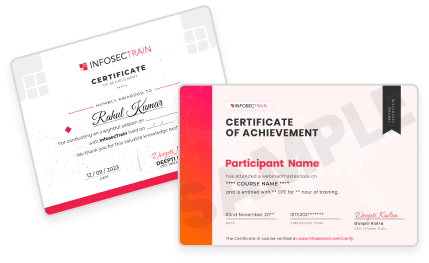
Get a Sample Certificate
Frequently Asked Questions
What is the Cybersecurity AI Foundation + AI Security Architecture combo course?
The AI Security Expert Training Program combines foundational AI learning with advanced AI security engineering. It covers how to build, attack, defend, monitor, and govern modern AI-enabled systems.
Why combine these two courses instead of taking them separately
The combination creates a structured progression from understanding AI fundamentals to applying advanced security engineering. Learners build the foundation first, then move into practical attack, defence, architecture, and operations.
Who should enroll in this combo program?
It is ideal for Security Engineers, Security Architects, SOC Analysts, Penetration Testers, Red Teamers, AppSec and DevSecOps professionals, as well as ML, LLM, and MLOps professionals moving into security.
Do I need prior AI or machine learning experience?
No. The program starts with AI, ML, LLM, RAG, and agentic AI fundamentals before progressing into advanced AI security engineering.
Is coding knowledge required?
No prior coding knowledge is required. Python fundamentals and relevant AI libraries are introduced as part of the learning path.
What will I learn from the Foundation Program?
You will learn AI, ML, NLP, LLMs, RAG, agentic AI, AI attacks, defence, governance, and AI-assisted security operations. Practical labs help you apply these concepts in real security workflows.
What will I learn from the AI Security Architecture Training?
You will learn to design, analyze, attack, and secure ML, LLM, RAG, and agentic systems. The training also covers adversarial testing, guardrails, MLOps security, monitoring, and incident response.
Does the combo cover securing LLMs and AI agents?
Yes. It covers prompt injection, jailbreaking, memory and context risks, RAG attacks, tool misuse, excessive agency, MCP risks, guardrails, gateways, and agent security controls.
Will I learn to identify AI-specific attack paths?
Yes. You will perform AI threat modeling, identify assets, trust boundaries, data flows, entry points, and abuse cases, and map attack paths across ML, RAG, LLM, and agentic systems.
Does the combo address AI governance, risk and compliance?
Yes. The course covers AI governance, NIST AI RMF, ISO/IEC 42001, EU AI Act concepts, responsible AI, control mapping, and governance evidence.
Which job roles does this combo prepare me for?
The program supports roles such as AI Security Engineer, Security Architect, AppSec Engineer, DevSecOps Engineer, Red Teamer, SOC Analyst, and AI Security Specialist.
Is there demand for AI security skills in 2027?
Yes, AI security is becoming increasingly important as organizations adopt LLMs, agents, and AI-enabled applications. Skills in AI security engineering, governance, monitoring, and secure MLOps are becoming more relevant across security teams.
How is AI security different from traditional cybersecurity?
AI security adds risks across models, prompts, training data, RAG pipelines, vector databases, agents, tools, and MLOps environments. It extends traditional security across the complete AI lifecycle.
Will this combo help me move from SOC or security operations into AI security?
Yes. The program connects familiar SOC skills such as log analysis, alert triage, threat intelligence, and incident response with AI-powered workflows and AI-specific security operations.
How long is the combo course?
The complete AI Security Expert Training Program includes 80 hours of LIVE instructor-led training across foundational and advanced AI security modules.
Should I take the Foundation course before the Architecture course?
Yes. The program is designed as a progressive pathway, with the Foundation phase building the AI knowledge needed to understand the advanced security engineering modules.
What happens after completing the combo course?
You will be equipped to assess, attack, secure, monitor, and govern AI-enabled systems across data, models, applications, infrastructure, and operational environments.
Why choose InfosecTrain for AI security training?
InfosecTrain combines foundational learning with hands-on AI security engineering, practical labs, real tools, offensive and defensive techniques, secure MLOps, monitoring, and governance in one structured program.