Information Security Career Roadmap: A Complete Guide
Cybersecurity is not one job, one certification, or one fixed career path.
Some professionals investigate suspicious activity. Some test systems for weaknesses. Others build security policies, protect cloud environments, manage privacy obligations, or secure artificial intelligence systems. That variety creates opportunity, but it also creates confusion.
A beginner may start studying ethical hacking because it looks exciting, only to discover that they are more interested in risk management. An experienced IT Administrator may collect several certifications without developing the practical cloud security skills required for a new role. A Compliance Professional may assume that cybersecurity requires advanced coding, even though their existing audit and business knowledge can provide an excellent foundation for a GRC career.
A useful information security career roadmap should therefore answer four questions:
- Which security domain matches your interests and existing experience?
- What foundational skills should you learn first?
- Which certifications or practical programs support your target role?
- What evidence can you show employers beyond certificates?
This guide organizes the information security career journey into six career pathways covered in this guide:
- Governance, Risk, and Compliance
- Cybersecurity AI
- Offensive Security
- Defensive Security
- Cloud Security
- Data Privacy
Each pathway progresses through three broad stages: Foundational, Professional, and Expert.
Information Security Career Paths
An information security career roadmap is a structured plan for developing the knowledge, practical skills, certifications, and experience required for a specific cybersecurity role. Beginners first build foundational IT and security skills, then specialize in one domain, gain hands-on experience, and finally progress toward advanced technical, consulting, architectural, or leadership responsibilities.
| Career Path | Primary Focus | Suitable For | Possible Career Progression |
| GRC | Risk, policy, audits, governance and compliance | Business-oriented and process-driven professionals | GRC Analyst → Risk Manager → Security Leader |
| Cybersecurity AI | Securing, governing and auditing AI systems | Security, governance, audit and AI professionals | AI Security Analyst → AI Auditor → AI Security Leader |
| Offensive Security | Identifying and exploiting weaknesses ethically | Practical, curious and technically driven learners | Junior Pentester → Red Teamer → Offensive Security Lead |
| Defensive Security | Detecting, investigating and responding to attacks | Analytical learners who enjoy investigation | SOC Analyst → Incident Responder → Threat Hunter |
| Cloud Security | Protecting cloud identities, workloads and data | IT, networking, administration and cloud professionals | Cloud Security Analyst → Engineer → Architect |
| Data Privacy | Protecting personal data and managing privacy obligations | Legal, compliance, governance and technology professionals | Privacy Analyst → Privacy Manager → DPO |
The levels in this guide represent career development stages, not official classifications assigned by each certification provider. Your appropriate starting point will depend on your previous education, work experience, and practical knowledge.
Understanding the Three Career Stages
Foundational Stage
The foundational stage builds a common language for information security. You learn how networks, operating systems, identities, applications, data, risks, threats, and controls work together. At this point, the objective is not to become an expert in every area. It is to understand enough to choose a specialization intelligently.
A strong foundation normally includes:
- Basic networking and operating-system concepts
- Common cyber threats and vulnerabilities
- Identity and access management
- Security policies and controls
- Risk and compliance fundamentals
- Cloud and data-security basics
- Clear technical documentation
Professional Stage
At the professional stage, learning becomes role-specific.
A SOC Analyst studies alert triage and incident response. A GRC Professional works with risk assessments and control frameworks. A Penetration Tester develops skills in web, network, and Active Directory testing. A Privacy Professional learns to interpret laws and operationalize privacy requirements.
Certifications become more valuable at this stage because they validate knowledge connected to a defined professional role.
Expert Stage
Expert-level professionals do more than follow established procedures. They design, lead, investigate, advise, or make decisions. Depending on the selected path, this may involve:
- Designing a security architecture
- Leading a red-team operation
- Managing a security program
- Conducting advanced threat hunting
- Building an AI governance framework
- Leading cloud security transformations
- Operating an enterprise privacy program
Expert status comes from the combination of knowledge, practical experience, judgment, communication, and accountability, not from holding one advanced certification.
1. GRC Career Roadmap
What is GRC in Cybersecurity?
GRC stands for Governance, Risk, and Compliance. Governance ensures that security supports organizational objectives. Risk management identifies, evaluates, treats, and monitors risks. Compliance helps the organization meet applicable legal, regulatory, contractual, and framework-based requirements.
GRC professionals frequently work with security policies, control assessments, internal audits, third-party risks, risk registers, business continuity, regulatory requirements, and management reporting.
ISO/IEC 27001 is particularly relevant because it provides requirements for establishing and continually improving an Information Security Management System and for applying a risk management process appropriate to the organization.
GRC Learning Path
| Stage | Recommended Learning and Certifications |
| Foundational | ISO/IEC 27001, CompTIA Security+ |
| Professional | CISSP, CISM, CISA, CRISC |
| Expert | GRC Hands-on, Practical CISO, Security Architecture Hands-on |
These recommendations represent possible learning milestones, not mandatory sequences. Some certifications require verified professional experience before the credential can be awarded.
Representative Roles Across Career Levels
GRC Analyst, IT Risk Analyst, Compliance Analyst, Information Security Auditor, Risk Manager, GRC Consultant, Security Architect, CISO
For a detailed role-by-role plan, explore the complete GRC Career Roadmap.
2. Cybersecurity AI Career Roadmap
What is Cybersecurity AI?
The cybersecurity AI pathway covers two connected areas:
Using AI in cybersecurity involves applying AI-assisted capabilities to detection, investigation, threat intelligence, automation, vulnerability analysis, and security operations.
Securing and governing AI involves protecting models, data, infrastructure, applications, prompts, agents, and AI supply chains while managing risks such as model manipulation, data leakage, insecure integrations, bias, misuse, and regulatory non-compliance.
This field needs professionals who understand both traditional security principles and the AI lifecycle.
Cybersecurity AI Learning Path
| Stage | Recommended Learning and Certifications |
| Foundational | Cybersecurity AI Foundation |
| Professional | ISO/IEC 42001 Lead Auditor or Lead Implementer, AAISM, AAIA, CompTIA SecAI+ |
| Expert | Practical AI Security Engineering, AIGP, CAIGS, C|RAGE |
Representative Roles Across Career Levels
AI Security Analyst, AI Risk Analyst, AI Governance Analyst, AI Auditor, AI Security Engineer, Responsible AI Specialist, AI Governance Lead, AI Security Manager
For a detailed role-by-role plan, explore the complete Cybersecurity AI Career Roadmap.
3. Offensive Security Career Roadmap
What is Offensive Security?
Offensive security involves testing systems by thinking and acting like an attacker, within authorized and clearly defined boundaries. Professionals identify vulnerabilities, validate whether weaknesses can be exploited, evaluate business impact, document evidence, and recommend remediation. The field includes network penetration testing, web application security, Active Directory testing, red teaming, wireless testing, and bug bounty hunting.
The objective is not simply to “hack” a system. Professional offensive security requires authorization, careful scoping, evidence handling, responsible testing, and clear reporting.
Offensive Security Learning Path
| Stage | Recommended Learning and Certifications |
| Foundational | CompTIA A+, CompTIA Network+, CompTIA Linux+ |
| Professional | CEH, CompTIA PenTest+, WAPT, Bug Bounty Hunting |
| Expert | Red Team Operations, AWAPT, CPENT, Active Directory Pentesting, C|OASP |
A learner with existing IT experience may not need every foundational certification. However, the underlying knowledge remains important.
Representative Roles Across Career Levels
Security Intern, Vulnerability Assessment Analyst, Junior Penetration Tester, Web Application Pentester, Active Directory Pentester, Red-Team Operator, Offensive Security Consultant, Red-Team Lead
For a detailed role-by-role plan, explore the complete Offensive Security Career Roadmap.
4. Defensive Security Career Roadmap
What is Defensive Security?
Defensive security focuses on preventing, detecting, investigating, containing, and recovering from cyber incidents. Defensive professionals monitor security events, analyze logs, investigate suspicious activity, improve detection rules, contain compromised systems, collect evidence, and help organizations learn from incidents.
This domain includes Security Operations Center activities, threat hunting, incident response, malware analysis, digital forensics, detection engineering, and cyber threat intelligence.
Defensive Security Learning Path
| Stage | Recommended Learning and Certifications |
| Foundational | ISC2 CC, CompTIA Network+ |
| Professional | CompTIA CySA+, CompTIA Security+, Certified AI SOC Analyst |
| Expert | Advanced Threat Hunting, DFIR, CHFI, ECIH |
Certifications provide vocabulary and structure, but defensive-security hiring frequently depends on whether you can investigate real or simulated evidence.
Representative Roles Across Career Levels
SOC Intern, Tier 1 SOC Analyst, Tier 2 SOC Analyst, Incident Responder, Threat Hunter, Detection Engineer, DFIR Consultant, SOC Manager
For a detailed role-by-role plan, explore the complete Defensive Security Career Roadmap.
5. Cloud Security Career Roadmap
What is Cloud Security?
Cloud security protects cloud-based identities, applications, data, networks, workloads, infrastructure, and management services. It requires more than learning a cloud provider’s interface. Professionals must understand shared responsibility, identity and access management, encryption, network segmentation, logging, configuration management, workload protection, compliance, incident response, and secure architecture.
Cloud Security Learning Path
| Stage | Recommended Learning and Certifications |
| Foundational | AWS Certified Cloud Practitioner, CompTIA Cloud+, AZ-900 |
| Professional | AWS Certified Solutions Architect – Associate, Microsoft SC-500, AWS Certified Security – Specialty, AZ-104 |
| Expert | CCSP, Microsoft Certified: Cybersecurity Architect Expert, AWS Solutions Architect Professional |
Microsoft introduced the SC-500: Cloud and AI Security Engineer Associate as a transition path from the AZ-500. The credential expands the security engineering role to cover cloud environments and AI workloads; Microsoft announced that the AZ-500 would retire on August 31, 2026.
Representative Roles Across Career Levels
Cloud Support Associate, Cloud Administrator, Cloud Security Analyst, Cloud Security Engineer, DevSecOps Engineer, Cloud Security Architect, Multicloud Security Lead
For a detailed role-by-role plan, explore the complete Cloud Security Career Roadmap.
6. Data Privacy Career Roadmap
What is Data Privacy?
Data privacy focuses on how personal information is collected, used, shared, retained, secured, and deleted. Privacy professionals help organizations understand applicable obligations, document data processing, respond to individual rights requests, assess privacy risks, review vendors, manage incidents, and integrate privacy requirements into technologies and business processes.
Data privacy and cybersecurity overlap, but they are not identical. Cybersecurity focuses broadly on protecting systems and information. Privacy focuses specifically on lawful, fair, transparent, and responsible handling of personal data.
Data Privacy Learning Path
| Stage | Recommended Learning and Certifications |
| Foundational | Privacy fundamentals, DPDPA Bootcamp |
| Professional | CIPP/E, CIPP/US, CIPM |
| Expert | CIPT, DPO Hands-on |
Representative Roles Across Career Levels
Privacy Analyst, Data Protection Analyst, Privacy Consultant, Privacy Program Manager, Privacy Engineer, Data Protection Officer, Head of Privacy
For a detailed role-by-role plan, explore the complete Data Privacy Career Roadmap.
How to Choose the Right Information Security Career Path
Choose according to the type of problems you want to solve.
| You Enjoy | Consider |
| Policies, audits, risk, and business discussions | GRC |
| AI risk, models, security, and governance | Cybersecurity AI |
| Testing systems and finding weaknesses | Offensive Security |
| Investigating alerts and incidents | Defensive Security |
| Cloud infrastructure and architecture | Cloud Security |
| Personal-data rights and obligations | Data Privacy |
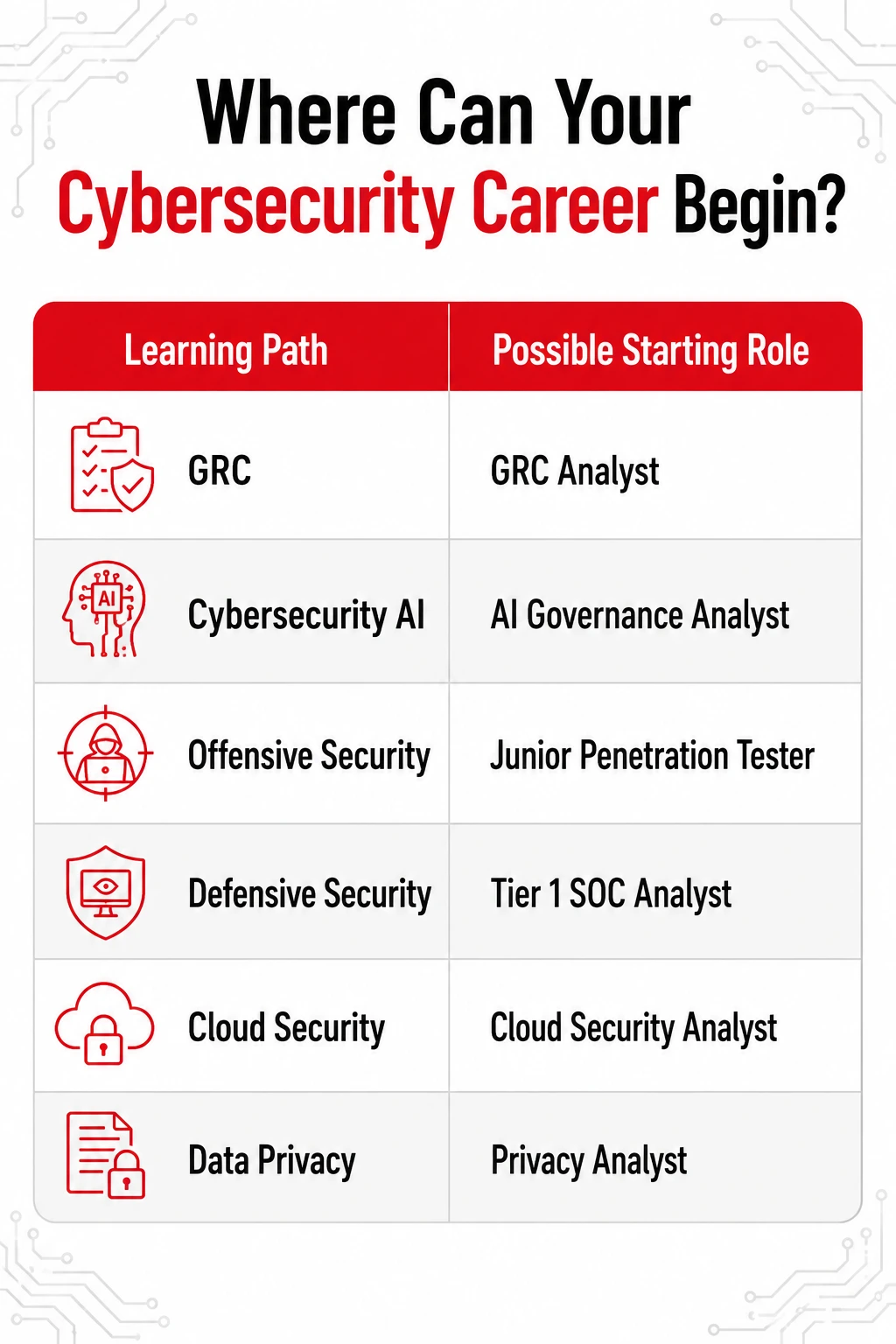
You are also not permanently locked into one domain. A SOC Analyst may move into cloud incident response. A GRC professional may specialize in AI governance. A Penetration Tester may become a Security Architect. A Privacy Professional may move into privacy engineering or AI assurance.
The best career paths often combine two complementary areas, but beginners should first establish one clear primary direction.
Certifications Alone Do Not Make You Job-Ready
Certifications can provide structured learning, validate knowledge, and help employers understand your areas of study. However, they should be combined with practical capability. A job-ready professional normally needs four things:
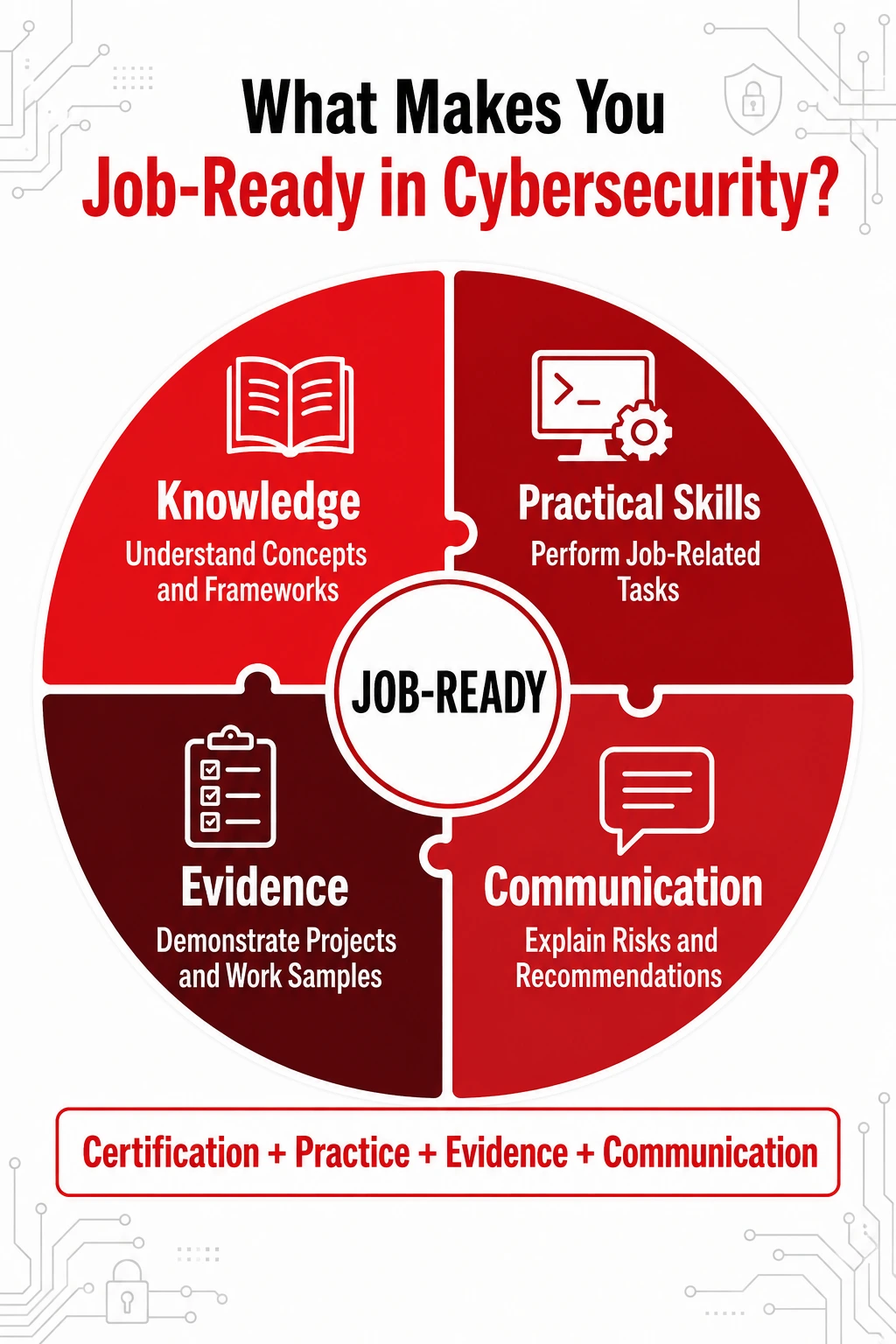
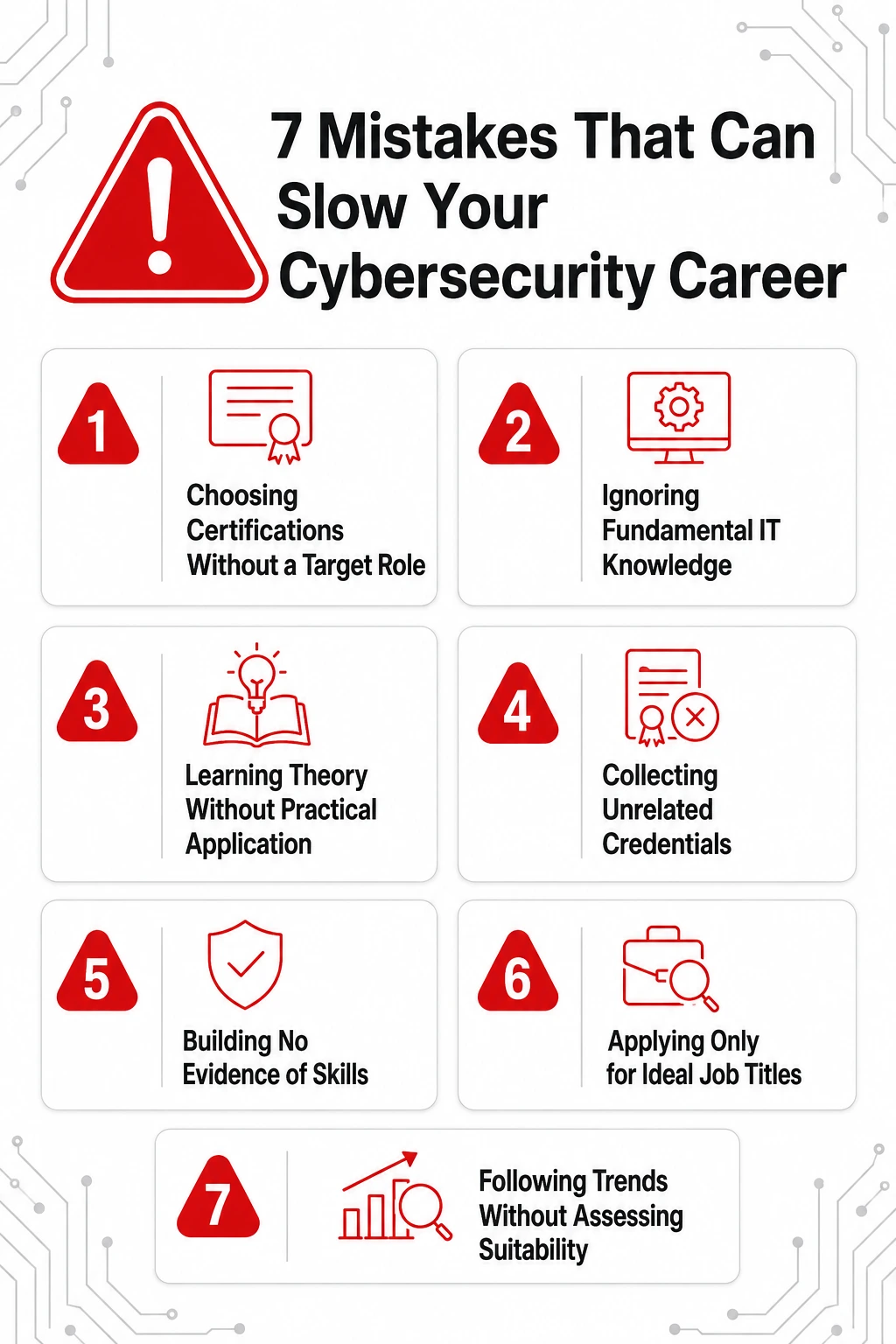
Instead of collecting several unrelated certifications, build a focused profile.
How to Build Your Information Security Career Step by Step
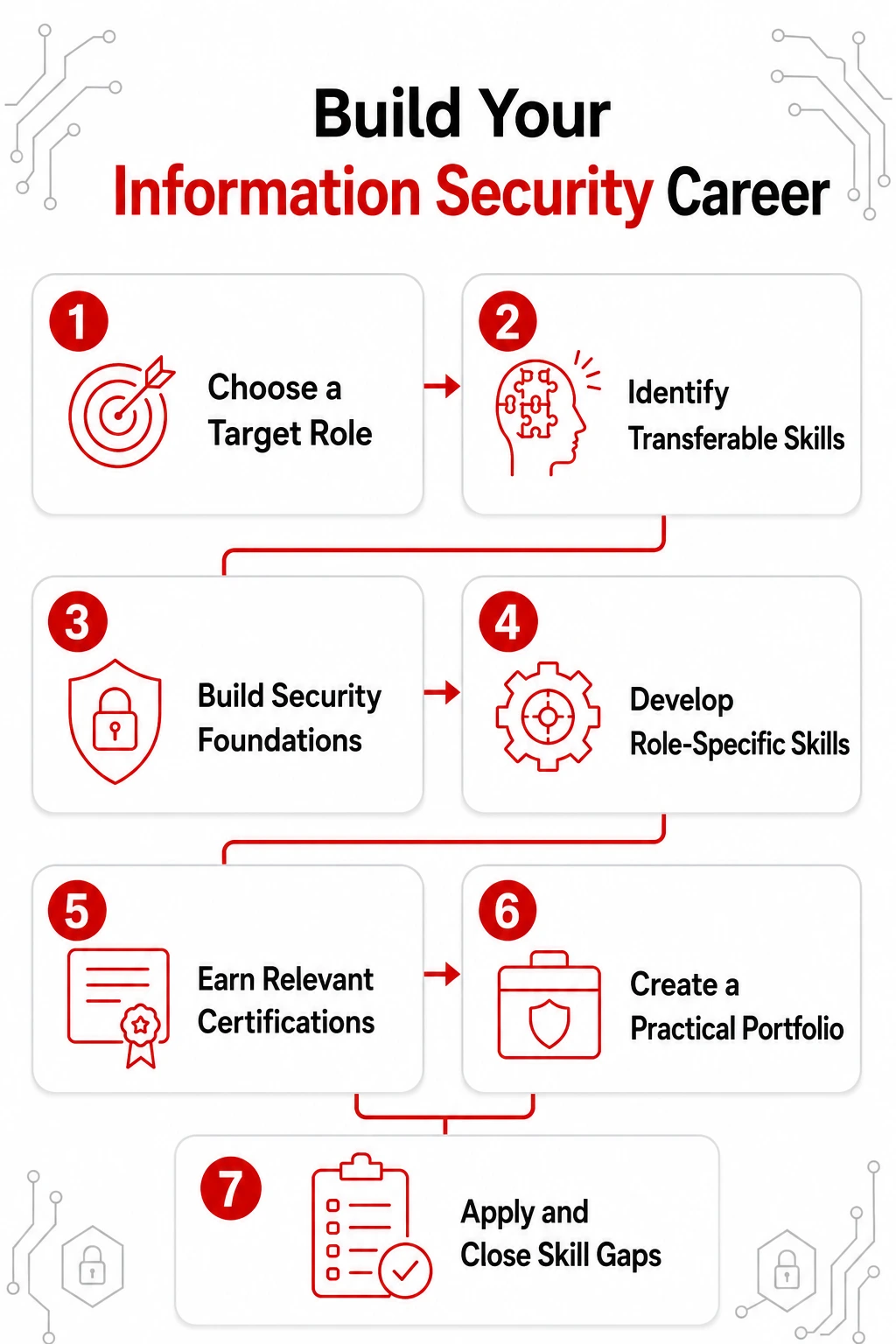
1. Choose a Target Role
Start with a specific role, such as GRC Analyst, SOC Analyst, Privacy Analyst, Penetration Tester, Cloud Security Analyst, or AI Governance Analyst. A clear target helps you prioritize the right skills and certifications.
2. Evaluate Your Transferable Experience
Identify knowledge from your current background that supports your chosen path. Experience in IT, auditing, compliance, law, cloud, development, or operations can provide a valuable starting point.
3. Build Essential Foundations
Develop a basic understanding of networks, operating systems, identities, cloud services, data, vulnerabilities, risks, and security controls before moving into a specialization.
4. Develop Role-Specific Skills
Focus on the practical tasks performed in your target role. This may include investigating alerts, conducting risk assessments, testing applications, reviewing cloud controls, or completing privacy impact assessments.
5. Select Relevant Certifications
Choose certifications that match your current level and career objective. Review the syllabus, prerequisites, and job relevance before committing to a program.
6. Create Evidence of Your Skills
Build a focused portfolio containing relevant labs, projects, reports, policies, scripts, playbooks, assessments, or architecture diagrams that demonstrate your practical capability.
7. Apply and Close Skill Gaps
Review job descriptions, apply for suitable entry points, and identify recurring skill gaps. Use interview feedback and market requirements to continuously refine your learning plan.
Conclusion
Building a successful information security career begins with choosing a path that aligns with your interests, existing experience, and long-term goals. Once you have identified the right direction, focus on developing practical, role-specific capabilities alongside relevant knowledge and certifications.
Progress steadily through the foundational, professional, and expert stages according to your competence and experience. A focused learning path, supported by hands-on practice and clear evidence of your skills, will take you further than collecting unrelated certifications without a defined career objective.
How InfosecTrain Can Support Your Career Roadmap
InfosecTrain provides certification-oriented, hands-on learning across GRC, cybersecurity, AI, offensive security, defensive security, cloud security, and data privacy. Learners can progress from foundational programs to role-based practical training in areas such as SOC operations, GRC implementation, red-team operations, security architecture, AI security engineering, AI governance, threat hunting, DFIR, cloud security, and Data Protection Officer responsibilities.
Select the appropriate program based on your current experience and target role, not simply the most advanced certification available.
Frequently Asked Questions
Which information security career path is best for beginners?
The right path depends on your interests and background. Technical learners may prefer offensive or defensive security, while those interested in risk, regulations, and business processes may choose GRC or data privacy.
Can I enter information security without an IT background?
Yes. Professionals from legal, audit, compliance, finance, and operations can transition into information security. However, basic knowledge of networks, systems, cloud services, threats, and security controls is valuable.
Which cybersecurity certification should I pursue first?
Choose a certification that matches your target role and current experience. Review its syllabus, prerequisites, and career relevance rather than selecting one solely based on popularity.
Are cybersecurity certifications enough to become job-ready?
No. Certifications should be supported by practical skills, projects, problem-solving ability, communication, and evidence such as reports, labs, scripts, policies, or architecture diagrams.
Can I switch between information security career paths?
Yes. Cybersecurity domains often overlap, allowing professionals to transition between areas such as SOC, cloud security, GRC, AI governance, privacy, and security architecture.
How do I choose between technical and non-technical roles?
Choose based on the work you enjoy. Technical paths involve systems, tools, and investigations, while GRC and privacy focus more on risk, regulations, documentation, and stakeholder communication.
How long does it take to build an information security career?
There is no fixed timeline. It depends on your experience, target role, learning consistency, practical exposure, and ability to demonstrate job-relevant skills.