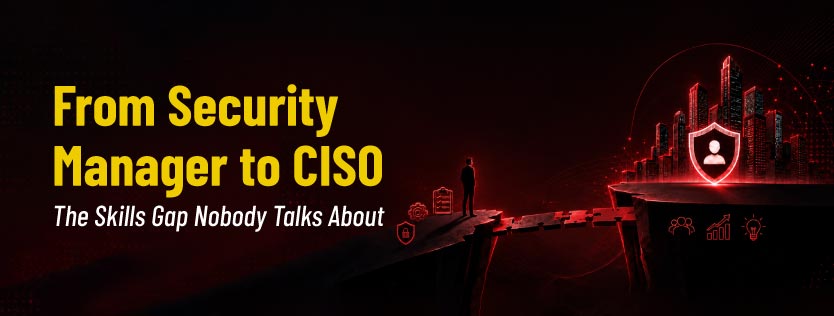
From Security Manager to CISO: The Skills Gap Nobody Talks About
Quick Insights:
The jump from Security Manager to CISO is not just a bigger promotion; it requires a complete mindset shift from managing technical security risk to managing overall business risk. Brilliant technical managers often struggle in the executive seat because boards care about revenue, downtime, and compliance penalties, not server patches or firewall configurations. To succeed, a CISO must stop being a technical gatekeeper who says no and become a business partner who translates technical flaws into financial impacts, aligns security investments with corporate growth, and speaks the language of the business.
Ask any ambitious Security Manager about their career goals, and they will likely give you a one-word answer: CISO.
On paper, the jump to Chief Information Security Officer feels like a natural promotion. You already run incident response, handle compliance, and lead talented engineers. You figure stepping up means managing a bigger team and a larger budget.
But when you actually land that executive seat, you hit an invisible wall.
Suddenly, the technical skills that made you a rockstar manager don’t carry the same weight in board meetings. You realize that becoming a CISO is not just a promotion; it is a complete career mutation. The biggest gap that sinks new CISOs is not a lack of technical depth; it is the sudden, sharp shift from managing security risk to managing business risk.
1. Translating Vulnerabilities into Volatilities
As a Security Manager, you focus on the technical ecosystem. You count unpatched servers, track mean time to remediate (MTTR), and monitor firewall logs. Success means keeping the dashboard green.
As a CISO, the board of directors does not care about your vulnerability scan scores. They care about financial volatility, operational downtime, and regulatory fines.
- The Gap: Failing to connect a technical flaw to a business consequence.
- The Pivot: Stop reporting that you have 30 critical vulnerabilities on the core database. Instead, explain that an unpatched vulnerability in our primary transaction database exposes us to a potential $2M regulatory fine and up to 12 hours of customer-facing downtime.
2. Moving from Budget Consumer to Revenue Protector
Security managers typically view budget as a resource to spend on tools and talent. You request $100k for a new endpoint detection platform because the old one lacks modern features.
Executives view the budget through the lens of return on investment (ROI) and resource allocation. If you position security strictly as a cost center, you will always fight an uphill battle for funding.
- The Gap: Treating cybersecurity as an isolated IT expense rather than an enterprise enabler.
- The Pivot: Align security with business growth. Show how robust data privacy controls help the sales team close enterprise deals faster, or how a secure cloud architecture accelerates the launch of a new digital product. You are not just buying software; you are protecting the company’s speed-to-market.
3. The Shift from No to How
Security operations thrive on guardrails. A Security Manager protects the perimeter by enforcing strict policies, blocking risky applications, and minimizing exceptions. You say no to protect the network.
A CISO cannot simply block business initiatives in the name of absolute security. If the company needs to adopt a new AI tool to stay competitive, a flat rejection from the CISO forces the business to bypass security entirely.
- The Gap: Acting as a gatekeeper instead of a business partner.
- The Pivot: Adopt a risk-acceptance framework. When a business unit introduces a risky objective, your job is to lay out the options: we can accept this risk, mitigate it by implementing these specific controls, or transfer it through insurance. Here are the costs and trade-offs for each. Let the business leaders own the risk decision while you provide the data.
4. Influencing Without Technical Authority
In the server room, your technical expertise grants you authority. People listen to you because you know how to design secure architectures.
In the C-suite, technical jargon isolates you. Peer executives (the CFO, CMO, and Chief Legal Officer) do not understand network layers, and they will tune out if you start talking about encryption protocols.
- The Gap: Relying on technical dominance instead of corporate diplomacy.
- The Pivot: Master the language of the business. Spend time with the CFO to understand the company’s financial goals. Sit with the legal team to understand upcoming compliance mandates. Your influence grows when peers realize you understand their pain points and design security strategies that help them succeed.
Conclusion
To move from security operations to business strategy, you have to change your mindset. You need to step away from technical firefighting and start viewing the company through the lens of growth, revenue, and resilience. The best CISOs don’t just protect the business; they help it grow.
If you are ready to make this leap, mastering corporate communication and business alignment is your next big step. To help you build these skills smoothly, the Practical CISO Training & Readiness Program with InfosecTrain offers hands-on, real-world training that gives you the confidence to lead in the boardroom.
Continue Your CISO Leadership Journey
Take your learning further with these expert guides covering CISO roles, executive responsibilities, and the skills needed to lead modern cybersecurity programs.
- vCISO vs. CISO
- CISO vs CTO vs CIO: Who Owns What in Enterprise Security
- Why Choose CISO Hands-On Training from InfosecTrain?

TRAINING CALENDAR of Upcoming Batches For CISO Training
| Start Date | End Date | Start - End Time | Batch Type | Training Mode | Batch Status | |
|---|---|---|---|---|---|---|
| 30-Jan-2027 | 21-Feb-2027 | 19:00 - 23:00 IST | Weekend | Online | [ Open ] |
Frequently Asked Questions
Why is moving from Security Manager to CISO a career mutation, not just a promotion?
A promotion means doing your old job on a bigger scale. Becoming a CISO requires a completely different skill set, shifting your focus entirely from technical tools and metrics to business strategy, ROI, and corporate diplomacy.
What is the biggest mistake a new CISO can make when presenting to the board?
Sharing raw technical data like vulnerability counts or patch percentages. The board will tune out. Instead, always translate technical flaws into business impacts, such as downtime, financial losses, or legal fines.
How should a CISO handle a request to use a risky, unvetted AI application?
Stop saying no as a gatekeeper. Instead, act as a business partner. Lay out a clear risk-acceptance framework with options to mitigate, transfer, or accept, and let the business leaders make an informed decision based on your data.
How can a CISO prove security is a revenue protector rather than just a cost center?
By tying security directly to business growth. Show how strong compliance helps the sales team close enterprise deals faster, or how secure architecture prevents costly delays during a new product launch.
What does it mean to influence without technical authority in the C-suite?
Your peers (the CFO, CMO, or Legal Counsel) do not care about encryption protocols. True influence comes from understanding their goals and pain points, then building a security strategy that helps them succeed.