What is Incident Management Training, Testing, and Evaluation?
Quick Insights:
Incident Management Training, Testing, and Evaluation (TT&E) is a continuous safety loop that transforms corporate panic into a structured defense. Organizations build baseline readiness through role-specific training, uncover hidden operational gaps through realistic simulations (such as tabletop and full-scale exercises), and analyze response speeds through deep-dive evaluations. This systematic loop constantly updates emergency playbooks to ensure the company stays resilient against real-world cyber threats.
Imagine a typical, busy morning at a local hospital. Suddenly, every computer screen goes black. A bright red warning pops up: Your files are locked. Pay a ransom to get them back.
Down in the IT room, chaos breaks out. A newly hired IT analyst has never reviewed the incident response plan, the PR team doesn’t know who should speak to the news, and no one knows how to switch patient records to the safe backup system. While the team stands around arguing about what to do first, important medical treatments are delayed, and patients lose trust.
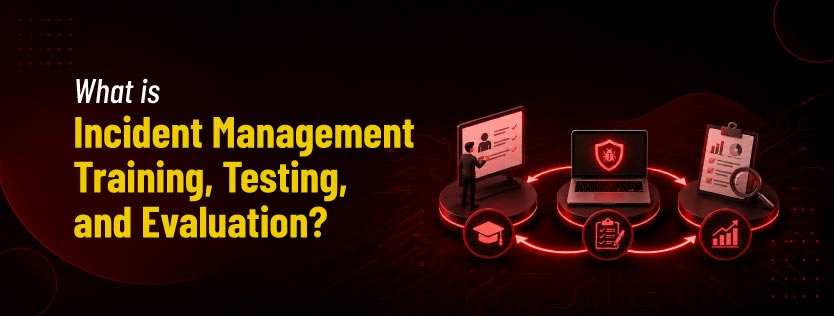
This scary situation shows exactly why a business cannot wait until a real emergency to develop its defense plan. To stay prepared, companies use a safety system called Incident Management Training, Testing, and Evaluation (TT&E). This is a regular practice program where teams learn their crisis roles, test their skills with realistic fake attacks, and fix their mistakes before a real hacker shows up. Let’s look at how these three steps work together to keep a company safe.
What is Incident Management Training?
Incident Management Training is the process of teaching employees the specific skills, processes, and security protocols needed to recognize and respond to emergencies, security incidents, operational disruptions, or cyberattacks. It ensures that everyone, from IT professionals to executive leaders, clearly understands their designated roles, communication channels, and the responsibilities outlined in the company’s official incident response plan before a real crisis occurs.
Types of Incident Management Training
- Role-Based & Awareness Training: Educates different organizational tiers on their specific duties. Frontline employees learn to spot and report anomalies, technical responders master specialized containment tools, and executives practice high-stakes crisis communications and legal compliance.
- Playbook Walkthroughs & Orientations: Group sessions where teams step-by-step review specific response plans, such as ransomware or data exfiltration protocols. This ensures all stakeholders understand the exact sequence of operations, hand-off points, and escalation paths before a crisis occurs.
- Technical Skill-Building (Lab-Based): Hands-on training where security analysts practice defensive techniques in isolated environments. Responders use these sessions to sharpen their skills in malware analysis, network forensics, log review, and system restoration.
What is Incident Management Testing?
Incident Management Testing is the active practice of running simulated crisis scenarios to test whether an organization’s defense plans work in real-world conditions. By using exercises such as discussion-based tabletop scenarios or live-action security simulations, companies can safely stress-test their workflows, tools, and response times to identify hidden flaws and communication bottlenecks without risking actual business operations.
Common Incident Management Testing Methods
- Tabletop Exercises (TTX): Discussion-based sessions where key team members gather in a conference room to talk through a hypothetical emergency scenario. A facilitator guides the group through the crisis timeline, forcing participants to explain how they would apply existing playbooks to resolve the issue.
- Functional Exercises: Practical, live-action drills that test specific technical capabilities or communication channels without disrupting actual business operations. For example, the security team might practice isolating a simulated infected server, or the network team might test switching over to a backup data center.
- Full-Scale Exercises (Red vs. Blue Team): Large-scale, immersive simulations where an internal or external attack group (the Red Team) launches realistic, controlled attack simulations against the organization’s defenses. The internal security team (the Blue Team) must detect, contain, and remediate the live threat in real time.
What is Incident Management Evaluation?
Incident Management Evaluation is the formal analysis of how well a team and its technical systems performed during a test or a real security event. Through structured after-action reviews, organizations measure key metrics such as discovery and response speeds, document exactly what went right or wrong, and use those lessons to update their security playbooks and training programs for the future.
Key Components of Incident Evaluation
- After-Action Review (AAR): A debriefing meeting held immediately following an exercise or real-world incident. Team members openly discuss what went right, what went wrong, and where the response ran into unexpected bottlenecks or technical friction.
- Quantitative Metrics Analysis: The evaluation of hard data points to measure response efficiency. Organizations track specific timestamps to calculate key metrics, including Mean Time to Detect (MTTD), Mean Time to Acknowledge (MTTA), and Mean Time to Respond/Contain (MTTR).
- Corrective Action Plan (CAP): A formal tracking document that converts lessons learned into actionable assignments. The CAP assigns specific playbook updates, tool reconfigurations, or targeted training sessions to designated owners with strict deadlines to prevent future response failures.
Conclusion
In the end, incident management is not a one-time setup; it is a muscle that companies must constantly exercise. By integrating training, testing, and evaluation into a routine, businesses can transform a chaotic situation, such as the hospital nightmare, into a calm, organized response that protects both data and reputation.
For professionals who want to lead these defensive strategies, mastering this balance is a core part of the CISM Certification Course with InfosecTrain, which equips you with the expert governance and risk management skills needed to build resilient enterprise security programs.

TRAINING CALENDAR of Upcoming Batches For CISM Training
| Start Date | End Date | Start - End Time | Batch Type | Training Mode | Batch Status | |
|---|---|---|---|---|---|---|
| 10-Oct-2026 | 01-Nov-2026 | 19:00 - 23:00 IST | Weekend | Online | [ Open ] | |
| 14-Nov-2026 | 06-Dec-2026 | 09:00 - 13:00 IST | Weekend | Online | [ Open ] | |
| 05-Dec-2026 | 10-Jan-2027 | 09:00 - 13:00 IST | Weekend | Online | [ Open ] | |
| 19-Dec-2026 | 17-Jan-2027 | 19:00 - 23:00 IST | Weekend | Online | [ Open ] | |
| 23-Jan-2027 | 14-Feb-2027 | 09:00 - 13:00 IST | Weekend | Online | [ Open ] | |
| 13-Feb-2027 | 07-Mar-2027 | 19:00 - 23:00 IST | Weekend | Online | [ Open ] | |
| 20-Mar-2027 | 11-Apr-2027 | 09:00 - 13:00 IST | Weekend | Online | [ Open ] |
Frequently Asked Questions
What is the main goal of Incident Management Training?
The primary goal is to build baseline readiness so employees know exactly what to do before a crisis hits. It ensures everyone understands their specific roles and communication plans, eliminating guesswork during a real emergency.
How do tabletop exercises differ from full-scale exercises?
Tabletop Exercises: Low-stress, discussion-based meetings where teams verbally walk through a hypothetical crisis scenario in a conference room. Full-Scale Exercises: High-intensity, realistic drills where an offensive team launches a live, unannounced mock attack to test defenses in real time.
What key metrics are analyzed during the Evaluation phase?
Organizations track operational timestamps to calculate response speeds, focusing on: Mean Time to Detect (MTTD): How fast a threat is discovered. Mean Time to Acknowledge (MTTA): How quickly the investigation begins. Mean Time to Respond/Contain (MTTR): How fast the threat is stopped.
What is a Corrective Action Plan (CAP)?
A CAP is a formal to-do list that turns lessons learned from a drill or incident into real fixes. It assigns tasks, such as updating a playbook or fixing a software tool, to specific people with strict completion deadlines.
Why is the Evaluation phase considered a continuous cycle?
This phase directly resets the loop. The mistakes and metrics uncovered during evaluation are used immediately to improve the next round of employee training and playbook updates, creating constant security upgrades.