What are the Key Component of AI Governance?
Quick Insights:
AI governance helps organizations use AI responsibly, safely, and transparently. It brings together ethics, accountability, data governance, risk management, compliance, monitoring, and technical controls so AI systems do not operate without oversight. A strong AI governance framework ensures that AI decisions are fair, explainable, secure, and aligned with business goals. It also enables organizations to minimize bias, safeguard data, stay aligned with regulatory requirements, and earn confidence from customers, employees, and regulators.
Artificial intelligence is no longer just an idea; it is already here, actively reshaping how businesses operate every day. Recent studies show an overwhelming surge in AI adoption across industries, yet a troubling oversight gap. In fact, 70% of businesses consider AI critical to their strategy, but less than half have established governance policies to manage it. This disconnect creates serious risks: AI systems can amplify biases, produce inexplicable decisions, or expose sensitive data if left unchecked. Poorly governed AI can lead to bias and discrimination, opaque “black box” decisions, regulatory penalties, and a major erosion of trust—no wonder a majority of organizations are now scrambling to put formal AI governance in place. A 2025 survey found 77% of companies are working on AI governance programs (rising to ~90% among those already using AI).
In essence, AI governance is like the operating system for responsible AI: it defines who is accountable for AI outcomes, how models are built and monitored, and what safeguards exist to ensure AI serves business goals ethically. It is like the constitution for your company’s AI-powered future, aligning AI development with your values, legal requirements, and stakeholder expectations. An effective AI governance framework is not just corporate red tape; it is the blueprint that keeps innovation on track and risks under control.
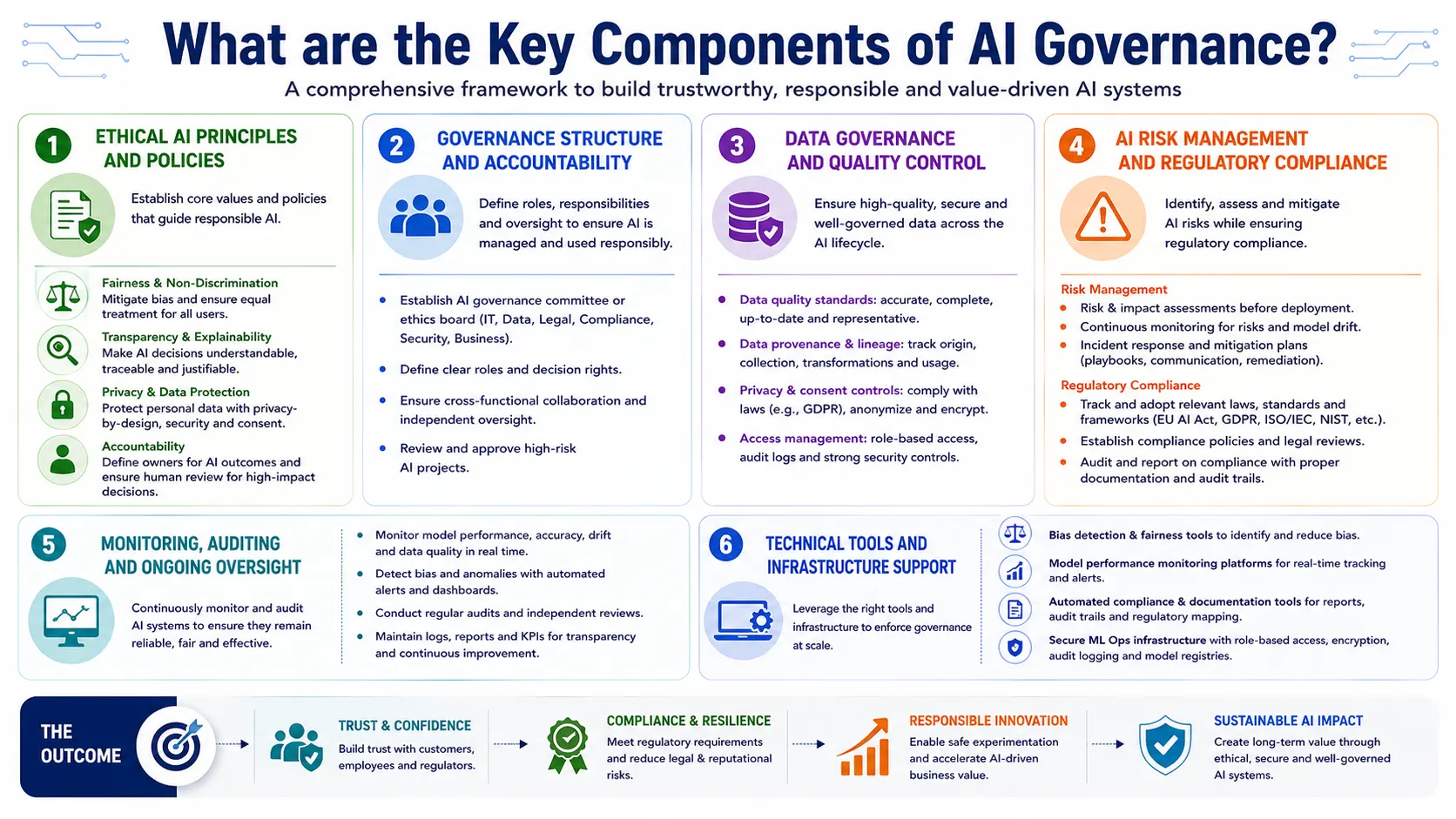
Ethical AI Principles and Policies (Fairness, Transparency, Privacy)
At the foundation of any AI governance program is a set of clear ethical guidelines and policies. These articulate the principles that ensure AI is developed and used responsibly. According to industry experts, every governance framework should start with core values like fairness, transparency, accountability, and privacy. In practice, this means establishing an AI Ethics Charter or similar policy that codifies these principles into actionable rules.
- Fairness and Non-Discrimination: AI systems must be designed to mitigate bias and treat all users equitably. This involves careful testing of algorithms to prevent discriminatory outcomes in areas like hiring, lending, or medical diagnosis.
- Transparency and Explainability: AI should never operate as a mysterious black box. Users and stakeholders have a right to understand how important AI decisions are made. This component calls for explainable AI techniques and documentation so that decisions can be traced and justified.
- Privacy and Data Protection: Responsible AI governance includes strict policies to safeguard personal data and sensitive information. This means ensuring AI systems comply with data protection laws and handle user data securely and with consent. Privacy-by-design, encryption, and access controls are typical measures here.
- Accountability: Clear accountability goes hand-in-hand with ethical AI. Organizations need to define who is responsible for the outcomes of AI systems. If an AI model makes a flawed decision, there should be a designated owner who will investigate and address the issue. Often, this principle is enforced by requiring human review for high-impact AI decisions (a “human-in-the-loop” for critical cases).
Key Components of AI Governance
1. Governance Structure and Accountability
Having great AI policies on paper is not enough; you need the right people and structures to enforce them. A key component of AI governance is setting up a structured framework where roles and responsibilities are clearly defined. In practice, this often means forming cross-functional governance bodies and assigning accountable owners for AI activities.
Many organizations create an AI governance committee or ethics board, a team comprising leaders from IT, data science, compliance, legal, security, and business units. This committee is charged with overseeing AI strategy and reviewing high-risk AI projects. Such a group ensures that no single department operates AI in a silo without oversight.
2. Data Governance and Quality Control
AI is only as good as the data that fuels it. Thus, robust data governance is a non-negotiable component of AI governance. This element emphasizes maintaining data quality, ensuring its integrity, and protecting its security across the entire AI lifecycle. If your data is garbage, your AI’s outputs will be garbage, or worse, biased and unlawful. Key elements of data governance for AI include:
- Data quality standards: Establishing criteria to ensure datasets are accurate, complete, up-to-date, and representative of the populations they affect. For example, if developing an AI model for loan approvals, your training data should reflect diverse demographics to prevent skewed results.
- Data provenance and lineage: Tracking where data comes from, how it was collected or generated, and any transformations it undergoes. Organizations must know the origin and handling of the data fed into AI models, which helps in verifying reliability and addressing any intellectual property or privacy concerns.
- Privacy and consent controls: Integrating privacy considerations into data practices. This involves obtaining proper consent for data use, anonymizing or encrypting personal data, and complying with regulations like GDPR. Data used for AI should be governed by the same (or higher) privacy standards as any other sensitive data.
- Access management: Ensuring that only authorized individuals or systems can access sensitive datasets or AI models. Role-based access controls, audit logs, and cybersecurity measures protect against data leaks or unauthorized model tampering.
3. AI Risk Management and Regulatory Compliance
Managing the risks associated with AI and complying with an evolving regulatory landscape are other pillars of AI governance. As AI systems move from pilot projects to core business operations, they introduce a spectrum of new risks: biased algorithms can damage your reputation, model errors can lead to legal liabilities, and unsecured AI can become a cybersecurity nightmare. A governance program must proactively identify, assess, and mitigate these AI-specific risks.
A best practice is to implement a structured AI risk management process. This often parallels traditional risk management (such as cybersecurity or operational risk) but is tailored to AI. Key steps include:
- Risk and impact assessments: Conducting thorough assessments before deploying AI. For example, perform an AI Impact Assessment or algorithmic bias audit to catch ethical, security, or legal issues early. Similar to how privacy teams use DPIAs (Data Protection Impact Assessments), AI teams can evaluate potential harms (e.g., will this model unfairly disadvantage a group?) and plan controls to address them.
- Continuous monitoring for risk: In risk terms, governance requires setting up triggers and KPIs to detect when an AI system starts drifting off course, whether it is accuracy dropping, bias creeping in, or unusual outputs indicating something’s wrong. By keeping an eye on these signals in real time, organizations can respond before small issues become big failures.
- Incident response and mitigation plans: Despite best efforts, things can go awry. A governance framework should outline how the organization will respond if an AI system causes an incident, say, a self-driving software glitch or an AI chatbot going rogue. Having a playbook for AI incidents (including communication plans, shutdown protocols, and remediation steps) is increasingly considered a governance must-have.
On the compliance side, AI governance needs to align with a patchwork of emerging laws, regulations, and ethical standards worldwide. The global regulatory landscape for AI is rapidly evolving, and non-compliance can be costly. For example, the EU AI Act will impose a risk-based classification on AI systems and threaten fines of up to 7% of global revenue for serious violations. Other jurisdictions have their own rules (e.g., NYC’s Local Law 144 on AI in hiring, sector-specific guidance like the FDA for AI in medical devices, etc.). Thus, a governance program should:
- Track and incorporate relevant regulations and standards: Staying current with laws like the EU AI Act, GDPR, California’s emerging AI regulations, as well as industry standards (ISO/IEC AI management standards, NIST AI Risk Management Framework, etc.). Many organizations build compliance checklists to ensure each AI project is evaluated against these requirements.
- Establish policies for regulatory compliance: For example, ensure that high-risk AI systems have documentation to meet transparency requirements, or that models making consumer decisions have an appeals process as required by law. Integrating legal review into the AI development lifecycle is wise.
- Audit and report on compliance: Regularly audit AI systems for adherence to both internal policies and external regulations. Maintain records (audit trails, decision logs, model version histories) that would satisfy an inquiry from regulators or an internal audit. This level of documentation not only keeps you compliant but also builds trust with customers and stakeholders.
4. Monitoring, Auditing, and Ongoing Oversight
AI governance does not end once a model is launched. In fact, continuous monitoring and auditing of AI systems is critical to ensure they remain trustworthy over time. Unlike traditional software that behaves consistently, AI systems can evolve unpredictably as data inputs change or as they learn. Governance programs must therefore include robust mechanisms for ongoing oversight.
Automated monitoring is often deployed to keep tabs on model performance and behavior. This might include tracking prediction accuracy, watching for data drift or concept drift (when the statistical properties of inputs shift), and scanning for outputs that indicate bias or errors. For example, a bank using an AI credit scoring model should continuously monitor approval rates across different demographic groups; if the model starts to disadvantage a group unfairly, the monitoring system should flag it. Many organizations integrate such monitors into their MLOps pipelines, with alerts that notify Data Scientists or Risk Officers of anomalies.
5. Technical Tools and Infrastructure Support
Last but not least, effective AI governance is bolstered by the right technical tools and infrastructure. As AI deployments grow, manual oversight alone will not scale; organizations need to leverage technology to enforce governance at scale. In fact, one of the core building blocks of AI governance is having technical enablers in place to support the policies and processes.
- Bias detection and fairness tools: Software that can scan AI models and their outputs for signs of bias or unfair treatment of groups. These might provide biased metrics or visualizations to help teams correct skewed models. For example, some tools can simulate model decisions for different demographic profiles to ensure consistent outcomes.
- Model performance monitoring platforms: These tools track metrics like accuracy, error rates, drift, and data quality in real-time for deployed models. They often integrate with dashboards and alerting systems, so stakeholders can get a quick health check on all AI systems in production.
- Automated compliance and documentation solutions: Given the heavy documentation burden in governance, tools that automatically generate compliance reports or maintain audit trails are invaluable. Some platforms log every model prediction and data change, creating an immutable record that auditors (or regulators) can review. Others map your AI models to regulatory requirements, flagging any gaps.
- Secure ML Ops infrastructure: Governance-minded organizations invest in ML platforms that have built-in security and access controls. For example, using secure cloud environments with role-based permissions and audit logging ensures only authorized staff can deploy or modify models. Likewise, tools like model registries help track model versions and ensure only approved models move to production.
Certified AI Governance Specialist (CAIGS) Training with InfosecTrain
AI governance is multi-faceted, and its components are deeply interrelated. An organization can not pick and choose which pieces to implement; true success comes from weaving all these elements into a cohesive program. All components must work in concert to create an effective system of AI governance.
In practice, this means your policies must be supported by training and culture, your risk assessments must tie into technical controls, your data governance must feed into fairness outcomes, and so on. It is a big effort, but the payoff is worth it. When done right, AI governance enables organizations to innovate with confidence, using AI to drive value while keeping risks in check. It builds a foundation of trust with customers, employees, and regulators by assuring them that AI systems are fair, transparent, safe, and accountable. Companies that master AI governance not only avoid pitfalls and compliance issues but can also differentiate themselves in a market that is increasingly sensitive to AI risks.
InfosecTrain’s Certified AI Governance Specialist (CAIGS) Training is designed to operationalize this very principle, helping professionals move from fragmented efforts to a fully integrated AI governance framework.
If you are ready to move beyond siloed AI initiatives and build a robust, end-to-end AI governance program, it’s time to upskill with InfosecTrain.
Join the Certified AI Governance Specialist (CAIGS) Training and learn how to design, implement, and manage AI governance frameworks that are compliant, ethical, and future-ready.

TRAINING CALENDAR of Upcoming Batches For CAIGS
| Start Date | End Date | Start - End Time | Batch Type | Training Mode | Batch Status | |
|---|---|---|---|---|---|---|
| 09-Nov-2026 | 17-Dec-2026 | 19:30 - 22:00 IST | Weekday | Online | [ Open ] | |
| 09-Nov-2026 | 17-Dec-2026 | 19:30 - 22:00 IST | Weekday | Online | [ Open ] | |
| 01-Feb-2027 | 04-Mar-2027 | 19:30 - 22:00 IST | Weekday | Online | [ Open ] | |
| 01-Feb-2027 | 04-Mar-2027 | 19:30 - 22:00 IST | Weekday | Online | [ Open ] |
Frequently Asked Questions
What are the key pillars of AI governance?
The key pillars of AI governance are ethical AI principles, accountability, data governance, AI risk management, regulatory compliance, continuous monitoring, and technical controls.
What are the 7 components of AI governance?
The 7 common components are AI policies, governance structure, data governance, risk management, compliance, monitoring and auditing, and AI tools/infrastructure.
What are the key components of governance?
The key components of governance include policies, roles and responsibilities, accountability, risk management, compliance, monitoring, reporting, and continuous improvement.
What are the 7 Sutras of AI governance?
The 7 Sutras of AI governance can be understood as fairness, transparency, accountability, privacy, security, human oversight, and continuous monitoring.
Why is AI governance important?
AI governance is important because it helps organizations manage AI risks, prevent bias, protect sensitive data, meet legal requirements, and build trustworthy AI systems.
