How are High-Level Design (HLD) and Low-Level Design (LLD) Used in Secure Architecture?
Quick Insights:
Security fails when high-level strategy does not align with low-level code. To secure a system from day one, you must bridge two phases: High-Level Design (HLD), which maps the global boundaries, trust zones, and security policies (the strategy), and Low-Level Design (LLD), which details the specific code, encryption libraries, and configurations to enforce them (the tactics). Combining both ensures abstract compliance becomes a resilient, real-world defense.
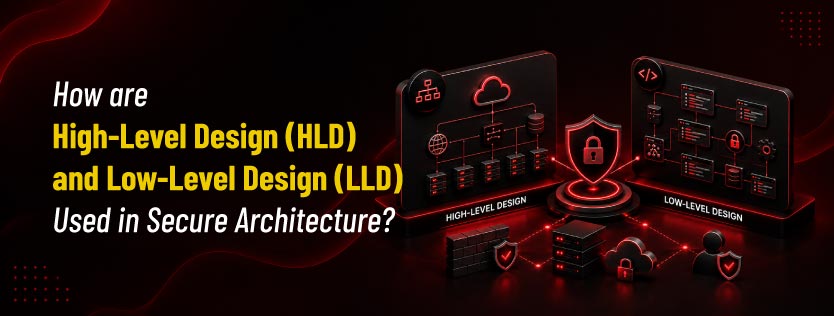
Most major security breaches trace back to a single gap: the disconnect between an architect’s high-level strategy and a developer’s low-level code. You cannot bolt security onto a finished system; you must bake it in from day one using a two-part design process:
- High-Level Design (HLD) acts as the strategic map, establishing the overall boundaries, trust zones, and global security policies.
- Low-Level Design (LLD) acts as the tactical blueprint, detailing the specific configurations, code blocks, and cryptographic choices that enforce those policies.
Bridging this gap is the only way to turn abstract security compliance into an uncompromised, active defense.
What is High-Level Design (HLD)?
High-Level Design (HLD) is the conceptual blueprint of a system. It defines the overall architecture, system components, database choices, external integrations, and the pathways through which data flows. Written in plain, non-academic language, HLD answers the question: What are the major pieces of this system, and how do they talk to each other?
Role of HLD in Secure Architecture
In secure architecture, HLD acts as the strategic shield. It establishes the global security policies and logical boundaries before anyone writes a single line of code.
- Threat Modeling: Architects use HLD to identify trust boundaries. At these transition points, data moves from an untrusted zone (such as the public internet) to a trusted zone (such as a private database). Teams apply frameworks like STRIDE at this stage to identify architectural flaws early.
- Defining Trust Zones: HLD maps out where to place firewalls, API gateways, and load balancers, and isolates sensitive workloads into private subnets or demilitarized zones (DMZs).
- Establishing Global Security Standards: HLD dictates the identity providers (IdP) for Single Sign-On (SSO), mandates global encryption standards (e.g., TLS 1.3), and defines central logging targets (e.g., SIEM integration) for compliance and auditing.
What is Low-Level Design (LLD)?
Low-Level Design (LLD) is the tactical, granular specification of a system. It translates the HLD’s conceptual blocks into actual database schemas, class diagrams, API endpoints, error-handling routines, and exact algorithms. LLD answers the question: How do we build and configure each component to work correctly?
Role of LLD in Secure Architecture
In secure architecture, LLD is the tactical armor. It translates broad security mandates into precise, actionable instructions for developers to prevent common software vulnerabilities.
- Granular Cryptographic Implementation: While HLD mandates encryption at rest, LLD specifies the exact cryptographic library, the algorithm (e.g., AES-256-GCM), and the precise Key Management Service (KMS) integration and rotation policies.
- Input Validation & Output Encoding: LLD mitigates risks such as SQL injection, Cross-Site Scripting (XSS), and command injection by specifying strict validation rules, regular expressions, and parameterized query requirements for every API input.
- Defensive Access Controls: LLD maps out the specific database queries, Access Control Lists (ACLs), and JSON Web Token (JWT) validation logic required to enforce Role-Based (RBAC) or Attribute-Based Access Control (ABAC).
- Secure Logging & Exception Handling: LLD defines how the application handles errors without leaking sensitive system data or personally identifiable information (PII) into the application logs.
Best Practices for Using HLD and LLD in Secure Architecture
- Shift Security Left During HLD
Run threat modeling (like STRIDE) on your HLD whiteboard before writing code. Catching architectural flaws early is infinitely cheaper than refactoring a live system later.
- Link HLD Policies Directly to LLD Code
Ensure every strategic requirement in your HLD maps to an exact implementation in your LLD. If your HLD mandates PCI DSS compliance, your LLD must detail the specific encryption keys, hashing algorithms, and code blocks that enforce compliance.
- Deploy Designs Using Infrastructure as Code (IaC)
Do not let secure designs sit dead on a wiki. Translate your HLD network zones (VPCs, subnets) and LLD access rules (firewalls, IAM) into Terraform or CloudFormation templates to ensure deployments match your blueprints.
- Detail Fail-Secure Rules in LLD
Design your code to default to a secure state in the event of unexpected errors. If a database connection drops or a token is malformed, the system must deny access rather than bypass security or leak sensitive logs.
- Keep Blueprints Synced with Code
Treat every API change, database update, or library swap as a trigger to update your LLD. Integrate design reviews into your CI/CD pipeline to catch and fix drift between your active code and your master blueprint.
Conclusion
Security succeeds only when you build an unbroken line of defense from system architecture to raw code. Connecting High-Level Design (HLD) trust boundaries with Low-Level Design (LLD) technical controls bridges the gap between passive policy and active protection. When both designs align, compliance becomes a resilient, real-world defense.
To build the practical skills needed to design and audit secure architectures, explore the Security Architecture hands on training at InfosecTrain.

TRAINING CALENDAR of Upcoming Batches For Security Architecture Training
| Start Date | End Date | Start - End Time | Batch Type | Training Mode | Batch Status | |
|---|---|---|---|---|---|---|
| 14-Nov-2026 | 06-Dec-2026 | 09:00 - 13:00 IST | Weekend | Online | [ Open ] | |
| 14-Nov-2026 | 06-Dec-2026 | 09:00 - 13:00 IST | Weekend | Online | [ Open ] |
Frequently Asked Questions
What is the main difference between HLD and LLD in security?
HLD is the strategic map that defines which security boundaries and trust zones exist. LLD is the tactical blueprint detailing how to enforce them through specific code, encryption libraries, and configurations.
Why is threat modeling done during HLD?
To catch major structural flaws, such as missing trust boundaries, before writing code. Fixing architectural weaknesses on a whiteboard is much cheaper than refactoring a built system.
How does LLD prevent software vulnerabilities?
By detailing precise input validation rules, output encoding, and parameterized database queries for every API endpoint to block threats like SQL injection.
What does fail-secure mean in LLD?
If an error occurs (such as a database dropout or a malformed token), the system defaults to denying access rather than bypassing security checks or leaking system details in logs.
How do you keep secure designs from becoming outdated?
Treat every API change or database update as a trigger to update your LLD, and integrate design reviews directly into your CI/CD pipeline.