CIPP/E Domain 2: European Data Protection Law and Regulation
Quick Insights:
The General Data Protection Regulation establishes the foundation of European data protection by defining what constitutes personal data and setting strict principles for lawful processing. It distinguishes between personal, sensitive, pseudonymous, and anonymous data, each with different compliance requirements. Core principles such as transparency, purpose limitation, data minimization, and security ensure responsible data handling in modern environments driven by AI, cloud computing, and cross-border data flows. Mastering these concepts is essential for understanding GDPR compliance and applying data protection effectively in real-world scenarios.
In today’s data-driven world, personal data powers innovation, analytics, artificial intelligence, cloud services, and global commerce. But with this opportunity comes responsibility. Organizations must understand what qualifies as personal data, how sensitive and pseudonymous data should be treated, and which GDPR principles govern lawful processing.

The General Data Protection Regulation (GDPR) modernized Europe’s data protection framework by replacing the 1995 Data Protection Directive. It strengthened individual rights and clarified responsibilities in a world defined by cloud computing, outsourcing, automation, AI systems, and cross-border data flows.
To build a strong foundation, start with our guide on CIPP/E Domain 1: Introduction to European Data Protection, which explains the evolution and principles behind European privacy laws.
This article explores the core concepts of CIPP/E Domain II, including personal data, special categories of data, pseudonymization, anonymization, and the key principles that govern lawful processing under the GDPR.
Personal Data
The GDPR defines personal data as any information related to an identified or identifiable individual. This includes:
- Names
- Identification numbers
- Location data
- Online identifiers (like IP addresses or cookies)
- Data connected to someone’s physical, genetic, mental, economic, cultural, or social identity
The EU’s Article 29 Working Party (now the European Data Protection Board – EDPB) outlined four key elements:
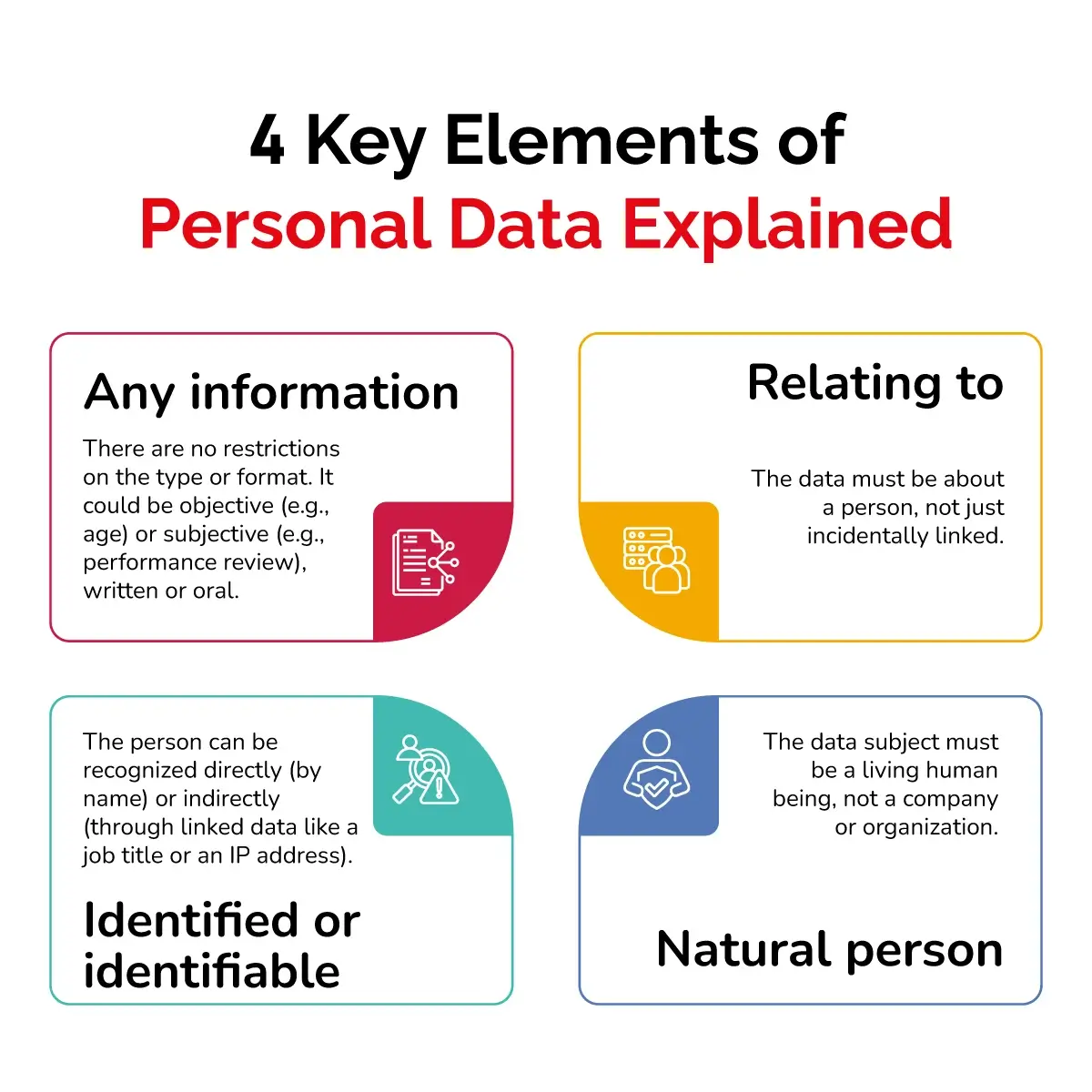
Dynamic identifiers, such as IP addresses, can be personal data under certain conditions, as ruled in Breyer v. Germany, where the potential to identify someone through additional ISP data was key.
Sensitive Personal Data (Special Categories of Personal Data)
Under the GDPR, some personal data is considered especially sensitive because its misuse could seriously impact an individual’s privacy, dignity, or rights. These are known as special categories of personal data and include information revealing:
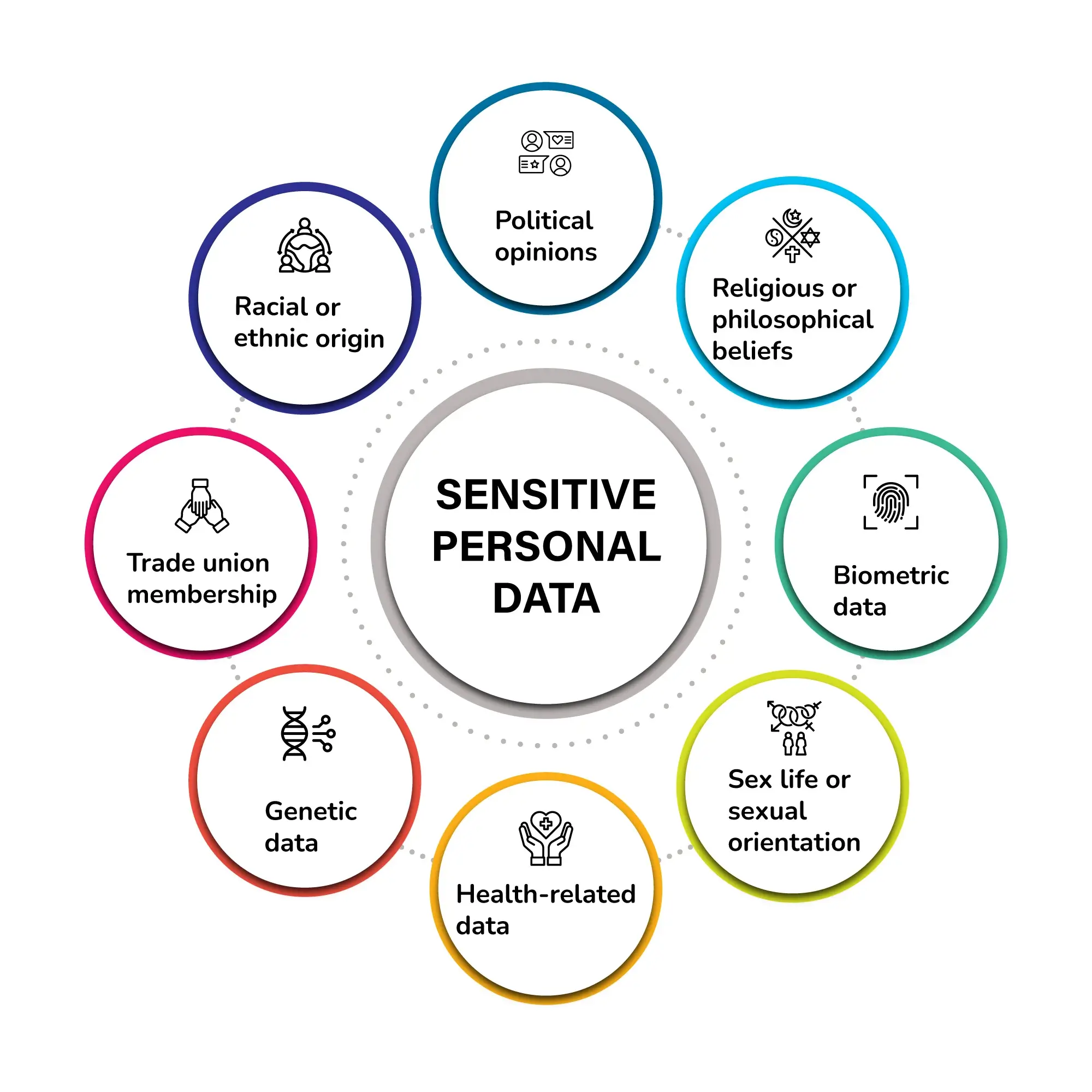
These categories are more strictly protected because they can be used to discriminate, stigmatize, or harm individuals if leaked or misused.
Health data is broadly defined and covers any information related to physical or mental health, test results, medical history, or care services.
Genetic data refers to inherited or acquired characteristics identified via biological samples.
Photographs are only considered biometric data if processed with technology (e.g., facial recognition software) for unique identification. However, they may still indirectly reveal sensitive traits (e.g., health or ethnicity).
Pseudonymous and Anonymous Data
Pseudonymous data is personal data that has been modified so that identifying an individual requires separate, additional information. Example: Replacing names with unique codes in a database, e.g., “User123” instead of “John Smith.”
Key points:
- The individual can still be identified if additional information (like a key or lookup table) is available.
- Pseudonymization is a security measure, not a method of anonymization.
- Under the GDPR, pseudonymous data is still personal data and subject to data protection rules.
Pseudonymization remains an important GDPR safeguard, especially for analytics, research, AI development, and internal reporting. However, organizations must not treat pseudonymized data as anonymous data. The EDPB’s 2025 guidance confirms that pseudonymized data remains personal data where re-identification is possible using additional information. This means GDPR obligations such as lawful basis, security, transparency, and data subject rights may still apply.
Anonymous data is data that cannot be used to identify an individual, directly or indirectly, even when combined with other information. Example: Aggregated statistics showing website visits per region without any link to individual users.
Key points:
- Anonymized data is not subject to the GDPR’s provisions.
- Once data is truly anonymized, it is no longer personal data.
- Anonymization must be irreversible; no one should be able to re-identify the person.
Pseudonymous vs. Anonymous Data
| Comparison | Pseudonymous Data | Anonymous Data |
| Definition (GDPR) | Personal data is processed so it cannot be attributed to a specific individual without additional information. | Data processed so that individuals are not identifiable at all, directly or indirectly. |
| GDPR Article Reference | Article 4(5), General Data Protection Regulation | Recital 26, General Data Protection Regulation |
| Is it still Personal Data? | Yes, it remains personal data. | No, it is no longer personal data. |
| Re-identification Possible? | Yes, if additional information (key, mapping table) is available. | No, re-identification is not reasonably possible. |
| Example | Replacing names with unique codes (e.g., Customer ID #A123). | Aggregated statistics (e.g., “30% of users are aged 25–30”). |
| Legal Obligations under GDPR | Fully applicable. All GDPR principles apply. | GDPR does not apply (if truly anonymous). |
| Security Requirement | Requires separate storage of identifying keys. | No key exists; identification cannot be restored. |
| Risk Level | Reduced risk, but still risk exists. | Very low risk (if anonymization is irreversible). |
| Use Cases | Research studies, clinical trials, and internal analytics. | Market trend analysis, statistical reporting, and public datasets. |
| Data Subject Rights Applicable? | Yes. Access, erasure, rectification, etc. | No. Because it is not personal data anymore. |
| Purpose under GDPR | Encouraged as a security & compliance measure. | Encouraged for data minimization and risk elimination. |
Key Principles of Lawful Processing
The GDPR is built upon a set of key principles that define how personal data should be processed. These principles ensure that organizations handle personal data responsibly, fairly, and transparently.
Controllers must not only comply with these principles but also demonstrate compliance, reflecting the GDPR’s accountability framework.
Under Article 5 of the GDPR, six key principles guide lawful processing.
1. Lawfulness, Fairness, and Transparency
Processing of personal data must comply with principles of lawfulness, fairness, and transparency.
- Lawfulness means processing must rely on a valid legal basis such as consent, legal obligation, contract, vital interests, public interest, or legitimate interests.
- Fairness requires organizations to avoid misleading or deceptive processing practices.
- Transparency requires that individuals be clearly informed about how their data is used, typically through privacy notices and other disclosures.
Transparency enables individuals to understand the risks, safeguards, and rights associated with processing.
2. Purpose Limitation
Personal data should be collected for explicit and legitimate reasons and must not be processed further in ways that are inconsistent with those purposes.
For example:
- Data collected for account registration cannot later be used for unrelated marketing without an appropriate legal basis.
- Compatible purposes such as research or statistical analysis may be permitted if safeguards exist.
Purpose limitation ensures that data is not reused in ways individuals would not reasonably expect.
3. Data Minimization
Organizations must collect only the personal data that is adequate, relevant, and necessary for the specified purpose.
This principle discourages excessive data collection and supports privacy-by-design practices.
For example:
- Collecting only essential contact details for a newsletter subscription.
- Avoiding unnecessary sensitive information when not required for the service.
4. Accuracy
Personal data must be accurate and kept up to date.
Controllers must take reasonable steps to:
- Correct inaccurate information
- Update outdated records
- Delete inaccurate data when necessary
This principle is closely linked to the right to rectification, allowing individuals to request corrections to their personal data.
5. Storage Limitation
Personal data should be kept only for as long as necessary for the purpose for which it was collected.
Organizations must establish retention schedules and delete or anonymize data when it is no longer required.
However, longer retention may be allowed for:
- Archiving in the public interest
- Scientific or historical research
- Statistical purposes
These provided appropriate safeguards are in place.
6. Integrity and Confidentiality (Security)
Personal data should be processed with suitable security measures to protect it against:
- Unauthorized access
- Accidental loss
- Destruction or damage
- Unlawful processing
Organizations must implement technical and organizational security measures, such as:
- Encryption
- Access controls
- Secure storage
- Incident response procedures
To Be Continued- Protecting Personal Data: Security Measures
In Conclusion
In today’s data-driven economy, understanding what qualifies as personal data and how it should be processed is central to compliance. The GDPR provides a structured approach through clearly defined roles, data classifications, and core processing principles. By applying concepts like data minimization, transparency, and security, organizations can reduce risk and build trust.
CIPP/E Certification Training with InfosecTrain
Join InfosecTrain’s CIPP/E European Privacy Training to gain a solid understanding of European data protection principles, including GDPR and related frameworks. Our course, led by industry experts, prepares you for the CIPP/E exam with practical insights, real-world examples, and detailed coverage of key legal, regulatory, and compliance requirements.

TRAINING CALENDAR of Upcoming Batches For CIPP/E Training
| Start Date | End Date | Start - End Time | Batch Type | Training Mode | Batch Status | |
|---|---|---|---|---|---|---|
| 10-Oct-2026 | 25-Oct-2026 | 09:00 - 13:00 IST | Weekend | Online | [ Open ] | |
| 16-Nov-2026 | 01-Dec-2026 | 20:00 - 22:00 IST | Weekday | Online | [ Open ] | |
| 05-Dec-2026 | 20-Dec-2026 | 09:00 - 13:00 IST | Weekend | Online | [ Open ] | |
| 04-Jan-2027 | 19-Jan-2027 | 20:00 - 22:00 IST | Weekday | Online | [ Open ] | |
| 04-Jan-2027 | 19-Jan-2027 | 20:00 - 22:00 IST | Weekday | Online | [ Open ] | |
| 06-Feb-2027 | 21-Feb-2027 | 19:00 - 23:00 IST | Weekend | Online | [ Open ] | |
| 06-Feb-2027 | 21-Feb-2027 | 19:00 - 23:00 IST | Weekend | Online | [ Open ] | |
| 01-Mar-2027 | 16-Mar-2027 | 20:00 - 22:00 IST | Weekday | Online | [ Open ] | |
| 01-Mar-2027 | 16-Mar-2027 | 20:00 - 22:00 IST | Weekday | Online | [ Open ] |
Frequently Asked Questions
What is personal data under GDPR?
Any information that can identify a person, either directly or indirectly, such as names, IP addresses, or location data.
What are special categories of personal data?
Sensitive data like health, biometric, genetic, or religious information requires stricter protection.
What is the difference between pseudonymous and anonymous data?
Pseudonymous data can still be re-identified with additional information, while anonymous data cannot be linked to an individual.
What are the key principles of GDPR?
Lawfulness, fairness, transparency, data minimization, purpose limitation, accuracy, storage limitation, and security.
Why is data minimization important?
It ensures organizations collect only necessary data, reducing privacy risks and improving compliance.