What are the Key Benefits of PIMS?
Quick Insights:
A Privacy Information Management System (PIMS) based on ISO/IEC 27701 helps organizations establish a framework for handling personal data. Instead of managing privacy in a scattered way, PIMS creates a clear framework for governance, risk management, and compliance. It strengthens data protection, supports regulations like GDPR and DPDP, and improves operational efficiency by standardizing processes. More importantly, it builds customer trust and reduces financial and legal risks, making it a practical necessity for organizations handling sensitive data today.
Data breaches and privacy violations are costing organizations more than ever. Recent studies indicate that organizations now face multi-million-dollar losses from data breaches on average, and penalties under regulations like the General Data Protection Regulation can reach as much as 4% of a company’s annual revenue.

Despite this, many organizations still operate without a structured approach to privacy management.
The result? Inconsistent controls, compliance gaps, and increased exposure to risk.
The issue is not just data protection; it is the absence of a centralized, scalable privacy framework. This is where a Privacy Information Management System (PIMS) changes the game.
Built on ISO/IEC 27701, PIMS enables organizations to proactively manage personal data, reduce privacy risks, and ensure compliance with global regulations.
In this blog, we break down the key benefits of PIMS and why it is becoming a must-have for modern organizations.
What is a Privacy Information Management System (PIMS)?
A Privacy Information Management System (PIMS) is a framework that helps organizations manage Personally Identifiable Information (PII) securely and in compliance with privacy laws.
It is typically implemented using ISO/IEC 27701, which extends ISO/IEC 27001 by adding privacy-specific controls and governance mechanisms.
PIMS enables organizations to:
- Define privacy policies and procedures
- Manage data processing activities
- Identify and mitigate privacy risks
- Ensure compliance with regulatory requirements
- Build accountability and transparency
PIMS Benefits
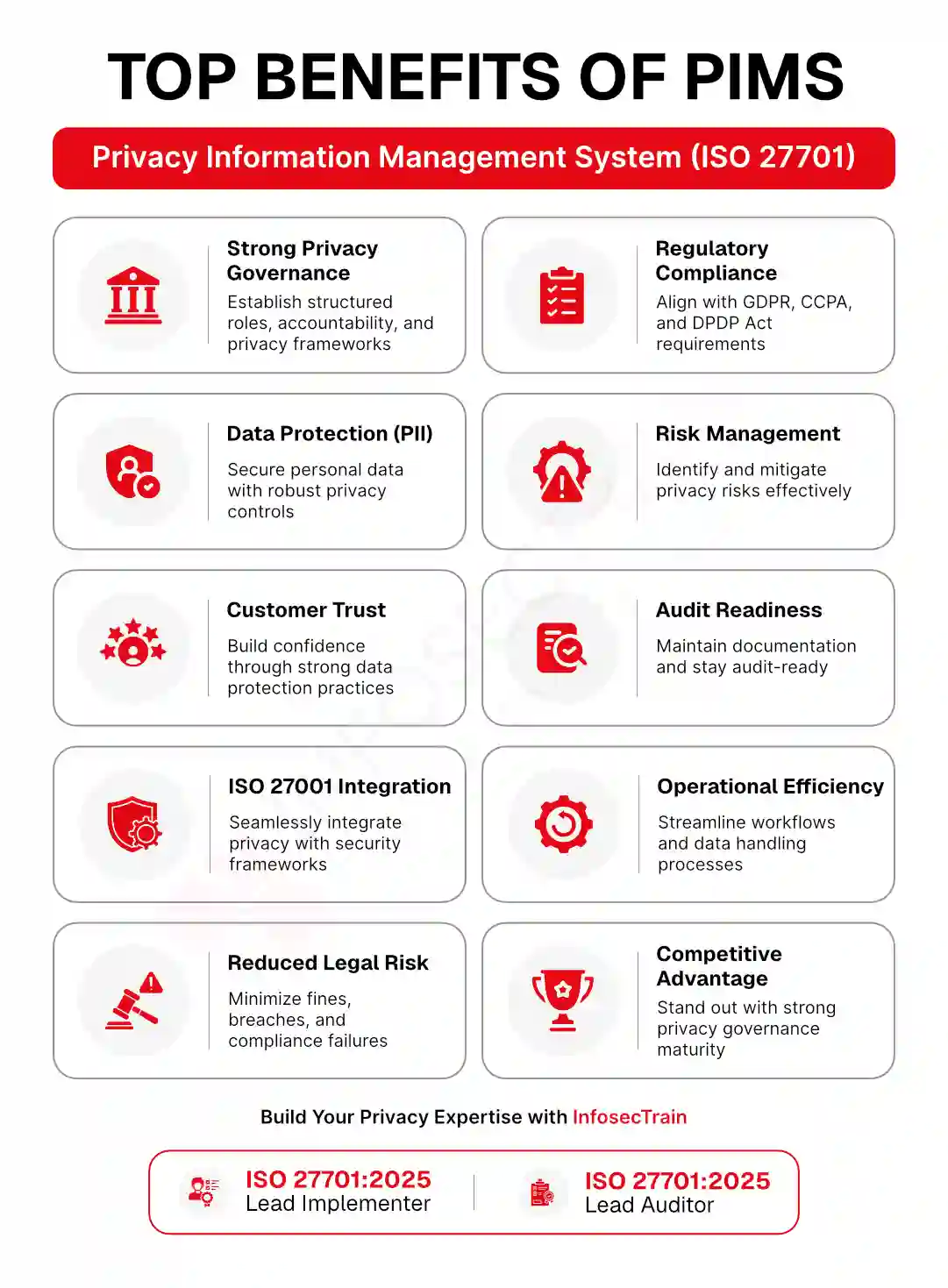
1. Strengthens Privacy Governance
One of the most important benefits of PIMS is that it establishes a structured privacy governance framework. Organizations can:
- Define roles and responsibilities (e.g., DPO)
- Implement accountability frameworks
- Align privacy with business strategy
This ensures privacy is treated as a strategic function, not just a compliance task.
2. Improves Protection of Personal Data (PII)
PIMS provides a structured approach to protecting Personally Identifiable Information (PII). Organizations can:
- Implement privacy controls
- Secure data throughout its lifecycle
- Reduce risk of data breaches
This leads to a stronger data protection posture.
3. Enhances Regulatory Compliance
PIMS helps organizations meet the requirements of major privacy laws, such as:
- GDPR (Europe)
- CCPA (California)
- DPDP Act (India)
By implementing PIMS, organizations can:
- Demonstrate compliance with regulators
- Maintain audit readiness
- Reduce risk of penalties and fines
4. Builds Customer Trust and Brand Reputation
In the digital economy, trust is everything. By implementing PIMS, organizations can:
- Demonstrate commitment to data privacy
- Increase customer confidence
- Strengthen brand reputation
Customers are more inclined to interact with organizations that prioritize data privacy.
5. Supports Integration with ISO 27001
PIMS is designed as an extension of ISO 27001, making it easy to integrate with existing Information Security Management Systems (ISMS).
The benefits include:
- Unified security with a privacy framework
- Reduced duplication of efforts
- Improved operational efficiency
6. Enables Effective Privacy Risk Management
PIMS integrates privacy risk management into business operations. Organizations can:
- Identify privacy risks early
- Conduct Privacy Impact Assessments (PIAs)
- Implement risk treatment strategies
This reduces the likelihood of privacy incidents and compliance failures.
7. Improves Operational Efficiency
PIMS introduces structured processes for managing personal data. Organizations benefit from:
- Clear workflows for data handling
- Standardized privacy processes
- Better coordination across teams
This results in smoother operations and greater clarity across teams.
8. Reduces Financial and Legal Risks
Privacy violations can lead to heavy regulatory fines, legal consequences, and reputation damage. PIMS helps mitigate these risks by:
- Ensuring compliance
- Preventing data breaches
- Strengthening governance
9. Enhances Audit Readiness
Organizations with PIMS are always prepared for audits. They can:
- Maintain proper documentation
- Track compliance activities
- Demonstrate accountability
This simplifies both internal and external audits.
10. Provides Competitive Advantage
Organizations that implement PIMS gain a strong market advantage. They can:
- Differentiate themselves in the market
- Win customer trust faster
- Meet global compliance requirements
Who Should Implement PIMS?
PIMS is beneficial for organizations that:
- Handle large volumes of personal data
- Operate in regulated industries (finance, healthcare, SaaS)
- Work with international clients
- Need to comply with multiple privacy regulations
In Conclusion
Implementing a PIMS enables organizations to move from reactive data protection to a more proactive and structured approach. It not only helps manage risks and meet regulatory requirements but also builds long-term trust with customers and stakeholders. For organizations dealing with personal data at scale, adopting PIMS is a strategic step toward stronger governance, resilience, and competitive advantage.
ISO 27701 Certification Training with InfosecTrain
Whether you are a Privacy Professional, Cybersecurity Expert, or Compliance Specialist, mastering ISO 27701 can significantly boost your career.
To build your PIMS expertise, join InfosecTrain, which offers industry-focused training programs:
- ISO 27701:2025 Lead Implementer Training: Learn how to design, implement, and manage Privacy Information Management Systems.
- ISO 27701:2025 Lead Auditor Training: Gain expertise in auditing and assessing PIMS frameworks for compliance.
With InfosecTrain, you get:
- Instructor-led training by industry experts
- Real-world case studies and simulations
- Structured exam preparation
- Post-training support
Enroll now with InfosecTrain and become a certified privacy professional.


Frequently Asked Questions
What is PIMS in ISO 27701?
PIMS is a framework defined in ISO 27701 that helps organizations manage personal data and ensure privacy compliance.
Why is PIMS important?
It helps organizations protect personal data, meet regulatory requirements, and manage privacy risks effectively.
Which organizations need PIMS?
Any organization handling personal data, especially in regulated industries, should implement PIMS.
Is PIMS mandatory?
While not mandatory, it is highly recommended for organizations aiming to comply with global privacy regulations.
Which regulations does PIMS help with?
PIMS supports compliance with major privacy laws like GDPR, CCPA, and India’s DPDP Act by aligning processes with global standards.